Fencing options and costs in North Delta
In North Delta, fencing choices usually come down to privacy needs, maintenance tolerance, and how your yard handles Fraser Valley–type moisture. With a population of 60,769 (Statistics Canada, 2021 Census), there’s steady residential demand across neighbourhoods like Ladner—where many homes sit behind established lots and homeowners frequently upgrade aging boundaries. Individual properties are a major predictor of local fence demand because each detached lot can add or replace boundary fencing, typically on a cycle of weathering, gate upgrades, or new privacy needs.
Lower Mainland–Southwest pricing is shaped by “mild but not trivial” frost and wind conditions. Even though coastal BC winters are less harsh than interior provinces, contractors still set posts below frost influence to reduce heaving, which can mean deeper holes and more concrete than homeowners expect. Wet soils common to the region also increase labour for excavation and post-setting, especially when drainage is poor or the ground is saturated. In addition, wind exposure can push crews toward tighter post spacing and stronger corner/gate bracing—most noticeably for taller wood and solid panel privacy fences.
Contractor availability is generally good in the Delta/Ladner corridor, but turnaround can stretch when multiple crews are booked for seasonal installs (spring/summer) and when disposal or slope work adds time. That’s why two quotes for the “same” fence line can still land in different price bands depending on height, finish, gate count, and whether old fence removal is included.
Below is a practical comparison of common materials and the kind of installed pricing range you’ll typically see in North Delta. Use this as your baseline before you compare itemised quotes.
| Material |
Lifespan |
Maintenance |
Privacy Rating |
Price per Linear Foot |
| Pressure-treated pine (standard wood) |
10–20 years |
Stain/seal every 2–3 years; inspect posts and hardware |
High (solid boards/panels) |
$55 – $95 |
| Cedar (natural rot resistance) |
15–25 years |
Reseal/stain every 2–3 years (or accept weathered look) |
High (best with tight board spacing) |
$70 – $110 |
| Vinyl / PVC (no-maintenance) |
20–30 years |
Occasional wash; rare part replacements |
Medium to high (depends on picket vs privacy style) |
$75 – $130 |
| Chain-link (galvanized steel) |
20–35 years |
Minimal; occasional slat/mesh tension checks |
Low to medium (can add privacy slats) |
$30 – $55 |
| Aluminum ornamental |
25–40 years |
Minimal; rinse and inspect brackets |
Low (best for visibility/security) |
$90 – $170 |
| Composite / recycled material |
20–35 years |
Low maintenance; follow manufacturer cleaning schedule |
High (often board style) |
$85 – $140 |
Prices are estimates only and vary by project scope, site access and material selection.
What affects the price of fencing in North Delta
Fence quotes in North Delta can swing by roughly 30–50% across the Lower Mainland–Southwest simply because “one lineal foot” doesn’t capture the real work: excavation difficulty, post setting depth, gate hardware, and how much of the job is removal/disposal. In coastal BC, mild temperatures don’t remove frost-related design needs, and wetter soils in the Fraser Valley often mean slower digging and more concrete to secure posts. Even when the same material is selected, contractor labour rates and crew efficiency vary—especially when the yard is sloped, access is tight, or the fence must be built around mature landscaping and drainage patterns.
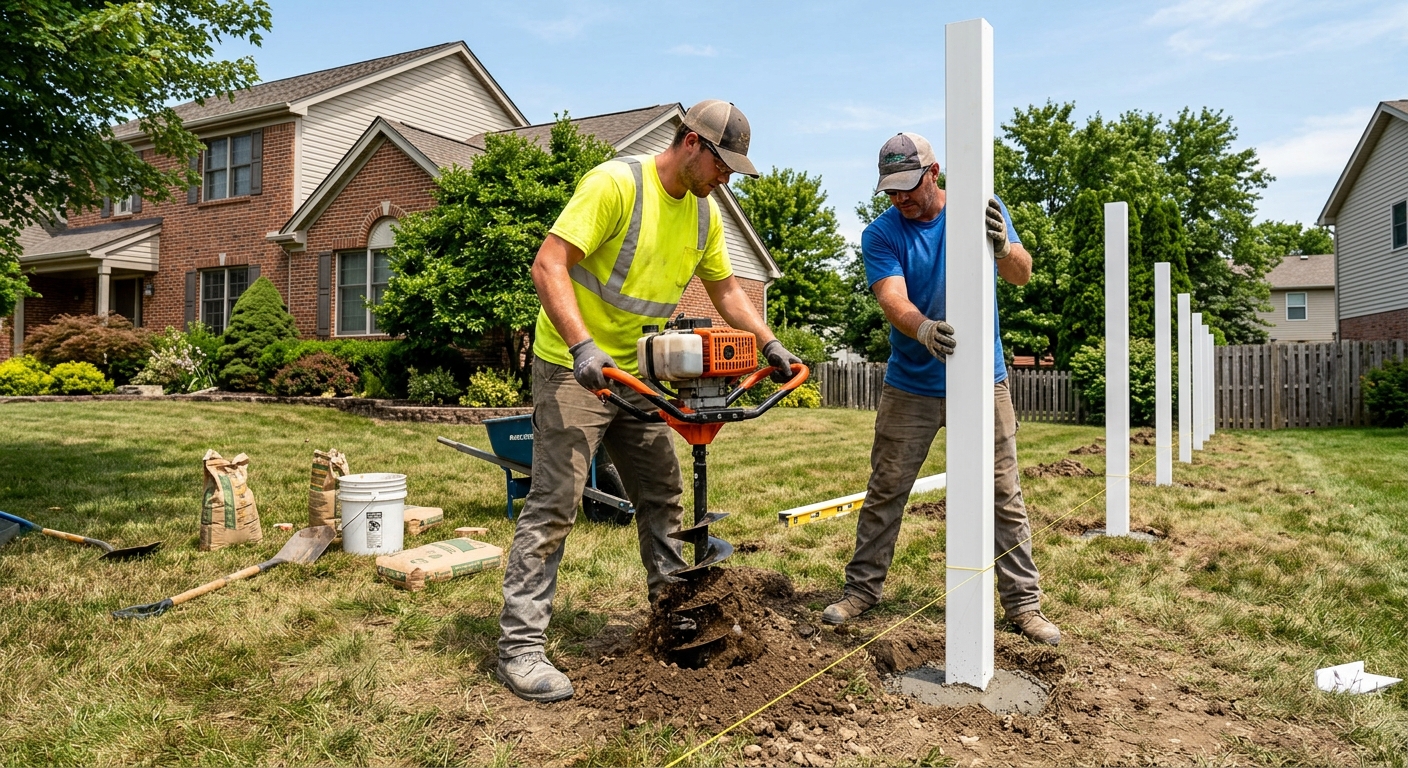
Post depth is the big technical driver. Guidance typically places embedment around 4–6 inches below the design frost depth to reduce heaving, and contractors often go deeper than bare-minimum calculations in BC’s mixed wet/freeze conditions. That can mean longer posts, deeper holes, and heavier concrete setting—pushing costs toward the upper end of the wood band (roughly $55–$95 installed per linear foot). In contrast, chain-link on shorter, simpler runs can land closer to the lower end (around $30–$55) because it usually uses lighter posts, simpler bracing, and less material bulk.
Local conditions that commonly raise cost in North Delta include saturated soil that requires rework when holes collapse, high-water/downgrade areas that need stepped racking, and wind-exposed corners near open lots where stronger bracing and tighter spacing are required. Costs can be lower when you have good access for a trailer or small excavator, straight fence runs, and minimal height changes.
To make the pricing fair, always compare itemised quotes that show post depth, concrete quantity, bracing at corners/gates, and whether disposal is included—those details explain most of the spread between $75–$130 vinyl installs and budget-friendly chain-link options.
| Price Factor |
Why It Matters |
Cost Impact |
| Fence length in linear feet — the primary cost driver |
More footage means more posts, rails, brackets, and labour hours |
Typically the largest contributor to total project cost |
| Post depth required — frost line determines post length and hole depth |
Deeper embedment reduces heaving risk in freeze-thaw cycles |
Can add concrete, excavation time, and post material |
| Post setting method — concrete vs. gravel pack vs. driven posts |
Moist/wet soils often need concrete setting for stability |
Concrete adds material and time; driven/pack methods reduce cost but may not be suitable |
| Material choice — vinyl vs. cedar vs. chain-link |
Material density, structural requirements, and hardware differ |
Vinyl often costs more than wood; chain-link is usually lowest |
| Gate count and type — walk-through vs. drive-through (double) |
Gates need heavier posts, hinges, latches, and bracing |
One drive-through can add a noticeable premium |
| Grade and terrain — sloped yards require stepped or raked panels |
Slopes increase cutting, layout, and sometimes custom sections |
Labour increases; straight-run pricing no longer applies |
| Old fence removal and disposal |
Demolition adds time; disposal fees can apply |
Often increases the job cost and scheduling lead time |
| Permit fees and survey / property line locate |
Confirming boundaries prevents encroachment disputes |
May add fixed administrative and/or survey costs |
Permits & regulations in British Columbia
In British Columbia, the fence rules are largely about height limits, location on the property, and respecting setbacks and property lines. As a practical baseline, fences above a height threshold—commonly 2.0 m (about 6.5 ft) at the rear and around 1.0–1.2 m (3–4 ft) at the front or corner—often require a building permit. Exact thresholds can vary with lot location and municipal bylaws, so for North Delta homeowners it’s smart to confirm with the City of Delta planning office or your contractor’s permit-handling process before you schedule post holes.
Before digging, always arrange utility locates. In BC, you can request locates through BC 1 Call so crews know where power, gas, and communication lines run. Also, obtain a survey or at least have property pins located so your contractor sets line posts on your correct boundary. For shared fences, provincial line-fences legislation governs responsibilities—especially around shared cost discussions and maintenance obligations.
Step-by-step for verifying your contractor in North Delta, BC:
- Ask for their certificate of insurance (liability) and confirm the name matches the business doing the work.
- Verify they carry appropriate worker coverage (commonly WSBC for employers). Request a clearance letter or evidence of coverage, and check the date.
- Confirm licensing status where applicable (some fencing companies may work through registered trades/contractors depending on scope and subcontracting).
- Keep copies of insurance documents and any permit correspondence tied to your address.
What typically does not require a permit: simple replacements on an existing fence line staying within height limits, routine maintenance, and repairs that don’t materially change height, location, or structure. What usually does require a permit: building a new fence or raising the height beyond the threshold, moving the fence line toward a setback boundary, or adding substantial structural elements that change the fence’s character.
Choosing the right fence material for North Delta
Choosing a fence material in North Delta is easiest when you match it to your top priority—privacy, low maintenance, upfront budget, or long-term appearance—then account for coastal BC weather: wet seasons, freeze-thaw cycles, and wind exposure. Pressure-treated pine is typically the budget-friendly route, but it needs periodic staining/sealing (often every 2–3 years) to prevent grey weathering and to protect fasteners and cut ends. Cedar offers better natural rot resistance and a warmer look, but it still benefits from regular maintenance to keep it looking clean and to extend the life of rails and posts.
Vinyl/PVC is popular for homeowners who want “set it and forget it.” It’s higher upfront, and while it handles Lower Mainland weather well, materials can become brittle in extreme cold snaps—so your fence should be installed correctly with proper spacing and hardware. Chain-link is usually the lowest installed cost, but it doesn’t provide true privacy unless you add slats; it’s also a strong choice for long boundaries because it lasts and resists rot.
Aluminum ornamental is rust-resistant and generally low maintenance, offering a sleek security option. It won’t give the same privacy as wood or vinyl privacy styles, but it can be ideal if you want a visible barrier that still brightens the yard.
For post depth: even in the Lower Mainland–Southwest, contractors often set posts below frost influence to reduce heaving, and many jobs use concrete at privacy panels, corner posts, and gate posts for stability. That means “cheapest material” doesn’t always equal “cheapest installed,” because the substructure still has to be correct.
Example of where the price difference is justified: if you’re comparing chain-link (often around $30–$55 installed per linear foot) to a vinyl privacy fence (roughly $75–$130 installed), the higher cost can be worth it when you need visual screening from the street, neighbours, or backyard space—especially in areas with more wind-driven drying that can still leave wood unprotected if maintenance slips.
| Material |
Cold Tolerance |
Lifespan |
Annual Maintenance |
Best For |
Price Band |
| Pressure-treated pine |
Good (with proper treatment and correct installation) |
10–20 years |
Low-to-moderate: inspection; stain/seal every 2–3 years |
Budget privacy with regular upkeep |
$55 – $95 |
| Cedar |
Very good (natural rot resistance) |
15–25 years |
Low-to-moderate: reseal/stain as needed (often every 2–3 years) |
Appearance + rot resistance |
$70 – $110 |
| Vinyl / PVC |
Good (avoid poor installs in extreme cold) |
20–30 years |
Low: rinse/clean; check hardware periodically |
Low maintenance privacy or semi-privacy |
$75 – $130 |
| Chain-link |
Excellent (galvanized steel performs well) |
20–35 years |
Very low: occasional tension checks |
Security, pet containment, long boundaries |
$30 – $55 |
| Aluminum ornamental |
Excellent (powder-coated aluminum resists corrosion) |
25–40 years |
Very low: rinse; inspect brackets |
Clean look with security (less privacy) |
$90 – $170 |
| Composite / recycled material |
Good (select quality brands and follow install specs) |
20–35 years |
Low: routine cleaning |
Long-life privacy with minimal upkeep |
$85 – $140 |
How to choose a fencing contractor in North Delta
Choosing the right fencing contractor in North Delta, BC starts with verifying they can legally and safely perform the work. For British Columbia coverage, ask for:
- Liability insurance: request a current certificate of insurance showing the business name, your address/interest if available, and the coverage limits.
- Worker coverage (WSBC): ask for confirmation/clearance evidence of employer coverage for the period of your project.
- Licensing/registration (as applicable): confirm whether they operate under a contractor registration for their scope and that any subcontractors are covered.
Next, get 2–3 itemised written quotes, not a single lump sum. You want labour and materials broken out so you can compare post depth, concrete setting, rail style, gate hardware, and whether the quote includes permit pulling or just “permit allowance.” A good quote specifies what’s excluded: old fence removal, disposal fees, concrete patching at the driveway edge, landscaping reinstatement, and any survey/property line locate costs.
Warranty matters in fencing because coastal BC moisture can reveal workmanship issues. Ask for a workmanship warranty length (often coverage for post alignment, fastening, and panel/rail failures), plus the product/manufacturer warranty. Confirm whether the warranty is transferable to future owners and whether it requires annual maintenance or specific cleaning methods.
For payment, never pay more than 10–15% upfront. If the contractor asks for more before any materials arrive or posts are set, that’s a warning sign. Use a holdback plan: hold remaining funds until the fence line is complete, gates operate smoothly, and debris/disposal is finished. Finally, require a start date and a completion estimate in writing so “best effort” timelines don’t turn into months.
- Confirm post depth and setting method in writing (concrete vs gravel pack) for your specific soil and height.
- Ask how they handle slope: stepped vs raked panels, and how they maintain consistent privacy.
- Verify gate bracing details (heavier hinges, latch type, and double-gate alignment if applicable).
- Check whether corner posts and line posts are reinforced at the right intervals for wind exposure.
- Look for proof of liability insurance and current WSBC coverage; copy it into your file.
- Request itemised disposal/removal if you’re replacing an old fence.
- Confirm utility locate responsibility (who books BC 1 Call and when).
- Ensure the quote includes rail and panel orientation details (privacy boards overlap, spacing rules).
- Ask about colour/stain selection and whether it includes premium fasteners and hardware coatings.
- Get a written measurement approach (tape measure vs survey locate) and how they ensure property-line accuracy.
- Require a detailed schedule and the number of workdays; avoid “we’ll get to it” estimates.
- Agree on a final inspection step: gates, alignment, and cleanup/debris removal.
Red flags to watch for in North Delta: vague quotes with no post depth or concrete setting details, refusal to provide insurance/WSBC evidence, promises of “standard” embedment without considering frost influence, asking for a large upfront payment (over 15%) before any install work, and starting work without confirming locate/survey needs—especially where mature landscaping or driveways could hide boundary or utility lines.
Frequently asked questions — fencing in North Delta
How much does a fence cost in North Delta?
In North Delta, a typical residential fence installation often falls within the regional price bands for the Lower Mainland–Southwest. For budgeting, chain-link is commonly the lowest at roughly $30 – $55 per linear foot installed, while pressure-treated wood usually lands around $55 – $95. Vinyl/PVC tends to cost more, commonly around $75 – $130 per linear foot depending on whether you choose semi-privacy pickets or full privacy panels. Total price will still vary with your fence length, height, number/type of gates, slope, and whether the quote includes old fence removal and disposal. Weather conditions matter too: wet soil and deeper post embedment can increase labour and concrete use versus a dry-site install.
How deep should fence posts be for North Delta's frost?
Even in coastal BC, you can’t assume shallow post holes. Contractors typically set posts below the design frost influence; in practice, that often means embedment that’s about 4–6 inches below the design frost depth so posts resist heaving in freeze-thaw conditions. Because North Delta has mild but wet winters, crews may also adjust based on soil saturation—wet ground can lead to hole collapse or post movement if the setting isn’t done correctly. Many installs still use concrete for privacy panels, corner posts, and gates for stability, which is why post depth and setting method show up in itemised quotes. If your quote only states “standard embedment” without a depth and a setting method, ask for the specifics in writing before work begins.
Wood vs vinyl vs aluminum fence — which is best?
“Best” depends on whether you want privacy, the look you prefer, and how much maintenance you’re willing to do in North Delta. Wood (pressure-treated or cedar) is usually the best match for strong privacy, often within $55 – $95 for standard wood installs, but it requires periodic staining/sealing every 2–3 years to keep it looking good in BC’s moisture and wind. Vinyl/PVC is a low-maintenance option and is commonly priced around $75 – $130, but it’s higher upfront and must be installed correctly for temperature changes. Aluminum ornamental is durable and low maintenance, typically falling in the $90 – $170 range, but it provides visibility rather than true privacy. Many Ladner-area homeowners choose wood or vinyl for backyard privacy and aluminum at the front for a cleaner street-facing look.
Do I need a permit to build a fence in British Columbia?
In British Columbia, permits may be required when a proposed fence exceeds local height thresholds—commonly around 2.0 m (6.5 ft) at the rear and about 1.0–1.2 m (3–4 ft) near the front or corners—plus when it conflicts with setbacks or property-line rules. For North Delta homeowners, the safest approach is to confirm your intended height and placement with the City of Delta and ensure the contractor clarifies whether they will pull the permit. Regardless of permits, you should call for utility locates before digging through BC 1 Call and ensure you have your property pins located or a survey to avoid encroachment disputes. Shared fence situations are also governed by line-fences legislation, which can affect how costs and responsibilities are handled.
How long does a wood fence last in North Delta?
Wood fence lifespan in North Delta commonly ranges from about 10–20 years for pressure-treated pine and 15–25 years for cedar, assuming proper post setting and maintenance. Coastal BC’s wet seasons and coastal wind exposure can accelerate surface weathering and fastener corrosion if the fence isn’t properly sealed and maintained. The biggest determinant is substructure quality: correct post depth and stable setting (often concrete at key posts/gates) reduce movement that leads to rail sagging and early failure. If you don’t plan to stain or seal on a reasonable cycle, vinyl or composite can be a better long-term value. If you do maintain it, wood remains one of the best privacy-per-dollar options in the $55 – $95 band.
Who owns and maintains a shared fence?
In British Columbia, shared fence ownership and responsibilities are guided by provincial line-fences legislation rather than the same rules used in every region. In general, if the fence is treated as a shared boundary structure, both neighbours may have rights and responsibilities related to maintenance and costs—especially when repairs or replacement are required. The practical approach in North Delta is to clarify in writing: which fence sections are shared, what condition they’re in, and how neighbours will split costs for repairs or replacement. If you’re replacing a fence, you’ll typically want a survey/property-line locate first so the boundary is correct, and you’ll want your contractor to document materials and installation scope. This reduces disputes and helps ensure maintenance obligations are clearly understood.