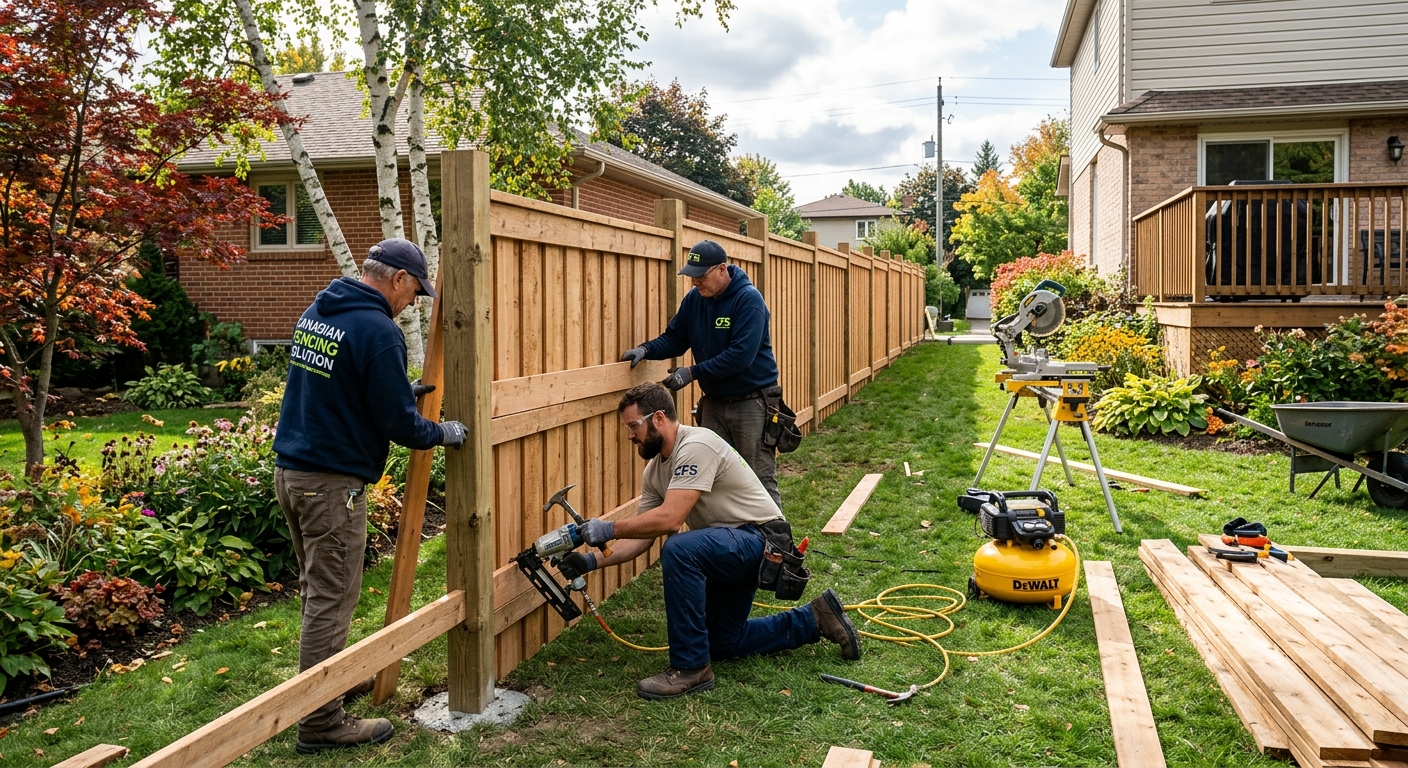
Fencing options and costs in Nanaimo
Nanaimo homeowners typically start with a simple question: what will it cost to get a fence that looks good, holds up to coastal weather, and doesn’t become a maintenance headache? With a population of 99,863 (Statistics Canada, 2021 Census) and 28,780 homeowner households—about two-thirds of all households—demand stays steady year-round, because fences get planned alongside home purchases, backyard renovations, and upgrades on existing lots (Statistics Canada, 2021 Census). And Nanaimo’s housing mix matters: with 51.5% of dwellings being single-detached homes, there are many properties with longer runs where neighbours and wind exposure become real cost factors.
On Vancouver Island and the Coast, the climate is mild but coastal: rain is frequent, winds off the Strait of Georgia can be persistent, and the freeze-thaw cycle still affects how posts perform. Even though the frost line is relatively shallow (about 45–60 cm), posts generally must be set below frost depth—often buried around 75–90 cm in practice—to reduce heaving and long-term leaning. That increases labour and sometimes concrete footing use, especially where soils are wet, clay-rich, or disturbed. In neighbourhoods like Departure Bay—where lots tend to be windy and yards are frequently bordered by neighbouring properties—you’ll see fencing contractors in demand for privacy upgrades and gate replacements. For most homeowners, the next step is comparing materials and installed pricing, which is easier once you see typical lifespan, maintenance, and per-foot expectations.
| Material |
Lifespan |
Maintenance |
Privacy Rating |
Price per Linear Foot |
| Pressure-treated pine (standard wood) |
10–15 years |
Stain/seal every 2–3 years; tighten boards as needed |
High (solid boards) |
$55 – $85 |
| Cedar (natural rot resistance) |
15–25 years |
Clean and re-stain every 3–4 years (or more often if you want it “bright”) |
High (solid boards) |
$75 – $110 |
| Vinyl / PVC (no-maintenance) |
20–30 years |
Rinse as needed; inspect for impact damage |
High (solid privacy styles) |
$70 – $110 |
| Chain-link (galvanized steel) |
25–35 years |
Occasional wash; tighten hardware |
Low–Medium (use slats/planting for privacy) |
$35 – $60 |
| Aluminum ornamental |
25–35 years |
Wash annually or as needed; check gate latches |
Low–Medium (open pickets) |
$80 – $140 |
| Composite / recycled material |
20–30 years |
Minimal cleaning; replace damaged panels if impacted |
High (solid privacy styles) |
$90 – $150 |
Prices are estimates only and vary by project scope, site access and material selection.
What affects the price of fencing in Nanaimo
In Nanaimo and across Vancouver Island and the Coast, it’s common to see fencing quotes swing by roughly 30–50% for what looks like the “same” fence on paper. The biggest reason is that installation isn’t just materials—it’s excavation conditions, wind loading decisions, and how long it takes to set accurate lines around obstacles. Even when your chosen style matches another homeowner’s, your yard can be very different: slope, rock pockets, saturated ground after fall rains, and how many gate openings you need. On top of that, contractors may price differently based on crew efficiency and disposal hauling, especially when older fences must be removed and hauled away.
Local ground conditions drive post depth. Vancouver Island’s frost depth is shallow compared with Ontario and Alberta, but the practical requirement is still to set posts about 4–6 inches below design frost depth; that’s why typical residential posts are often buried around 75–90 cm. In colder regions, posts frequently need to go 1.5–2.0 m into the ground, which explains why those markets can push pricing higher through longer posts, deeper holes, and more concrete setting. Coastal BC also brings frequent moisture, which accelerates wood rot if untreated or if post hardware isn’t properly corrosion-resistant—so higher-quality fasteners and proper coatings can add cost but protect the fence.
Here are a few concrete examples of what changes cost in Nanaimo: (1) a cedar privacy fence on clay-rich soil often needs more labour for clean holes and more stable concrete footings, (2) a solid wood or vinyl panel design in frequent wind may need closer post spacing or heavier posts, and (3) a chain-link upgrade can be cheaper because it tolerates wind better with standard spacing. If a comparable run of wood is quoted around the $55 – $85 band, switching to vinyl might land you closer to $70 – $110, and the difference is justified mainly when you value reduced maintenance and better corrosion resistance in coastal weather.
| Price Factor |
Why It Matters |
Cost Impact |
| Fence length in linear feet |
Labour scales directly with footage; materials are proportional. |
Largest driver; small changes in length can move total by thousands |
| Post depth required |
Frost considerations determine hole depth and post length. |
More depth increases labour and concrete/aggregate use |
| Post setting method |
Concrete vs. gravel pack vs. driven posts affects stability. |
Concrete-set posts typically cost more but reduce leaning risk |
| Material choice |
Vinyl, cedar, and chain-link have different costs, hardware, and longevity. |
Upgrades can shift project totals significantly across price bands |
| Gate count and type |
Gates need stronger framing, hinges, latches, and accurate alignment. |
Every gate adds labour and hardware; drive-through is usually highest |
| Grade and terrain |
Slope may require stepped panels or raked styles. |
Extra measuring, extra components, and more installation time |
| Old fence removal and disposal |
Demolition, haul-away, and disposal fees vary by condition and access. |
Can add substantial cost and time, especially on wet sites |
| Permit fees and survey / property line locate |
Some heights need permits; line locate avoids disputes. |
Direct out-of-pocket costs plus schedule impacts |
Permits & regulations in British Columbia
In British Columbia, fence rules are often tied to height and location on the property. While local by-laws and strata rules can vary, fences above a height threshold—commonly around 2.0 m (6.5 ft) at the rear and about 1.0–1.2 m (3–4 ft) near the front or corners—may require a building permit. You must also respect property lines and any municipal setback requirements, because a fence that’s even slightly over the line can trigger disputes with neighbours and lead to costly rework.
Before you dig any post holes, arrange utility locates. In British Columbia, call BC 1 Call (you can also follow the “one-call” process used locally) so underground services are marked. For many homeowners in Nanaimo, the safest approach is also to confirm where your property pins are (or commission a locate if you’re unsure), because many lots have old markers, survey plan differences, or boundary uncertainty after landscaping changes. Shared fence ownership and maintenance responsibilities are typically handled through provincial line-fences legislation; if you’re dealing with an existing shared boundary, you’ll want written agreement on who pays for repairs or replacement.
To verify a fencing contractor in BC: check their business licence/registration details with the appropriate provincial and municipal listings (as applicable), request a current certificate of insurance (liability coverage) and confirm what it covers, and ask for clear proof of workplace coverage (WSIB/WCB, depending on the applicable system for the contractor and their workers). Look for a clearance letter where they provide it, and ensure the certificate lists your address or job site as an insured interest if you’re requiring it by contract.
Choosing the right fence material for Nanaimo
Choosing a fence in Nanaimo should start with what you want to solve: privacy, low maintenance, budget, or long lifespan. Coastal BC weather is wet, windy, and salty enough to accelerate corrosion and wood wear. That means materials with proven corrosion resistance and stable post systems tend to perform better over time.
Pressure-treated pine is usually the most budget-friendly option, but it typically needs staining or sealing every 2–3 years to prevent grey weathering and to keep water from degrading the surface. Cedar looks great and resists rot better, but it still benefits from periodic staining if you want it to hold its colour and avoid premature surface breakdown. Vinyl/PVC is popular in Nanaimo because it’s low maintenance—no annual staining—and it handles moisture well; however, extremely cold snaps and impact can crack panels, so you want the right profile and installation (proper expansion clearances). Chain-link is the longest-life low-cost option, but it’s not truly private unless you add slats or a living screen. Aluminum ornamental gives an attractive, rust-resistant look with mid-range pricing, though it won’t block wind the way solid privacy boards do.
For Vancouver Island frost considerations, the key is not “how cold is it,” but “how stable are the posts.” Even with moderate coastal frost (roughly 45–60 cm), posts are typically buried around 75–90 cm in residential builds, and concrete-set footings are often recommended when soils are saturated, disturbed, or when you’re installing heavier solid panels and gates. In wind-exposed yards, solid designs may require closer post spacing to reduce panel flex.
Where the money makes sense: if you can get a pressure-treated pine privacy fence around the $55 – $85 range, upgrading to vinyl near $70 – $110 is often justified when you want fewer maintenance visits and better performance in coastal moisture. If you’re staying hands-on with yearly/periodic upkeep, cedar can be a strong “looks + durability” middle ground, but it isn’t the cheapest.
| Material |
Cold Tolerance |
Lifespan |
Annual Maintenance |
Best For |
Price Band |
| Pressure-treated pine |
Good (properly sealed and installed) |
10–15 years |
Low to moderate: inspect and touch up 1–2 times/yr; stain every 2–3 years |
Budget privacy with a homeowner willing to maintain |
$55 – $85 |
| Cedar |
Good (still seal/maintain for best appearance) |
15–25 years |
Low to moderate: clean and re-stain about every 3–4 years |
Natural look, rot resistance, long-term appearance |
$75 – $110 |
| Vinyl / PVC |
Moderate (avoid impact; proper installation matters) |
20–30 years |
Very low: rinse/wash as needed; check for impact cracks |
Low-maintenance privacy in wet coastal weather |
$70 – $110 |
| Chain-link |
Excellent |
25–35 years |
Very low: wash and tighten hardware occasionally |
Security, pets, keeping costs down |
$35 – $60 |
| Aluminum ornamental |
Excellent |
25–35 years |
Low: periodic cleaning and latch checks |
Attractive curb appeal without rust |
$80 – $140 |
| Composite / recycled |
Good (impact management recommended) |
20–30 years |
Very low: rinse and inspect after storms |
Durable privacy with minimal upkeep |
$90 – $150 |
How to choose a fencing contractor in Nanaimo
In Nanaimo and across British Columbia, you want a contractor who can prove they’re insured, properly set up to work, and clear about scope. Start by requesting their British Columbia business registration details (as applicable), their liability insurance certificate, and proof of workplace coverage (WSIB/WCB, depending on the contractor’s coverage system). Ask to see a current certificate of insurance and confirm the policy is active and covers fencing work (not just general business). If they provide a clearance letter or coverage document for workers, keep it with your contract records.
Next, get 2–3 itemised written quotes. “Itemised” should mean a line-by-line breakdown of labour, materials, post style and depth, gate components, and any disposal costs—rather than one lump sum. Carefully read what’s excluded: is permit pulling included if required, is property line locating assumed, and is old fence removal and hauling included? In Nanaimo’s older housing stock—39.1% of homes built before 1981 (Statistics Canada, 2021 Census)—it’s common to encounter mixed materials and buried anchors, so removal/disposal scope should be explicit.
Warranty matters too. Ask for the workmanship warranty length, the manufacturer warranty on product components (when applicable), and whether warranties are transferable to future homeowners. For payment, a sensible schedule is to never pay more than 10–15% upfront; hold back a portion until you’ve verified the fence line, alignment, gate operation, and that all clean-up/disposal is complete. Finally, require a written timeline with a start date and an estimated completion window so you can plan around delivery and weather delays.
- Verify liability insurance certificate is current and ask what it covers for fencing work.
- Confirm workplace coverage (WSIB/WCB) for workers involved in the project.
- Ask for proof of British Columbia licensing/registration and check the contractor’s details match the quote.
- Require itemised quotes: labour, materials, posts, rails, and gates listed separately.
- Confirm post depth plan (below frost depth) and post-setting method (concrete vs gravel pack).
- Ask how they handle slopes: stepped vs raked panels, and who provides the layout.
- Clarify gate hardware quality (hinges/latches) and whether adjustments are included.
- Confirm disposal is included: old fence removal and haul-away fees.
- Ask whether utility locates are arranged and whether they mark the site before digging.
- Verify warranty terms in writing for workmanship and any product/manufacturer warranty.
- Review payment schedule; do not allow large upfront payments.
- Get the start date, completion estimate, and “weather delay” process in writing.
Red flags in Nanaimo include: quoting only a lump sum with no post depth or setting method, refusing to show an up-to-date insurance certificate, promising “no concrete needed” on a solid privacy run without soil discussion, skipping utility locates before digging, and giving an unclear warranty (or no written warranty at all).
Frequently asked questions — fencing in Nanaimo
How long does a wood fence last in Nanaimo?
A wood fence in Nanaimo commonly lasts about 10–15 years for standard pressure-treated pine when it’s properly installed (correct post depth and solid bracing) and maintained. Cedar often reaches 15–25 years because it resists rot better, but coastal moisture and wind exposure still require periodic upkeep. Nanaimo’s wet winters and frequent wind off the Strait of Georgia can loosen fasteners and stress panels, especially on solid privacy styles, so repairs tend to be needed before the wood “falls apart.” If you’re comparing budgets, wood projects often fall into the $55 – $85 range per linear foot, while cedar and longer-life options can move toward higher bands. A realistic plan is to budget staining/sealing every 2–3 years for pine and about every 3–4 years for cedar if you want best-looking results.
Who owns and maintains a shared fence?
In British Columbia, shared fence responsibilities are generally governed by provincial line-fences rules, but the practical answer depends on how your boundary fence is set up on your specific property. If a fence sits directly on the property line, it may be considered a shared boundary fence with shared maintenance expectations, and disputes typically come down to who agreed to build it, who paid historically, and what the current condition is. In Nanaimo, many older neighbourhoods have boundary fences installed decades ago, so documentation matters. Before replacing any section, confirm whether it is on the boundary (not set entirely on one neighbour’s land), and discuss cost-sharing in writing. A contractor can help document the existing boundary fence condition and replacement scope, but you and your neighbour should still coordinate responsibilities before work begins.
How do I find my property line before fencing?
Your safest option in Nanaimo is to confirm where your property pins are located before any post holes get dug. Start by checking your survey documents from when you bought the home, and then locate the pins on-site (often with a metal detector or by marking their positions). If you don’t have a recent survey or the markers are unclear, commission a property line locate/survey. This is especially important because slopes, landscaping changes, and older boundary markers can make fences accidentally encroach. Also remember: even with good intentions, installing posts in the wrong spot can lead to neighbour disputes and costs to move the fence. Before digging, arrange utility locates through BC 1 Call so you don’t hit underground services while verifying the line and planning excavation.
What's the most low-maintenance fence?
For most Nanaimo homeowners, vinyl/PVC is the “set-and-forget” pick: it doesn’t need staining, it resists rot, and it performs well in coastal moisture. Aluminum ornamental is also low maintenance, though it’s typically more open for privacy. Chain-link is low maintenance too, but it won’t provide privacy unless you add slats or screening. In practice, the lowest maintenance choice often aligns with your privacy goal: vinyl privacy commonly fits the $70 – $110 per linear foot band, while chain-link can be closer to $35 – $60 but with lower privacy. Even low-maintenance fences should be inspected after heavy windstorms for loose hardware and after impacts (especially around gates and corners).
How tall can my fence be in Nanaimo?
Fence height limits in British Columbia are typically tied to where the fence sits (front/corner vs rear) and whether a permit is required. As a common guideline, fences above about 2.0 m (6.5 ft) at the rear and around 1.0–1.2 m (3–4 ft) toward the front or corners may require a building permit, though exact requirements can be confirmed with the local authority and your specific site conditions. Nanaimo homeowners should also consider that setbacks and property-line placement affect what’s allowed. If you’re in a strata or have any covenants, those can add additional limits beyond municipal rules. The safest move is to confirm the target height with a contractor who can advise on local requirements and, when needed, include permit steps in the scope.
Should fence posts be set in concrete here?
In Nanaimo and coastal Vancouver Island conditions, concrete is often the right choice for stability, but it’s not always universal. Because there is moderate coastal frost, posts generally must be set below frost depth to reduce heaving and long-term leaning. Even though coastal frost is shallow (roughly 45–60 cm), in practice residential fence posts are commonly buried around 75–90 cm. Concrete-set posts are especially recommended where soils are wet or clay-rich, where you’re disturbing ground during excavation, and for heavier solid fences or gates that experience more load. Gravel pack or alternative methods may be acceptable in certain conditions, but the best method depends on your soil, fence style, and post size. If you’re pricing wood at $55 – $85 per linear foot or vinyl closer to $70 – $110, ask your contractor to specify post depth and setting method—because that choice directly affects performance.