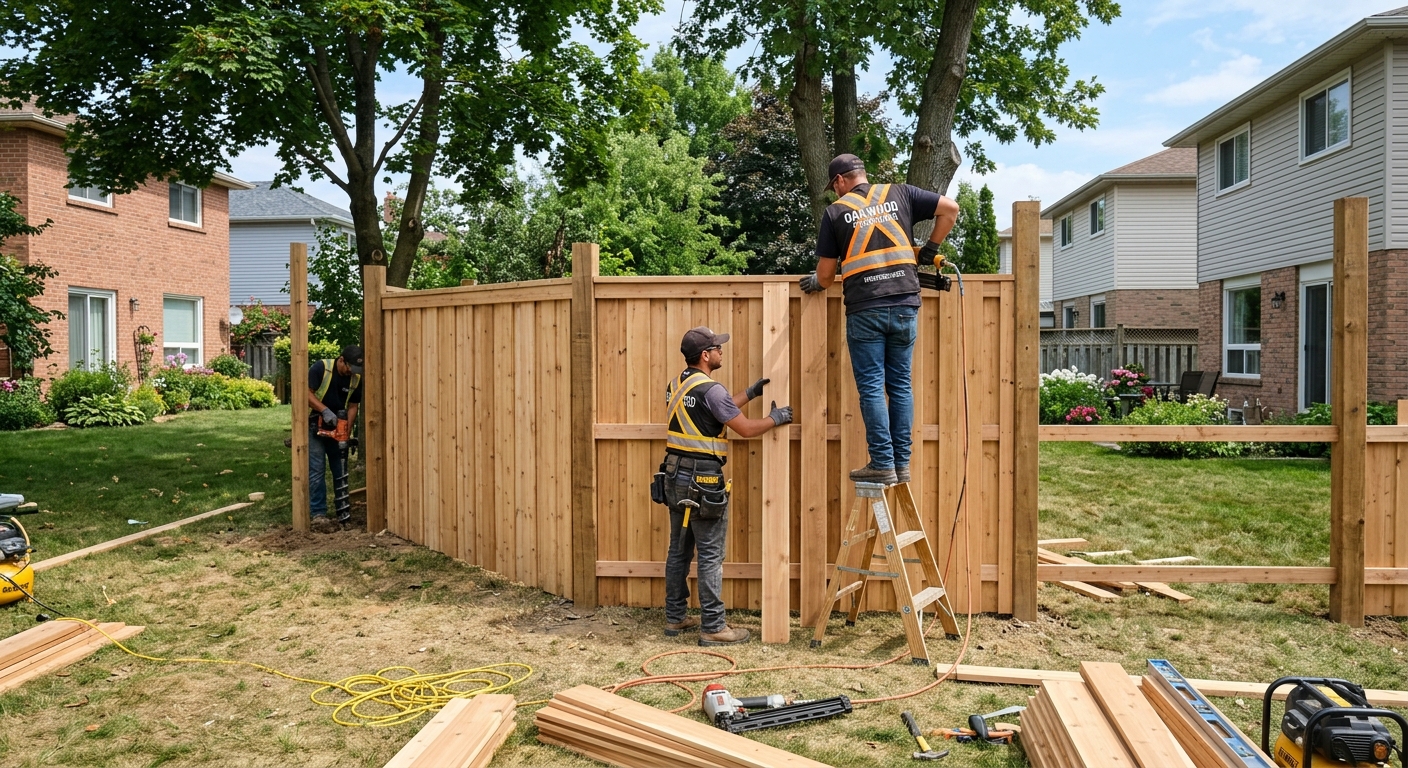
Fencing options and costs in Rossland
Rossland homeowners typically choose fencing based on privacy, durability and long-term maintenance, and with 1,445 homeowner households in the city (Statistics Canada, 2021 Census), there’s steady demand for new builds and fence replacements. Just as importantly, Rossland’s housing stock is older than average: 68.1% of homes were built before 1981 (Statistics Canada, 2021 Census), which often means existing boundary lines, treed edges and fence footprints are being updated as properties change hands.
In the Kootenays, pricing is shaped by frost line depth and freeze–thaw cycles. Even when your fence style looks simple, contractors in Rossland usually need deeper augers and more concrete for post footings to reduce frost heave. For privacy fences and corner runs, that often means bell-shaped concrete footings below frost depth, plus longer posts to match the design. On top of that, Rossland’s exposed ridgelines and winter wind can rack lighter panels, so many quotes include tighter post spacing and sturdier rails in areas like Columbia Gardens and the broader downtown/uptown corridor.
Material availability also matters locally. When crews are booked up for winter-ready installations, labour scheduling can shift and impact total cost, especially if removal and disposal are included. The table below compares common materials you’ll see in Rossland and helps you ballpark what different options usually run per project and per linear foot.
| Material |
Lifespan |
Maintenance |
Privacy Rating |
Price per Linear Foot |
| Pressure-treated pine (standard wood) |
10–15 years |
Stain/seal every 2–3 years to slow grey weathering |
Medium–High (solid pickets) |
$45 – $75 |
| Cedar (natural rot resistance) |
15–25 years |
Light staining or sealing every 3–4 years |
High (board-on-board) |
$65 – $105 |
| Vinyl / PVC (no-maintenance) |
20–30 years |
Minimal wash-down; inspect hardware seasonally |
High (solid panels) |
$70 – $110 |
| Chain-link (galvanized steel) |
20–40 years |
Occasional rinse; straighten posts if hit |
Low (security only) |
$30 – $55 |
| Aluminum ornamental |
25–40 years |
Occasional cleaning; check latch alignment |
Low–Medium (visual openness) |
$80 – $140 |
| Composite / recycled material |
25–35 years |
Minimal; follow manufacturer cleaning instructions |
High (solid look) |
$95 – $140 |
Prices are estimates only and vary by project scope, site access and material selection.
What affects the price of fencing in Rossland
In Rossland and across the Kootenay region, you can see the same fence line quoted 30–50% apart, even when the height is identical. That difference usually comes from how deep posts must be set for frost conditions, how many corners and gates you have, and whether the contractor includes concrete-setting and removal/disposal. Labour availability also shifts through the season—winter-ready installs still require proper footing work, and crews can price schedules differently when demand is high.
Post depth is the big swing factor. For frost-heave control, posts are commonly set about 4–6 inches below the design frost depth, which in cold Southern Interior conditions typically means excavating to roughly 1.2–1.5 m (or deeper depending on engineering and soil). That translates into longer posts, more augering time, and more concrete per post—especially at structural corners and gate posts. In milder regions, the “2 ft” rule of thumb leads to premature movement; in Rossland, we generally plan for deeper footings and bell-shaped concrete resistance where uplift and lateral pressure are expected.
Concrete examples from typical Rossland sites: (1) a steep backyard off a retaining slope often adds excavation and stepped/raked rails, raising labour even if the fence length stays the same; (2) a chain-link line on firm, level ground may stay near the lower band (about $30–$55/linear foot), while a privacy wood or vinyl fence with concrete-set corners often lands in the mid-to-upper bands (about $70–$110/linear foot) because of post footing quantity and hardware; (3) when old fencing is close to buried services, utility-locate coordination can add time and risk controls that show up in the quote.
With 68.1% of homes built before 1981 (Statistics Canada, 2021 Census), it’s common to encounter older property boundaries, mature trees and historical fence footprints—each one can increase layout time and grading, which is why “just replace the same fence” doesn’t always cost the same.
| Price Factor |
Why It Matters |
Cost Impact |
| Fence length in linear feet |
Every material and labour task scales directly with length (posts, rails, fencing panels) |
Largest overall driver; can change total cost by thousands |
| Post depth required |
Frost line determines hole depth and post length to prevent heaving |
Deeper holes increase concrete, auger time and disposal |
| Post setting method |
Concrete-set posts resist uplift and lateral soil pressure better than gravel-only backfill |
Concrete setting typically adds material and labour per post |
| Material choice |
Vinyl, cedar and chain-link have different panel stiffness, wind performance and installation methods |
Can shift you between chain-link ($30–$55) and vinyl ($70–$110) ranges |
| Gate count and type |
Double-drive gates need heavier frames, additional posts and stronger hinges/latches |
Commonly the single biggest add-on after length |
| Grade and terrain |
Slopes require stepped/raked panels and additional labour to keep tops aligned |
Adds design time and more hardware adjustments |
| Old fence removal and disposal |
Scrap handling, hauling and site clearing take time |
Often adds a noticeable line-item even if materials are removed efficiently |
| Permit fees and survey / property line locate |
Locates reduce encroachment risk; permit processes may apply for taller fences |
Small-to-medium impact but critical for avoiding redo costs |
Permits & regulations in British Columbia
In British Columbia, fence permits can apply depending on your fence’s height and where it’s located. As a practical rule of thumb, fences above a typical 2.0 m (6.5 ft) at the rear and around 1.0–1.2 m (3–4 ft) at the front or corner often need a building permit (final height thresholds can vary by municipal bylaws). Regardless of permitting, all fences must respect property lines and municipal setback bylaws—so the first job is confirming exactly where your boundary is before any digging.
Before you install any posts, call for utility locates (BC 1 Call or the applicable call-before-you-dig service). Then, verify your property boundary with a survey or a locate of your property pins/markers. This is where homeowners sometimes lose money: a fence shifted even a little can turn into neighbour disputes or require rework.
What typically DOES require a permit: new fences over the local height threshold, and any fence that may affect visibility at corners or sits in a regulated setback. What typically does NOT: like-for-like repairs that do not change height, location, or materially alter the boundary footprint.
For contractor credibility in Rossland, verify licensing and insurance before work starts. Ask for your contractor’s certificate of insurance (liability coverage) and confirm their coverage documents are current. For workers, ensure they carry the required provincial coverage through the WorkSafeBC system—don’t accept a verbal “we’re covered.” Finally, request their clearance letter or proof of account status and check the date range, then keep copies with your quote and contract.
Choosing the right fence material for Rossland
Choosing a fence in Rossland is less about looks alone and more about matching the material to winter exposure, snow impacts and the way your yard freezes and thaws. Pressure-treated pine is the budget-friendly option, but it typically needs staining or sealing every 2–3 years to slow grey weathering and keep the surface from drying out. Cedar offers a nicer finish and better natural rot resistance, yet it still benefits from periodic sealing if you want it to age evenly rather than patchy. Vinyl/PVC is the classic “no-maintenance” choice, but in extreme cold it can become brittle at mounting points if hardware and spacing aren’t installed correctly—so you want quality components and proper post alignment from day one.
Chain-link is usually the lowest-cost path and will last a long time with minimal attention, but it won’t give privacy unless you add slats or screening. Aluminum ornamental looks sharp and won’t rust, though it provides limited privacy and is less effective as a wind barrier because it’s open.
Because Kootenay frost conditions push you toward deeper, stable footings, the post system is as important as the picket material. For typical Rossland projects, concrete-set posts are often necessary for structural corners and gate posts, and post depth is commonly designed below frost depth (often 4–6 inches deeper) to reduce heaving. In practice, that means the “same length” fence with higher-end materials may not be the biggest cost jump—the footing and hardware strategy is.
For example, a privacy chain-link line might come in around the $30–$55/linear foot band, but if you want real privacy and stronger winter panel stiffness, upgrading to vinyl commonly moves you toward $70–$110/linear foot. That difference is usually justified when wind-racking risk and snow-load stress are part of the design, not just because the fence “looks better.”
| Material |
Cold Tolerance |
Lifespan |
Annual Maintenance |
Best For |
Price Band |
| Pressure-treated pine |
Good (if sealed and kept dry at cut ends) |
10–15 years |
Low to moderate; plan staining every 2–3 years |
Budget-conscious privacy runs |
$45 – $75 |
| Cedar |
Good (naturally rot-resistant) |
15–25 years |
Low; sealing every 3–4 years helps appearance |
Attractive, longer-lasting privacy |
$65 – $105 |
| Vinyl / PVC |
Very good (quality hardware matters in cold) |
20–30 years |
Minimal; seasonal hardware check |
Low-maintenance privacy |
$70 – $110 |
| Chain-link |
Excellent (galvanized steel) |
20–40 years |
Minimal; rinse and straighten as needed |
Security with visibility |
$30 – $55 |
| Aluminum ornamental |
Excellent |
25–40 years |
Minimal; wash and check latch alignment |
Decorative curb appeal |
$80 – $140 |
| Composite / recycled |
Good (designed for weather stability) |
25–35 years |
Low; follow manufacturer cleaning guidance |
Private look with longer service life |
$95 – $140 |
How to choose a fencing contractor in Rossland
When you’re hiring a fence contractor in Rossland, confirm insurance and provincial coverage before you sign anything. First, ask for proof of liability insurance (it should be current and clearly name the coverage holder). Second, verify WorkSafeBC coverage—request a current clearance letter or equivalent proof and check the effective dates. Third, ensure the contractor’s general business information is legitimate and consistent across their quote, invoice and insurance certificate. If they won’t provide documentation up front, that’s a red flag.
Next, get 2–3 itemised written quotes. You want a breakdown that separates labour from materials, includes post type and post setting method, shows the number of posts and gates, and lists removal/disposal if you need it. A lump-sum number without line items is where homeowners get surprised later. Also ask whether permit pulls (if needed) are included, whether utility locates are scheduled, and what happens if the site conditions differ after augering.
Warranty matters for both workmanship and products. Ask how long they warranty labour installation (workmanship), what the manufacturer warranty covers (boards/panels/hardware), and whether it’s transferable to future owners.
On payment terms, never accept a schedule that asks for large upfront sums. In my experience, staying near 10–15% maximum upfront and holding back the balance until completion protects you if weather, materials, or workmanship isn’t right. Finally, get the start date and a completion estimate in writing, including weather contingencies for post-hole work and concrete curing.
- Confirm liability insurance with a certificate of insurance (current dates).
- Ask for WorkSafeBC clearance/proof and check it’s valid for the project period.
- Require an itemised quote: posts, rails, panels, concrete/hardware, gates, labour and cleanup.
- Verify post-depth plan in writing (frost depth strategy and footing method).
- Ask how corners and gate posts are reinforced (structural posts, rails and hinges).
- Clarify removal/disposal: what’s included and where the waste is hauled.
- Confirm utility locates are included or your responsibility is clearly stated.
- Request the warranty length for workmanship and product warranty terms.
- Get start date and target completion date with weather delays noted.
- Use a reasonable payment schedule: 10–15% upfront maximum; holdback until final walkthrough.
- Ensure they address slopes (stepped vs raked panels) and top alignment.
- Check that your contract includes measurements, layout confirmation, and change-order rules.
Red flags I’ve seen in Rossland: crews that won’t discuss frost-depth footing methods, quotes that omit concrete/post-setting details, contractors asking for most of the money upfront, “we’ll figure out the boundary later” language, and contracts with no written warranty or no itemised materials/labour breakdown.
Frequently asked questions — fencing in Rossland
How do I handle a fence dispute with a neighbour in British Columbia?
In British Columbia, the best first step is to slow down and confirm the facts: locate your property line (survey or pin/marker verification) before you argue style or placement. If the fence already exists, document the current position with photos, measurements and dates, and ask your neighbour to do the same. Then compare your boundary evidence to the fence location so you’re not debating opinions. Rossland’s older housing stock and mature landscaping can make “everyone says it’s always been there” situations common, so proof matters.
If you can’t resolve it informally, talk to a qualified professional for a boundary survey and keep all communication civil and written. If your planned fence is over the typical local height threshold (often 2.0 m rear or 1.0–1.2 m front/corner), permitting and setbacks can add complications, so resolve location first. For context, even a basic line item like chain-link can start around $30 – $55 per linear foot, so moving it after installation can become expensive quickly.
What fence style offers the best wind resistance in Rossland?
For Rossland’s winter conditions, wind resistance usually comes down to panel stiffness and how the fence is framed—not just the material. A solid privacy fence (board-on-board or vinyl privacy with proper rails) performs better than open styles because it reduces turbulence, but it must be built with adequate framing and proper post spacing so the wind load doesn’t rack the panels. Where you see problems is when lighter rails are used or post spacing is too wide for exposed ridgeline lots.
In practice, vinyl or cedar privacy fences often win for wind-stability because they’re designed as coherent panel systems, and their hardware can be upgraded to stronger hinges and tension points. If your goal is security with less wind pressure on the fence itself, chain-link with a strong top rail and correctly set posts can still stand up well, but it won’t block sightlines. Regardless of style, ensure corner and gate posts are structurally reinforced with concrete-set footings below frost depth. Costs typically land in higher bands when privacy and structural strength are included—vinyl often ranges around $70 – $110 per linear foot installed.
How much does a fence cost in Rossland?
Fence cost in Rossland depends on length, height, gate count and—most importantly—post footings designed for freeze–thaw conditions. Because Kootenay sites commonly require deeper setting than milder regions, labour time for augering and the amount of concrete per post can raise the total quote even for “standard” fence lines.
As a quick homeowner reference, chain-link is often the lowest installed option, typically about $30 – $55 per linear foot. Vinyl privacy commonly runs higher, often around $70 – $110 per linear foot depending on post spacing, footing method and gate hardware. Standard wood (pressure-treated pine) frequently lands in the mid range around $45 – $75 per linear foot, but wood needs periodic maintenance to keep it looking even and to slow weathering.
If you tell us your total linear feet, approximate height, and whether you need old fence removal, you can usually narrow a realistic band quickly. Site access, slopes, and whether permits are required can shift prices as well.
How deep should fence posts be for Rossland's frost?
For Rossland and much of the Kootenays, frost heave is the reason we don’t rely on shallow “rule of thumb” post depths. In general, posts should be set close to or below design frost depth, with many installs using a strategy of placing post footings about 4–6 inches below the design frost line. That typically means deeper holes than you’d see in milder parts of BC, and it often results in concrete-set footings for structural posts (corners and gates).
Whether your contractor proposes concrete vs gravel pack (or driven posts) matters because soils expand and contract during freeze–thaw cycles. When footings aren’t deep enough, you can see gaps under rails, leaning panels, or hardware misalignment after a couple of winters. If you’re comparing quotes, ask how they calculate post length, what depth they plan to excavate, and whether they’re using concrete for the structural points. A well-built fence is more consistent over time—especially on exposed lots where wind and snow loads add stress.
Wood vs vinyl vs aluminum fence — which is best?
“Best” depends on what you’re optimizing for in Rossland. Wood (pressure-treated pine) usually starts out cheaper, often in the $45 – $75 per linear foot band, and it can look great with the right stain schedule. The trade-off is maintenance: you’ll generally need staining or sealing every 2–3 years to slow weathering and keep the finish even. Cedar typically costs more, but it has natural rot resistance and often looks warmer; it’s commonly in a higher range than pine.
Vinyl is a strong fit if you want low maintenance. It’s frequently installed around $70 – $110 per linear foot, and you should expect minimal upkeep beyond occasional cleaning and hardware checks. It can crack in extreme cold if installed with poor hardware choices, so quality installation is key.
Aluminum ornamental is durable and rust-resistant and often lands around $80 – $140 per linear foot. It’s ideal for curb appeal and longer life, but it provides limited privacy because it’s open.
If privacy is your priority, vinyl or cedar privacy styles are usually the best match; if you want security and a decorative boundary, aluminum is excellent.
Do I need a permit to build a fence in British Columbia?
In British Columbia, you may need a building permit if your fence is above typical height thresholds and located in certain parts of your property. As a rule of thumb, permits often come up for fences over about 2.0 m (6.5 ft) at the rear and around 1.0–1.2 m (3–4 ft) at the front or corners, though local bylaws control the final requirement. Even when a permit isn’t required, you still must follow setback rules and keep the fence within your property line.
Before you start, confirm boundaries with a survey or a pin/locate of your property markers to avoid encroachment disputes. Also call for utility locates before digging any post holes—this is essential in Rossland as well, where services may run near older fence lines on pre-1981 properties (Statistics Canada, 2021 Census). When comparing contractor quotes, ask whether permit pulling (if needed) and locates are included and whether they’ll coordinate with your schedule and inspection needs.