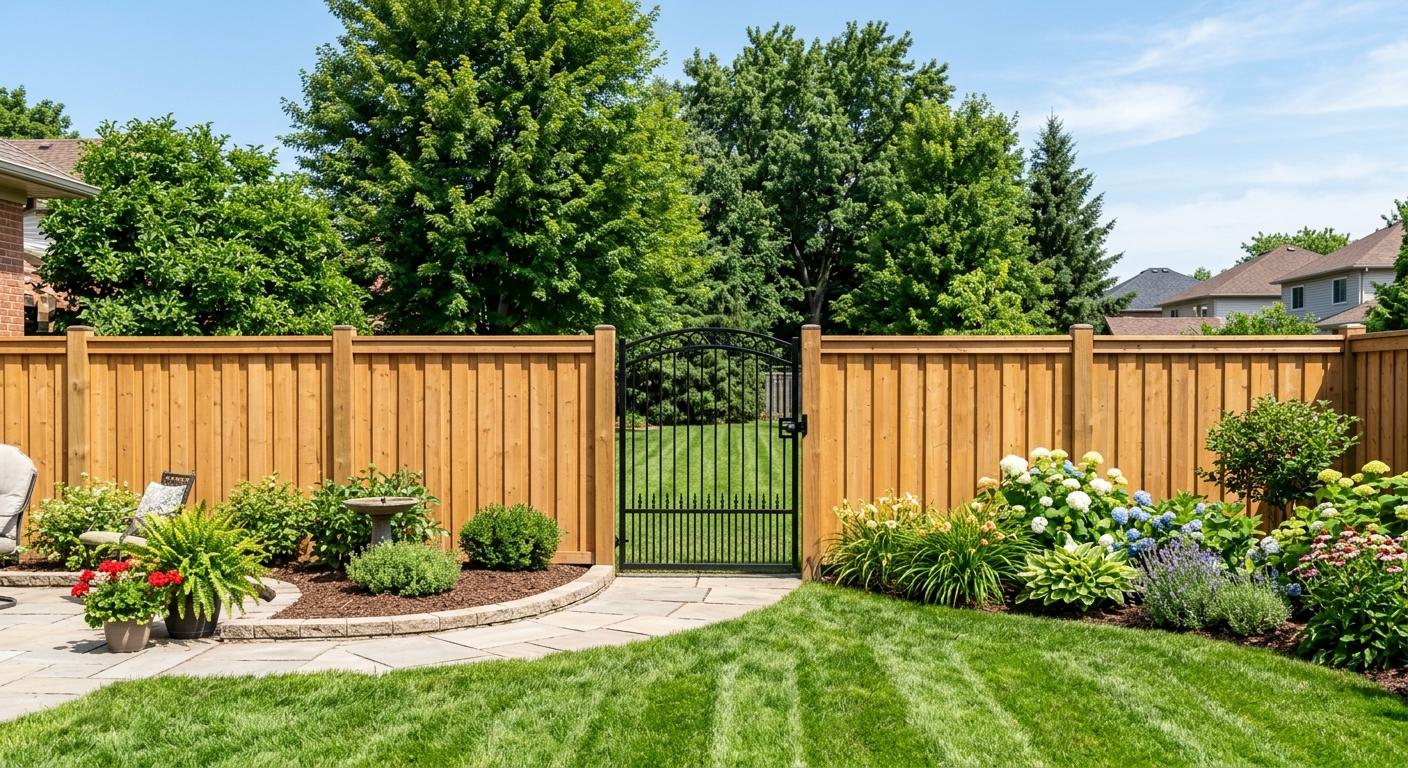
Fencing options and costs in Meadowbrook
Meadowbrook is a compact community in the Lower Mainland–Southwest, and in a neighbourhood this size (population 1,969 in 2021, Statistics Canada, 2021 Census) even small housing changes can affect fencing demand. That matters because detached homes and family lots are often where homeowners add perimeter fencing for pets, kids, and yard privacy—so contractors tend to stay busy where residents plan backyard upgrades or replace older, weathered boards.
In the Lower Mainland–Southwest, pricing is influenced by mild but not trivial frost and frequent wind-driven rain. Posts still need to be set below the design frost depth to limit heaving, and wetter Fraser Valley soils commonly mean deeper holes, more concrete, and a bit more labour than a dry-site install. Access and grade also show up quickly in Meadowbrook quotes—tight side yards near older lanes or sloped backyards around the East Meadowbrook area often require more careful layout and material handling.
Availability of crews can also shift costs: when multiple fence projects overlap, premium scheduling and extra truck runs can push the high end of typical installed prices. As a result, it helps to compare materials with realistic lifespan and maintenance expectations—not just the sticker price. Below are common fence types homeowners choose in Meadowbrook, along with typical local cost bands and performance ratings, to set you up for a fair apples-to-apples discussion with contractors.
| Material |
Lifespan |
Maintenance |
Privacy Rating |
Price per Linear Foot |
| Pressure-treated pine (standard wood) |
10–15 years |
Stain/seal every 2–3 years; check for warping |
Medium–High (solid board runs) |
$55–$95 |
| Cedar (natural rot resistance) |
15–25 years |
Light staining/sealing every 3–4 years (optional for patina) |
High (full privacy boards) |
$70–$115 |
| Vinyl / PVC (no-maintenance) |
20–30 years |
Rinse annually; no paint/stain |
High (solid or board-and-rail designs) |
$75–$130 |
| Chain-link (galvanized steel) |
25–40 years |
Minimal; periodic tension checks |
Low (open mesh) |
$30–$55 |
| Aluminum ornamental |
25–40 years |
Wash as needed; no rusting |
Low–Medium (decorative pickets) |
$90–$170 |
| Composite / recycled material |
20–30 years |
Wash occasionally; avoid impact damage |
High (solid privacy panels) |
$95–$155 |
Prices are estimates only and vary by project scope, site access and material selection.
What affects the price of fencing in Meadowbrook
In Meadowbrook and across the Lower Mainland–Southwest, two quotes for the “same” length of fence can still vary by 30–50% because the real drivers are hidden on-site conditions: soil type, frost-set depth, wind exposure, and how hard it is to access the run. Labour pricing also fluctuates when crews are stretched between jobs in nearby Abbotsford and the Fraser Valley corridor, and that changes how much time they spend preparing the base, adjusting the layout, and managing traffic/parking constraints.
Frost line depth is a big reason costs aren’t purely a material problem. Contractors typically set posts with embedment that’s about 4–6 inches below the local design frost depth—so if that frost depth translates to deeper holes, you need longer posts and more concrete. In colder regions across Canada (and even in some colder BC pockets), Ontario and Alberta installs often require deeper setting—commonly around 1.5–2.0 m into the ground—which means longer lumber, more labour, and higher material spend. BC’s coastal influence can be shallower than the Prairies, but crews often still go deeper than the bare minimum for stability, especially for privacy panels, corner posts, and gates.
Wind exposure also changes the build. On more open Fraser Valley lots, tighter post spacing and stronger framing are common, which increases labour even when panel height is the same. Coastal BC’s mild but wet climate accelerates wood rot if treatment and detailing aren’t right—so pressure-treated pine may need more careful fastening, drainage gaps, and proper staining to avoid early breakdown.
Concrete examples from Meadowbrook: a long run through heavier, wetter soil usually means deeper auger holes and more concrete; a gate installation (especially a drive-through double) often adds reinforced posts and hardware; and a sloped backyard can require stepped or raked panels that increase cutting and labour. That’s why a wood privacy fence might land around the mid of the $55–$95 band, while upgrading to vinyl often moves you into the $75–$130 range for stronger, more rigid support details.
| Price Factor |
Why It Matters |
Cost Impact |
| Fence length in linear feet |
The primary driver; every added foot adds posts, rails, and installation time |
High (direct proportional increase) |
| Post depth required |
Frost line determines post length and hole depth to prevent heaving |
Medium–High (longer posts + deeper excavation) |
| Post setting method |
Concrete vs. gravel pack vs. driven posts affects stability and labour |
Medium (concrete adds material + setting time) |
| Material choice |
Vinyl/cedar and chain-link each have different material and structural requirements |
High (materials differ significantly) |
| Gate count and type |
Gates need reinforced posts and heavier hardware than typical fence bays |
Medium–High (hardware + framing time) |
| Grade and terrain |
Sloped yards need stepped or raked panels and extra cutting |
Medium (labour increases even if length stays the same) |
| Old fence removal and disposal |
Demolition, hauling, and dump fees can be time-consuming |
Medium (can add noticeable cost to a replacement job) |
| Permit fees and survey / property line locate |
Documentation and accurate layout prevent encroachment disputes |
Low–Medium (site-dependent) |
Permits & regulations in British Columbia
In British Columbia, fencing height can trigger a building permit, especially for taller runs. While exact thresholds can vary by municipality, a common guideline is that fences above about 2.0 m (6.5 ft) at the rear and around 1.0–1.2 m (3–4 ft) at the front or corner often require a permit. Regardless of permit status, all fence locations must respect property lines and municipal setback bylaws, so your layout should be confirmed before posts are dug.
Before digging any post hole, you must call for utility locates. Use the appropriate provincial service (Ontario One Call, BC 1 Call, or Alberta One-Call in their respective provinces). Even in Meadowbrook, where projects are typically straightforward, locates are non-negotiable—hitting a buried service can stop work and become expensive fast.
Step one for homeowners: obtain a survey or locate your property pins so you can establish the true line. Step two: ask the contractor whether they are pulling the permit (when required) and whether the estimate includes the permit cost and any required inspection. Step three: confirm shared fence ownership rules through provincial line-fences legislation if you’re building along or replacing a boundary fence.
To verify a British Columbia fence contractor, check: (1) their licensing/registration status through the relevant online registry; (2) certificate of insurance for liability coverage showing your job address; and (3) coverage for workers through the required workplace insurance program (look for proof/clearance documentation). Request these before signing so there’s no mismatch when work starts.
Choosing the right fence material for Meadowbrook
Choosing the right fence material in Meadowbrook is mostly about matching your priorities to how the Lower Mainland–Southwest handles moisture, wind, and freeze-thaw. Pressure-treated pine is the budget-friendly option, but it typically needs staining or sealing every 2–3 years to prevent grey weathering and to slow surface decay. Cedar usually looks better longer and has natural rot resistance, yet it still benefits from periodic sealing depending on sun exposure and how wet the run stays.
Vinyl/PVC is the low-maintenance choice: it doesn’t require painting or staining, and homeowners often like that it cleans easily. However, very cold snaps can make some sections brittle if the system is installed with poor fastening or without proper expansion considerations. Chain-link is usually the lowest up-front cost and offers the longest service life, but it won’t deliver privacy unless you add slats/mesh or plant screening. Aluminum ornamental fencing resists rust and can handle damp conditions well, but it provides minimal privacy because of open picket styling. Composite/recycled materials can deliver a strong privacy look while staying low-maintenance, but it’s priced closer to mid-high material bands because of the engineered boards.
Post depth matters across materials. Even with BC’s generally milder conditions, crews often set posts below frost influence to avoid heaving—meaning deeper holes and longer posts on wetter sites. Concrete-set posts are most common for corner posts, gate posts, and areas with unstable or very wet soil; it’s less about “trend” and more about keeping fences plumb and rigid against wind.
A realistic decision point: if you’re deciding between standard wood and vinyl privacy, the vinyl option often costs within the $75–$130 band instead of wood’s $55–$95 band. That difference can be justified when you want to reduce yearly upkeep, especially on fence runs that stay damp most of the year or where you can’t easily access both sides for maintenance.
| Material |
Cold Tolerance |
Lifespan |
Annual Maintenance |
Best For |
Price Band |
| Pressure-treated pine |
Good (with proper treatment and sealing) |
10–15 years |
Inspect and typically stain/refresh every 2–3 years |
Lower upfront cost with willingness to maintain |
$55–$95 |
| Cedar |
Good (rot-resistant in wet seasons) |
15–25 years |
Light sealing/maintenance about every 3–4 years |
Natural look, better weathering than standard pine |
$70–$115 |
| Vinyl / PVC |
Moderate to good (proper installation is key) |
20–30 years |
Rinse and inspect annually |
Low-maintenance privacy and curb consistency |
$75–$130 |
| Chain-link |
Excellent (steel durability) |
25–40 years |
Minimal checks; rinse as needed |
Security on a budget; pets with unobstructed airflow |
$30–$55 |
| Aluminum ornamental |
Excellent (powder-coated) |
25–40 years |
Wash as needed |
Rust-free appearance with boundary definition |
$90–$170 |
| Composite / recycled |
Good (engineered boards) |
20–30 years |
Wash occasionally; inspect for damage |
Privacy look with reduced upkeep |
$95–$155 |
How to choose a fencing contractor in Meadowbrook
When you’re hiring a fencing contractor in Meadowbrook, start with proof—not promises. In British Columbia, verify licensing/registration where applicable for fencing and related work, then confirm liability insurance (so you’re protected if something is damaged on your property). Ask for proof of workers’ coverage through the applicable workplace insurance program (the clearance/coverage documentation) and keep copies for your records.
Next, get 2–3 itemised written quotes, not lump sums. The best quotes break down labour and materials separately and clearly show what you’re paying for: fence panels, rails, posts, gate frames and hardware, fasteners, concrete/aggregate, and any site prep like disposal. Read the scope line by line to see what’s excluded (for example, tree trimming, rock removal, concrete walk cutting, or extending the run to meet a finished grade). Confirm whether permit pulling is included when required, and whether old fence removal and dump fees are part of the price.
Look closely at warranties: you want a workmanship warranty length (how long they stand behind installation) and the manufacturer/product warranty for materials. Ask if warranties are transferable if you sell the home.
For payment scheduling, avoid large deposits. A good rule is never more than 10–15% upfront, then hold back a portion until the job is complete and cleaned up. Finally, require a start date and completion estimate in writing so schedule changes don’t become extra claims later.
- Provide a detailed, itemised estimate (materials and labour line items).
- List post types, spacing, and whether corner/gate posts are reinforced.
- State the post setting method (concrete vs. gravel pack) by location on the plan.
- Confirm disposal/hauling is included for old fencing (if replacement).
- Clarify permit responsibility if height thresholds require one.
- Show proof of liability insurance with your address/job site noted (certificate).
- Show workplace coverage proof/clearance for workers.
- Give the workmanship warranty term and what it covers in writing.
- Confirm product/manufacturer warranty details and any exclusions.
- Include a payment schedule (deposit and final payment timing).
- Provide a start date and an estimated completion timeframe in writing.
- Include how they handle slopes (stepped vs. raked panels) on your specific yard.
Red flags to watch in Meadowbrook: (1) they won’t put the scope in writing or won’t itemise materials and labour; (2) they ask for a large upfront payment (beyond ~15%); (3) they can’t provide insurance and coverage documentation on request; (4) they talk vaguely about “minimum post depth” without explaining frost/soil approach; and (5) they won’t discuss gates, reinforcement, and hardware details (hinges/latches) before you approve the price.
Frequently asked questions — fencing in Meadowbrook
Should fence posts be set in concrete here?
In Meadowbrook and throughout the Lower Mainland–Southwest, concrete can be the right choice, but it depends on soil and where the post sits. For corner posts, end posts, and especially gate posts, many contractors use concrete because it resists wobble and keeps the gate aligned under wind load. In wetter Fraser Valley-style soils, deeper holes and concrete are also common to reduce settling after rain. In some runs on stable ground, contractors may use a gravel/aggregate pack approach for standard line posts, but the quote should specify the method for each post location and explain why. If a contractor promises “one method for everything” without looking at your yard’s drainage and stability, that’s a concern.
What's the best fence for privacy?
For privacy in British Columbia’s damp, windy conditions, a solid panel design typically beats open styles. Vinyl/PVC privacy fencing is often a top pick because it’s low maintenance and holds its appearance with minimal staining needs—commonly priced within the $75–$130 band for installed work. Cedar privacy boards also perform well in wet seasons and naturally resist rot, though you still need periodic maintenance to keep the look tight. Standard pressure-treated pine can be the budget solution, usually landing around $55–$95, but you should plan on sealing/staining every couple of years. For any material, prioritize proper post embedment and reinforcement on corners and gates; privacy isn’t just the panel—it's the frame resisting racking in wind.
How do I compare fencing quotes?
Compare quotes like a project scope, not like a single number. Ask each contractor to itemise labour and materials (posts, rails, panels, fasteners), confirm post setting depth and whether concrete is used, and list gate hardware details. Verify whether the quote includes site prep (clearing, leveling, rock handling if applicable), disposal of an old fence, and any permits or property line locating. In Meadowbrook, slope and access can change labour time, so make sure the plan shows how they’ll handle stepped or raked sections. Also confirm what’s excluded (e.g., tree trimming, utility mark-up requirements, or additional survey costs). If two quotes are far apart, the gap is usually concrete setting, reinforced posts, gate framing, or the finish grade of the material.
How long does fence installation take in Meadowbrook?
Most residential fence installs in Meadowbrook are scheduled in phases: layout/locates, excavation/post setting, panel assembly, then finishing and clean-up. For shorter runs (a few dozen linear feet), installation can be completed in about 1–2 working days, assuming access is straightforward and there are no major grading surprises. Longer privacy fences with multiple gates may take 3–5 days, mainly because reinforced posts and concrete setting add time and because crews often must work around wet weather windows. Weather still affects schedules in the Lower Mainland–Southwest: heavy rain can slow trenching and concrete work, and wind can delay alignment work on solid panels. Your best timeline comes from an itemised quote that includes start date and a realistic completion estimate.
Can I install a fence on a slope in Meadowbrook?
Yes, you can install on a slope in Meadowbrook, but it should be built intentionally rather than “making it work.” Contractors typically use either stepped panels (distinct height changes per section) or raked panels (following the contour). The right choice depends on fence style and how much grade change exists across the run. Stepped styles often look more uniform for privacy boards, while raked designs can work well on decorative aluminum where panel alignment matters. The price can change because extra measuring, cutting, and sometimes different mounting hardware are needed. Also confirm how they plan to keep posts properly embedded below frost influence and avoid leaving unsupported gaps. A good quote will show a layout method and state the finish grade strategy so the fence sits level-looking from your perspective.
What is the most weather-resistant fence for Meadowbrook's climate?
There isn’t one perfect fence for every home, but several options are notably weather-resistant in Meadowbrook’s Lower Mainland–Southwest conditions (wet seasons, periodic frost influence, and wind). Cedar and properly installed vinyl/PVC privacy fencing are strong performers: cedar has natural rot resistance, and vinyl doesn’t absorb moisture the way wood can. If you want the longest service life with minimal upkeep, chain-link is also very resilient against rot and decay (though it won’t provide privacy by itself). In terms of cost, wood options often sit around $55–$95, while vinyl privacy commonly lands around $75–$130 for typical installs. The “most weather-resistant” result still depends on correct post embedment, quality fasteners, and gate reinforcement so the fence stays straight through wind-driven rain and freeze-thaw cycles.