Fencing options and costs in Scott Creek
In Scott Creek, choosing a fence usually starts with balancing privacy, maintenance, and how the Lower Mainland–Southwest climate treats timber. With a population of 2,828 people in 2021 (Statistics Canada, 2021 Census), demand is steady because every detached home boundary and backyard upgrade creates a fencing opportunity. That local housing demand tends to cluster where homeowners are actively refreshing lots, especially around residential pockets off the highway corridor near the community’s built-up areas.
Lower Mainland–Southwest pricing is also shaped by a “mild but not trivial” frost-and-wind reality: posts still need to be set below frost influence to limit heaving, and wetter Fraser Valley soils often mean deeper holes, more concrete, and extra labour compared with drier sites. Vinyl and composite systems cost more up front because materials and structural requirements are higher, while chain-link stays the lowest-cost option. Wood sits in the middle, but coastal-style moisture swings in BC can accelerate weathering unless you select the right product and plan maintenance.
In practice, contractor availability and scheduling affect your final number too—busy seasons push crews to bundle installs efficiently, which can reduce labour-per-foot on longer runs. Short runs, many corners, and gate work add cost because they require extra framing, hardware, and careful alignment. Use the table below to compare typical lifespans, maintenance expectations, and regional price bands per linear foot before you request a project-specific estimate.
| Material |
Lifespan |
Maintenance |
Privacy Rating |
Price per Linear Foot |
Price Range |
| Pressure-treated pine (standard wood) |
10–15 years |
Stain/seal every 2–3 years |
Good (solid panels) |
$55–$95 |
$2,200–$3,800 |
| Cedar (natural rot resistance) |
15–25 years |
Seasonal inspection; stain/coat as needed |
Good to excellent |
$65–$110 |
$2,500–$4,500 |
| Vinyl / PVC (no-maintenance) |
20–30 years |
Occasional wash; no staining |
Excellent (solid styles) |
$75–$130 |
$3,000–$5,200 |
| Chain-link (galvanized steel) |
25–40 years |
Rinse/inspect tension; replace damaged sections |
Low (see-through) |
$30–$55 |
$1,200–$2,200 |
| Aluminum ornamental |
25–35 years |
Rinse; occasional touch-up |
Low to fair (open pickets) |
$90–$170 |
$3,600–$6,800 |
| Composite / recycled material |
20–30 years |
Minimal cleaning; no painting |
Good to excellent (solid boards) |
$85–$150 |
$3,400–$6,000 |
Prices are estimates only and vary by project scope, site access and material selection.
What affects the price of fencing in Scott Creek
Fencing quotes in the Lower Mainland–Southwest can vary by roughly 30–50% for the same “style” in Scott Creek because labour intensity and site conditions often drive the job. Two contractors may both quote a “6 ft privacy fence,” but one includes concrete-setting for critical posts, better rail bracing for wind, and waste disposal—while the other assumes easier soil and standard embedment. Material pricing also differs: cedar and vinyl/PVC cost more than pressure-treated pine, and aluminum/metal is usually the highest because of fabrication and hardware.
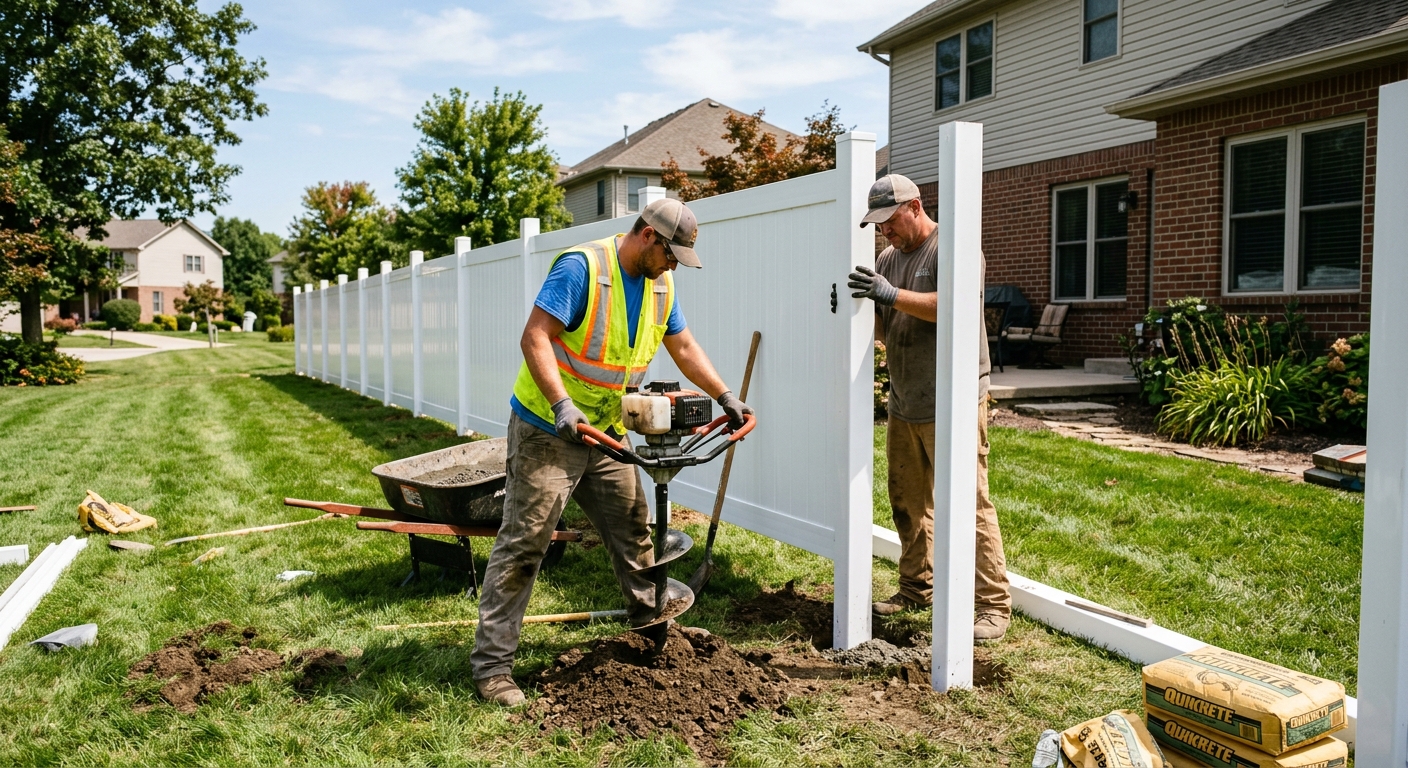
On frost and foundations, the core factor is embedment depth. Published guidance commonly uses minimum post embedment around 3 feet in much of Canada, and in coastal BC conditions contractors often go shallower than the Prairies—yet still typically set posts below the design frost influence to prevent heaving. Practically, that means crews still plan holes deeper than you might expect and often use longer posts plus concrete for corner posts, gate posts, and privacy panel lines. If your site has wetter Fraser Valley soils, expect deeper holes, more concrete, and extra labour time to keep alignment plumb.
Wind exposure influences framing and spacing. In more exposed lots, contractors tighten post spacing and choose stronger rails and reinforced gates—especially for solid wood and vinyl privacy designs. By contrast, chain-link can stay cheaper because it needs less solid-panel resistance; typical chain-link pricing in this region often lands in the $30–$55 per foot band, while wood projects usually fall around the $55–$95 per foot band, with vinyl generally higher.
Concrete examples in Scott Creek that raise costs include: (1) a sloped backyard that requires stepped or raked panels, which increases cutting and material waste; (2) heavy clay or saturated ground after rain, which adds time and concrete for stable post setting; and (3) corner-heavy layouts near property lines, which require more line posts, stronger hardware, and careful layout work. If you’re replacing an old fence, removal and hauling can also add meaningful cost—sometimes enough that upgrading from standard pressure-treated pine to cedar or moving from pine to vinyl becomes a “difference you feel” rather than a small premium.
| Price Factor |
Why It Matters |
Cost Impact |
| Fence length in linear feet — the primary cost driver |
Labour and materials scale directly with run length |
High (majority of the total) |
| Post depth required — frost line determines post length and hole depth |
Deeper holes and longer posts increase excavation and materials |
High in wet/variable soils |
| Post setting method — concrete vs. gravel pack vs. driven posts |
Concrete setting stabilizes posts; gravel pack reduces materials but needs suitable soil |
Medium to high |
| Material choice — vinyl vs. cedar vs. chain-link |
Material cost and framing requirements differ |
Medium to high |
| Gate count and type — walk-through vs. drive-through (double) |
Gates require heavier posts, hinges, latches, and sometimes bracing |
High for drive-through doubles |
| Grade and terrain — sloped yards require stepped or raked panels |
More layout work, extra cuts, and sometimes more posts |
Medium |
| Old fence removal and disposal |
Demolition, hauling, and dump fees add time and cost |
Medium |
| Permit fees and survey / property line locate |
Administrative steps and locating pins prevent boundary disputes |
Low to medium |
Permits & regulations in British Columbia
In British Columbia, many fences above a height threshold typically require a building permit—commonly around 2.0 m (6.5 ft) at the rear and roughly 1.0–1.2 m (3–4 ft) at the front or corners. Even when a permit isn’t required, all fencing must respect the property line and municipal setback requirements, which can vary by location and lot configuration. If you’re planning a solid privacy fence that looks like a “full wall,” treat it as a permit candidate unless your contractor confirms otherwise in writing.
Before any post holes are dug, call for utility locates. In practice, that means using BC 1 Call for utility markings so excavation doesn’t damage buried services. Also, it’s smart to obtain a survey or at least have property pins located before you install—boundary mistakes are one of the most common causes of neighbour disputes and expensive rework. Shared fence ownership is governed by provincial line-fences legislation, so if you’re building or replacing a fence that straddles a boundary, clarify responsibility early.
What typically DOES require a permit: new fences or major upgrades that exceed the common height thresholds (especially full-height privacy fences) and projects that materially change the structure in front/corner areas. What typically does NOT: short, boundary fences below the height threshold, minor repairs, or replacing a fence in like-for-like condition where height and placement don’t change (confirm with your contractor and local bylaws).
To verify a contractor in Scott Creek: ask for (1) their licence/registration information if applicable through provincial business/contractor registration; (2) a certificate of liability insurance naming you as a certificate holder if required; and (3) proof of coverage for workers—WSIB-style coverage where applicable (WCB coverage) or a clearance letter showing status. If they can’t produce documentation promptly, treat that as a red flag. Many homeowners check the contractor’s public registry details online, then verify the dates and coverage limits directly on the insurance certificate.
Choosing the right fence material for Scott Creek
Choosing the right fence material in Scott Creek is less about “what looks best” and more about what will perform through wet spells, winter cold snaps, and coastal-style moisture. Pressure-treated pine is the budget-friendly starting point, but it usually needs staining or sealing every 2–3 years to limit greying and premature surface breakdown. Cedar offers better natural rot resistance and a warmer look over time, though it still benefits from periodic coating to keep it looking crisp and to slow splitting or shrinkage. Vinyl/PVC is the lowest-maintenance option day-to-day—no staining and easy wash-down—but it can become brittle in extreme cold unless the system is properly rated, and solid panels still need good framing and braces to resist gusts.
Chain-link is typically the lowest upfront cost and has a long service life, but it provides little privacy unless you add screening (which changes maintenance and can affect wind loads). Aluminum ornamental is attractive and won’t rust like some steels; it’s usually mid-range to higher cost, and it prioritizes appearance over privacy. For Lower Mainland–Southwest installations, post embedment still matters: contractors often set posts below the frost influence (commonly planning roughly 4–6 inches below the design frost depth in many Canadian approaches) and for wetter ground they frequently use concrete for corner posts and gate posts to maintain alignment.
Where wind and rain meet snow in winter, solid-panel fences can see higher stress at corners and gates. If you have a corner run with a gate, spending on a stronger system can be justified. For example, upgrading a cedar privacy section over standard pine may be worth it when your project is already leaning toward the $55–$95 per foot wood band; the extra you pay for cedar often reduces early re-staining and improves appearance for longer. Conversely, moving from chain-link to vinyl only makes sense when you truly need privacy, because chain-link can be a smart budget choice at the $30–$55 per foot band if visibility is not the priority.
| Material |
Cold Tolerance |
Lifespan |
Annual Maintenance |
Best For |
Price Band |
| Pressure-treated pine |
Good (with proper top coating) |
10–15 years |
Inspect annually; stain/seal every 2–3 years |
Budget privacy with acceptable upkeep |
$55–$95 |
| Cedar |
Good |
15–25 years |
Inspect annually; coat as needed |
Natural look and better rot resistance |
$65–$110 |
| Vinyl / PVC |
Fair to good (system dependent) |
20–30 years |
Occasional wash; check hardware |
Low maintenance privacy and clean appearance |
$75–$130 |
| Chain-link |
Good |
25–40 years |
Inspect tension; replace damaged wire as needed |
Security with lowest upfront cost |
$30–$55 |
| Aluminum ornamental |
Good |
25–35 years |
Rinse; occasional touch-up |
Attractive boundaries with minimal corrosion risk |
$90–$170 |
| Composite / recycled |
Good |
20–30 years |
Minimal cleaning; check fasteners |
Solid privacy with reduced maintenance |
$85–$150 |
How to choose a fencing contractor in Scott Creek
Start by confirming the contractor is properly set up to work in British Columbia and can document coverage. Ask for their business registration details (and any relevant provincial contractor registration information if applicable), then request a current certificate of liability insurance. For worker coverage, ask for proof of WCB coverage or a clearance letter showing account status—this is especially important if they’ll be hiring crews for post excavation and scaffold work near homes. Don’t accept “it’s included” answers; verify dates and coverage limits on the certificate.
Next, get 2–3 itemised written quotes. You want a breakdown that separates labour, posts and rails, concrete (if included), gate hardware, and disposal/haul-away—not just one lump sum. Pay attention to inclusions and exclusions: permit pulling, utility locate costs, survey/property line locate, and whether they re-level or replace affected landscaping.
Warranty matters for both workmanship and product. Ask how long the contractor’s workmanship warranty is (commonly a multi-year commitment for alignment and fastening issues) and whether the manufacturer’s product warranty applies to the specific boards/rails purchased. Also ask if the warranty is transferable if you sell your home.
On payment, never pay more than 10–15% upfront. Hold back part of the amount until the job is fully complete and you’ve had a final walk-through. Request a start date and an estimated completion timeline in writing, and confirm what weather conditions could delay the schedule—post-hole work and concrete setting can be affected by soil saturation and rain in coastal/wet periods.
- Provide written scope with fence height, style, panel dimensions, and post spacing.
- List what post setting includes (concrete, gravel pack, or driven method) and where.
- Confirm corner posts and all gate posts are treated as high-stress anchors.
- Show material specs (cedar grade, vinyl thickness/type, gate hardware model).
- Include utility locate confirmation and who pays if locates require re-visits.
- Clarify permit responsibility: pull permit included or homeowner obtains it.
- State whether old fence removal and disposal are included and the hauling method.
- Add grading details: stepped vs. raked panels and how heights are handled.
- Specify warranty terms for workmanship and products, in writing.
- Confirm payment schedule and maximum upfront deposit in the contract.
- Include start date, completion estimate, and clean-up expectations.
- Ensure quote includes allowance for extras (e.g., additional posts near odd corners).
Red flags in Scott Creek: (1) a quote that assumes “standard embedment” without discussing frost influence and soil wetness; (2) no line-item detail for concrete/post setting, gates, or disposal; (3) refusal to provide insurance documents and WCB/WCB-style clearance; (4) asking for a large upfront payment beyond 10–15%; and (5) vague timelines or no written scope covering permit responsibility and property-line layout.
Frequently asked questions — fencing in Scott Creek
What fence style offers the best wind resistance in Scott Creek?
In Scott Creek and the broader Lower Mainland–Southwest, the wind risk comes from gusty coastal conditions meeting lots with open exposure and lots that channel wind around corners. For best wind resistance, look for solid privacy styles with correctly braced rails, properly anchored corner posts, and gates built with heavier hinges and diagonal bracing. A well-built semi-privacy design can also work, but it must still have a strong frame—don’t confuse “open” with “low stress,” because flapping panels and weak posts can loosen hardware over time. Vinyl and solid wood systems typically need tighter installation tolerances and good post setting at corners/gates. Chain-link can handle wind loads well structurally, but it doesn’t provide privacy, so many homeowners combine it with screening if privacy is the goal.
How much does a fence cost in Scott Creek?
Typical installed fencing costs in Scott Creek generally align with Lower Mainland–Southwest price bands: chain-link often falls around $1,200–$2,200 for many residential runs depending on length and gate needs, while wood commonly lands in the $55–$95 per linear foot range. Vinyl/PVC usually comes in higher, commonly around the $75–$130 per foot band, because of material and stronger structural requirements for rails and hardware. Aluminum ornamental is generally the most expensive per foot, frequently aligning with the $90–$170 band. Your final number will depend heavily on fence length, post embedment method (and whether concrete is used), and how many gates you have. If you share your approximate linear footage and gate count, contractors can narrow the quote quickly.
How deep should fence posts be for Scott Creek's frost?
For Scott Creek, you still have to account for frost influence even though BC is milder than Ontario and Alberta. In many Canadian approaches, minimum embedment is often around 3 feet, but contractors commonly plan deeper than bare minimums to reduce heaving risk—especially in wetter soils. A practical rule used by crews is setting posts several inches below the local design frost depth influence (commonly described as about 4–6 inches below that target in broader Canadian guidance). What matters most is that corner posts, line posts for solid privacy, and gate posts are installed deep enough and stabilized properly. On wet or clay-heavy lots in the Fraser Valley area, deeper holes plus concrete setting are common to keep posts plumb and aligned through wet winters and spring thaw.
Wood vs vinyl vs aluminum fence — which is best?
“Best” depends on whether you prioritise privacy, maintenance, or appearance. Wood (pressure-treated pine or cedar) offers good privacy and a mid-range cost; wood privacy projects often sit around the $55–$95 per foot band, but cedar or better workmanship increases that range. Vinyl/PVC is usually the best choice for low maintenance and solid privacy because you typically won’t stain it—costs often align with the $75–$130 per foot band. Aluminum ornamental is best when you want an attractive, corrosion-resistant boundary but accept lower privacy; it’s usually higher in cost, often matching the $90–$170 band. In Scott Creek’s wet and wind-exposed stretches, the “best” option is also the one installed with correct post setting and bracing—material alone won’t fix weak corner anchors or undersized gate framing.
Do I need a permit to build a fence in British Columbia?
In British Columbia, fences that exceed common height thresholds typically require a building permit—for example, commonly around 2.0 m (6.5 ft) at the rear and roughly 1.0–1.2 m (3–4 ft) near the front or corners. Even where a permit isn’t required, you must still follow property lines and municipal setback bylaws. Before you dig any post holes in Scott Creek, ensure utility locates are called through BC 1 Call. It’s also smart to confirm property-line placement with a survey or located pins to avoid encroachment disputes. Shared boundary fencing is governed by provincial line-fences legislation, so clarifying responsibilities upfront matters. Your contractor should tell you in writing whether your project triggers a permit based on height and location.
How long does a wood fence last in Scott Creek?
A properly installed wood fence in Scott Creek typically lasts about 10–15 years for standard pressure-treated pine and 15–25 years for cedar, assuming good post embedment, correct drainage, and reasonable maintenance. The Lower Mainland–Southwest climate can accelerate grey weathering and surface wear, so plan to inspect annually and stain/seal pressure-treated wood about every 2–3 years to slow deterioration. Cedar resists rot better and often looks better longer, but it still benefits from periodic coating, especially on north-facing or shaded runs where moisture stays longer. Lifespan also depends on the details contractors include: deeper post setting for frost influence and solid hardware for gates. If you’re comparing budgets, remember wood sits around the $55–$95 per foot band, while vinyl is often higher—but can trade higher upfront cost for less routine upkeep.