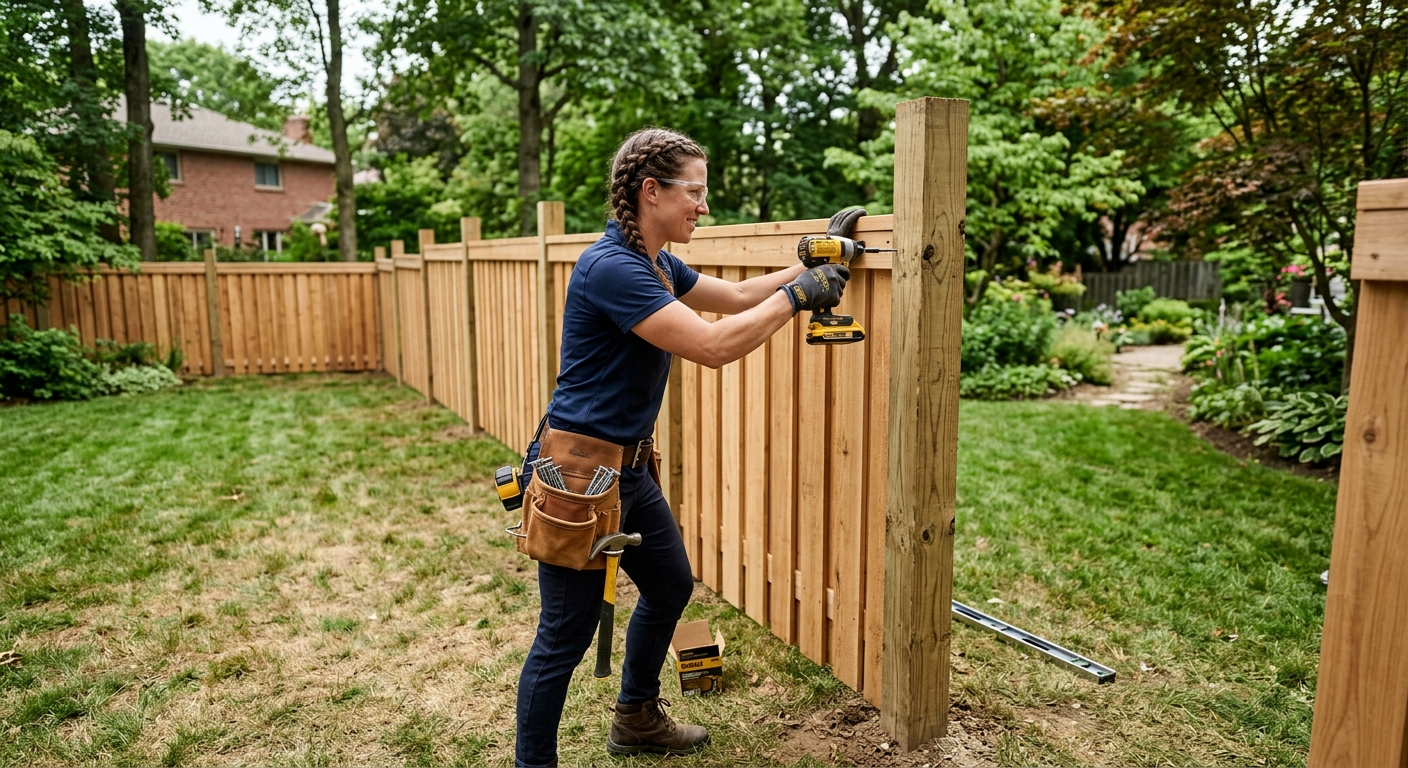
Fencing options and costs in Port Coquitlam
Port Coquitlam homeowners have a lot of fencing choices, but cost and performance come down to the same basics: your yard layout, how much privacy you need, and how well the fence materials handle Lower Mainland–Southwest weather. With a population of 61,498 (Statistics Canada, 2021 Census) and 17,645 homeowner households (77.1% of households own), there’s steady local demand—every single-detached home can become a potential client for a new boundary, privacy, or gate upgrade. And because 36.7% of dwellings are single-detached, many properties have side-yard runs where winds can hit the fence face directly.
In the Lower Mainland–Southwest, the weather is “mild but not trivial” for contractors: frost is typically less severe than colder provinces, but wet Fraser Valley soils still mean deeper holes and more labour than you’d expect on a dry site. Posts need to be set below the design frost influence to reduce heaving risk, and many crews still use concrete on corner posts, gate posts, and privacy runs for stability. That combination pushes vinyl/PVC and cedar/wood projects upward compared with simple installs, especially on sloped lots common around areas like Mary Hill and the Westwood Plateau corridor.
Availability also matters—labour demand is consistent, so tight timelines can affect your final price. The good news is you can usually balance budget and longevity by choosing the right material and detailing (post depth, bracing, and panel type). Use the comparison below as a realistic “starting point” for your quote before you compare contractor line items.
| Material |
Lifespan |
Maintenance |
Privacy Rating |
Price per Linear Foot |
Price Range |
| Pressure-treated pine (standard wood) |
10–15 years |
Stain/seal every 2–3 years |
Medium to high (solid panels) |
$16–$30 |
$55–$95 |
| Cedar (natural rot resistance) |
15–25 years |
Wash and re-seal every 2–4 years |
High (solid shadowbox/board) |
$22–$38 |
$65–$110 |
| Vinyl / PVC (no-maintenance) |
20–30 years |
Rinse only; inspect brackets |
High (solid privacy styles) |
$25–$45 |
$75–$130 |
| Chain-link (galvanized steel) |
20–40 years |
Occasional rinse; re-tension if needed |
Low to medium (open mesh) |
$11–$18 |
$30–$55 |
| Aluminum ornamental |
25–40 years |
Rinse; rare hardware checks |
Low to medium (open pickets) |
$18–$40 |
$90–$170 |
| Composite / recycled material |
20–30 years |
Wash; no staining |
High (board-style systems) |
$24–$48 |
$85–$140 |
Prices are estimates only and vary by project scope, site access and material selection.
What affects the price of fencing in Port Coquitlam
In Port Coquitlam and the broader Lower Mainland–Southwest, two neighbours can receive quotes for what looks like the “same” fence and still see a 30–50% difference—mainly because site conditions determine how much labour and hardware the job really needs. In practice, differences come from post depth requirements, soil moisture, gate complexity, slope and access for delivery/setting. Even the same material can price differently: a cedar privacy fence with concrete-set corner and gate posts costs more than a simpler run with lighter bracing.
Post depth is the big one. In most of Canada, guidance puts minimum embedment at about 3 feet for many residential installs, and contractors often go deeper where frost heave risk exists. In cold Ontario and Alberta, crews commonly set posts around 1.5–2.0 m into the ground and use concrete more often; that increases both material cost and labour. British Columbia’s coastal conditions can be shallower than the Prairies, but Lower Mainland wet soils and freeze-thaw cycles still mean crews frequently dig deeper than the bare minimum—especially for privacy panels, corner posts, and gate posts that must resist wind loading.
Wind exposure also changes the build. Prairie sites drive tighter post spacing and heavier bracing; in Port Coquitlam, wind can still stress wide privacy panels during storms, so contractors may beef up rails and use stronger posts. Meanwhile, coastal BC’s mild-but-wet pattern accelerates wood weathering and rot if treatment and bottom sealing aren’t done properly.
Two local examples that commonly raise cost here: (1) wetter ground near older backyards—many homes built before 1981 make up 32.9% of the housing stock (Statistics Canada, 2021 Census), and those lots often have mature landscaping and compacted soils that slow excavation; (2) sloped yards that require stepped or raked panel layouts, which increases labour even when total linear footage is unchanged. As a result, a basic chain-link run can sit closer to the $30–$55 band, while privacy materials like vinyl/PVC often land in the $75–$130 band depending on gates and post detailing.
| Price Factor |
Why It Matters |
Cost Impact |
| Fence length in linear feet |
Directly drives materials (rails, pickets/mesh) and installation labour. |
Major driver; increases totals proportionally. |
| Post depth required |
Controls hole size and post length to reduce heaving risk. |
Higher when deeper/longer posts and excavation are needed. |
| Post setting method |
Concrete setting resists movement; gravel packs can be cheaper but depend on soil. |
Concrete typically adds cost vs. gravel pack or driven posts. |
| Material choice |
Vinyl, cedar, and chain-link have different structural and hardware requirements. |
Vinyl/PVC and cedar usually cost more than chain-link. |
| Gate count and type |
Gates require thicker posts, hinges/latches, and alignment adjustments. |
Extra gates can noticeably increase the quote, especially drive-through. |
| Grade and terrain |
Slopes require stepped panels or raked frames to maintain a straight top line. |
Labour-heavy; adds cost even at similar linear footage. |
| Old fence removal and disposal |
Hauling, dump fees, and disposal rules affect time and cost. |
Can add a significant one-time charge. |
| Permit fees and survey / property line locate |
Locates reduce the risk of encroachment and help confirm exact offsets. |
Usually a smaller line item, but essential for complex boundaries. |
Permits & regulations in British Columbia
In British Columbia, fences above a height threshold often require a building permit—commonly around 2.0 m (6.5 ft) for rear yards and 1.0–1.2 m (3–4 ft) near the front or corners, depending on your local placement and bylaw rules. Regardless of height, fences must respect property lines and any municipal setback requirements. Before digging any post holes, you also need to call for utility locates (BC 1 Call or the relevant service) so you don’t damage buried services. A survey or property pin locate is strongly recommended before installation, particularly in older Port Coquitlam neighbourhoods where boundary lines and existing fencing can be “out by a little,” which is enough to create disputes.
Shared fence ownership and line-fence matters are governed by provincial line-fences legislation, so if you’re replacing an existing fence with a neighbour, confirm who owns or shares the fence and how replacement costs are handled.
Permit-requiring work: if your proposed fence is over the height threshold (or triggers local requirements), you should expect a permit is required for the fence height/placement. Permit-less work: typical lower fences that clearly sit within common height limits and do not alter protected areas or contravene setbacks are often approved without a building permit, but you should still confirm with your municipality before digging.
To verify a Port Coquitlam contractor, ask for: (1) a copy of their licence/registrations relevant to fencing trades as applicable in BC, (2) liability insurance certificate naming you as additional insured if possible, and (3) WSIB/WCB coverage documentation (or clearance letter) showing active coverage. Where to look: the contractor’s registry/licensing listing for status, and the certificate of insurance for coverage amounts and expiry dates. If a contractor won’t provide documents promptly, that’s a practical red flag.
Choosing the right fence material for Port Coquitlam
Choosing the right fence in Port Coquitlam is mostly about matching your priorities—privacy, low maintenance, lifespan, and budget—to how Lower Mainland–Southwest weather behaves. This area is milder than many Canadian regions, but it’s also wet: wood can weather, fastenings corrode, and rot starts at ground contact if you don’t detail the system correctly. That means “looks good today” isn’t the same as “performs after a few seasons.”
Pressure-treated pine is the budget workhorse. It’s usually the starting point for many homeowners, but it will typically need staining or sealing every 2–3 years to slow grey weathering and protect against moisture uptake. Cedar is a step up: it has better natural rot resistance and an attractive finish, but it still benefits from regular wash and re-seal—especially for boards near the bottom of the fence line. Vinyl/PVC offers genuine low maintenance because it doesn’t need staining; however, in cold snaps it can become brittle at hardware points if installed with the right expansion allowances and proper bracing. Chain-link is the lowest upfront option and tends to last a long time, but it provides little privacy unless you add screening (shrubs/mesh slats). Aluminum is rust-resistant and long-lived; it’s mid-range to premium in most BC markets, though it’s usually more decorative than private. Composite/recycled materials can be great for privacy with low upkeep, but pricing typically tracks higher-end systems.
On post depth: even in coastal BC, crews generally set posts deep enough to stay stable through freeze-thaw and wet soil movement—often around the “about 3 feet minimum” guidance, and deeper for privacy panels, gate posts, and corners depending on site conditions. Concrete-set posts are commonly used where loads and movement must be controlled. Wind matters too: wide privacy panels need solid rails and correctly spaced posts, while open styles (like chain-link and aluminum) catch less wind resistance but may still require bracing at corners and gates.
Dollar example: if you’re comparing a cedar privacy fence versus pressure-treated pine, the cedar often costs more upfront, but the difference can be justified if you want a better-looking finish and longer service life without replacing boards early. For many typical residential runs, cedar commonly lands closer to the mid-to-upper wood range, while vinyl/PVC often moves into the $75–$130 band when you include gate hardware and concrete at key posts.
| Material |
Cold Tolerance |
Lifespan |
Annual Maintenance |
Best For |
Price Band |
| Pressure-treated pine |
Good (with proper sealing) |
10–15 years |
Low effort: inspect and re-stain/caulk every 2–3 years |
Lower upfront cost with standard privacy |
$55–$95 |
| Cedar |
Good (natural rot resistance) |
15–25 years |
Wash/inspect and re-seal every 2–4 years |
Attractive privacy with better resistance to wet rot |
$65–$110 |
| Vinyl / PVC |
Moderate to good (hardware details matter) |
20–30 years |
Very low: rinse and inspect brackets after storms |
Low maintenance privacy in wet coastal conditions |
$75–$130 |
| Chain-link |
Good |
20–40 years |
Low: occasional rinse; check tension at corners |
Security and pet control on a tight budget |
$30–$55 |
| Aluminum ornamental |
Good |
25–40 years |
Very low: rinse and tighten hardware as needed |
Decorative boundary with durability (less privacy) |
$90–$170 |
| Composite / recycled |
Good (system dependent) |
20–30 years |
Low: wash; no staining |
Privacy with a “wood-like” look and reduced upkeep |
$85–$140 |
How to choose a fencing contractor in Port Coquitlam
Choosing the right fencing contractor in Port Coquitlam starts with documentation. In British Columbia, you should verify that the contractor has appropriate business standing, carries liability insurance, and has workers’ compensation coverage (WSIB/WCB coverage documentation and/or a clearance letter, depending on their coverage situation). How to check each: (1) ask for a recent certificate of insurance showing active general liability with you listed where applicable, and verify the limits and expiry date; (2) request proof of coverage and clearance letter for workers’ compensation; (3) confirm their registry/licence status using the relevant online listing for the trade/business—don’t rely only on verbal assurances.
Next, get 2–3 itemised written quotes. The best quotes break down labour (posts, rails, panel assembly, gate build, removal) and materials (fasteners grade, panel type, concrete amount where used, hardware brand). Avoid offers that only provide a lump-sum number without specifying height, material thickness, post spacing, post depth, and whether concrete setting is included for corner/gate posts. Scope should clearly state what’s excluded: permit pull (if required), utility locate coordination, disposal/hauling, damaged landscaping restoration, and any survey/locate costs.
Warranty matters in this market because wet cycles accelerate failures if workmanship is weak. Ask for the workmanship warranty length, what it covers (posts, hardware, panel alignment), and whether the product manufacturer warranty is separate—and whether it’s transferable to future owners. Payment schedule should be conservative: never more than 10–15% upfront, then pay the remainder on milestones, with a holdback until the job is fully complete and cleaned up. Finally, get the start date and completion timeline in writing, not just by text message.
- Request proof of liability insurance with current expiry dates.
- Confirm workers’ compensation coverage and get a clearance letter if applicable.
- Verify business/licence status through the appropriate online registry.
- Require quotes to specify fence height, style, panel layout, and post spacing.
- Ask whether corner, end, and gate posts are concrete-set and how deep they’ll be installed.
- Ensure the quote includes gate hardware type (hinges, latch, latch direction, gate bracing).
- Check whether permit pull is included or your responsibility (for height/placement-triggered cases).
- Confirm utility locate coordination is handled (and that locates are called before digging).
- Ask who supplies and disposes of old fence materials if removal is included.
- Confirm fastener and hardware quality (exterior-rated screws/bolts) and corrosion protection details.
- Get a written workmanship warranty and clarify what is covered for alignment and post stability.
- Use a payment schedule with a holdback until final inspection/cleanup.
Concrete red flags in Port Coquitlam: contractors who refuse to state post depth and setting method, quotes that omit gate bracing/hardware specs, “cheap” bids that don’t include concrete for corner and gate posts, vague disposal language (no mention of haul-away and dump fees), and crews that won’t provide insurance and coverage documents before you sign.
Frequently asked questions — fencing in Port Coquitlam
What fence style offers the best wind resistance in Port Coquitlam?
In Port Coquitlam and the Lower Mainland–Southwest, the most wind-stable option is usually a properly braced privacy fence with solid or semi-solid panels—provided the posts, rails, and gate hardware are built for load. Wind doesn’t “push” like the Prairies do, but storm gusts still catch wide panel surfaces, so the details matter: correctly spaced posts, heavier top and mid-rails, solid corner reinforcement, and gate posts set firmly (often with concrete). A well-built pressure-treated pine or cedar privacy design can be very wind-resistant when installed with correct alignment and diagonal bracing at corners. For reference, typical wood privacy installs often land in the $55–$95 band, while more robust vinyl/PVC privacy builds typically price higher due to material structure and hardware.
How much does a fence cost in Port Coquitlam?
Most Port Coquitlam residential fence projects price within the common BC bands, adjusted for site access, soil, slope, height, and how many gates you’re adding. Chain-link often comes in around the $30–$55 range when it’s a straightforward backyard run. Wood is usually mid-range (commonly $55–$95) depending on whether it’s pressure-treated pine or cedar and whether the contractor is using concrete setting at key posts. Vinyl/PVC privacy fencing is typically higher, often $75–$130, because the system needs stronger structural components and specialized fittings. Aluminum ornamental tends to be premium, often $90–$170, since materials and fabrication are costlier. If you’re seeing a quote outside these bands, ask for the hidden details: post depth, concrete setting, brace design, and disposal.
How deep should fence posts be for Port Coquitlam's frost?
Port Coquitlam’s coastal BC climate is milder than colder provinces, but you still need stable posts through wet freeze-thaw cycles. In much of Canada, published guidance puts minimum embedment around 3 feet (about 0.9 m), and contractors commonly set posts a bit deeper than the “bare minimum” when soils are wet. In practical Lower Mainland installs, the target is often to set posts roughly 4–6 inches below the local effective frost influence line, which can lead to deeper holes than expected on damp sites. Concrete setting is especially common for corner posts, gate posts, and privacy runs where movement would quickly cause sagging. If a quote doesn’t specify post depth and setting method, treat it as incomplete—you want those details written before work begins.
Wood vs vinyl vs aluminum fence — which is best?
There isn’t one “best” for every Port Coquitlam yard—there’s a best fit. Wood (pressure-treated pine or cedar) is often the best value if you’re comfortable with periodic maintenance (staining/re-sealing every couple of years for pine; wash and re-seal every 2–4 years for cedar). Vinyl/PVC is the best choice for low-maintenance privacy: it’s popular in the $75–$130 band and typically needs only rinsing and hardware inspection after storms. Aluminum is best for durability and appearance if you don’t need full privacy—its open picket style is decorative, typically $90–$170, and it won’t rust. Chain-link is the budget security option, but it won’t give privacy. If wind resistance and privacy are your priority, wood or vinyl privacy styles with proper bracing and post setting are usually the most dependable.
Do I need a permit to build a fence in British Columbia?
In British Columbia, fences above a typical height threshold often require a building permit—commonly around 2.0 m (6.5 ft) for rear yards and 1.0–1.2 m (3–4 ft) near the front or corners, depending on placement and local rules. Even when a permit isn’t required, your fence must still respect property lines and any municipal setbacks. Before digging any post holes in Port Coquitlam, call for utility locates so you can avoid hitting buried services. Also, obtain a survey or locate your property pins if there’s any uncertainty about the boundary to prevent encroachment disputes. When requesting a quote, ask whether the contractor will pull the permit (if required) or whether you’ll be responsible—good fence contractors spell that out clearly in the scope.
How long does a wood fence last in Port Coquitlam?
A well-built wood fence in Port Coquitlam typically lasts around 10–15 years for pressure-treated pine and about 15–25 years for cedar, assuming correct installation and maintenance. Lower Mainland–Southwest moisture means the bottom boards and post ends take the most punishment, so details like proper treatment at ground contact, adequate drainage, and quality fasteners make a big difference. Post setting matters too: corner and gate posts should be stable (often concrete-set) to prevent sagging and gaps that let water collect. Maintenance affects longevity: pine usually needs staining/sealing every 2–3 years to prevent heavy grey weathering, while cedar should be washed and re-sealed every 2–4 years. If you want a “set it and forget it” approach, vinyl/PVC in the $75–$130 band is often chosen specifically to avoid ongoing staining.