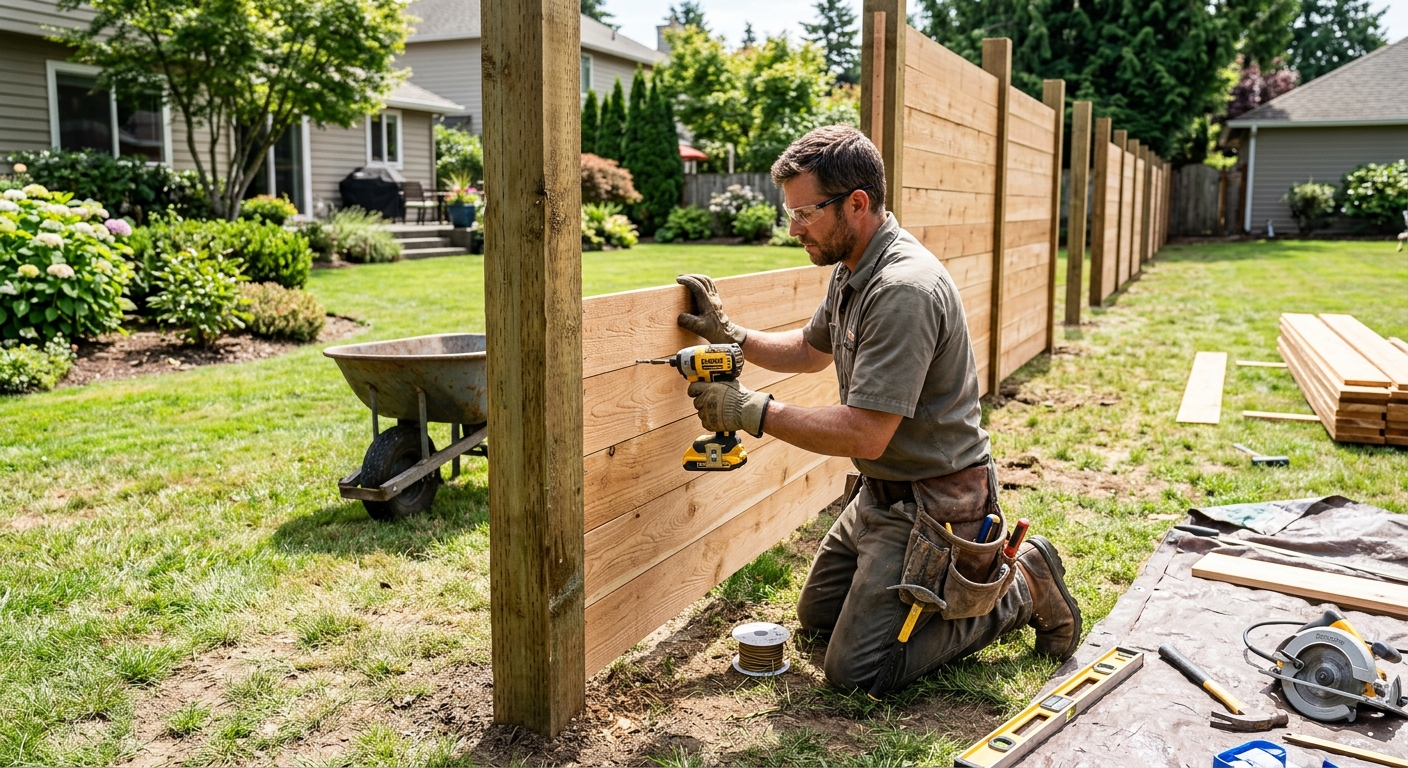
Fencing options and costs in Sparwood
Sparwood homeowners typically have a clear sense of what they want from a fence, and the local housing mix helps explain the steady demand. With single-detached homes making up 55.4% of dwellings and about 71.6% of households owning their homes (Statistics Canada, 2021 Census), most fence work is planned as long-term property protection—privacy, kids and pets containment, and boundary definition. That planning matters because fencing in Sparwood isn’t just a weekend install: the Kootenays’ freeze–thaw cycles drive deeper post requirements and more concrete setting time, especially for corners and gate posts.
In the region, frost depths are commonly in the ~1.2–1.5 m range, so contractors generally set posts close to or below design frost depth to prevent frost heave. In practice, that means more excavation, more rebar-reinforced footing where needed, and longer material lead times. It also affects labour availability: crews who routinely build structural, concrete-set fence systems can charge a premium, while lighter-duty installs can be cheaper but may need earlier touch-ups after harsh winters.
Demand is particularly strong around the town’s residential growth areas near the Sparwood area core where lots are frequently fenced for privacy and snow storage planning along driveways. If you’re comparing options for a new yard boundary or a full replacement, the table below gives typical cost ranges and performance trade-offs for common materials in Sparwood.
| Material |
Lifespan |
Maintenance |
Privacy Rating |
Price per Linear Foot |
| Pressure-treated pine (standard wood) |
10–15 years |
Stain/seal every 2–3 years; check for loosening rails |
Good (solid rails/panels) |
$45 – $75 |
| Cedar (natural rot resistance) |
15–25 years |
Seal or stain every 2–4 years; tighten hardware |
Good–Very good (solid boards/panels) |
$60 – $95 |
| Vinyl / PVC (no-maintenance) |
20–30 years |
Rinse as needed; inspect for impact damage |
Very good (solid privacy panels) |
$70 – $110 |
| Chain-link (galvanized steel) |
25–35 years |
Occasional tension checks; remove weeds at base |
Low (security only) |
$30 – $55 |
| Aluminum ornamental |
25–40 years |
Wash annually or as needed; touch up minor chips |
Low–Medium (open pickets) |
$80 – $140 |
| Composite / recycled material |
20–30 years |
Minimal washing; periodic panel/fastener inspection |
Very good (solid styles) |
$95 – $135 |
Prices are estimates only and vary by project scope, site access and material selection.
What affects the price of fencing in Sparwood
In Sparwood, fence quotes for what looks like the same “privacy fence” can vary by 30–50% because the biggest drivers aren’t the visible boards—they’re the below-ground design choices and install method. Two contractors may propose similar height and spacing, yet one includes proper frost-depth post embedment with concrete footings and reinforced corners, while another uses a lighter approach that can be cheaper upfront but more prone to winter movement.
The regional frost line is the main reason. Even though some milder regions use about a 2 ft post set, in the Kootenays contractors often set posts about 4–6 inches below the design frost depth to prevent heaving. That typically means deeper augering, longer posts, and more concrete per post—especially at structural corners, plus heavier gate systems. You’ll usually feel this difference most on longer runs: in Sparwood, the labour and excavation effort can push a project that starts near a “wood fence” band of $45 – $75 toward the upper end once the crew is doing full concrete set and working around drainage and buried lines.
Next is wind and panel stiffness. While we don’t have Prairie-level gusts, exposed yards and ridge lines still rack panels in winter storms. That pushes crews to tighten post spacing and use stronger rails. Chain-link tends to stay in the lower band (often around $30 – $55), but if you add privacy slats or wind-rated tension systems, cost rises. Conversely, jobs on flatter, easier-access lots can be closer to the low end because excavation is faster.
Concrete examples from Sparwood: (1) a sloped driveway approach often requires step-racking, increasing labour for rail alignment; (2) a corner run with a swing gate needs extra bracing and may require heavier concrete footings; (3) removing a mature old fence can add disposal time and hauling fees, raising total project cost. Also, older housing stock—over half of homes built before 1981 (Statistics Canada, 2021 Census)—often means buried utilities or irregular lot grading, which can change excavation time and concrete volume.
| Price Factor |
Why It Matters |
Cost Impact |
| Fence length in linear feet |
The more lineal footage, the more posts, rails, and labour time |
High (primary driver) |
| Post depth required |
Frost depth dictates hole depth and post length to prevent heaving |
High (more augering + more concrete) |
| Post setting method |
Concrete vs. gravel pack vs. driven posts changes materials and labour |
Medium–High (concrete typically costs more) |
| Material choice |
Vinyl/PVC and composite cost more upfront than basic chain-link or treated wood |
Medium–High |
| Gate count and type |
Drive gates need heavier frames and bracing than walk gates |
High (gates often raise total cost disproportionately) |
| Grade and terrain |
Slopes require raked/stepped systems to keep top rails aligned |
Medium (more labour and hardware) |
| Old fence removal and disposal |
Hauling and dump fees add time and equipment use |
Medium (can be significant on long runs) |
| Permit fees and survey / property line locate |
Documentation and verified pins reduce disputes and rework |
Low–Medium (varies by situation) |
Permits & regulations in British Columbia
In British Columbia, fences above certain height thresholds often require a building permit—commonly around 2.0 m (6.5 ft) at the rear and 1.0–1.2 m (3–4 ft) at the front or corner. Requirements can vary by local bylaws and the exact fence location, but the safe approach in Sparwood is to confirm your lot’s front and side yard definitions before you schedule digging. Every fence must also respect property lines and municipal setback rules to avoid encroachment disputes.
Before installing any fence posts, call for utility locates (BC 1 Call). Even if you believe your yard is clear, underground services can sit deeper than expected, and a mistaken post hole can become an expensive rework. If you’re uncertain about the property line, get a survey or locate your pins before you start. Shared fence ownership and responsibilities are also guided by provincial line-fences legislation—so it’s smart to communicate and document what’s being built and where.
How to verify your contractor in BC (step-by-step): first, ask for proof of the contractor’s licence/registration where applicable and check relevant online registries for active status. Second, request a certificate of insurance (liability) showing coverage limits, and confirm the policy is valid for the project dates. Third, ask for evidence of WCB/WSIB coverage (as applicable to the contractor) and, if provided, a clearance letter indicating good standing. You should also have these documents before signing and prior to payment milestones.
Choosing the right fence material for Sparwood
Choosing the right fence material in Sparwood comes down to matching your priorities—privacy, low maintenance, budget, and lifespan—to a climate that punishes poor detailing. With winter freeze–thaw and deep frost embedment demands, the “best” material is the one that stays aligned and structurally sound after repeated movement in the soil.
Pressure-treated pine is the budget-friendly choice in many cases, typically built in the wood band around $45 – $75 per linear foot depending on height, post setting and complexity. The trade-off is maintenance: pine needs staining or sealing every 2–3 years to reduce grey weathering and slow surface breakdown. Cedar costs more, but its natural rot resistance usually improves how it ages outdoors; it’s a strong option if you want a warmer look with better weather performance, though cedar still benefits from periodic sealing.
Vinyl/PVC is popular for low maintenance and privacy panel options, often landing in the $70 – $110 band. In extreme cold, vinyl can be more brittle than wood—impacts from snow clearance or errant tools can crack panels—so detailing and post rigidity matter. Chain-link is the longest-life security option at the lower end, but it won’t provide privacy unless you add slats or a privacy screen (which increases cost and wind considerations). Aluminum ornamental offers rust-free longevity and a clean look, but it’s more about aesthetics than blocking wind and eyes.
For all materials in the Kootenays, post-depth matters as much as the picket. Concrete-set posts are commonly used because deeper embedment reduces frost heave risk. If your yard has exposed wind and heavy snowfall drift, stronger rails, adequate post spacing, and wind-rated panel frames are essential—especially for tall privacy fences.
Dollar example: if you’re comparing pressure-treated pine at about $45 – $75 versus vinyl around $70 – $110, the extra can be justified when you want fewer maintenance cycles and a stable appearance for 15–20+ years. If you’re willing to maintain wood, pine or cedar can be a better value; if you’re snow-ploughing near the fence, vinyl and composite may be more vulnerable to impact damage without careful clearance planning.
| Material |
Cold Tolerance |
Lifespan |
Annual Maintenance |
Best For |
Price Band |
| Pressure-treated pine |
Good with proper sealing |
10–15 years |
Inspect yearly; stain/seal every 2–3 years |
Budget privacy with regular upkeep |
$45 – $75 |
| Cedar |
Excellent with periodic sealing |
15–25 years |
Inspect yearly; seal/stain every 2–4 years |
Appearance + better rot resistance |
$60 – $95 |
| Vinyl / PVC |
Good; protect from impact in hard winters |
20–30 years |
Minimal; rinse and check for cracks after impacts |
Low maintenance privacy panels |
$70 – $110 |
| Chain-link |
Excellent; resilient to freezing |
25–35 years |
Low; tension and base weed control |
Security + longest service life |
$30 – $55 |
| Aluminum ornamental |
Excellent |
25–40 years |
Low; occasional wash and hardware checks |
Decorative fencing with durability |
$80 – $140 |
| Composite / recycled |
Good; depends on product grade and fasteners |
20–30 years |
Low; rinse and inspect fasteners |
Privacy with minimal maintenance |
$95 – $135 |
How to choose a fencing contractor in Sparwood
Choosing a fence contractor in Sparwood should start with verifying basics that protect your property and your timeline. In British Columbia, confirm the contractor’s licence/registration status (where applicable) and ask for a certificate of insurance that lists you/your property as the project site and shows liability coverage appropriate to fence construction. Next, verify WCB/WSIB coverage: request confirmation or a clearance letter indicating the contractor is in good standing for the work they’ll perform. Don’t accept “we don’t need that” answers—fence installs include excavation, lifting, and gate hardware adjustments where injuries and property damage can occur.
Then get 2–3 written, itemised quotes—not lump sums. Ask for a breakdown that separates: post supply and length, excavation depth, concrete quantity (or setting method), labour, rails/hardware, panels/slats, gate frames, and any disposal costs. Also confirm what’s excluded: permit pulling, utility locate fees, survey locate costs, rock excavation charges, and landscaping restoration (topsoil/seed or sod replacement). Workmanship warranty matters too—ask how long the contractor warrants labour and what it covers (loose posts, racked rails, panel failures). Product/manufacturer warranty should be listed separately and note whether it’s transferable if you sell your home.
For payment, keep deposits conservative: never pay more than 10–15% upfront, and request a holdback until the final inspection and cleanup are complete. Finally, get a clear start date and completion estimate in writing so weather delays don’t leave you guessing.
- Ask for proof of BC insurance and the project-effective coverage dates.
- Confirm WCB/WSIB clearance and that subcontractors are covered.
- Request licence/registration details (and verify online if listed).
- Insist on itemised labour vs materials so you can compare apples-to-apples.
- Make sure post-depth and setting method are written into the quote (not “as needed”).
- Ask whether corners and gate posts include reinforced bracing and extra concrete.
- Confirm whether utility locates and property pin locating are included or excluded.
- Clarify permit responsibility if your design exceeds common BC height thresholds.
- Check who handles old fence removal and whether disposal is included.
- Verify warranty length for workmanship and what failures trigger a fix.
- Get installation schedule and communication plan for weather delays.
- Review payment schedule; hold back until gates are aligned and fence line is straight.
Red flags I see in Sparwood: quotes that don’t specify post depth or setting method for frost; “one-size-fits-all” pricing with no site measurement; vague warranties with no workmanship term; asking for large deposits (more than 15%) before any materials are on site; and no proof of insurance or WCB/WSIB clearance when asked.
Frequently asked questions — fencing in Sparwood
What is the most weather-resistant fence for Sparwood's climate?
For Sparwood’s freeze–thaw winters and deep frost conditions, the most weather-resistant choices are typically chain-link with galvanized steel and properly designed concrete-set posts, or vinyl/PVC privacy panels installed with rigid framing. Chain-link performs well because the corrosion resistance is strong in cold conditions and the system tolerates frost movement better when posts are set at frost-appropriate depth. Vinyl can last 20–30 years, but it needs careful post spacing and protection from impact from snow clearing. In many Kootenay installs, concrete setting is the performance difference—not just the material. If you’re budgeting, chain-link often fits the lower band (roughly $30 – $55 per linear foot) while higher privacy styles can land higher.
How do I prevent wood fence rot in Sparwood?
To prevent rot in Sparwood, focus on the details that keep moisture out and soil movement down. First, ensure posts are set using a frost-safe method with correct embedment depth; if posts heave, water sits around the base and accelerates rot. Second, use proper treatment and install fasteners that match the material system—mixing incompatible hardware can shorten life. Third, seal or stain on a schedule: pressure-treated pine generally needs staining or sealing every 2–3 years in outdoor Kootenay exposure. Cedar is more rot-resistant, but it still benefits from periodic sealing. Finally, keep sprinkler overspray and leaf debris off the fence line—persistent moisture at the base is where failures start.
What is the cost per linear foot for fencing in Sparwood?
In Sparwood, pricing commonly falls within local market bands based on material and how much concrete-set work your site requires. As a baseline, chain-link often lands around $30 – $55 per linear foot, pressure-treated wood is commonly around $45 – $75, and vinyl/PVC privacy systems often fall near $70 – $110. Aluminum ornamental can be higher, and composite usually sits above vinyl. The part people underestimate is how post depth and frost-safe installation method affect total labour and material quantities—deeper augering and more concrete can move a “budget” option toward the top of its band. For an accurate number, insist on an itemised quote that lists post depth, spacing, and setting method.
Should I repair or replace my old fence in Sparwood?
Repair can make sense if the posts are solid, the fence line is mostly straight, and the damage is limited to a few boards or rails. If you see leaning sections after winters, gaps at the bottom, or repeated post movement, replacement is usually the better long-term value because frost heave can mean the underlying post installation method isn’t holding. Also consider how old your fence is: many Sparwood homes were built before 1981 (Statistics Canada, 2021 Census), and older fence layouts may have been installed without frost-depth embedment. If rotting is present at the post bases or rails are consistently loose, replacement typically avoids recurring patch costs. Ask contractors to assess post integrity (not just board condition) and to include a clear scope: repair vs full re-set plus removal.
How do I handle a fence dispute with neighbour in British Columbia?
In British Columbia, fence boundary questions are often handled through provincial line-fences principles and shared ownership responsibilities, but the practical first step is always evidence. Start by locating your property pins or obtaining a survey to confirm the property line. Then document what you and your neighbour agree on: fence placement, height, and who pays for which sections. Communication matters—many disputes escalate when someone assumes the fence belongs to them without verifying the line. If you already installed something, don’t assume “it’s close enough”; frost-safe post placement can mean the actual hole locations matter. For your own protection, keep the quote, measurements, and photos, and make sure any contractor follows BC utility locate and permitting expectations where applicable.
What fence style offers the best wind resistance in Sparwood?
In Sparwood, wind resistance is mostly about how the fence resists racking and how stiff the framework is—especially for tall sections. For privacy fences, solid or semi-solid panels can catch wind, so the system needs stronger rails, adequate post spacing, and reinforced corners and gate posts with frost-safe concrete set. Open styles like standard chain-link can “shed” wind better but offer less privacy; adding slats increases resistance to wind movement but also increases load on posts and rails. A contractor who designs for the local freeze–thaw movement will generally outperform one who focuses only on surface materials. If you’re targeting maximum wind stability, choose a properly braced privacy layout and keep the fence height realistic for your yard exposure rather than maximizing height without structural upgrades.