Fencing options and costs in Fruitvale
Fencing options in Fruitvale start with the reality that most homeowners are planning a long-lived boundary, and the demand is supported by local housing patterns: about 72.7% of dwellings in the area are single-detached homes, and homeowner households make up 80.7% of households (Statistics Canada, 2021 Census). That combination typically means many projects are full yard perimeters—plus gates—rather than small back-lot touch-ups.
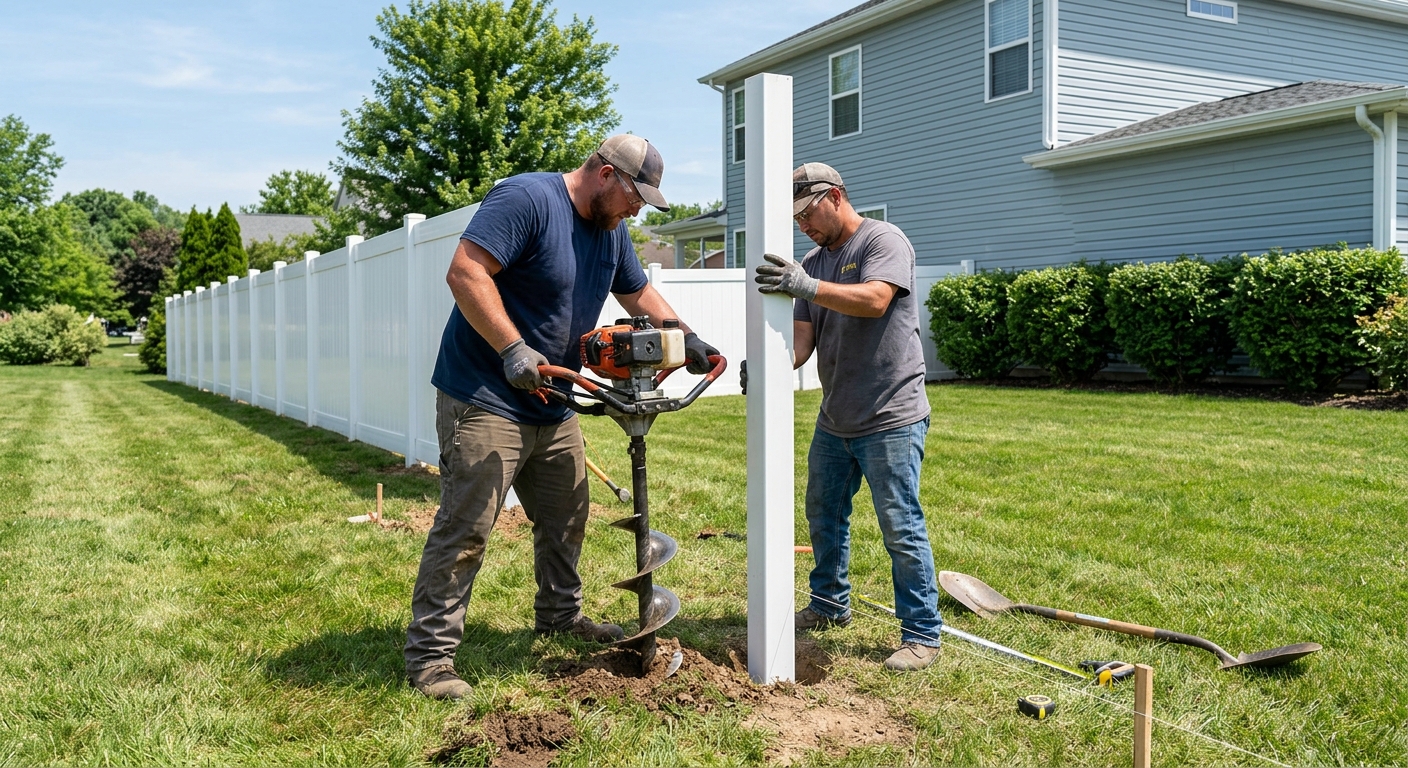
In the Kootenays, the biggest reason fence quotes can move up or down is the frost-and-freeze–thaw cycle. Southern B.C. frost depths are commonly in the 1.2–1.5 m range, so fence posts usually need to be set near or below that level (often about 4–6 inches below design frost) to resist frost heave. Practically, that means deeper augering, more concrete per post, and longer posts—especially at corners and gate openings where strength is critical. If your property is on a slope or in an exposed Fruitvale area, we often add stepped panel layouts or tighter post spacing to reduce racking during winter wind and snow load.
In Fruitvale, fencing tends to be especially in demand along busier residential pockets and acreage fringes where privacy and wind-blocking matter—commonly around the Fruitvale Station area and nearby residential streets. With that in mind, the comparison below shows typical lifespan, maintenance, and price bands you’ll see for material choices in this market.
| Material |
Lifespan |
Maintenance |
Privacy Rating |
Price per Linear Foot |
| Pressure-treated pine (standard wood) |
10–15 years |
Stain/seal every 2–3 years to reduce grey weathering |
8/10 (solid board systems) |
$45 – $75 |
| Cedar (natural rot resistance) |
15–25 years |
Light staining or oiling every 2–4 years |
9/10 (solid board or shadowbox) |
$55 – $95 |
| Vinyl / PVC (no-maintenance) |
25–30 years |
Wash as needed; check fittings after extreme cold snaps |
8/10 (solid privacy styles) |
$70 – $110 |
| Chain-link (galvanized steel) |
20–30 years |
Occasional tension check and rust touch-ups if needed |
3/10 (privacy requires slats/screens) |
$30 – $55 |
| Aluminum ornamental |
25–40 years |
Wash yearly; repaint only if damaged |
4/10 (ornamental pickets) |
$80 – $140 |
| Composite / recycled material |
20–30 years |
Minimal cleaning; inspect for warping after impacts |
8/10 (solid panels) |
$85 – $135 |
Prices are estimates only and vary by project scope, site access and material selection.
What affects the price of fencing in Fruitvale
Even when two homeowners describe “the same fence,” Kootenay and wider B.C. pricing can still differ by 30–50% once you factor in site conditions and post design. In Fruitvale, the frost line and freeze–thaw cycles drive most of the variation: contractors commonly set posts about 4–6 inches below the design frost depth to reduce frost heave. That typically means deeper holes, more concrete, and often longer posts—so a fence line with 40–60 posts can add real labour and material costs quickly compared to milder regions.
Wind and snow loading also matter. While the Kootenays don’t experience the same Prairie-level exposure, ridgelines and open lots still see strong gusts and heavy snow drifting against fence faces. The result is tighter post spacing and stronger panel framing for privacy fences, which can push a project toward the higher end of wood and vinyl ranges (for example, the wood band of $45 – $75 or vinyl at $70 – $110 per linear foot). Coastal B.C. may have less deep frost, but its wet conditions accelerate wood rot if treatment and detailing are off—so contractors often price “better fasteners, better sealing, better drainage” there; here in Fruitvale, the emphasis is deeper footings.
Concrete examples from Fruitvale jobs: (1) A standard backyard run on level ground with straight lines might use fewer deep holes, while a corner-heavy layout increases labour because corners and gates need stronger bracing and often larger concrete pours. (2) On a sloped yard, stepped panels can keep the top rail aligned but require extra layout time and additional hardware. (3) If you’re removing an old fence, disposal and haul-off can add cost on top of the new installation. Finally, with many homes in the region built before 1981 (69.0% of dwellings), you often see older property line markers, uneven ground, and existing anchor points that take more time to work around.
| Price Factor |
Why It Matters |
Cost Impact |
| Fence length in linear feet |
The main driver: more lineal feet means more posts, rails, and labour hours |
High (majority of total cost) |
| Post depth required |
Frost line determines hole depth and post length; deeper setting increases concrete and excavation time |
High |
| Post setting method |
Concrete set vs gravel pack vs driven posts affects stability, uplift resistance, and installation time |
Medium to high |
| Material choice |
Vinyl and aluminum cost more upfront; cedar and pressure-treated rely on maintenance and detailing; chain-link is lowest cost |
Medium to high |
| Gate count and type |
Drive-through (double) gates require stronger posts, extra bracing, and heavier hardware |
Medium to high |
| Grade and terrain |
Sloped yards require stepped or raked panels and more measuring/layout time |
Medium |
| Old fence removal and disposal |
Break-down, haul-off, and disposal add labour and sometimes additional fees |
Medium |
| Permit fees and survey / property line locate |
Complex property lines can require locate work; permits may be needed for taller fences |
Low to medium (but can be non-trivial) |
Permits & regulations in British Columbia
In British Columbia, fences above a height threshold—commonly around 2.0 m (6.5 ft) for the rear and about 1.0–1.2 m (3–4 ft) for the front or corner—often require a building permit. Exact requirements vary by municipality, but the key principle is the same: fences must respect property lines and any local setback bylaws. Before digging post holes, homeowners should also arrange utility locates through the proper call service (commonly BC 1 Call in B.C.).
To avoid encroachment disputes, I recommend you obtain a survey or confirm your property pins/line locate before fence installation, especially if you’re dealing with an older boundary or a fence that’s already drifted over time. In B.C., shared fence ownership concepts are typically handled under provincial line-fences legislation, but the practical step for you is documenting agreements in writing when neighbours are involved.
Verification steps (what to ask for, and where to look): (1) Request the contractor’s B.C. licence details (and any relevant trade certification, if applicable). (2) Ask for a certificate of insurance naming you as an additional insured. (3) Confirm workers’ coverage—commonly through WCB. (4) If a clearance letter is available, request it for your file. A reputable Fruitvale contractor will provide these documents quickly and will explain what permits are required for your fence height and location.
Choosing the right fence material for Fruitvale
Choosing a fence material in Fruitvale comes down to matching your priorities—privacy, maintenance level, budget, and lifespan—to the Kootenay climate. With many homes in the area built before 1981 (69.0%), you’ll often see older posts, uneven ground, or existing structures where a “quick fix” can fail if the foundation wasn’t designed for frost heave. In this region, post depth and concrete setting details matter as much as the fence surface material.
Pressure-treated pine is the budget-friendly option, but it typically needs staining or sealing every 2–3 years to prevent grey weathering and surface checking. Cedar naturally resists rot better and usually holds appearance longer, yet it still benefits from periodic staining or oiling. Vinyl/PVC is popular for low maintenance: wash and inspect, and it can last 25–30 years, but in extreme cold snaps it’s important to use correct expansion and mounting practices so sections don’t crack. Chain-link has the longest cost-effective service life and is very durable, but privacy is limited unless you add privacy slats or screens—so for a true backyard privacy goal, many homeowners move to wood, vinyl, cedar, or composite. Aluminum ornamental offers clean, rust-resistant looks and mid-range cost, but it’s not a privacy fence.
Post-depth-wise, deeper frost means concrete-set posts are commonly the most reliable approach for stability in winter. On tall fences, we also plan for wind and snow load by using stronger rails and tighter spacing to reduce racking. As a dollar example, homeowners who compare wood at about $45 – $75 per linear foot versus vinyl at about $70 – $110 per linear foot often justify vinyl when they want fewer maintenance visits over the long run—especially if they don’t have time to re-stain regularly. If your goal is privacy and you’re comfortable with routine upkeep, cedar can be a sweet spot between appearance and service life.
| Material |
Cold Tolerance |
Lifespan |
Annual Maintenance |
Best For |
Price Band |
| Pressure-treated pine |
Good when properly sealed and fastened; protect exposed cuts |
10–15 years |
Check fasteners; plan stain/seal every 2–3 years |
Lower upfront cost and classic look |
$45 – $75 |
| Cedar |
Very good; resists rot in B.C. moisture swings |
15–25 years |
Inspect annually; stain/oil every 2–4 years |
Natural appearance with better rot resistance |
$55 – $95 |
| Vinyl / PVC |
Good; needs correct mounting/expansion in extreme cold |
25–30 years |
Minimal—wash and visual inspection |
Low-maintenance privacy and long service life |
$70 – $110 |
| Chain-link |
Excellent in cold; galvanized steel withstands freeze–thaw |
20–30 years |
Occasional tension checks; spot touch-ups if needed |
Security with longest life per dollar |
$30 – $55 |
| Aluminum ornamental |
Excellent; non-rusting frame |
25–40 years |
Wash; inspect for physical damage |
Attractive boundaries where privacy is secondary |
$80 – $140 |
| Composite / recycled |
Good; impact protection matters |
20–30 years |
Low—cleaning and occasional alignment checks |
Privacy with reduced maintenance |
$85 – $135 |
How to choose a fencing contractor in Fruitvale
Picking the right fencing contractor in Fruitvale is mostly about confirming they build correctly for B.C. conditions—especially frost-set posts, solid corner strength, and proper documentation. Start by verifying licensing (where applicable), liability insurance, and workers’ coverage. Ask for a certificate of insurance and check that it’s current, includes general liability, and names you as an additional insured if required by your agreement. For workers’ coverage, request proof of WCB coverage and/or clearance paperwork where they can provide it. If they can’t produce these, treat it as a major warning sign—especially on deeper excavations where jobsite risk increases.
Get 2–3 itemised quotes, not just a lump sum. A good quote breaks down labour and materials (posts/rails, privacy panels or pickets, gate hardware, concrete/footings, and any grading or stepped layout). Confirm what’s excluded: is permit pulling included (when required), is old fence disposal hauled away, and are utility locates included or the homeowner’s responsibility? Check warranty terms too—ask for (a) workmanship warranty length, (b) manufacturer/product warranty length, and (c) whether any product warranty is transferable if you sell the home. Payment should be controlled: never pay more than 10–15% upfront, and hold back the remainder until the fence is complete and cleaned up. Finally, demand a written start date and a completion timeline, not a verbal estimate.
- Ask for post-depth plan based on local frost conditions and soil.
- Confirm corners and gate posts are braced and concrete-set (not just tamped).
- Request an itemised quote showing labour, materials, and concrete quantities.
- Make sure gates include the correct hinges/latches for winter use.
- Verify the quote includes or excludes permit pulling (if height triggers it).
- Ask who calls for utility locates and when it will be done.
- Check if old fence removal and disposal are included.
- Confirm measurement method and that a property pin/locate step is planned for accuracy.
- Require a workmanship warranty in writing (length and what it covers).
- Get the product/manufacturer warranty details and any limitations.
- Use a payment schedule with a small deposit and a completion holdback.
- Request a cleanup and final inspection step in the contract.
Red flags I commonly see in Fruitvale-area fencing quotes: contractors who offer “shallow posts” to cut cost, quotes that are not itemised (no footing/concrete line), missing proof of insurance or workers’ coverage, refusal to put the warranty in writing, and inconsistent gate hardware specs (hinges/latches don’t match the gate weight or width).
Frequently asked questions — fencing in Fruitvale
Can I install a fence on a slope in Fruitvale?
Yes—sloped yards are common around Fruitvale, but the build method matters. In British Columbia, you typically address slope using stepped panels (each section rises or drops in increments) or racked panels (continuous slope alignment). For winter performance, stepped layouts are often more practical because they keep each panel square to its section and reduce stress on rails during freeze–thaw. Just remember that property line accuracy is essential on slopes, particularly if older fencing has drifted. Also, budget time into your quote: stepped layouts add layout and hardware work even when material per linear foot looks similar to a level run (Statistics Canada, 2021 Census).
What is the most weather-resistant fence for Fruitvale's climate?
For most Fruitvale yards, a properly built privacy fence with concrete-set posts set for frost depth is the most weather-resistant approach, regardless of cladding. Material-wise, vinyl/PVC often performs well because it doesn’t rot, and it fits nicely with a no-maintenance goal; typical pricing in this region sits around $70 – $110 per linear foot. Cedar is also strong if maintained—its natural rot resistance suits B.C. moisture swings, but it still needs periodic staining. Chain-link is extremely durable in cold and wind, but it won’t provide privacy unless you add slats or screens.
How do I prevent wood fence rot in Fruitvale?
Wood rot prevention is mostly about details. First, make sure the post-depth and footing design prevents frost heave, because a heaved post leaves gaps that trap moisture against rails. Second, use appropriate pressure-treated or cedar and ensure cut ends are treated and fasteners are exterior-rated. Third, maintain a proper fence face: stain or seal pressure-treated wood every 2–3 years and keep staining schedules tight in damp spells. Also check drainage—if your fence line sits in a low area where water pools, you’ll want grading or a drainage plan before installation. In older areas where homes were commonly built before 1981, ground conditions can be uneven, so it’s worth requesting an on-site layout review (Statistics Canada, 2021 Census).
What is the cost per linear foot for fencing in Fruitvale?
Typical installed pricing in Fruitvale follows the local market bands by material type. As a ballpark, wood fencing often lands around $45 – $75 per linear foot, while vinyl/PVC usually comes in around $70 – $110 per linear foot. Chain-link fencing is commonly lower, roughly $30 – $55 per linear foot, and aluminum ornamental typically runs higher, about $80 – $140 per linear foot. Your exact total can move upward when you add deeper frost-set post requirements, more corner/bracing, drive-through gates, slopes, and old fence removal and disposal.
Should I repair or replace my old fence in Fruitvale?
In Fruitvale, the decision usually depends on whether the foundation and posts are still stable. If boards are weathered but posts are solid (no wobble, no leaning from frost movement), repair can be cost-effective—replacing panels, rails, and hardware is often cheaper than full replacement. If you see lifted posts, rot near the ground line, or rails that are pulling away, replacement is usually the safer long-term choice because repairs often repeat the same weakness. Given that many homes here were built before 1981 (69.0% of dwellings), older fences can have older post spacing and fastening methods that don’t meet modern frost-heave expectations. A contractor should assess post stability and footing depth before you decide.
How do I handle a fence dispute with a neighbour in British Columbia?
Fence disputes in British Columbia are best handled calmly and with good documentation. Start by verifying the boundary and your shared fence understanding: locate property pins/survey markers before measuring, because fencing can drift over time. Then review what type of fence agreement applies (shared fence ownership concepts are governed under provincial line-fences legislation). If there’s disagreement about responsibility for repairs or cost sharing, keep written records: photos, measurements, contractor reports, and any prior written agreements. Involving a surveyor and getting an itemised written quote can also clarify what’s fair. If your fence height or location triggers permitting rules, ensure both sides understand what is required so you’re not arguing over an unbuildable plan.