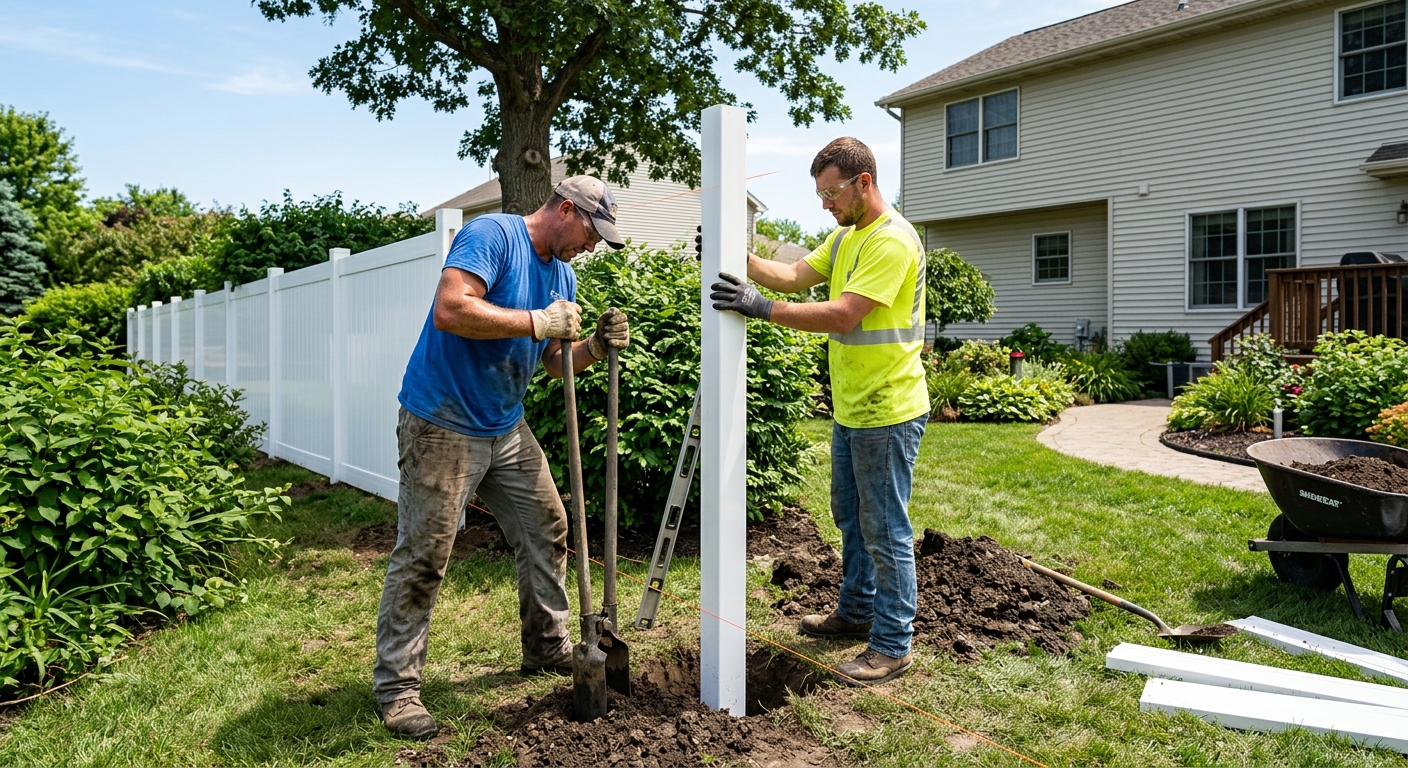
Fencing options and costs in Cultus Lake
Cultus Lake, British Columbia has a real mix of shoreline-adjacent yards and hillside lots, and that matters when you’re budgeting a new fence. With a 2021 population of 1,164 (Statistics Canada, 2021 Census), the local fencing market is smaller, so availability can tighten during peak spring installs. At the same time, detached homes make up a meaningful share of households locally, and each one is a potential fencing customer—so contractors tend to price with both demand and labour travel time in mind (Statistics Canada, 2021 Census). That’s part of why you’ll see quote differences even for “the same” 6-foot run.
In the Lower Mainland–Southwest, frost is mild but not trivial: posts still need to be set below the effective frost zone to limit heaving, especially in wetter Fraser Valley soils. Wetter ground often means deeper holes, more concrete (particularly at corners and gates), and extra labour to keep lines plumb and gates level. Mild coastal conditions also speed up wood wear when treatment and staining are skipped—so materials selection directly affects ongoing cost. If you’re near the busier residential pockets around Cultus Lake Village and the surrounding lake-adjacent neighbourhoods, you’ll often find more demand for privacy and gated yard fencing, particularly in spring and early summer.
Below is a practical side-by-side of common materials, typical lifespans, and cost expectations for an average residential install in Cultus Lake, so you can compare quotes before you choose.
| Material |
Lifespan |
Maintenance |
Privacy Rating |
Price per Linear Foot |
| Pressure-treated pine (standard wood) |
8–15 years |
Stain or seal every 2–3 years; inspect posts and rails annually |
Medium–High (solid boards) |
$55 – $95 |
| Cedar (natural rot resistance) |
12–20 years |
Seal/stain every 2–4 years; periodic tightening |
High (solid boards) |
$70 – $115 |
| Vinyl / PVC (no-maintenance) |
20–30 years |
Rinse/clean seasonally; no staining |
High (solid panel styles) |
$75 – $130 |
| Chain-link (galvanized steel) |
20–40 years |
Occasional wash; replace damaged fabric/tension parts as needed |
Low (open mesh) |
$30 – $55 |
| Aluminum ornamental |
25–40 years |
Wash; repaint only if you choose to change colour |
Low–Medium (picket look) |
$90 – $170 |
| Composite / recycled material |
20–30 years |
Low—cleaning only; check hardware and base trim |
Medium–High (solid styles) |
$85 – $140 |
Prices are estimates only and vary by project scope, site access and material selection.
What affects the price of fencing in Cultus Lake
In Cultus Lake and the wider Lower Mainland–Southwest, the same fence can come in 30–50% apart across quotes because contractors price the “invisible” work differently: soil conditions, how far crews have to travel for hauling, how long it takes to get posts set plumb on slopes, and whether materials are upgraded for wind and wet-season durability. British Columbia jobs also vary based on how tight access is to the back yard (driveway width, gate access, and whether a crew needs to bring tools in by hand). Those factors change labour time more than homeowners usually expect, especially once you add gate hardware and removal/disposal.
Post depth is a big driver. Even though Lower Mainland winters are milder than Ontario or Alberta, posts still need to be set below the design frost depth to limit heaving—commonly achieved by setting holes roughly 4–6 inches below the frost depth line. In colder Canadian regions, guidance often pushes embedment to about 1.5–2.0 m, which increases concrete volume and post length; that’s why crews plan for deeper holes when your site stays damp and freezes unevenly. In Cultus Lake, wetter Fraser Valley soils can behave like “hard work soil”: deeper holes and more concrete become the norm for privacy panels, corner posts, and gate posts. Wind exposure also matters: while Cultus Lake isn’t as gusty as open Prairie sites, wind-driven rain still punishes loose rails and undersized posts—so higher wind loading often means tighter post spacing or thicker panel frames.
Concrete examples from local installs: (1) sloped yards near the lakeshore often require stepped panels, which increases layout time and sometimes means extra rails; (2) removing an old fence can cost more when buried post stubs require cutting and concrete chipping; (3) properties with soft, saturated ground after spring storms typically need more concrete to stabilize bases, nudging the total toward the upper end of the $55 – $95 wood band or into cedar/vinyl pricing. For reference, a basic chain-link run usually tracks the lower $30 – $55 band, while vinyl privacy commonly aligns with the mid-to-upper $75 – $130 band due to material and structural requirements.
| Price Factor |
Why It Matters |
Cost Impact |
| Fence length in linear feet |
Labour scales linearly with runs, rails, and hardware. |
Typically the largest driver of total cost. |
| Post depth required |
Frost protection and soil conditions determine embedment and post length. |
Deeper holes can add concrete, labour, and post material. |
| Post setting method |
Concrete-set posts resist rot and movement better in wet ground. |
Concrete vs gravel pack vs driven posts changes material and labour time. |
| Material choice |
Vinyl, cedar, and chain-link have very different materials and install requirements. |
Switching materials can shift you from low-cost to mid/high-cost bands. |
| Gate count and type |
Gates need heavier framing and precise alignment for daily use. |
Walk-through is cheaper; drive-through double gates cost notably more. |
| Grade and terrain |
Sloped yards require stepped frames or raked panels. |
More cutting, layout time, and sometimes extra rails. |
| Old fence removal and disposal |
Demolition, stump/chip-out, and hauling vary by site. |
Can materially increase quote totals if posts are encased in concrete. |
| Permit fees and survey / property line locate |
Verification prevents encroachment disputes and supports compliance. |
May add line locate and admin costs; permits vary with fence height and location. |
Permits & regulations in British Columbia
In British Columbia, fences above a height threshold—often around 2.0 m (6.5 ft) at the rear and roughly 1.0–1.2 m (3–4 ft) at the front or corner—may require a building permit. Height limits and setback requirements still depend on the municipal bylaws where your property sits, and property lines must be respected. The most important practical step before digging is to call for utility locates—whether you use BC 1 Call or your local equivalent—so you don’t hit buried services with augers.
Before you order materials, also confirm your property pins or get a survey/locate done. That avoids fence-on-your-neighbour’s-lawn disputes and helps your contractor set the correct line and offsets for gates. Shared fence responsibilities are handled under provincial line-fences legislation, so if you and a neighbour are building or repairing a shared boundary fence, the agreement matters—especially for who pays and what “like for like” replacement means.
What typically DOES require a permit in BC: building a new fence (or significantly increasing height) that crosses the local height thresholds, or any project that changes the boundary structure in a way that triggers municipal review. What typically does NOT require a permit: minor repairs, replacing an existing fence in like-for-like dimensions where height and location do not change, and reinstalling sections within the same footprint (confirm with your contractor and municipality).
To verify your Cultus Lake contractor’s credentials: check the public licence registry for their business/contractor authorization (where available), ask for a current certificate of insurance showing liability coverage, and confirm they have the required worker coverage (WSIB/WCB as applicable). Request the paperwork before signing, and keep copies—your quote and contract should reference the coverage you were given.
Choosing the right fence material for Cultus Lake
Choosing a fence material in Cultus Lake is mostly about matching your priorities—privacy, low maintenance, upfront budget, and lifespan—to the local climate pattern: mild winters, wet spells, and the need for correct post embedment. Pressure-treated pine is the budget-friendly route, but it typically needs staining or sealing every 2–3 years to prevent grey weathering and to keep boards looking solid. Cedar offers a more natural look and better rot resistance, but it still benefits from periodic sealing—especially where wind-driven rain hits end-grain and gate edges.
Vinyl/PVC gives the easiest ownership experience: it’s usually no-stain and you can expect low maintenance, but the higher upfront cost is real. In extreme cold, vinyl can become more brittle, so quality products and proper installation (including correct post setting and spacing) matter. Chain-link is the lowest-cost and tends to last a long time, but it’s not a privacy solution on its own. Aluminum ornamental fences are attractive and won’t rust, but they’re typically chosen for boundary definition rather than screening views.
On the Lower Mainland–Southwest, frost protection still governs post installation. Even with a shallower frost line than inland Canada, crews commonly set posts deeper than “bare minimum,” and concrete-set posts are often used for corners and gates for stability in wetter soil. Wind and snow load considerations still show up in whether the installer uses tight framing, appropriate post spacing, and hardware that won’t loosen over seasons.
Example: if your quote for a wood privacy fence lands near the $55 – $95 range per linear foot but your gate hardware and corner posts push it toward the top end, spending the extra to reach vinyl privacy in the $75 – $130 band can be justified if you want to avoid repeated staining and you plan to stay put for 10+ years.
| Material |
Cold Tolerance |
Lifespan |
Annual Maintenance |
Best For |
Price Band |
| Pressure-treated pine |
Good (with correct treatment and sealing) |
8–15 years |
Inspect yearly; stain/seal every 2–3 years |
Budget privacy with natural wood look |
$55 – $95 |
| Cedar |
Good (end-grain protection still matters) |
12–20 years |
Inspect yearly; seal/stain every 2–4 years |
Premium look and better rot resistance |
$70 – $115 |
| Vinyl / PVC |
Good (proper installation reduces brittleness risk) |
20–30 years |
Minimal—clean/rinse seasonally |
Low maintenance privacy |
$75 – $130 |
| Chain-link |
Very good (galvanized steel) |
20–40 years |
Minimal—wash and replace tension parts as needed |
Security boundary and pets |
$30 – $55 |
| Aluminum ornamental |
Very good |
25–40 years |
Low—wash; touch-up only if desired |
Attractive frontage and durability |
$90 – $170 |
| Composite / recycled material |
Good (depends on product blend and installation) |
20–30 years |
Low—periodic cleaning and hardware checks |
Wood-like look with reduced upkeep |
$85 – $140 |
How to choose a fencing contractor in Cultus Lake
Choosing the right contractor in Cultus Lake starts with proof, not promises. First, verify British Columbia contractor licensing (where applicable) and ask for liability insurance—your contractor should provide a certificate of insurance before work begins. Next, confirm workers’ coverage (WSIB/WCB as applicable) so you’re not left carrying risk if an accident occurs on site. The best practice is to request a certificate that matches the company name doing the work, and to confirm the coverage is current.
Then get 2–3 itemised written quotes (not a single lump sum). A proper fence quote breaks down labour and material separately, lists the post size and embedment method, names the panel style, and includes gate hardware details. Pay attention to what’s excluded: sometimes removal/disposal, permit pulls, survey/property line location, or stepped/raked panel labour get left out until change orders. In BC, ask specifically whether permit pull and any required locate are included, and whether hauling/disposal of old fencing is part of the package.
Warranty matters too. Ask for the workmanship warranty length (for example, post-setting and alignment issues) and the manufacturer warranty for the product components. Also ask whether warranties are transferable if you sell your home—this is often overlooked but can matter to buyers.
For payment, avoid large deposits: never pay more than 10–15% upfront, and hold a portion back until the fence is complete and gates operate properly. Get a start date and an estimated completion timeline in writing, especially if you’re coordinating around landscaping or seasonal use of your yard.
- Ask for itemised labour and materials (posts, rails, panels, hardware) and compare apples-to-apples.
- Confirm post depth/setting method in writing (especially for wet soil and frost protection).
- Require proof of liability insurance and current workers’ coverage before work starts.
- Check that the quote includes corner posts and gate posts as reinforced, not “standard.”
- Clarify disposal of old fence and any concrete post removal/chip-out.
- Confirm whether permit/administration fees (if triggered by height/location) are included or billed separately.
- Verify how they handle property line locations—survey pin locate or your provided survey.
- Ask about warranty: workmanship duration, product warranty, and whether it’s transferable.
- Review the schedule: written start and completion estimate, plus weather contingencies.
- Ensure gates are specified (hinge type, latch, and whether they’re self-closing if needed).
- Confirm cleanup: haul-away of debris and restoration of disturbed ground/gravel.
- Use a payment schedule with a small deposit and holdback until final walkthrough.
Red flags I see in Cultus Lake include: (1) quotes that don’t state post embedment depth or setting method; (2) missing insurance paperwork or vague “covered by the business” statements; (3) “low price” quotes that exclude gate hardware or reinforcement at corners; (4) pressure to pay most of the total upfront; and (5) no clear warranty details for workmanship or materials. If any of those show up, ask for revisions before signing.
Frequently asked questions — fencing in Cultus Lake
Should I repair or replace my old fence in Cultus Lake?
In Cultus Lake, repair is often worth it when the posts are still solid and you only have board-by-board weathering, minor sagging, or a few sections impacted by wind and wet-season rot. If you find multiple leaning posts, loose rails, or bases that have heaved after freeze-thaw cycles, replacement usually costs less over time. A quick rule of thumb: if more than about 30% of the fence is compromised (posts, corner reinforcements, or gate frames), replacement tends to be the better value. For pricing context, a basic wood install commonly sits in the $55 – $95 per linear foot range, so a like-for-like repair may look cheaper—but only if the structure is still sound and your neighbour line stays correct.
How do I handle a fence dispute with a neighbour in British Columbia?
Fence disputes in British Columbia are usually about the property line, shared responsibilities, or what “repair” means. Start by verifying the boundary: if you’re unsure where the fence should sit, obtain a survey or property line locate and ask your contractor to set the alignment using the pins/marks. Keep communications calm and in writing—photos, measurements, and any contractor notes help. If you’re working on a shared fence, provincial line-fences legislation governs how costs and responsibilities are handled, so your neighbour agreement should clearly state who pays and what materials/height are being used. In practice, the best way to reduce disputes is to make sure the fence location and height comply with the local rules and that your scope matches the agreed boundary.
What fence style offers the best wind resistance in Cultus Lake?
For wind resistance in Cultus Lake and the Lower Mainland–Southwest, privacy-style solid panels typically perform best when they’re built with proper post spacing, reinforced corner posts, and correctly set gate posts. Solid fences can act like a sail, so the “best” result comes from structural details—not just solid material. That means using stronger framing, appropriate post sizes, and secure hardware for hinges and latches. Wood privacy fences can work well if the contractor uses correct embedment (below the effective frost line) and braces where needed. Vinyl privacy can also hold up nicely if it’s installed correctly and not underbuilt. If you want maximum airflow (less wind load), a well-designed semi-open style or aluminum ornamental with correct framing is often more tolerant, but it won’t give the same privacy.
How much does a fence cost in Cultus Lake?
Fence cost in Cultus Lake depends mainly on length, gate count, grade (sloped yards), and how the posts are set for frost protection and wet soil stability. For a realistic range, chain-link installations commonly track the $30 – $55 per linear foot band. Wood privacy fencing is usually mid-range at about $55 – $95, depending on whether you choose pressure-treated pine or cedar and how many corners/gates you have. Vinyl/PVC privacy typically lands in the $75 – $130 band because of material cost and structural requirements. Your quote can shift upward if you need heavy reinforcement at gates, require fence removal and concrete post extraction, or if site access forces more labour time. Always ask for an itemised labour and materials breakdown.
How deep should fence posts be for Cultus Lake's frost?
In Cultus Lake, posts should be set deep enough to prevent heaving during freeze-thaw cycles. Even in coastal BC where frost can be shallower than inland Canada, contractors typically embed posts below the effective frost zone—often achieved by setting the hole roughly 4–6 inches below the design frost depth—so the fence doesn’t move over time. As a practical comparison point, colder regions of Canada often require deeper embedment (about 1.5–2.0 m) and more concrete-setting due to deeper frost. In the Lower Mainland–Southwest, wetter Fraser Valley soils can increase the need for stable concrete bases (especially for corners, privacy panels, and gate posts). Your contractor should specify the post length and embedment depth in writing, not just the board height.
Wood vs vinyl vs aluminum fence — which is best?
In British Columbia, “best” depends on your priorities. Wood (pressure-treated pine or cedar) offers a classic look and good privacy, and it often fits the $55 – $95 wood band, but it requires periodic staining/sealing—typically every 2–3 years—to slow greying and weathering from wet coastal conditions. Vinyl/PVC is usually the best choice if you want low maintenance: it’s commonly in the $75 – $130 band and avoids staining, though correct installation and hardware matter. Aluminum ornamental is usually the most durable long-term and won’t rust, but it’s often chosen for frontage definition rather than privacy; pricing commonly fits the $90 – $170 range. If you share a boundary and need privacy screening, vinyl or wood privacy styles generally win over ornamental aluminum.