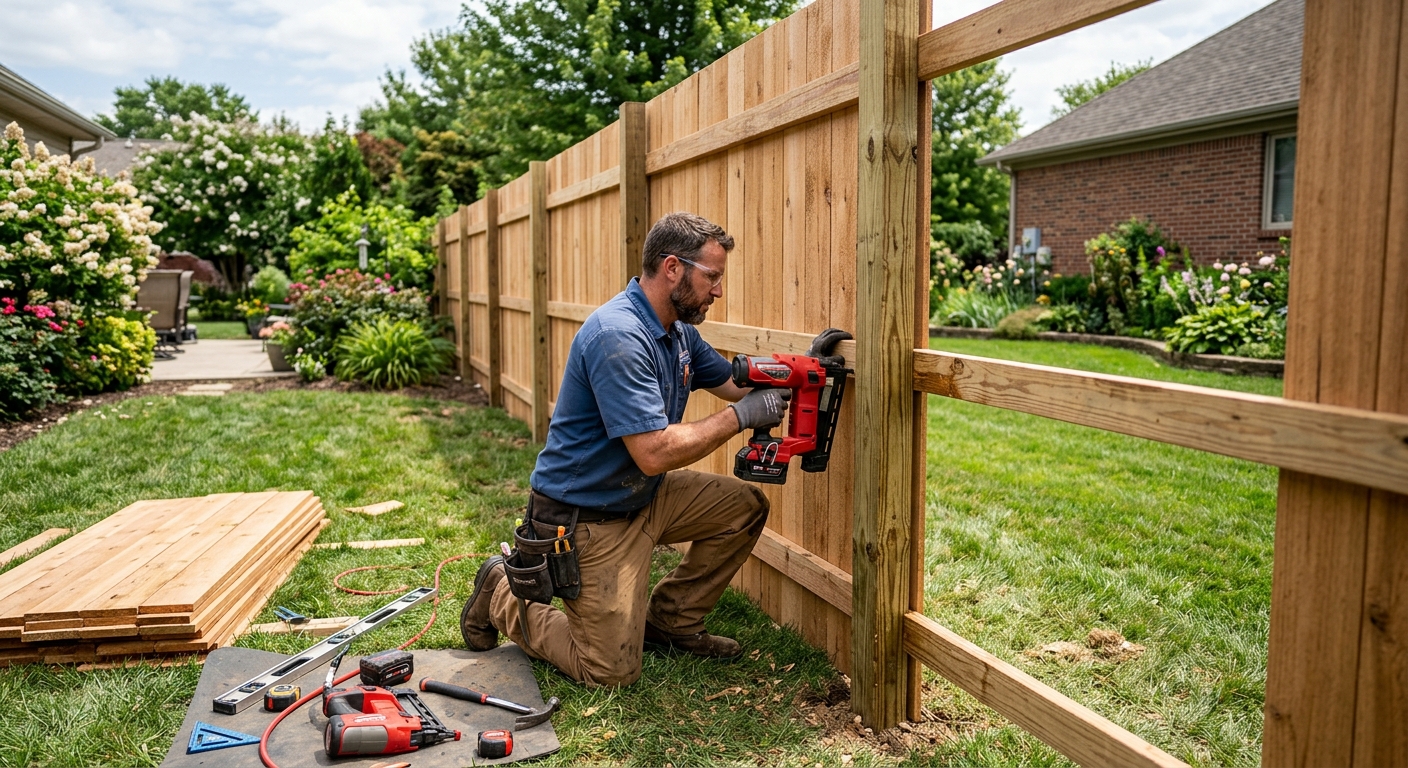
Fencing options and costs in Surrey City Centre
In Surrey City Centre, homeowners typically shop for fencing based on privacy, curb appeal, and long-term maintenance. With a population of 33,520 (Statistics Canada, 2021 Census), there’s steady demand for boundary upgrades—especially because detached homes remain a common housing type in the area, and each property often needs ongoing fence refreshes as yards change and families expand. In the Lower Mainland–Southwest, mild winters and wind off open stretches can feel less severe than interior Canada, but the soils are wetter and frost heave risk is still taken seriously. Contractors commonly set posts below local frost depth guidance (often working out to roughly 4–6 inches below the design frost depth) and use deeper holes, more concrete for key posts, and careful grading so panels don’t lift or lean.
This local climate also affects how we price “the same fence” from one street to the next: wetter Fraser Valley soils generally mean extra labour for deeper excavations and proper drainage, while windy sites can require tighter post spacing and stronger rail framing. In Surrey City Centre, areas around Fleetwood–Guildford and South Surrey–style development pockets near major arterials often see more upgrades because yards are more exposed and homeowners are actively improving privacy along side yards.
Below is a practical comparison of material options so you can benchmark quotes before we talk about your layout, height, gate locations, and whether removal is included.
| Material |
Lifespan |
Maintenance |
Privacy Rating |
Price per Linear Foot |
| Pressure-treated pine (standard wood) |
10–15 years |
Stain/paint every 2–3 years; inspect fasteners annually |
High (solid pickets) |
$55–$85 |
| Cedar (natural rot resistance) |
15–25 years |
Typically stain every 2–4 years; treat end-grain and posts |
High (solid boards) |
$70–$110 |
| Vinyl / PVC (no-maintenance) |
20–30 years |
Wash as needed; check for panel warping after extreme cold |
High (solid privacy styles) |
$75–$130 |
| Chain-link (galvanized steel) |
20–35 years |
Occasional rinse; repair tension at gates |
Low (open mesh) |
$30–$55 |
| Aluminum ornamental |
25–40 years |
Rinse; inspect hardware and hinges |
Medium (decorative spacing) |
$100–$160 |
| Composite / recycled material |
20–30 years |
Minimal; occasional cleaning; address surface scuffs |
Medium-High (depends on style) |
$90–$145 |
Prices are estimates only and vary by project scope, site access and material selection.
What affects the price of fencing in Surrey City City Centre
In Surrey City Centre and across the Lower Mainland–Southwest, the same fence height and length can come in 30–50% apart between contractors because of how each crew handles posts, soil conditions, gates, and site prep. Even when material pricing stays in the same band, labour expands quickly: crews may need deeper holes, more concrete for corner and gate posts, and extra time to step panels on grades. A neighbourhood with lots of mature landscaping and narrow side-yard access can also slow down installs and increase disposal costs.
Climate and ground conditions are a major pricing lever here. Frost line depth still sets how deep posts must be set—often treated as about 4–6 inches below the design frost depth—so posts don’t heave when freeze/thaw cycles occur. While BC is milder than places like Ontario or Alberta, the Lower Mainland’s wetter soils in the Fraser Valley often mean deeper excavations and more concrete to stabilize fence lines. Wind exposure also matters: compared with sheltered back lanes, open and windy sites can push contractors toward tighter post spacing and sturdier rails, especially for solid wood and vinyl privacy fences.
Concrete examples from typical Surrey City Centre installs: (1) a privacy fence on clay-heavy soil may require extra concrete setting and longer posts, raising the overall job closer to the upper wood range (for example, $70–$95 in the wood band). (2) a yard with a slope and multiple gate locations can add stepped rails and more framing time, pushing a vinyl job from mid-range toward the top end (often $110–$130 in many practical scenarios). If you’re comparing options, remember that chain-link at $30–$55 can be a lower-cost baseline, while vinyl at $75–$130 costs more largely because of material structure and post systems.
| Price Factor |
Why It Matters |
Cost Impact |
| Fence length in linear feet — the primary cost driver |
Most pricing scales directly with footage, posts, rails, and fasteners. |
Major driver: can swing total cost most. |
| Post depth required — frost line determines post length and hole depth |
Deeper embedment reduces heaving and leaning. |
Often adds concrete + labour; can raise costs meaningfully. |
| Post setting method — concrete vs. gravel pack vs. driven posts |
Wet-site stability typically favours concrete for key posts. |
Concrete setting usually increases material and labour costs. |
| Material choice — vinyl vs. cedar vs. chain-link |
Material cost and structural requirements differ by type. |
Mid-range vs premium: vinyl and cedar typically cost more. |
| Gate count and type — walk-through vs. drive-through (double) |
Gates require stronger posts, hinges, and often custom framing. |
Can add substantial labour and hardware costs. |
| Grade and terrain — sloped yards require stepped or raked panels |
More cutting, fitting, and extra rails for alignment. |
Moderate to high impact depending on slope severity. |
| Old fence removal and disposal |
Demolition, hauling, and site clearing take time. |
Often adds a noticeable add-on if not included. |
| Permit fees and survey / property line locate |
Required documentation can add administrative time and costs. |
Usually a smaller line item, but can affect total. |
Permits & regulations in British Columbia
In British Columbia, fences above a height threshold often require a building permit—commonly around 2.0 m (6.5 ft) at the rear and 1.0–1.2 m (3–4 ft) at the front or corner, depending on the local bylaw and where the fence sits relative to the street. In Surrey City Centre, you still need to respect property lines and any municipal setback requirements that apply to your lot and fence location.
Before digging post holes, call for utility locates (BC 1 Call). Also, get a survey or at least a property line locate if you’re unsure where your pins are; fence disputes often start when lines are estimated rather than verified. If your fence is shared with a neighbour, line-fences rules are governed by provincial legislation, so clear agreements on cost-share and maintenance responsibilities matter—especially for corner and gate posts.
What usually DOES require a permit: installing or replacing a fence over the local height thresholds (especially where it could affect sightlines or street-facing areas), and structural elements tied to the fence height/type. What typically does NOT: minor, in-kind repairs, and replacing a fence that stays below the threshold—though you should confirm the height and placement for your exact location.
To verify your contractor, ask for their British Columbia business licensing info if applicable, request a certificate of liability insurance showing adequate coverage, and confirm coverage for workers under the appropriate workplace safety system (and that they can provide clearance evidence). For insurance, look at the policy status, insured party name, and the expiry date; never accept a blurry copy.
Choosing the right fence material for Surrey City Centre
Choosing the right material in Surrey City Centre is mostly about matching your priorities—privacy, low maintenance, budget, and lifespan—to how the Lower Mainland–Southwest climate behaves. Even though we don’t see the extreme cold snaps some provinces do, we still get enough freeze/thaw and wind-driven moisture to punish fences that aren’t installed with solid post depth and proper drainage. For many yards, the “best” fence is the one that won’t lean after a couple of winters and won’t force you into frequent staining.
Pressure-treated pine is the budget-friendly route. It’s typically the mid-range of the wood band, but it generally needs staining or painting every 2–3 years to reduce grey weathering and keep moisture from working into the surface. Cedar has better natural rot resistance and a richer look, but it still benefits from periodic finishing—especially on exposed ends and near the ground. Vinyl/PVC is popular for low maintenance, but in extreme cold it can become brittle if the system is undersupported; correct post depth and rail spacing help. Chain-link stays the lowest-cost option for perimeter security, but it provides little privacy. Aluminum ornamental gives a clean, rust-resistant look with medium privacy due to spacing. If you want a “set-and-forget” feel, vinyl or composite often wins, but budget accordingly.
On post depth: Lower Mainland–Southwest installs still commonly set posts below frost depth guidance (often realized as deeper holes than a “bare minimum” approach). Whether concrete-set posts are necessary depends on soil and where the loads are—corner posts, gate posts, and privacy panels in wet soil are where we typically add concrete for stability.
As a dollar example: if your choice is between pressure-treated wood around $55–$95 and vinyl around $75–$130, the extra cost often makes sense when you value low maintenance for a privacy fence on a windy, exposed side yard where staining is hard to keep up with.
| Material |
Cold Tolerance |
Lifespan |
Annual Maintenance |
Best For |
Price Band |
| Pressure-treated pine |
Good, with proper finishing and tight installation |
10–15 years |
Light inspection + re-stain/paint every 2–3 years |
Budget privacy and traditional look |
$55–$95 |
| Cedar |
Good, tolerates moisture better than most softwoods |
15–25 years |
Inspect plus stain/seal every 2–4 years |
Higher-end appearance with natural rot resistance |
$70–$110 |
| Vinyl / PVC |
Very good; avoid undersupported panels in cold snaps |
20–30 years |
Wash occasionally; check hardware after storms |
Low-maintenance privacy in exposed yards |
$75–$130 |
| Chain-link |
Very good; metal is stable in cold |
20–35 years |
Rinse and tension checks at gates |
Security and boundary definition |
$30–$55 |
| Aluminum ornamental |
Excellent; powder-coating resists moisture |
25–40 years |
Occasional wash; check fasteners |
Curb appeal with minimal visual bulk |
$100–$160 |
| Composite / recycled |
Good; performance depends on mounting and support |
20–30 years |
Minimal cleaning; monitor for surface wear |
Durability with reduced staining effort |
$90–$145 |
How to choose a fencing contractor in Surrey City Centre
When you hire a contractor in Surrey City Centre, don’t rely on word-of-mouth alone—verify coverage and scope. In British Columbia, you should expect a professional crew to carry liability insurance (ask for a certificate of insurance and confirm it’s active), and to ensure workers are properly covered under the workplace safety system (they should be able to provide proof/clearance documentation when requested). For licensing, confirm the business is properly registered and operating legally in BC, and that the person quoting can provide proof of past work similar to your fence type and height.
Next, get 2–3 itemised written quotes instead of a single lump-sum number. A solid quote breaks down materials (posts, rails, panels, hardware), labour, concrete quantity if included, and any line items for demolition, disposal, and gate fabrication. Read the scope: what’s excluded (for example, stump/grind, tree removal, landscaping restoration, or replacing damaged sprinklers)? Also confirm whether permit pulling, if required, is included or billed separately.
Warranty matters in fencing. Ask for a clear workmanship warranty length (how long the contractor stands behind post alignment, fastening, and panel stability), plus the manufacturer/product warranty for materials. Confirm whether the warranty is transferable and what conditions void it (often improper installation or missing maintenance). For payment, a common safe approach is to avoid paying more than 10–15% upfront; hold back a portion until the job is complete and you’ve inspected alignment, gate operation, and hardware.
Finally, insist on a written timeline: a start date target, weather-dependent milestones, and an estimated completion date so you’re not stuck waiting between phases.
- Provide an itemised quote with labour + materials, not only a total.
- Show how posts will be set (depth and concrete/gravel pack plan).
- Confirm gate hardware quality and whether hinges are adjustable.
- List included services: demo/removal, hauling, disposal, and site cleanup.
- State who handles permits (if required) and the expected timeline.
- Include a protection plan for irrigation lines and landscaping.
- Specify fence height, style, and whether it’s solid/board-on-board.
- Ask how they’ll handle slopes (stepped vs. raked panels).
- Confirm warranty details: workmanship vs. product/manufacturer.
- Verify liability insurance certificate (active, correct insured name).
- Request workplace coverage evidence for workers before signing.
- Use a payment schedule with a holdback until final inspection.
In Surrey City Centre, common red flags include contractors who won’t discuss post depth and setting method, quotes that omit gate hardware details, refusal to provide insurance evidence, missing or vague warranties, and a payment request that asks for more than 10–15% upfront without a signed agreement and milestone plan.
Frequently asked questions — fencing in Surrey City Centre
How long does fence installation take in Surrey City Centre?
Timelines in Surrey City Centre typically depend on fence length, gate count, and how much site prep is needed (old fence removal, grading, and access). For many standard residential runs, a crew can complete a straightforward section in a few days, while longer privacy fences with multiple gates can stretch closer to a week, especially if post holes need deeper excavation in wetter soils. Weather can also matter: crews plan around heavy rain and ground saturation because setting posts and achieving proper alignment is harder when the soil is soft. If you’re comparing budget options like chain-link (often in the $30–$55 band) versus solid privacy wood or vinyl, remember that solid panels usually take more framing time and careful fastening for wind stability in the Lower Mainland–Southwest.
Can I install a fence on a slope in Surrey City Centre?
Yes—slope fencing is common around Surrey City Centre, but it needs the right layout. Contractors usually handle slopes by stepping panels up in increments or “raking” the design so it follows the grade smoothly. Stepped installation is often better for solid privacy panels because it keeps the post spacing consistent and reduces structural stress. For raked styles, the system must be carefully engineered so rails and pickets remain properly aligned for wind loads. Because BC soils can stay wet, consistent post embedment is important on sloped areas so posts don’t shift differently at the top and bottom of the grade. Make sure your quote explains whether they’ll use stepped or raked panels and how they’ll keep your fence level at consistent heights.
What is the most weather-resistant fence for Surrey City Centre's climate?
For Surrey City Centre’s wet, coastal-influenced conditions, the most weather-resistant choices are usually vinyl/PVC and properly built cedar or composite—provided the post depth and setting are done correctly. Vinyl tends to resist moisture and won’t rot, though it relies on solid framing and good post support to prevent panel flex in windy spells. Cedar has natural rot resistance and looks great, but it still benefits from periodic finishing and correct end-grain treatment. Chain-link is durable too (and often costs least, roughly $30–$55), but it won’t provide privacy. In the Lower Mainland–Southwest, the biggest failure point is often not the material itself—it’s posts that aren’t set deep enough or corner/gate posts that aren’t properly anchored.
How do I prevent wood fence rot in Surrey City Centre?
Wood rot prevention starts before the first board goes up. Ensure posts are set with proper depth for frost heave risk and in a way that manages moisture—corner and gate posts should be treated as structural anchors. In wetter Fraser Valley soils around Surrey City Centre, deeper holes and good concrete setting at key posts can help stabilize the fence and reduce movement that opens gaps for water infiltration. Use pressure-treated lumber or cedar, but also insist on proper hardware (galvanized/stainless) and correct board spacing so water doesn’t get trapped. Finish all exposed wood surfaces, including cut ends, and plan for maintenance: pressure-treated pine often needs staining every 2–3 years, while cedar may run every 2–4 years depending on sun exposure and wind-driven moisture. A good contractor will explain their post setting and finishing plan in writing.
What is the cost per linear foot for fencing in Surrey City Centre?
In Surrey City Centre, installed pricing varies by material and site factors, but you can use local bands as a realistic benchmark. Chain-link is usually the lowest, commonly landing around $30–$55 per linear foot installed. Wood fences (pressure-treated pine) typically price in the mid-range around $55–$95, while vinyl/PVC privacy fences are often higher due to material and structural requirements, commonly around $75–$130. Final totals still depend on length, gate count, slope, soil conditions, and whether removal/disposal and permit work are included. When you get quotes, compare apples-to-apples: post depth, concrete setting, rail spacing, and gate framing can change the price even with the same listed material.
Should I repair or replace my old fence in Surrey City Centre?
In Surrey City Centre, it’s often worth repairing when the fence is structurally sound—posts aren’t leaning, and rails are solid—even if panels look tired. Replacement is usually the better value when you see widespread post movement, extensive rot at the base, failing gate hardware, or multiple fence sections that were previously patched with mismatched materials. Wet-site rot is especially common in areas where water collects at the bottom of posts or where irrigation repeatedly wets the same fence line. Get a contractor to assess: check for loose posts, rusted hardware, and board failure near ground level. If repairs would require many new posts, multiple rail replacements, and cosmetic patching across a long run, replacement can cost less over time. Your quote should clearly separate “repair scope” from “replacement scope,” so you can compare totals honestly within local price bands.