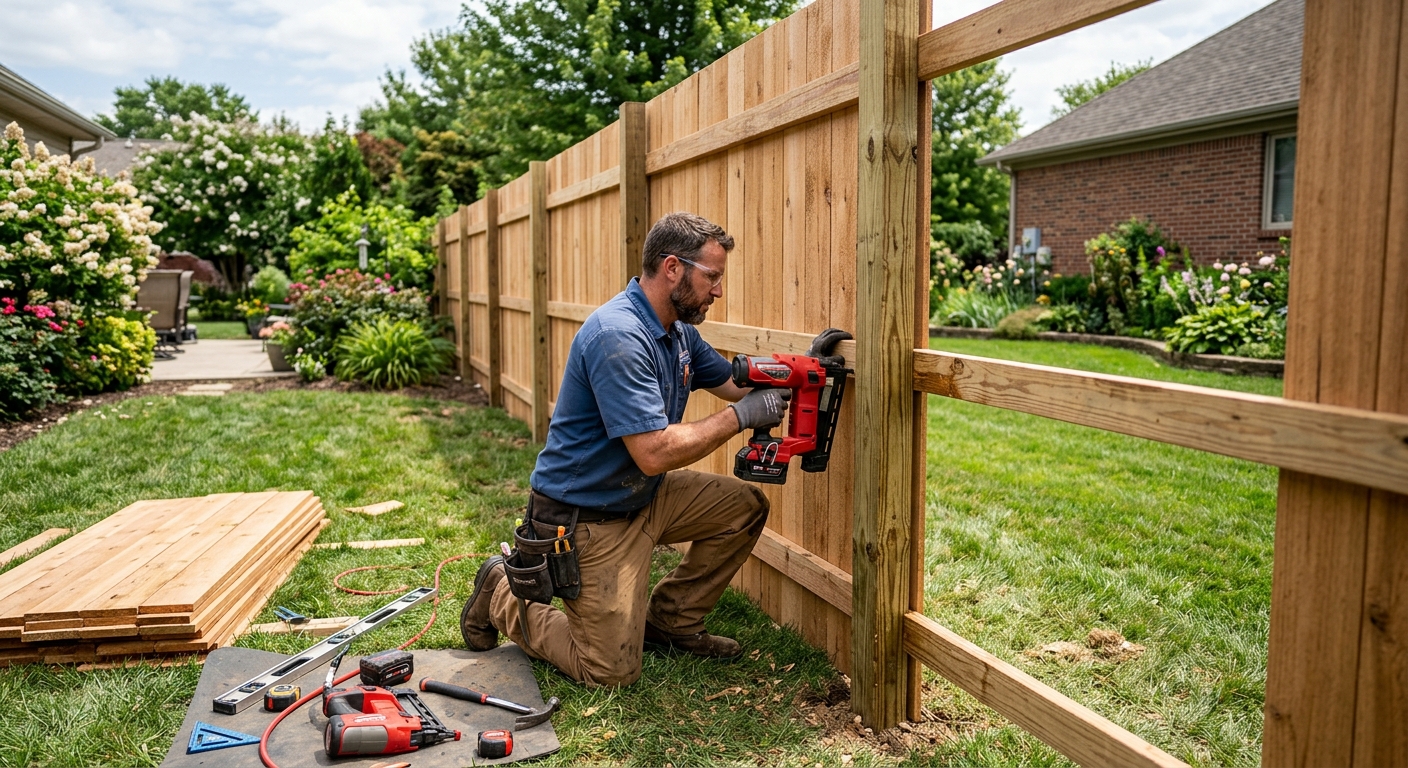
Fencing options and costs in Union Bay
Union Bay is a small community on Vancouver Island where fencing is often part practical security and part neighbourhood “curb appeal.” With a population of 1,200 (Statistics Canada, 2021 Census), most jobs are for single properties rather than large subdivisions, so demand clusters around detached homes and seasonal residents who upgrade yards before spring weather swings. In the Lower Mainland–Southwest market, that pattern matters because it concentrates contractor availability into peak months, and it can affect scheduling when multiple homeowners are booking at once.
In this region, costs are shaped by a mild but not trivial frost-and-wind reality: posts still need to be set below frost depth to reduce heaving, and Fraser Valley–type soils (often wetter than people expect) frequently mean deeper holes, more concrete for key posts, and more labour than dry-site installs. Coastal BC is also wetter, so wood needs correct treatment and detailing to slow rot—especially for privacy panels that trap moisture.
Locally, fencing work is especially in demand around residential pockets near the waterfront and in more exposed lots where wind-driven rain impacts the back line. If you’re comparing materials, a good starting point is to look at installed price bands in BC: chain-link typically comes in lowest, wood lands in the middle, and vinyl/PVC and metal come higher due to materials and structural requirements.
Below is a quick comparison to help you budget for Union Bay, before you narrow choices with a contractor quote.
| Material |
Lifespan |
Maintenance |
Privacy Rating |
Price per Linear Foot |
| Pressure-treated pine (standard wood) |
10–15 years |
Stain/seal every 2–3 years |
Good (solid pickets/boards) |
$55 – $95 |
| Cedar (natural rot resistance) |
15–25 years |
Light staining or clear-coat as needed (typically every 3–4 years) |
Good to very good (board-on-board) |
$75 – $115 |
| Vinyl / PVC (no-maintenance) |
20–30 years |
Occasional washing only |
Very good (solid privacy panels) |
$75 – $130 |
| Chain-link (galvanized steel) |
25–40 years |
Minimal (rinse; tighten hardware if needed) |
Low (see-through) |
$30 – $55 |
| Aluminum ornamental |
20–40 years |
Minimal (wash; repaint only if you choose decorative paint) |
Low to moderate (open design) |
$90 – $170 |
| Composite / recycled material |
20–30 years |
Low (no staining; occasional cleaning) |
Very good (solid styles) |
$95 – $155 |
Prices are estimates only and vary by project scope, site access and material selection.
What affects the price of fencing in Union Bay
Two homeowners can receive quotes that differ by 30–50% for what looks like the “same fence” in Union Bay and the Lower Mainland–Southwest. The gap is usually not the material label—it’s the installed complexity: access (narrow lanes, gates, retaining walls), slope, how many line changes there are, and how difficult it is to place posts safely in damp soil. Labour availability also plays a role in BC; when demand peaks, crews prioritize jobs that are easiest to mobilize, so your quote can reflect schedule risk and crew time.
Frost depth drives more of the cost than many people expect. While BC’s coastal conditions are generally shallower than Ontario or Alberta, you still need posts set below frost heave risk—contractors often aim for embedment around 3 ft as a baseline in much of Canada, and in BC coastal/wetter areas that commonly means going deeper and/or using concrete-setting for key posts. In Ontario and Alberta regions, posts can effectively require 1.5–2.0 m embedment, which raises material cost because you need longer posts and more concrete; that same principle influences BC contractors’ willingness to go deeper than the absolute minimum on wet-site installs.
Coastal BC’s wet conditions also accelerate wood wear if ventilation gaps and post detailing are off, pushing crews toward cedar or fully treated systems. In Union Bay, you may pay more if you have: (1) saturated ground that eats gravel and demands more concrete for stability, (2) wind-exposed yards that require tighter post spacing or reinforced rails to prevent panel wobble, or (3) privacy boards that must be installed with correct lapping to shed water. On the budget end, a chain-link run can stay near the $30–$55 band, while a solid wood or cedar privacy fence typically moves into the mid-range (around $55–$115+) because of heavier rails, more labour, and more durable hardware.
| Price Factor |
Why It Matters |
Cost Impact |
| Fence length in linear feet — the primary cost driver |
More runs mean more posts, rails, hardware, and time |
Larger increases than any single material change |
| Post depth required — frost line determines post length and hole depth |
Deeper holes reduce heaving risk and improve long-term stability |
Can add concrete, longer posts, and extra labour hours |
| Post setting method — concrete vs. gravel pack vs. driven posts |
Concrete improves stability in wetter or questionable soils |
Concrete-setting usually increases cost, but reduces failure risk |
| Material choice — vinyl vs. cedar vs. chain-link |
Materials differ in cost, structural requirements, and wind performance |
Chain-link often lowest; vinyl/metal higher |
| Gate count and type — walk-through vs. drive-through (double) |
Gates need heavier frames, hinges, and proper alignment |
More gates can quickly add labour and hardware expense |
| Grade and terrain — sloped yards require stepped or raked panels |
Slopes drive cuts, alignment time, and sometimes special rails |
Often adds labour and may increase material waste |
| Old fence removal and disposal |
Demolition, haul-off, and buried post extraction are labour-intensive |
Can be a major add-on, especially for concrete-set posts |
| Permit fees and survey / property line locate |
Complex lots may require locate work to avoid encroachment |
Small to moderate cost, but can be essential |
Permits & regulations in British Columbia
In British Columbia, fences above a height threshold typically require a building permit—commonly around 2.0 m (6.5 ft) for rear yards and 1.0–1.2 m (3–4 ft) for front or corner locations. Exact thresholds can vary by municipal bylaws, but the practical takeaway for a homeowner in Union Bay is: if you’re planning a tall privacy fence near a street-facing side, assume a permit is likely and ask your contractor to confirm in writing before posts are dug.
All fences must follow property lines and municipal setback bylaws. Before digging any post holes, you should arrange utility locates so crews don’t hit buried services—BC 1 Call is the standard start for locating underground utilities. You should also obtain a survey or confirm your property pins/locate information; this step prevents encroachment disputes, which are costly to fix after the fence is installed. Shared fence ownership and responsibilities are governed by provincial line-fences rules, which can affect who pays for repairs if your line is shared.
Licence and insurance verification (for Union Bay and across BC): step one is to check the contractor’s business profile and licensing status through the appropriate online registry. Step two is to request a current certificate of insurance (liability) naming you as the certificate holder where appropriate, and confirm whether they carry coverage required for workers (commonly addressed through WSBC/WCB coverage). Step three is to ask for a clearance letter or proof of account status if their quote includes any work that relies on those coverages.
If a contractor won’t provide documents on request, treat it as a red flag and get another quote.
Choosing the right fence material for Union Bay
Choosing the right fence material in Union Bay is mainly about matching your priorities—privacy, low maintenance, budget, and lifespan—to a wet, windy coastal environment. Pressure-treated pine is the most budget-friendly option, but it’s also the one that usually needs the most attention: even when properly treated, you should plan for staining or sealing every 2–3 years to reduce grey weathering and help the pickets resist moisture absorption. Cedar is more naturally rot-resistant and typically looks better as it ages, but it still benefits from periodic maintenance to maintain colour and reduce surface checking.
Vinyl/PVC is the easiest “set and forget” choice because it generally needs only occasional washing. The trade-off is that you pay more upfront (often aligning with the $75–$130 band) and you still need solid post depth and bracing for wind; in extreme cold, some plastics can become more brittle, so good installation matters more than in mild climates. Chain-link is usually the lowest cost and very durable, but it won’t provide privacy unless you add screening. Aluminum ornamental fencing offers long life and rust resistance with a mid-range price point, though it’s typically lower privacy because of its open design.
In the Lower Mainland–Southwest, frost heave prevention is still a “real” cost driver, so concrete-setting is commonly used for corner posts, gate posts, and often for privacy-panel runs. If your yard is exposed to wind, solid wood/vinyl panels may require tighter post spacing and heavier rails, which is why privacy fences can land above chain-link.
To illustrate, upgrading from chain-link (often around $30–$55 per linear foot installed) to a solid vinyl privacy run frequently adds cost, but it’s justified if you want real enclosure and fewer seasonal maintenance tasks—especially when you have damp ground where wood doesn’t dry quickly.
| Material |
Cold Tolerance |
Lifespan |
Annual Maintenance |
Best For |
Price Band |
| Pressure-treated pine |
Good (with proper installation and detailing) |
10–15 years |
Plan for stain/seal every 2–3 years (light touch-ups yearly) |
Lower initial cost privacy |
$55 – $95 |
| Cedar |
Good |
15–25 years |
Light staining/clear-coat as needed (often every 3–4 years) |
Natural look with better rot resistance |
$75 – $115 |
| Vinyl / PVC |
Fair to good (installation quality is key in cold snaps) |
20–30 years |
Occasional washing (no staining) |
Low-maintenance privacy |
$75 – $130 |
| Chain-link |
Very good |
25–40 years |
Minimal hardware checks |
Security on a tight budget |
$30 – $55 |
| Aluminum ornamental |
Very good |
20–40 years |
Occasional wash; inspect fittings |
Decorative, rust-free perimeter |
$90 – $170 |
| Composite / recycled |
Good |
20–30 years |
Low; occasional cleaning |
Solid look with low upkeep |
$95 – $155 |
How to choose a fencing contractor in Union Bay
To choose the right fencing contractor in Union Bay, verify the basics before you compare prices. In British Columbia, ask for proof of business licensing (where applicable), current liability insurance, and worker coverage (commonly WSBC/WCB). How to check: (1) request a current certificate of insurance and review dates and coverage limits; it should be issued by a recognized insurer. (2) ask for documentation showing their account status/clearance for worker coverage; if they can’t provide it, walk away. (3) confirm their contractor profile details in online registries so you’re not relying on a verbal assurance.
Next, get 2–3 itemised written quotes. You want a labour + materials breakdown, not a single lump sum. Itemisation should show post spacing, post depth approach, concrete quantity (if included), rail/hardware type, gate framing, and disposal/removal scope. Carefully read what’s excluded: fence painting/staining, permit handling, tree/roots removal, and whether the contractor is responsible for any survey locate costs.
Warranty matters too: ask for the workmanship warranty length (how long they stand behind installation), plus the manufacturer warranty for product components. Find out if warranties are transferable to future owners.
For payments, avoid big deposits—keep upfront payments around 10–15% and hold back until you’re satisfied with completion and punch-list items. Get a written start date and realistic completion estimate, especially if your yard requires access adjustments or if old posts are buried with concrete.
- Provide insurance certificate and confirm coverage dates before work starts.
- Confirm worker coverage/clearance for WSBC/WCB (ask for documentation).
- Use an itemised quote: posts, rails, fasteners, concrete, gate frames, labour, and disposal.
- Clarify post-depth approach and whether concrete is included for corner/gate posts.
- Confirm how they handle slopes: stepped vs. raked panels, and who sets the grade line.
- Ask what happens if utility locates affect the layout—no surprises on change orders.
- Request the permit plan in writing: who pulls permits and who pays fees.
- Get a material spec: wood grade, cedar style, vinyl profile, coating type (if aluminum).
- Ask for hardware details: hinge type, latch grade, tension wire/brace system.
- Check warranty terms: workmanship duration, product warranty duration, exclusions.
- Keep payment schedule conservative: 10–15% upfront; holdback until completion.
- Confirm haul-away/disposal is included if you’re removing an old fence.
Concrete red flags I see in Union Bay: contractors who only quote a rough per-foot price without a site walk; missing insurance/coverage documents; no clear post-depth method (especially for wet soil where concrete setting is often required); vague scope language about disposal and permits; and pressure to pay most of the job upfront or start without utility locates.
Frequently asked questions — fencing in Union Bay
Do I need a permit to build a fence in British Columbia?
In British Columbia, many fences require a building permit when they exceed common height thresholds—often about 2.0 m (6.5 ft) at the rear and 1.0–1.2 m (3–4 ft) in front or corner areas. Municipal bylaws can tighten or expand these requirements, so the safest approach is to ask a contractor to confirm the permit trigger for your exact location in Union Bay before digging. In practice, simple low runs may not need a permit, while tall privacy fences typically do. Regardless of permit requirements, you must respect property lines and setbacks, and you should arrange utility locates before post holes are dug. If you’re unsure whether a permit is needed, treat it as a scope item and have the contractor explain how they’ll handle it.
How long does a wood fence last in Union Bay?
Wood longevity in Union Bay depends on moisture control, board spacing, and how the fence is installed in wet coastal soil. With pressure-treated pine, many homeowners see roughly 10–15 years of service life when maintenance is kept up (typically staining or sealing every 2–3 years). Cedar usually lasts longer—often 15–25 years—because it resists rot better, but it still needs periodic maintenance to keep colour and limit surface cracking. Climate matters: coastal BC’s persistent moisture means details like proper rail elevation, good drainage, and correct post embedment below frost heave risk are essential. If you compare budgets, pressure-treated pine often falls in the $55–$95 installed range, while cedar privacy fences usually cost more, commonly pushing you toward the $75–$115+ band for stronger long-term performance.
Who owns and maintains a shared fence?
For shared fence lines in British Columbia, responsibilities are handled under provincial line-fences legislation. Practically, this means you and your neighbour both have rights and duties related to maintaining the fence along the boundary, but the specifics can vary based on how the fence was established and which portion is shared. Before you replace or extend a shared fence, confirm whether it sits fully on the property line and whether it is considered a shared structure. In many cases, costs for maintenance or replacement can be shared, but agreements should be in writing to avoid disputes. For homeowners in Union Bay, I recommend documenting the existing boundary condition (photos and measurements) and discussing scope early—especially if your new fence will be taller than the old one, which can raise permit requirements.
How do I find my property line before fencing?
To find your property line in Union Bay, start with your survey documents and your property pins. If you don’t have a current survey, hire a surveyor or request a property pin/locate service so you’re not guessing based on old markers or landscaping. You can also request a locate for utility services through BC 1 Call before you dig, but that’s separate from property boundary verification. The goal is to avoid encroachment—moving posts even a small distance can trigger disputes and can add replacement costs. If you’re getting quotes, ask the contractor whether they will reference your locate/survey and how they confirm offsets for gates and corner turns. This is especially important when slopes or fences on awkward lines force panel changes.
What's the most low-maintenance fence?
For low day-to-day effort in Union Bay and coastal BC conditions, vinyl/PVC is usually the easiest: it typically doesn’t require staining and only needs occasional washing to remove salt/mineral film and dirt. Aluminum ornamental can also be low maintenance because it won’t rust, but it’s often less private due to open designs. Chain-link is low maintenance in terms of weather durability and hardware checks, but it won’t give privacy unless you add screening. Wood can be low maintenance for appearance if you accept greying and avoid frequent staining, but most homeowners who want it to look good plan for maintenance on a 2–4 year cycle. Budget-wise, vinyl/PVC commonly sits in the $75–$130 installed range, while chain-link may be closer to the $30–$55 band. The “best” choice usually depends on whether you value privacy enough to pay for it.
How tall can my fence be in Union Bay?
In Union Bay, the usable height limit depends on where the fence sits relative to the street and corner side, and whether a permit is required. As a general BC guideline, fences above about 2.0 m at the rear and about 1.0–1.2 m at the front or corner often trigger a building permit process. Exact setbacks and height allowances can vary by municipal bylaw, so treat those as starting points—not a final answer. For tall privacy fences, the practical installation matters too: wind exposure means you’ll want strong posts, reliable bracing, and proper embedment below frost heave risk. If you’re budgeting, tall solid-panel fences often land above mid-range wood pricing and can approach vinyl/PVC or metal bands depending on materials and gate complexity.