Fencing options and costs in View Royal
View Royal homeowners typically start their fence search by balancing privacy, durability and maintenance, and the decision is easier when you understand local demand. With 36.0% of dwellings being single-detached houses, there are plenty of yards that can benefit from perimeter upgrades, especially as owners maintain older properties—28.6% of homes in the community were built before 1981 (Statistics Canada, 2021 Census). Those older lots often have weathered fencing, shifting alignments and occasional drainage issues, which affects both material choice and labour time. Across Vancouver Island and the Coast, a moderate coastal frost line (about 45–60 cm) and frequent wind exposure shape how deep posts must be set to help prevent heaving and long-term leaning. Even though the frost is shallower than many inland regions, contractors in View Royal still plan for post burial around 75–90 cm and, for heavier fences or disturbed soils, concrete footings are common.
Neighbourhoods near Langford Parkway/Highway 1 corridors and the established residential pockets closer to the Galloping Goose Trail are especially busy when families replace aging back fences—those areas see frequent wind gusts and lots of gate traffic, so proper bracing and corrosion-resistant hardware matter. The contractor availability is strong, but quote differences can be noticeable when one company budgets for excavation through rock pockets or clay-rich areas, and another assumes straightforward digging.
Below is a realistic comparison of common fence types installed in View Royal, with lifespan and maintenance differences you’ll feel year to year. Use this table to narrow options, then we’ll map the biggest price drivers in the next section.
| Material |
Lifespan |
Maintenance |
Privacy Rating |
Price per Linear Foot |
| Pressure-treated pine (standard wood) |
12–18 years |
Stain or seal every 2–3 years; check posts after wet winters |
High (solid board) |
$16–$25 |
| Cedar (natural rot resistance) |
18–25 years |
Light staining/sealing every 2–4 years; occasional hardware checks |
High (solid board) |
$22–$35 |
| Vinyl / PVC (no-maintenance) |
25–30 years |
Rinse annually; inspect for impact damage and keep clear of shrub growth |
High (solid picket/board) |
$26–$42 |
| Chain-link (galvanized steel) |
20–35 years |
Minimal: wash off salt spray; inspect tension/hinges |
Low–Medium (open mesh) |
$13–$20 |
| Aluminum ornamental |
30–40 years |
Occasional rinse; no rust concerns with proper powder coating |
Low–Medium (ornamental gaps) |
$22–$40 |
| Composite / recycled material |
25–35 years |
Rinse as needed; rarely stain/paint—check for warping after impacts |
High (board-style) |
$28–$48 |
Prices are estimates only and vary by project scope, site access and material selection.
What affects the price of fencing in View Royal
In View Royal and across Vancouver Island and the Coast, it’s common to see fencing quotes for the “same” fence range by about 30–50%. The difference usually comes down to how each contractor accounts for local digging difficulty, wind loading requirements, and post installation depth—details that matter more here than in some regions because the coast is wet and windy, even when the frost line is relatively shallow. In coastal BC, the frost depth is often estimated around 45–60 cm, but posts still need to be set below design frost to prevent heaving and long-term leaning. In practical residential work, that typically means burying posts around 75–90 cm, and using concrete setting more often when the soil is disturbed, clay-rich, or saturated.
To put that into cost terms, the “wood look” path can swing when concrete and heavier posts are included. For example, pressure-treated pine at the budget end might land near the wood price band of $55–$85 per panel/section in typical scopes, but adding concrete-set posts where soils are wet can push labour and disposal up, narrowing the gap versus cedar. Conversely, chain-link at $35–$60 is often comparatively stable in price because it uses lighter components and open mesh that behaves better in wind; solid privacy fences, especially higher ones, tend to catch wind and may need closer post spacing, additional bracing and sturdier hardware.
Two real-world cost examples in View Royal: (1) a backyard run with rocky pockets or roots near an established hedge line often adds digging time and rock disposal; (2) a gate replacement at the top of a sloped lot can require stepped rails or raked panels, adding layout time and sometimes extra framing. Housing age also plays a role—older lots (28.6% built before 1981) may have older drainage patterns and buried obstructions that slow down excavation. These factors are exactly why itemised quotes matter.
| Price Factor |
Why It Matters |
Cost Impact |
| Fence length in linear feet |
Most materials scale directly with length; layout and extra posts increase proportionally |
High (primary driver) |
| Post depth required |
Frost line determines hole depth and post length to reduce heaving and leaning |
High |
| Post setting method |
Concrete vs. gravel pack vs. driven posts changes labour, material and cure time |
Medium–High |
| Material choice |
Vinyl and composite cost more up front; cedar needs selective labour for quality appearance; chain-link varies by gauge |
Medium–High |
| Gate count and type |
Drive-through and double gates require stronger frames, hinges and sometimes reinforcement |
High |
| Grade and terrain |
Slope requires raked/stepped construction and additional planning to maintain alignment |
Medium |
| Old fence removal and disposal |
Hauling charges, stump/anchor removal and weathered posts can add time |
Medium–High |
| Permit fees and survey / property line locate |
Some projects need documentation; locate work prevents redesign due to setbacks |
Low–Medium |
Permits & regulations in British Columbia
In British Columbia, fence rules are usually tied to height and placement, plus municipal bylaws. Many projects that exceed typical height thresholds—often around 2.0 m (6.5 ft) at the rear and about 1.0–1.2 m (3–4 ft) at the front or corner—commonly trigger a building permit requirement (exact thresholds can vary by municipality and location type). Regardless of permit needs, all fences must respect property lines and local setback rules, so it’s critical to confirm where the fence will sit before any digging starts.
Before you install posts, you must also arrange utility locates. In BC this is typically done through BC 1 Call; in practice, you should book locates before drilling or excavating. If you don’t already have a reliable survey, plan to obtain a survey or a locate of your property pins so you don’t accidentally build over the line. Shared fence ownership and responsibilities are governed by provincial line-fences legislation, so boundary discussions are part of doing it right—especially when neighbours may want a different material or height.
To verify a contractor in View Royal step-by-step: (1) ask for their licence information and check they’re in good standing via the appropriate provincial online registry for their trade category; (2) request a current certificate of liability insurance showing coverage limits and ensure it’s active for the project period; (3) confirm WSBC (workers’ compensation) coverage—your contractor should provide clearance or proof they’re enrolled. If a contractor can’t provide these documents promptly, that’s a major warning sign.
Choosing the right fence material for View Royal
Choosing a fencing material in View Royal is mostly about matching your priorities to Vancouver Island’s wet, windy climate. Pressure-treated pine is the budget-friendly option, but it typically needs staining or sealing every 2–3 years to prevent grey weathering and protect the surface from constant moisture. Cedar has better natural rot resistance and usually looks warmer and more “finished” for longer; however, it still benefits from maintenance to keep colour and reduce checking around fasteners. Vinyl/PVC is popular for low maintenance—most owners just rinse it and watch for impact—but in extreme cold snaps it can crack if struck, so gates and driveways still need careful installation and solid hardware.
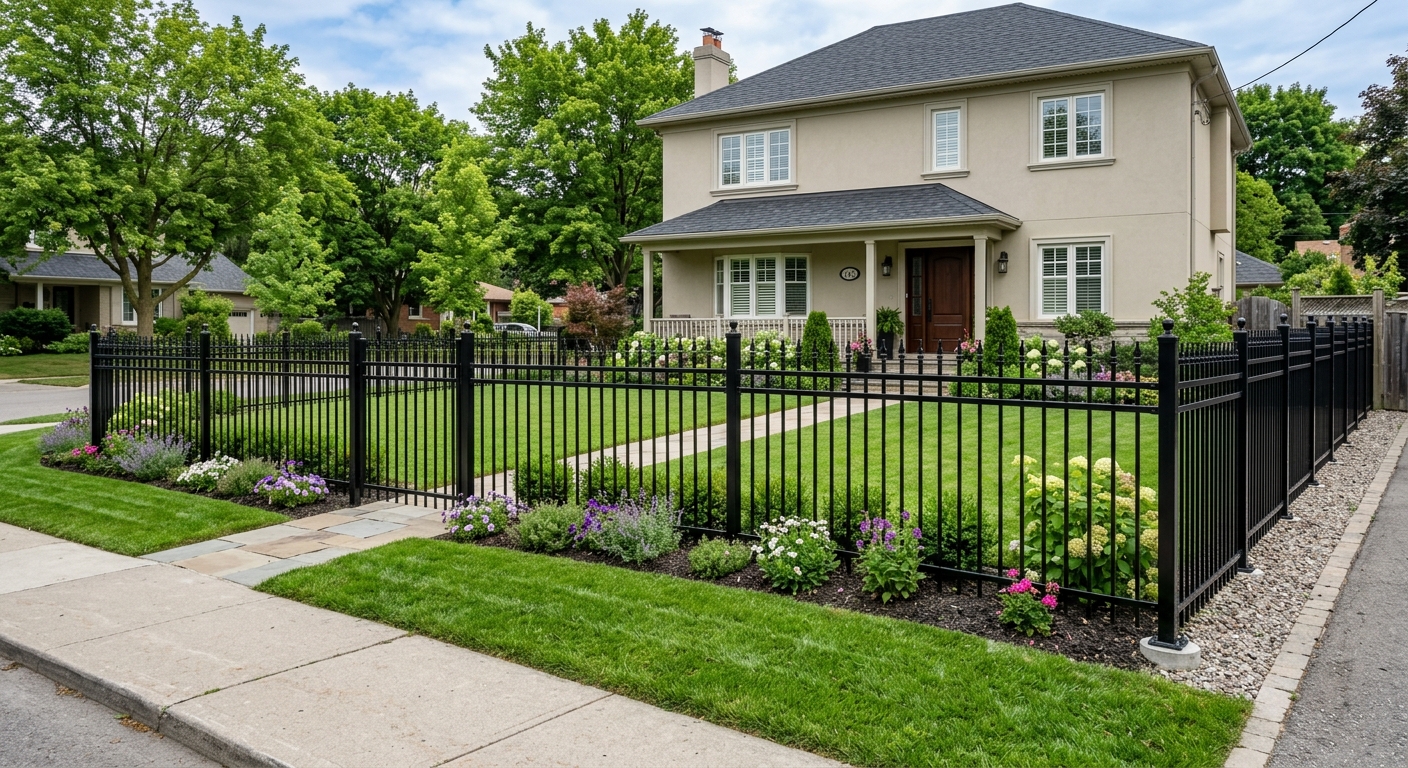
Chain-link is usually the lowest-cost fencing approach and performs well long-term in coastal conditions because galvanized steel resists corrosion; it also handles wind better thanks to the open mesh. The trade-off is privacy: you’ll get limited screening unless you add slats or grow privacy vegetation. Aluminum ornamental is mid-range and won’t rust like untreated steel; it’s a good choice if you want curb appeal and durability, but it won’t provide “solid privacy” without additional treatments.
Post depth matters across materials because the frost line—even at about 45–60 cm—still requires posts set below frost to prevent heaving. That’s why concrete-set posts are often used in View Royal for privacy fences, tall gates, and sites with wet or clay-rich soil. If you’re comparing budgets, here’s a concrete example: upgrading from chain-link (often near the $35–$60 band for typical scopes) to cedar board privacy is frequently justified because you’re paying for solid privacy, faster wind deflection handling through bracing, and longer-lasting wood choice—yet the right foundation (often concrete-set posts at typical 75–90 cm burial depth) is what protects the investment from leaning.
| Material |
Cold Tolerance |
Lifespan |
Annual Maintenance |
Best For |
Price Band |
| Pressure-treated pine |
Good (with proper staining) |
12–18 years |
Light wash; plan stain/seal every 2–3 years |
Budget-friendly privacy with acceptable upkeep |
$55–$85 |
| Cedar |
Good (moisture-aware detailing) |
18–25 years |
Rinse; stain/seal every 2–4 years |
Premium look with natural rot resistance |
$70–$110 |
| Vinyl / PVC |
Moderate (impact sensitive in cold) |
25–30 years |
Rinse; inspect after storms/impacts |
Low maintenance and consistent appearance |
$70–$110 |
| Chain-link |
Excellent |
20–35 years |
Occasional wash; check tension/hinges |
Security and budget with open visibility |
$35–$60 |
| Aluminum ornamental |
Excellent (powder coat) |
30–40 years |
Rinse; tighten hardware as needed |
Curb appeal with durable perimeter fencing |
$80–$140 |
| Composite / recycled |
Good (avoid impacts) |
25–35 years |
Rinse; inspect for warping at hinges/posts |
Long-life privacy with minimal staining |
$80–$140 |
How to choose a fencing contractor in View Royal
When you’re hiring a fencing contractor in View Royal, focus on proof of coverage and clarity of scope—not just the lowest number. In British Columbia, you should verify the company’s trade licence/registration for fencing-related work (and that they’re in good standing), confirm they carry liability insurance, and ensure workers’ compensation coverage is active through WSBC. Ask for a current certificate of insurance and check that it matches the contractor’s legal name and the project address (or at least the job location category). For WSBC, look for a clearance letter or proof of coverage that indicates they’re authorized to perform the work.
Next, request 2–3 itemised written quotes. You want a breakdown of labour, materials (including post type, rails, hardware and panels), delivery/disposal, and any access or excavation allowances. Confirm what’s excluded: for example, rock removal, trimming mature shrubs, hauling away old fence materials, or re-locating gates after layout corrections. Ask whether permits or property line locate/survey work is included or quoted separately.
On warranties, distinguish between workmanship warranty (how long they stand behind installation) and manufacturer warranty (for materials). Ask whether the manufacturer warranty is transferable if you sell your home. For payment, never agree to more than about 10–15% upfront; keep a holdback until the fence is complete and cleaned up. Finally, get a start date and completion estimate in writing so weather delays and cure times for concrete-set posts are planned.
- Ask for insurance certificate + verify coverage dates and contractor name
- Confirm WSBC clearance/proof of coverage before work begins
- Request licence/registration proof for the fencing trade category they claim
- Get 2–3 itemised quotes (labour + materials, not a single lump sum)
- Confirm post type and depth (typical 75–90 cm burial on coastal frost, with concrete where needed)
- Clarify post setting method: concrete-set vs gravel pack vs driven posts
- Specify gate hardware and whether hinges/frames are reinforced for wind loads
- Confirm disposal/haul-away of old fence materials is included or priced separately
- Ask who handles utility locate scheduling and when it’s booked
- Check how they handle sloped yards: raked vs stepped sections (and how the layout is set)
- Review warranty details: workmanship length, manufacturer coverage, and transferability
- Use a payment schedule with 10–15% max upfront and holdback until completion
Red flags I see in View Royal: contractors who won’t provide insurance/WSBC proof, quotes that omit post depth and setting method, vague scope language like “assumes easy digging,” no written start/finish timeline, and agreements requiring a large upfront deposit (beyond 10–15%).
Frequently asked questions — fencing in View Royal
How do I find my property line before fencing?
In View Royal, the safest approach is to confirm your boundary before any post hole is dug. Start by locating your property pins from your survey records; if you don’t have them, hire a surveyor to mark pins or obtain a property line locate. Ask your fencing contractor if they can work from pin locations and provide a layout showing fence alignment before installation. Utility locates should also be arranged through BC 1 Call before digging, even if you believe you’re only working in your yard—coastal neighbourhoods often have buried services along lanes and near mature trees. This step helps avoid disputes and prevents costly rework if a fence ends up too close to a setback or shared boundary.
What's the most low-maintenance fence?
For low maintenance in British Columbia (including View Royal), vinyl/PVC is often the easiest to live with because it doesn’t require staining. Many homeowners choose it for the “wash and forget” routine, plus it holds colour better in wet coastal conditions. That said, it still needs care around gates and impact zones—strong wind gusts and shifting yard use can damage panels if hardware isn’t properly reinforced. If you want a similar maintenance profile with different looks, composite/recycled materials can also be low upkeep. In price terms, vinyl/PVC typically sits near the $70–$110 range for many residential scopes, while chain-link can be lower (often $35–$60) but won’t deliver privacy on its own.
How tall can my fence be in View Royal?
Height limits are usually tied to where the fence sits (front/corner versus rear) and whether the fence triggers permit requirements. In BC, fences around or above common thresholds—often about 2.0 m (6.5 ft) at the rear and roughly 1.0–1.2 m (3–4 ft) at the front/corner—commonly require a building permit, but exact requirements can vary by municipality and site context. In View Royal, don’t rely on fence “rules of thumb” from other streets; confirm with your local building department or a contractor who has experience with local applications. Regardless of height, you must still respect property lines and setbacks, and keep the fence positioned so it doesn’t interfere with drainage or neighbour access.
Should fence posts be set in concrete here?
Often, yes—especially for privacy fences and heavier gate assemblies in View Royal. Even though coastal frost is relatively shallow (commonly estimated around 45–60 cm), posts still need to be set below frost depth to prevent heaving and leaning. In practice, that means typical residential posts are buried about 75–90 cm, and concrete setting is commonly used where soils are wet, clay-rich, disturbed, or where wind exposure will stress the fence. Concrete footings increase labour and can affect disposal costs, but they help keep panels straight over multiple wet winters. If you’re comparing quotes, insist on the post depth and the setting method (concrete vs gravel pack) so you’re comparing apples to apples.
What's the best fence for privacy?
For real privacy in British Columbia, look for solid board or solid-panel designs (typically cedar, pressure-treated wood, vinyl/PVC, or composite privacy fences). Open styles like chain-link provide security but limited screening unless you add slats or landscaping. Coastal winds also influence your “privacy choice”: solid fences catch wind and can require closer post spacing, sturdier posts and better bracing to stay straight. A properly built cedar privacy fence is often a strong option where you want appearance plus rot resistance, but it still benefits from periodic maintenance. If budget is your priority, pressure-treated pine privacy fences can be a workable solution, often aligning with the wood installation band of $55–$85 for many typical residential runs—just ensure concrete-set posts and quality hardware are included where needed.
How do I compare fencing quotes?
Compare quotes by scope, not by the final total. Ask for itemised breakdowns: labour hours, post type and post depth, setting method (concrete vs gravel pack), rail/bracing specs, gate hardware, material grade, and whether disposal of the old fence is included. In View Royal, also compare how each contractor handles access constraints and digging conditions like rock pockets, roots and clay-rich soil—these are common sources of surprise costs. For permits and property line locate, confirm what’s included. Finally, verify coverage: check liability insurance and WSBC proof, and make sure the quote includes a workmanship warranty. If one quote is much lower—especially compared with the $80–$140 band for aluminum/metal or $70–$110 for vinyl—it should be explained with specific scope differences.