Fencing options and costs in Bridgeview
In Bridgeview, British Columbia, the right fence choice starts with matching material to your tolerance for maintenance and your expectations for privacy. With a population of 5,082 (Statistics Canada, 2021 Census), you’ll find a steady trickle of residential fence projects each year—mostly driven by detached homes that need boundary protection, pet containment, and privacy around patios and backyards. In the Lower Mainland–Southwest, that demand is especially noticeable in areas with heavier rental turnover and frequent property upgrades, including pockets near local shopping nodes and older established streets where yards get refreshed after landscaping and driveway work.
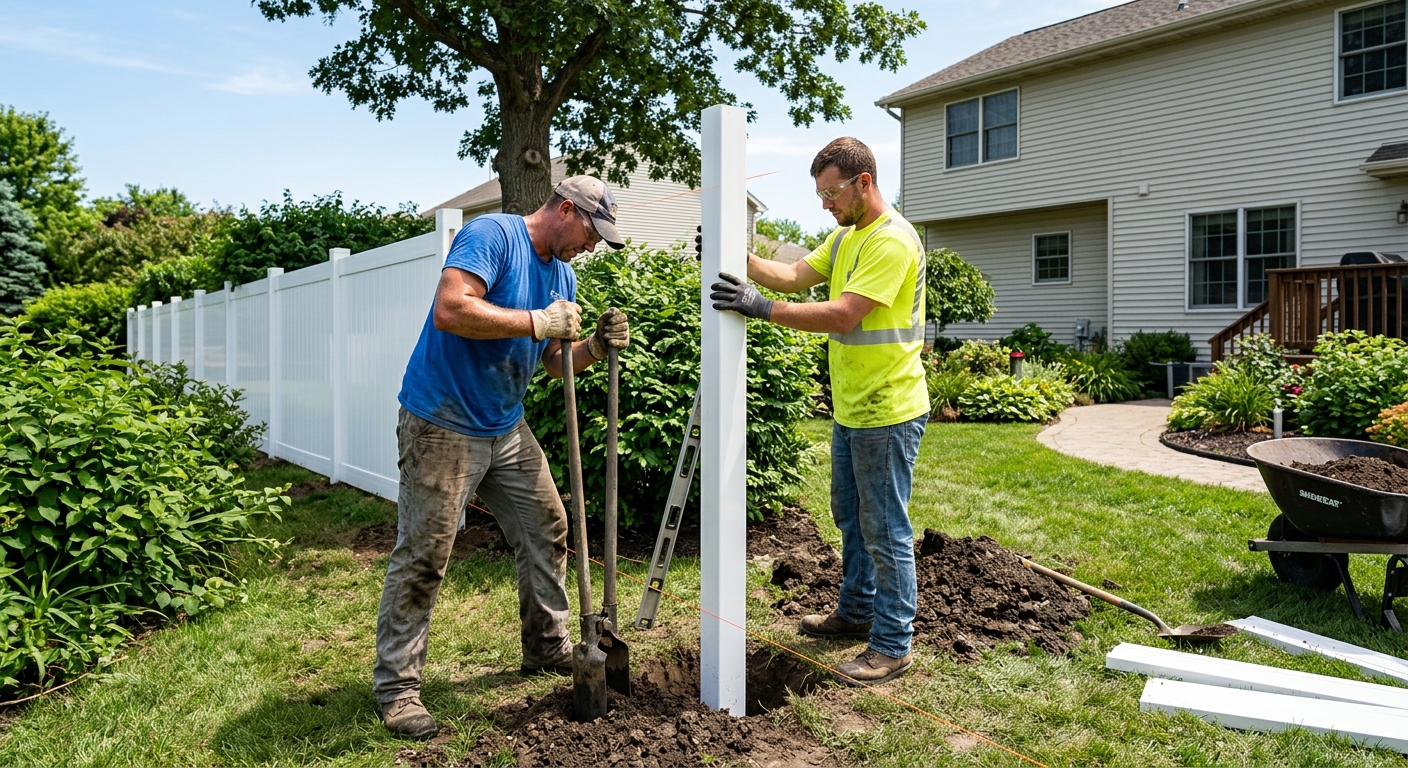
Lower Mainland–Southwest pricing is shaped by mild but wet conditions and frost that still matters for post stability. Even though coastal BC is “shallower” than the Prairies, crews typically set posts deeper than the bare minimum to reduce heaving and keep panels plumb in Fraser Valley-style soils. Wetter ground often means deeper holes, more concrete on posts that carry load (corners, end posts, and gate posts), and extra labour to keep the fence alignment tight while the soil behaves like it’s always slightly damp.
Contractor availability is usually strongest for common residential runs—backyards with straightforward access and minimal removal—while custom gate work, long privacy runs, and sloped sites tend to book out first. If you’re pricing multiple materials, it’s helpful to anchor your expectations using a practical per-linear-foot range and then refine the quote based on your site.
The comparison below gives homeowners in Bridgeview a realistic starting point before you request an itemised estimate.
| Material |
Lifespan |
Maintenance |
Privacy Rating |
Price per Linear Foot |
| Pressure-treated pine (standard wood) |
10–15 years |
Stain or seal every 2–3 years |
Good (solid board style) |
$55 – $95 |
| Cedar (natural rot resistance) |
15–25 years |
Light staining/finishing every 2–4 years |
Very good (solid boards) |
$70 – $110 |
| Vinyl / PVC (no-maintenance) |
20–30 years |
Rinse and occasional panel cleaning |
Very good (solid privacy styles) |
$75 – $130 |
| Chain-link (galvanized steel) |
20–35 years |
Minimal; occasional repairs |
Low (visual line-of-sight) |
$30 – $55 |
| Aluminum ornamental |
25–40 years |
Wash as needed |
Low to medium (open pickets) |
$90 – $170 |
| Composite / recycled material |
20–30 years |
Occasional cleaning; no staining |
Good (solid/composite boards) |
$85 – $140 |
Prices are estimates only and vary by project scope, site access and material selection.
What affects the price of fencing in Bridgeview
In Bridgeview and across the Lower Mainland–Southwest, fence quotes for what looks like the “same” job can still swing by 30–50% because the labour and materials aren’t the same behind the scenes. The biggest reason is that post installation and reinforcement vary with soil moisture, frost heave risk, and wind loading. Two contractors can price different embedment depths, concrete volumes, and panel/bracing types—and those differences translate quickly into dollars.
Frost line depth is a key driver. In most Canadian guidance, minimum embedment is commonly around 3 feet in many regions, and crews still set posts deeper than the bare minimum—often with holes placed about 4–6 inches below the design frost depth—to prevent heaving. Cold provinces like Ontario and Alberta can require much deeper posts (often 1.5–2.0 m) and therefore higher material and labour costs. Bridgeview is milder than those inland regions, but wetter Fraser Valley soils often behave unpredictably when they freeze and thaw, so deeper holes and heavier post bases still cost more than you’d expect from a “coastal” assumption.
Wind exposure also matters. While Bridgeview isn’t as wind-battered as some open Prairie sites, wet coastal conditions can accelerate wood decay if the fence isn’t treated properly. A cedar or pressure-treated run that’s nailed together without robust post bracing and proper ventilation can end up failing sooner, forcing earlier replacement.
Concrete examples of cost changes in Bridgeview include: (1) adding concrete at corner posts, end posts, and all gate posts (common in privacy builds) raises material and labour but improves alignment; (2) a wet, soft site often needs more concrete or a wider hole for stability; and (3) sloped yards may require stepped panels or raked sections, which add labour and can increase rail and fastening waste.
That’s why a basic chain-link install might land near the region’s low band (around $30 – $55), while a solid wood privacy fence typically sits in the mid-range ($55 – $95) and vinyl can move higher due to structural rigidity and panel hardware.
| Price Factor |
Why It Matters |
Cost Impact |
| Fence length in linear feet — the primary cost driver |
Every additional foot adds posts, rails, and materials |
High (often the biggest swing) |
| Post depth required — frost line determines post length and hole depth |
Deeper embedment resists heaving and keeps panels plumb |
Medium to high |
| Post setting method — concrete vs. gravel pack vs. driven posts |
Concrete increases stability; driven/gravel can reduce cost if soil allows |
Medium to high |
| Material choice — vinyl vs. cedar vs. chain-link |
Materials have different unit prices and installation requirements |
High |
| Gate count and type — walk-through vs. drive-through (double) |
Gates require heavier hinges, stronger posts, and bracing |
High |
| Grade and terrain — sloped yards require stepped or raked panels |
Slopes change rail heights and cutting/waste |
Medium |
| Old fence removal and disposal |
Demolition, hauling, and any hidden fasteners add labour |
Medium |
| Permit fees and survey / property line locate |
Administrative costs plus locating pins to avoid encroachment |
Low to medium (can be higher on complex sites) |
Permits & regulations in British Columbia
In British Columbia, fences over a height threshold typically require a building permit. A common reference point is around 2.0 m (6.5 ft) for rear yards, and about 1.0–1.2 m (3–4 ft) near the front or corners, but exact requirements can vary by municipal rules and lot configuration. Regardless of permit needs, all fence work must respect property lines and municipal setback requirements.
Before you dig any post holes, call for utility locates—BC 1 Call is the usual starting point in the province—so you don’t accidentally hit buried services. Also consider a survey or at least a professional locate of your property pins before installing, because fence disputes often come from assumed boundaries rather than verified ones. Shared fence ownership and responsibilities are governed by provincial line-fences principles, so it’s smart to clarify who maintains which side if you’re near a neighbour’s shared boundary.
Step-by-step for Bridgeview homeowners: (1) Confirm your fence height and where it’s located (front/corner vs rear). (2) Verify setbacks with your municipality or ask your contractor to include the permit step if thresholds are met. (3) Request the contractor’s licence details and insurance documents before work starts. (4) Ask for confirmation of utility locate completion and property line verification.
For BC contractors, you should verify: British Columbia licence status where applicable through the appropriate provincial registry; liability insurance (certificate of insurance) naming you where required; and coverage for worker-related costs (commonly WSIB/WCB-style clearance letters or equivalent proof). If a contractor can’t produce documents on request, treat it as a major caution sign before signing.
Choosing the right fence material for Bridgeview
Choosing a fence for Bridgeview usually comes down to four priorities: privacy, low maintenance, budget control, and lifespan in a wet coastal climate. Pressure-treated pine is the budget-friendly starting point, but it needs a proper stain or seal every 2–3 years to slow grey weathering and reduce water absorption. Cedar has better natural rot resistance and a warmer look, but it still benefits from periodic finishing, especially where rain and wind-driven moisture hit hardest.
Vinyl/PVC is popular for homeowners who want “install and forget,” because it doesn’t require staining and typically stays clean with occasional rinsing. The trade-off is cost: vinyl often lands in the higher end of the regional band (around $75 – $130) and in extreme cold it can become more brittle, which is why solid post spacing, proper hardware, and wind-rated installation matter. Chain-link is the lowest-cost option (often near $30 – $55) and it tends to last a long time, but it doesn’t provide meaningful visual privacy unless you add privacy slats or vegetation. Aluminum is attractive and rust-resistant, but it’s usually more ornamental than private.
In Lower Mainland–Southwest conditions, post depth still matters even though frost is milder than inland Canada. Contractors commonly set posts deeper than the bare minimum to reduce heaving, and concrete is often used for corner posts, end posts, and gate posts where loads concentrate. Stronger bracing is also wise for any solid panel style, because wet wind and rain can increase the strain on rails.
A concrete example: if your budget is tight and you’re okay with partial privacy, switching from a vinyl privacy panel to a pressure-treated wood privacy fence can move you from the vinyl range ($75 – $130) down into the mid-range ($55 – $95). If you expect 15–25 years and don’t want recurring finishing work, paying the vinyl or cedar premium can be justified—especially if your backyard stays damp most of the year.
| Material |
Cold Tolerance |
Lifespan |
Annual Maintenance |
Best For |
Price Band |
| Pressure-treated pine |
Good (with proper installation and finishing) |
10–15 years |
Low to moderate (seasonal inspection; stain/seal every 2–3 years) |
Budget privacy with ongoing upkeep |
$55 – $95 |
| Cedar |
Good (naturally resistant, still affected by moisture) |
15–25 years |
Low to moderate (finish/refresh every 2–4 years) |
Premium look and better rot resistance |
$70 – $110 |
| Vinyl / PVC |
Moderate to good (can be more rigid in cold) |
20–30 years |
Very low (wash/rinse as needed) |
Low-maintenance privacy |
$75 – $130 |
| Chain-link |
Good (steel frame handles cold well) |
20–35 years |
Very low (check tension and posts) |
Security and pets with minimal cost |
$30 – $55 |
| Aluminum ornamental |
Very good (corrosion-resistant finish) |
25–40 years |
Very low (occasional cleaning) |
Attractive boundary definition (less privacy) |
$90 – $170 |
| Composite / recycled |
Good (designed for outdoor moisture) |
20–30 years |
Low (cleaning; inspect fasteners) |
Solid privacy with low staining |
$85 – $140 |
How to choose a fencing contractor in Bridgeview
When you’re choosing a fence contractor in British Columbia, start with documentation and then move to pricing transparency. Verify licensing by asking for their BC business licence details or the applicable contractor registration information, and confirm they can legally perform the scope they’re quoting. Next, review liability insurance: request a certificate of insurance and ensure it’s valid and includes fence-related operations. For worker coverage, ask for proof of WSIB/WCB clearance or the appropriate coverage documents—contractors should be able to provide them quickly.
For quotes, avoid “lump sum” statements. Request 2–3 itemised written quotes with a breakdown of labour and materials (posts, rails, panels, gates, concrete quantity, hardware, and any finish/stain). Confirm whether removal of the old fence and disposal are included, whether site prep is included (grading/levelling), and whether a permit pull is included when required. Pay attention to whether the quote specifies post embedment depth and post spacing; those details are where low-ball estimates often hide.
Warranty is non-negotiable: ask for workmanship warranty length and whether it covers posts, rails, and gate alignment after install. Distinguish between product/manufacturer warranty and the contractor’s workmanship warranty, and ask whether warranties are transferable if you sell your home.
Payment scheduling matters. Never pay more than 10–15% upfront. Hold back a meaningful portion until the job is complete and gates swing properly and line is straight. Finally, insist on a start date and completion estimate in writing so you have a clear timeline.
- Ask for proof of BC insurance (certificate of insurance) before signing.
- Confirm worker coverage/clearance for the jobsite (WSIB/WCB-style proof).
- Request an itemised quote: labour vs materials, and include concrete/footings line items.
- Ensure the scope states old fence removal and disposal (or confirms it’s excluded).
- Verify post depth and setting method in writing (embedment + concrete vs gravel pack).
- Confirm gate hardware and whether posts are reinforced for gate loads.
- Ask how they handle slope (stepped vs raked) and whether it’s included.
- Confirm who pulls permits (if height thresholds apply) and who pays permit fees.
- Ask whether they do utility locates and whether that cost is included.
- Get the warranty terms in writing for workmanship and the product.
- Set a payment schedule with 10–15% max upfront and holdback until completion.
- Require a written start date, estimated completion date, and contact for scheduling changes.
Red flags in Bridgeview include: vague quotes that don’t specify post embedment depth or concrete use, “too cheap” pricing that omits gate reinforcement, refusing to provide insurance/coverage documentation, pressuring you into a large upfront deposit, and skipping a written scope that clearly lists removal, disposal, and permit responsibility.
Frequently asked questions — fencing in Bridgeview
How do I compare fencing quotes?
To compare fencing quotes in Bridgeview fairly, look past the total number and compare the scope line-by-line. Ask each contractor to itemise labour and materials, including posts, rails, panel style, hardware, and how much concrete is used (especially at corner, end, and gate posts). Confirm post spacing and embedment depth, because that’s where stability and heaving resistance come from in Lower Mainland–Southwest soils. Also check whether removal and disposal of the old fence are included, whether utility locates are handled, and whether the permit step is included when height thresholds are met. Finally, compare comparable materials: a “wood fence” can be pressure-treated pine versus cedar, and “privacy” can mean solid boards versus spaced boards.
How long does fence installation take in Bridgeview?
Typical installation timelines in British Columbia vary mainly by length, access, and whether you need old-fence removal. For an average residential yard run with straightforward access and no major slope, a small chain-link section or a short wood run can often be completed in a day or two. Larger privacy fences usually take longer because posts need proper embedment, alignment checks, and sometimes concrete setting. If you’re installing gates or removing an existing fence, plan additional time for demolition, disposal, and rework around utilities or landscaping. As a rough expectation, you might see timelines stretch from a couple of days for smaller projects to a week or more for longer solid-panel jobs—especially when crews coordinate material delivery and site conditions are wet.
Can I install a fence on a slope in Bridgeview?
Yes, you can install a fence on a slope in Bridgeview, but the method matters for both appearance and structural strength. Contractors typically choose between stepped panels (stair-step sections) or raked panels (following the slope smoothly). Stepped styles are common for solid privacy fences because they keep rail structure stable and simplify alignment. Raked panels can be done, but they require careful layout and more cutting/waste to keep gaps consistent and prevent twisting in wet conditions. Before quoting, ask how they’ll measure slope, how they’ll address drainage or low spots, and whether the quote includes stepped/raked labour. Proper base preparation also helps prevent leaning when soil stays saturated through the rainy season.
What is the most weather-resistant fence for Bridgeview's climate?
In Bridgeview’s mild but wet Lower Mainland–Southwest climate, the most weather-resistant choices are usually vinyl/PVC, cedar (when properly installed and finished), and well-built chain-link with galvanized hardware. Vinyl doesn’t rot or require staining, and with correct post spacing and quality hardware it performs well through wet winters and mild freezes. Cedar resists rot better than pressure-treated pine, but it still needs routine maintenance to protect the surface from moisture and UV. Chain-link is exceptionally durable because the frame is galvanised, but it provides little privacy unless you add slats or plant screening. Regardless of material, weather resistance depends heavily on correct post embedment and concrete at the right load points—corners, ends, and gates.
How do I prevent wood fence rot in Bridgeview?
Preventing wood rot in British Columbia is mostly about keeping wood dry and fasteners corrosion-resistant while using the right post strategy. Ensure posts are set with adequate embedment depth and, for load points like corners and gates, concrete setting where appropriate—this reduces post movement and prevents water pooling at unstable bases. Use pressure-treated lumber rated for ground contact, and for privacy fences choose solid installation details that avoid trapped water on horizontal caps and rails. Stain or seal on a schedule (often every 2–3 years for pine, and typically every 2–4 years for cedar depending on exposure) to reduce water absorption and grey weathering. Finally, keep vegetation trimmed back so constant shade and leaf litter don’t hold moisture against boards.
What is the cost per linear foot for fencing in Bridgeview?
For Bridgeview, fencing cost per linear foot typically lines up with the regional British Columbia price bands, but your final number depends on length, post embedment, gate count, and whether old fence removal is included. As a practical guide, chain-link often falls around $30 – $55 per linear foot installed. Wood fence installation commonly lands around $55 – $95, while vinyl/PVC is usually higher at about $75 – $130. Aluminum ornamental fencing can be more expensive, often roughly $90 – $170, because of materials and fabrication. If your soil is wet and contractors need deeper holes and more concrete setting (common in the Lower Mainland–Southwest), you should expect pricing at the upper end of the band.