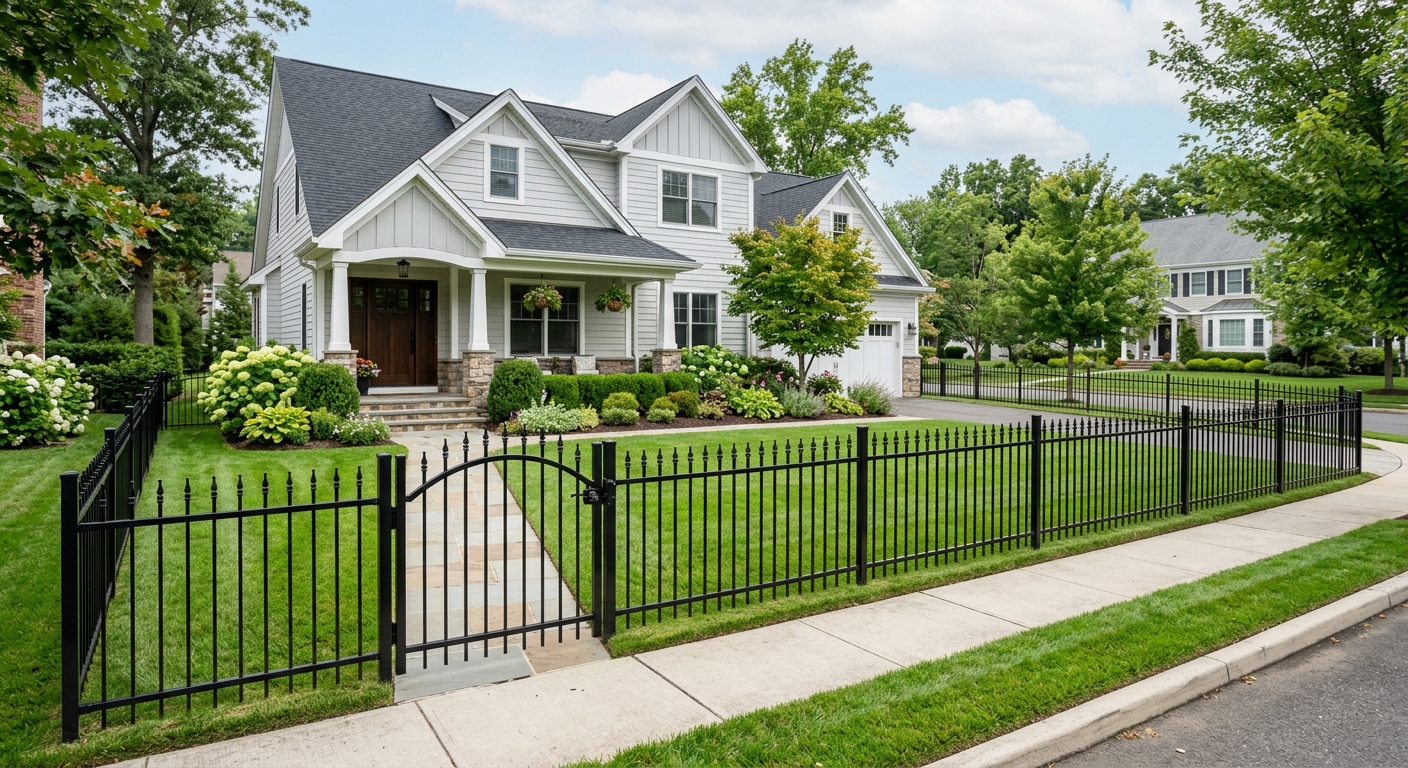
Fencing options and costs in Princeton
In Princeton, British Columbia, your fence choice usually starts with two realities: most properties are single-detached homes (66.2% of dwellings), and the area has a strong base of homeowner households (1,025 households; 74.5% of households own) who tend to invest in durable, long-term yard upgrades. In practical terms, that means steady local demand, especially around older neighbourhood blocks where fences get refreshed as maintenance becomes harder. If you’re near the core of Princeton or along the busier residential corridors, you’ll notice trades are often scheduled around back-yard access and post-hole excavation logistics.
Thompson–Okanagan pricing reflects interior frost and wind exposure. In this region, contractors typically set posts below the regional frost line so they don’t heave during freeze–thaw cycles. Interior valleys and colder pockets often require deeper, larger-diameter footings and, in clay or poorly drained spots, concrete-set posts to stabilize movement. At the same time, wind on more open lots can drive tighter post spacing and sturdier hardware, which raises labour and material use. That’s why you’ll sometimes see wood or chain-link come in at the lower end of the regional bands, while vinyl, aluminum, or any fence on tough soil tends to land closer to the higher end.
Below is a clear cost comparison for Princeton homes, using the city’s typical project reality (deep post holes, standard framing, and common hardware). Use it as a baseline, then we’ll narrow the estimate once we measure linear footage and confirm your soil and wind exposure before you choose a material.
| Material |
Lifespan |
Maintenance |
Privacy Rating |
Price per Linear Foot |
| Pressure-treated pine (standard wood) |
10–15 years |
Stain or re-seal every 2–3 years; inspect rails annually |
Good (solid boards) |
$14 – $20 |
| Cedar (natural rot resistance) |
15–25 years |
Light staining or sealing every 2–4 years; check for warping |
Good–Very good (solid boards) |
$20 – $28 |
| Vinyl / PVC (no-maintenance) |
25–30 years |
Rinse as needed; inspect for impact damage |
Very good (solid styles) |
$18 – $30 |
| Chain-link (galvanized steel) |
20–30 years |
Occasional tension checks and coating touch-ups |
Low–Medium (no privacy unless you add slats) |
$13 – $18 |
| Aluminum ornamental |
25–35 years |
Wash annually or as needed; check fasteners after heavy wind |
Low (open pickets) |
$22 – $40 |
| Composite / recycled material |
20–30 years |
Minimal cleaning; periodic inspections for fasteners |
Good–Very good (solid boards) |
$24 – $38 |
Prices are estimates only and vary by project scope, site access and material selection.
What affects the price of fencing in Princeton
Fence quotes in Princeton can swing by 30–50% even when the drawings look similar, because Thompson–Okanagan conditions and labour availability aren’t the same as the very mild, wet coastal microclimates in BC. In interior valleys, deeper post holes and more robust foundations are common. That raises labour hours (augering, digging, inspection, and concrete work) and often increases the total material count because stronger posts, more hardware, and additional bracing are used to handle freeze–thaw movement and wind load.
Frost depth is the biggest driver. Local practice is to set posts about 4–6 inches below the design frost depth to prevent heaving. In colder interior settings, that typically means longer posts and deeper holes—often pushing crews into concrete-set posts rather than gravel backfill. When you compare regions: colder markets like Ontario and Alberta often see posts set 1.5–2.0 m into the ground, which increases material and install cost; Princeton follows the “deeper interior” approach even if it’s not quite as severe. Where soils stay saturated or are clay-heavy, concrete setting is more likely because it limits post movement over winter.
Wind also matters. On exposed benches, you may need tighter post spacing and sturdier rails, which can move a fence toward the higher side of the regional bands (for example, wood installation at $55 – $85 for labour-and-setup style projects, or aluminum at $90 – $150 where bracing and heavier framing are required). On more sheltered lots, standard spacing can keep vinyl / PVC closer to its mid-range, but on open sites you’ll often pay more for hardware upgrades.
Two concrete examples from typical Princeton jobs: (1) a cedar privacy fence on heavier clay usually needs concrete-set posts, which increases labour time and concrete volume; (2) a short chain-link run around a well-kept, level yard can stay near the lower band because it uses simpler footings and less bracing. With homes built before 1981 (66.2% of homes), it’s also common to find older property layouts where fence lines meet mature shrubs or uneven grades, adding time for relocation, raking, and disposal.
| Price Factor |
Why It Matters |
Cost Impact |
| Fence length in linear feet |
The most direct driver of labour, posts, rails and materials |
Typically the largest swing; linear footage often determines the base quote |
| Post depth required |
Frost line determines hole depth and the required post length |
Deeper holes increase excavation time and post-material usage |
| Post setting method |
Concrete-set posts resist heave and movement better than simple backfill in tough soils |
Concrete and auger time can add meaningful cost in interior BC |
| Material choice |
Vinyl and aluminum use different framing hardware; cedar changes labour and waste rates |
Vinyl tends to price higher upfront than treated pine; chain-link is usually the lowest |
| Gate count and type |
Gates need stronger frames, more hinges/latches and often extra bracing |
Each additional gate can materially increase time and hardware |
| Grade and terrain |
Slopes require stepped panels or raked framing for a consistent top line |
More layout labour and sometimes more material cutting |
| Old fence removal and disposal |
Removal adds crews, dump fees, and hidden fixings or buried posts |
Can add a significant add-on, especially with concrete bases |
| Permit fees and survey / property line locate |
BC requires locates and permits for certain fence heights; disputes are expensive to fix |
Small compared to materials, but delays and survey work add cost |
Permits & regulations in British Columbia
In British Columbia, many fences require a building permit once they exceed common height thresholds—typically 2.0 m (6.5 ft) for fences along rear yards, and about 1.0–1.2 m (3–4 ft) for fences at the front or corners. Exact rules can vary by location and where the fence sits relative to road allowances, but the safest approach in Princeton is to confirm the fence height, location and setbacks before any post holes are dug.
All fences must respect property lines and municipal setback bylaws. Before you excavate, you should have your utilities located (utility locates) so you don’t hit buried services. In BC, homeowners commonly use BC 1 Call for locating; Ontario One Call is for Ontario and Alberta One-Call is for Alberta, but in Princeton you’d be using the BC service. Also, get a survey or at least locate your property pins before installing so you’re not building across a boundary. Fence ownership and cost-sharing on shared boundaries is governed by provincial line-fences legislation.
What typically requires a permit: higher fences above the thresholds (commonly rear yard around 2.0 m, and front/corner thresholds around 1.0–1.2 m). What typically does not: modest-height fences below those typical thresholds, as long as they meet property-line and setback rules.
To verify a Princeton contractor in BC, check their licence and trade standing through the appropriate online registry, request a certificate of liability insurance, and confirm they carry the required WSIB/WCB coverage (ask for a clearance letter or proof of account coverage). If they can’t provide clear proof, treat it as a red flag before work starts.
Choosing the right fence material for Princeton
Choosing a fence material in Princeton is less about what looks good on day one and more about surviving Thompson–Okanagan winters: freeze–thaw cycles, interior cold, and periods of strong wind. Start by matching material to your priorities—privacy, low maintenance, budget, and lifespan. Pressure-treated pine is the budget-friendly option, but you should plan to stain or seal roughly every 2–3 years to reduce grey weathering and keep boards looking even. Cedar has better natural rot resistance and tends to age more gracefully, yet it still benefits from periodic sealing to protect its surface.
For low-maintenance performance, vinyl / PVC stands out. It’s typically no-maintenance aside from occasional rinsing, and privacy styles can be very effective. The trade-off is upfront cost, and extreme cold can make some components more brittle if low-quality hardware is used—so good installation practices still matter. Chain-link is usually the lowest upfront and the longest-life choice for durability, but it won’t deliver privacy unless you add slats or plant screens. Aluminum ornamental offers an attractive, rust-resistant look and mid-range pricing, but it’s mainly for appearance and boundary definition rather than privacy.
On post depth: interior BC practice is to set posts below the frost line so they don’t heave, which often means deeper holes and sometimes concrete-set posts—especially in clay or poorly drained areas. Wind and snow load also influence framing: exposed lots may need stronger rails and closer spacing. With older homes (66.2% built before 1981), yard layouts can be cluttered with mature landscaping, making material handling and accurate racking on slopes part of the real cost.
Dollar-wise, a privacy project might look like “wood vs vinyl” on paper, but the justification is about maintenance. If pressure-treated pine is near the lower end of wood installation—around $55 – $85 for typical wood-style installs—then choosing vinyl at roughly $75 – $115 (depending on style and hardware) can make sense when you want to avoid ongoing staining and weekend upkeep for decades.
| Material |
Cold Tolerance |
Lifespan |
Annual Maintenance |
Best For |
Price Band |
| Pressure-treated pine |
Good (with proper staining and quality fasteners) |
10–15 years |
1 inspection; stain/seal every 2–3 years |
Budget privacy with acceptable upkeep |
$55 – $85 |
| Cedar |
Very good (natural oils help resist rot) |
15–25 years |
1 inspection; seal/stain every 2–4 years |
Premium look with moderate maintenance |
$60 – $95 |
| Vinyl / PVC |
Good (depends on quality and installation hardware) |
25–30 years |
Low: rinse as needed; check for impact |
Low-maintenance privacy |
$75 – $115 |
| Chain-link |
Excellent (galvanized steel holds up well) |
20–30 years |
Low: tension check and occasional touch-ups |
Security with minimal cost |
$35 – $60 |
| Aluminum ornamental |
Very good (powder-coated protection) |
25–35 years |
Low: wash/inspect fasteners after storms |
Appearance, boundary definition |
$90 – $150 |
| Composite / recycled |
Good (stable boards if installed correctly) |
20–30 years |
Very low: cleaning and hardware checks |
Clean look with reduced upkeep |
$85 – $135 |
How to choose a fencing contractor in Princeton
Start by verifying the basics with your fencing contractor in Princeton, British Columbia: licensing/trade standing (for fence installation activities that fall under applicable requirements), liability insurance, and the correct workers’ compensation coverage (WSIB/WCB). Ask for the certificate of insurance and confirm the coverage is active and matches your project type; for workers’ compensation, request proof such as a clearance letter or current account documentation. Don’t rely on verbal assurances—ask to see documents before scheduling your start date.
Next, request 2–3 itemised written quotes instead of a lump-sum. You want a breakdown that separates labour, materials, post setting (concrete vs gravel pack), gate hardware, and removal/disposal of any old fence. Confirm whether permits are included (when required for taller fences), and whether the contractor handles survey/property line locate coordination. The best quotes show quantities: number of posts, estimated linear footage, and gate sizes.
Warranty matters. Look for a workmanship warranty (how long the contractor stands behind installation) and separate product/manufacturer warranty. Ask if the warranty is transferable to future owners—many homeowners appreciate that when selling later. For payment, keep it controlled: never pay more than about 10–15% upfront. Use a holdback until the fence is complete, gates are operating smoothly, and the site cleanup is finished. Finally, insist on a start date and a completion estimate in writing so you’re not left waiting through frozen ground conditions.
- Confirm they set posts below the frost line and explain how they’ll achieve required depth in your soil.
- Ask what post setting method they’ll use (concrete-set vs gravel pack) and why.
- Require an itemised quote: posts, rails, panels, hardware, and gates broken out.
- Check whether old fence removal and disposal is included, especially if posts are concrete-set.
- Ask for gate hinge/latch brand and warranty details.
- Verify liability insurance is current and provides enough coverage for property damage.
- Verify workers’ compensation (WSIB/WCB) coverage with proof/clearance letter.
- Confirm permit responsibility in the quote where required by fence height.
- Ensure the quote states panel layout on slopes (stepped vs raked) and includes any extra labour.
- Ask about how they protect landscaping and handle roots and buried services.
- Confirm the warranty is in writing and specify workmanship vs product coverage.
- Use a payment schedule that avoids large upfront deposits and includes a holdback on completion.
Red flags in Princeton include contractors who won’t show insurance/clearance proof, quotes that don’t state post depth or setting method, “all-in” pricing with no hardware or gate breakdown, demanding large upfront payments beyond 10–15%, and vague timelines (no start date or completion estimate). If they can’t clearly explain frost-depth installation and how they’ll manage wind loading on your lot, that’s usually a sign the fence won’t perform well through winter.
Frequently asked questions — fencing in Princeton
What's the most low-maintenance fence?
In Princeton and across Thompson–Okanagan, the lowest-maintenance option is typically a vinyl / PVC fence. It resists rot, doesn’t need staining, and only needs occasional rinsing and hardware checks after heavy winds. If you’re comparing budgets, wood installations can start nearer the lower end of typical wood-style pricing (around $55 – $85), but pressure-treated pine usually requires staining or re-sealing every 2–3 years to keep boards looking consistent. Cedar can be “easy” visually, yet it still benefits from periodic sealing to slow weathering. Chain-link is also low maintenance in terms of materials and longevity, but it won’t provide privacy without adding slats. For homeowners who are 1) busy and 2) investing in a fence that will look good through freeze–thaw seasons, vinyl is usually the best balance of upkeep vs lifespan in this interior BC climate (Statistics Canada, 2021 Census).
How tall can my fence be in Princeton?
In British Columbia, fence height thresholds often trigger building permits—commonly about 2.0 m (6.5 ft) at the rear yard and around 1.0–1.2 m (3–4 ft) at the front or at corners. Princeton follows provincial and municipal rules that require the fence to sit within property lines and comply with local setback bylaws. The key practical step is to measure the exact fence location (front/corner vs rear) and confirm the planned height before you book excavation. If your design is above the typical threshold, plan for a permit process. Also, keep in mind wind and snow: very tall privacy fences act like sails on exposed lots, so you may need closer post spacing and stronger bracing even if height is allowed.
Should fence posts be set in concrete here?
Often, yes—especially if your soil is clay-heavy, drains poorly, or you have areas that stay damp after spring melt. Thompson–Okanagan freeze–thaw conditions mean posts must be set below the regional frost line to prevent heaving. In these circumstances, many Princeton installations use deeper holes and concrete-set posts to stabilize movement. That said, the “best” method depends on soil conditions and the fence’s design load (wind exposure, panel type, and gate size). A contractor should explain how they’ll achieve required depth and whether concrete is necessary for your specific ground conditions. If the soil is stable and well-draining on a sheltered lot, some installs can use gravel backfill methods—but any quote that doesn’t address post depth and setting method should raise questions, because frost performance is the long-term cost saver.
What's the best fence for privacy?
For privacy in Princeton, you’ll generally get the best results with a solid-panel design: vinyl / PVC solid privacy styles, cedar, or pressure-treated pine. These materials block sightlines far better than chain-link or ornamental aluminum. Vinyl is popular when homeowners want minimal upkeep; it typically needs no staining and can last 25–30 years with proper installation. Cedar provides a natural look with good rot resistance, but you should budget for periodic sealing to slow weathering. If you’re on a tighter budget, pressure-treated pine privacy fences can be more cost-accessible, often aligning with typical wood installation pricing around $55 – $85. Just remember that privacy fences in windy, exposed spots may require sturdier framing and closer post spacing, which can push the project toward the higher end of the band.
How do I compare fencing quotes?
To compare quotes fairly in Princeton, insist on itemised detail—especially labour vs materials, and post setting method. First, confirm the measured linear footage and the number of posts, since both directly affect the final price. Second, compare post depth and how they’ll address frost performance (depth and setting method should be spelled out). Third, look at gates: gate frames, hinges, latches, and whether drive-through gates are included can change the cost more than people expect. Fourth, check inclusions: permit handling (when required for taller fences in BC), utility locates, and old fence removal/disposal. Finally, compare warranty terms: workmanship warranty length and product warranty coverage. A “cheaper” quote that omits concrete-set posts, proper depth, or hardware specs often costs more later. If you want a benchmark, wood installs commonly fall in the $55 – $85 range, while aluminum is often higher, around $90 – $150.
How long does fence installation take in Princeton?
Timelines in Princeton depend on linear footage, gate count, and—most importantly—ground conditions for post holes. If the site is accessible and the soil is workable, shorter runs (for example, a modest yard line with one gate) can take about 1–2 days. Larger privacy fences typically run several days because crews must excavate to frost-safe depth, set posts (concrete adds drying/setup time depending on the method), and complete panel alignment on slopes. Weather affects scheduling too: wet or frozen ground can slow drilling and require rescheduling to protect foundation quality. If you’re also removing an old fence, add time for dismantling, haul-away, and disposal. Before signing, ask for a written start date and completion estimate that accounts for frost-depth excavation and any permit steps required by your planned height.