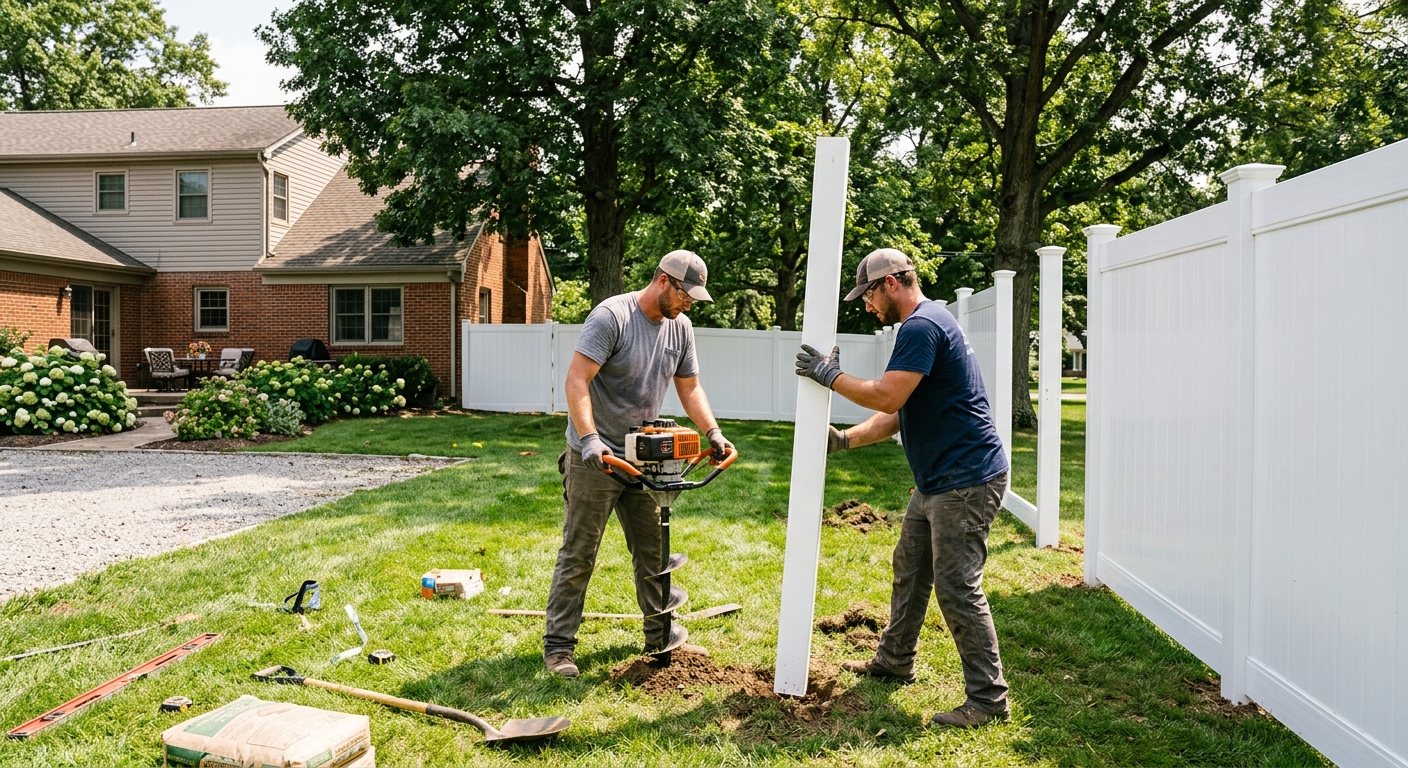
Fencing options and costs in Carisbrooke
Carisbrooke is a small community in the Lower Mainland–Southwest, and fencing demand tends to track the area’s steady growth and established homeownership. With a population of 4,577 (Statistics Canada, 2021 Census), there are enough detached properties for fencing to be a regular trade, and most jobs are driven by privacy needs, pet containment, and curb-appeal updates. In practice, each detached yard is effectively a “brand new project” for future homeowners—especially where rear yards back onto laneways and park edges.
Lower Mainland–Southwest pricing is shaped by mild but not trivial frost and wind conditions. Even though BC is generally milder than Ontario and the Prairies, contractors still set posts below the design frost depth to limit frost heaving. Fraser Valley soils are often wetter than dry-site installs, so deeper holes, more concrete at corner/gate posts, and more labour time are common. That’s why two fences of the same height can land far apart in price depending on soil condition, slope, and access.
For Carisbrooke, one area where fence installs are especially common is the residential strip around Lefeuvre Road and nearby neighbourhood streets where backyards and side yards frequently need privacy screening from adjacent homes. If you’re comparing options right now, the table below gives realistic lifespan, maintenance expectations, and typical per-linear-foot pricing by material—then we’ll break down what pushes a quote up or down.
| Material |
Lifespan |
Maintenance |
Privacy Rating |
Price per Linear Foot |
Price Range |
| Pressure-treated pine (standard wood) |
10–15 years |
Stain/paint every 2–3 years; tighten hardware as needed |
Medium–High (solid styles) |
$25–$40 |
$55 – $95 |
| Cedar (natural rot resistance) |
15–25 years |
Reseal/stain every 3–4 years to maintain colour and reduce warping |
High (solid boards) |
$30–$55 |
$70 – $120 |
| Vinyl / PVC (no-maintenance) |
20–30 years |
Wash as needed; inspect posts/fasteners periodically |
High (solid panels) |
$35–$70 |
$75 – $130 |
| Chain-link (galvanized steel) |
25–35 years |
Occasional cleaning; check tension and coatings |
Low (limited view blocking) |
$16–$30 |
$30 – $55 |
| Aluminum ornamental |
25–40 years |
Wash as needed; inspect gates and hinges |
Low–Medium (open pickets) |
$28–$55 |
$90 – $170 |
| Composite / recycled material |
20–30 years |
Rinse/wash; avoid harsh scraping; check for fastener wear |
Medium–High (board styles) |
$32–$65 |
$80 – $140 |
Prices are estimates only and vary by project scope, site access and material selection.
What affects the price of fencing in Carisbrooke
In Carisbrooke, two fences can differ by 30–50% even when the material and height look “the same” at a glance. That’s typical across the Lower Mainland–Southwest and across British Columbia overall because labour rates, haul distance for materials, and how crews handle wet soils and frost precautions vary by neighbourhood access and ground conditions. A quote also changes when the contractor has to spend extra time on line corrections, stepped sections for slope, or removing an old fence before setting new posts.
Frost line depth is a big driver. In most of Canada, installers often set posts about 4–6 inches below the design frost depth, and in colder regions contractors may need around 1.5–2.0 m of embedment. While BC coastal conditions are generally shallower than Ontario and the Prairies, Carisbrooke jobs still commonly require deeper holes than the “bare minimum,” especially where the yard stays damp. More hole depth means longer posts, more digging time, and—on privacy panels, corners, and gates—more concrete setting.
Wind exposure can also push cost. While the Prairies are the extreme, the Lower Mainland can still see strong gusts through openings, and that’s why we tighten post spacing and use heavier framing for solid wood and vinyl privacy fences. Wet climates accelerate deterioration if the wood isn’t treated and installed correctly, which can affect both material choice and how much labour is needed to make posts sit level.
Two concrete examples from Carisbrooke that commonly raise cost: (1) sloped backyards near major residential streets often require stepped/raked panel layouts, adding framing time; (2) wetter soil along lower spots may force deeper concrete-set holes and more backfill work. If you’re comparing budgets, chain-link often lands in the lower end of $30–$55, while privacy options like vinyl/PVC typically sit around $75–$130 depending on solid panel density and gate complexity.
| Price Factor |
Why It Matters |
Cost Impact |
| Fence length in linear feet — the primary cost driver |
Labour and materials scale directly with footage and number of rails |
Typically the largest swing; small access issues compound |
| Post depth required — frost line determines post length and hole depth |
Deeper embedment helps prevent heaving and misalignment |
Can add hours and increase concrete/post material |
| Post setting method — concrete vs. gravel pack vs. driven posts |
Concrete improves stability for privacy, corners, and gates |
Concrete-set posts usually raise cost |
| Material choice — vinyl vs. cedar vs. chain-link |
Material cost and structural requirements differ by type |
Vinyl and cedar are higher; chain-link is lowest |
| Gate count and type — walk-through vs. drive-through (double) |
Gates require reinforced framing, hardware, and careful alignment |
Multiple gates can add a significant labour/material premium |
| Grade and terrain — sloped yards require stepped or raked panels |
Slopes increase cutting, layout time, and framing adjustments |
Often increases labour even if footage is the same |
| Old fence removal and disposal |
Demolition, hauling, and disposal add time and equipment |
Can noticeably raise the final total for older builds |
| Permit fees and survey / property line locate |
Verification work prevents encroachment and rework |
May add administrative cost depending on the project |
Permits & regulations in British Columbia
In British Columbia, fence requirements commonly hinge on height. In many municipalities, fences above a height threshold—often around 2.0 m (6.5 ft) for rear yards and about 1.0–1.2 m (3–4 ft) for front or corner areas—may require a building permit. Even when a permit is not required, you still need to respect property lines and municipal setback rules. Before any post hole is dug in Carisbrooke, you should arrange utility locates through the appropriate provincial service (BC 1 Call for BC). This matters because fencing posts are frequently placed where underground lines or service runs may be present.
Step one for a smooth project is to confirm boundaries: obtain a survey or have the property pins located so the fence is installed on the correct line. This reduces the risk of disputes—especially where older fences were installed loosely on “assumed” property lines. In BC, shared fence ownership and responsibility are guided by provincial line-fences legislation, so disputes are usually addressed through documented agreements and the actual boundary.
To verify a contractor in Carisbrooke, ask for: (1) their provincial business/contractor information or registration details from the appropriate online registry; (2) liability insurance certificate (request the COI); and (3) confirmation of required worker coverage (WSIB/WCB where applicable) or a clearance letter. A reputable fencing contractor will provide certificates on request and match the insured name and project address on the paperwork.
Choosing the right fence material for Carisbrooke
Your best fence material in Carisbrooke depends on what you’re trying to achieve: privacy, low maintenance, budget, or a longer lifespan. Lower Mainland–Southwest yards tend to get enough dampness that untreated or poorly installed wood can age faster than many homeowners expect. That makes pressure-treated pine workable as a budget choice, but it will typically need staining or painting every 2–3 years to slow grey weathering and protect against moisture. Cedar naturally resists rot better and looks warmer than pine, but it still needs periodic staining/sealing to keep boards looking consistent and to reduce warping.
Vinyl/PVC is the low-maintenance option—generally no painting and easy cleaning—but it’s more expensive up front. In extreme cold snaps (still less frequent than inland Canada, but they happen), vinyl can become more brittle, so installing with proper post setting, tension, and expansion practices matters. Chain-link is usually the cheapest and lasts a long time, yet it offers limited privacy unless you add slats or screening. Aluminum ornamental is solid for durability and rust resistance, but because it’s open picket by design, it’s typically medium to low privacy.
Regarding post-depth: even with BC’s milder climate, contractors often set posts below the design frost line to prevent heaving. Concrete setting is commonly used for corner posts, gate posts, and privacy line posts where stability matters most in wet soil.
A practical dollar example: if chain-link is priced around the $30–$55 band, upgrading to vinyl privacy often lands in the $75–$130 range. That difference is usually justified when you want visual privacy, stronger wind-bracing (with tighter framing), and fewer maintenance days over the life of the fence.
| Material |
Cold Tolerance |
Lifespan |
Annual Maintenance |
Best For |
Price Band |
| Pressure-treated pine |
Good (properly set and treated) |
10–15 years |
Light inspection + wash; stain every 2–3 years |
Budget privacy with the expectation of upkeep |
$55–$95 |
| Cedar |
Good (naturally rot-resistant) |
15–25 years |
Wash + stain/seal every 3–4 years |
Better appearance with moderate maintenance |
$70–$120 |
| Vinyl / PVC |
Moderate (can be more brittle in deep cold) |
20–30 years |
Wash as needed; inspect fasteners after storms |
Low maintenance privacy and clean appearance |
$75–$130 |
| Chain-link |
Good |
25–35 years |
Occasional cleaning; check tension |
Security and pet containment at lowest cost |
$30–$55 |
| Aluminum ornamental |
Good |
25–40 years |
Wash as needed; inspect hinges/gates |
Durable curb-appeal with open views |
$90–$170 |
| Composite / recycled |
Good (installed to allow expansion) |
20–30 years |
Rinse/wash; inspect for fastener wear |
Long-life privacy without wood staining |
$80–$140 |
How to choose a fencing contractor in Carisbrooke
Choosing the right contractor starts with verifying British Columbia requirements. First, ask for their business details and confirm the registration information through the appropriate online registry. Next, request a certificate of liability insurance for the correct legal name and the address of the work site. For worker coverage, ask whether they maintain WSIB/WCB coverage where required; if they can provide a clearance letter or current coverage confirmation, that’s a strong sign of professionalism. Don’t accept “we’re covered” without paperwork—get documents you can review.
Then, get 2–3 itemised written quotes, not lump sums. You want a breakdown showing labour hours (or crew time), materials (rails, pickets/panels, posts, hardware), and line items for concrete, post depth preparation, gate hardware, and any removal/disposal. Carefully read what’s excluded: permitting assistance, utility locates, survey/locate work, and fence disposal should be clear before you sign. If an old fence needs removal, confirm whether haul-away and dumping fees are included or add-on.
Look for two kinds of warranty: workmanship and product/manufacturer. Workmanship warranties should cover fastening and installation defects; product warranties cover material issues. Ask if the workmanship warranty is transferable if you sell the home. For payment, never pay more than 10–15% upfront—hold the remainder until the job is complete and gates are operating smoothly. Get the start date and completion estimate in writing so weather delays and scheduling expectations are clear.
- Provide COI (liability insurance) with policy number and coverage effective dates
- Confirm worker coverage status (WSIB/WCB) or provide a clearance letter
- Use itemised quotes: posts, rails, panels/pickets, concrete, hardware, labour, and gates
- Specify post depth and setting method (concrete-set vs gravel pack) in the proposal
- State whether disposal/removal of old fencing is included
- List gate type and hardware brand/model where possible (hinges, latches, closing mechanisms)
- Show how slope will be handled (stepped vs raked) and whether measurements are taken on site
- Confirm permits/pull responsibility—whether the contractor applies or the homeowner does
- Include a written timeline with start date and estimated completion date
- Ask about cleanup standards and final grade/surface restoration
- Get a workmanship warranty length in writing
- Use a payment schedule that limits upfront payment and includes a holdback
In Carisbrooke, a few red flags I see often: (1) quotes that don’t specify post embedment depth or setting method; (2) “lowest price” proposals that skip corner/gate reinforcement; (3) refusing to provide COI/coverage documents; (4) vague scope language like “materials included” with no quantities; and (5) pushing large upfront deposits (more than 10–15%) before any work begins.
Frequently asked questions — fencing in Carisbrooke
Should I repair or replace my old fence in Carisbrooke?
In Carisbrooke and across the Lower Mainland–Southwest, repair can make sense when posts are solid and the damage is limited to a few boards or rails. If the fence has leaning sections due to post movement, rot at the bottom, or widespread sagging, replacement is usually the more cost-effective long-term choice because you’ll need new posts and proper embedment anyway. As a quick benchmark, if your current fence is failing in multiple bays, the labour to “patch” can approach a meaningful portion of a new install—especially once concrete-set corner and gate posts are involved. If you’re comparing options, new chain-link often sits around the $30–$55 band, while privacy fences like vinyl commonly land around $75–$130. That price gap is why homeowners often repair small sections, but replace when structural stability is compromised. (Statistics Canada, 2021 Census)
How do I handle a fence dispute with a neighbour in British Columbia?
Fence disputes in British Columbia usually start with boundaries and responsibilities. Step one is to verify the property line using a survey or by having your property pins located—don’t rely on an old fence location when the ground has changed or the fence was installed informally. Next, document everything: photos, measurements, the fence condition, and any communications. In BC, shared fence ownership rules are handled under provincial line-fences legislation, so your neighbour’s involvement and cost-share may depend on the established boundary and the type of fence. If you can’t agree, get professional input (like a contractor’s written assessment of whether posts are on the correct line and whether the fence is structurally compromised). If height is part of the disagreement, check the municipal rules that commonly set thresholds (rear vs front/corner). Keeping the conversation grounded in boundary verification typically reduces conflict and rework.
What fence style offers the best wind resistance in Carisbrooke?
For wind resistance in Carisbrooke, the key is not just the fence “style,” but the framing, post embedment, and how much surface area the wind hits. Solid privacy fences (wood or vinyl) generally do best when installed with stronger corner/bracing, properly spaced line posts, and concrete setting for critical posts. Even though BC isn’t as windy as some Prairie sites, gusts can catch open gates and large continuous panels, especially where the yard faces prevailing wind corridors. If you prefer less visual blocking, aluminum ornamental or chain-link can be more forgiving because wind passes through; however, those styles typically need good gate hardware and secure latching to avoid racking. If you’re comparing budgets, solid privacy materials usually cost more (vinyl commonly in the $75–$130 band), but the added structure is often what you’re really paying for—better anchoring and reduced movement.
How much does a fence cost in Carisbrooke?
Fence cost in Carisbrooke typically depends on length, gate count, material, slope, and how wet/rocky the soil is for post holes. In this region, a realistic homeowner budget usually lands within the common BC installed price bands: chain-link often comes in around $30–$55 per linear foot, while wood privacy fencing is often mid-range (about $55–$95). Vinyl/PVC privacy commonly ranges from $75–$130, largely because of material and the structural requirements for solid panels. The Lower Mainland–Southwest climate can also affect pricing through frost precautions and deeper post embedment to prevent heaving, especially where soils hold moisture. If you want a tighter estimate, measure footage, count gates, and share photos of access and any slope—those are usually the biggest drivers before material selection. (Statistics Canada, 2021 Census)
How deep should fence posts be for Carisbrooke's frost?
Even though Carisbrooke is milder than many other parts of Canada, contractors still set posts below the local frost line to reduce heaving risk. A common planning rule is embedment about 4–6 inches below the design frost depth, and in colder regions this can translate to around 1.5–2.0 m. In BC, frost depth is typically shallower than inland/provincial interior areas, but we still often dig deeper than “just enough” because Lower Mainland soils can stay wet and destabilize posts. Practically, that means your contractor should specify post depth in the quote and explain whether posts are concrete-set (especially for corners and gates) versus set in a gravel pack where appropriate. If someone is proposing shallow holes with no explanation, that’s a red flag. The correct depth is also tied to local soil conditions—clay, water table conditions, and slope can push the recommended embedment.
Wood vs vinyl vs aluminum fence — which is best?
The “best” choice in Carisbrooke depends on whether you’re prioritizing privacy, maintenance, and longevity versus open visibility. Wood (pressure-treated pine) is often the budget-friendly option within roughly the $55–$95 band, but it usually needs staining or painting every 2–3 years to handle BC’s damp weathering. Cedar looks better and resists rot more, but it still requires periodic maintenance to keep boards stable and looking uniform. Vinyl/PVC is typically the lowest-maintenance for privacy, commonly in the $75–$130 range; it won’t be painted, but it must be installed with correct post setting and hardware to handle cold snaps and gusts. Aluminum ornamental is durable and rust-resistant with mid-to-high cost, but it’s generally open picket, so privacy is limited. If you tell me your goal—privacy level, pets, or curb appeal—and the approximate fence length and gate count, I can help narrow the best fit among these.