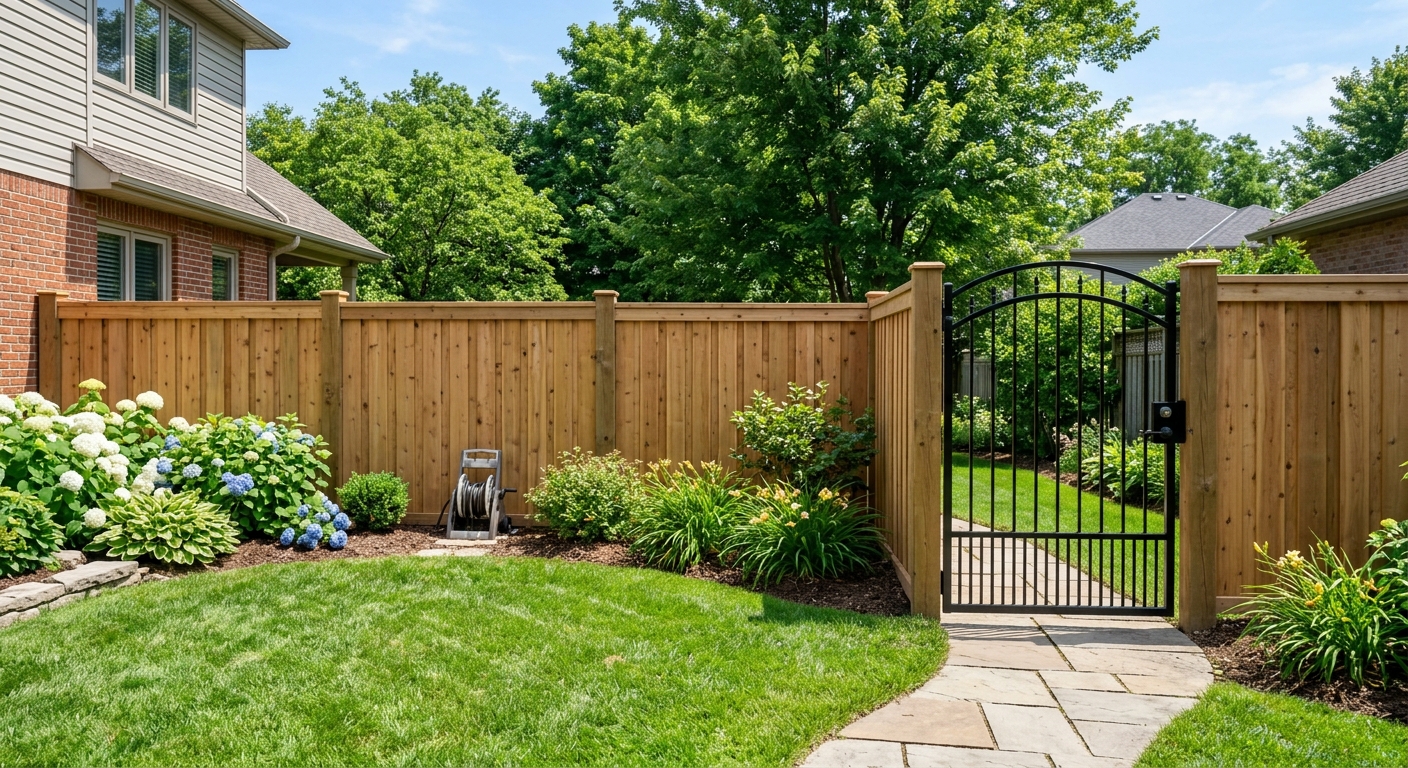
Fencing options and costs in Fort Langley
Fort Langley homeowners typically shop for fencing when they’re protecting privacy, pets, and property boundaries—especially as local housing stock continues to evolve. With a population of 3,836 residents (Statistics Canada, 2021 Census) and a community built around small-lot living, fence demand is steady and close to year-round. It’s also common to see fencing on single-family properties and newer subdivisions, where each lot effectively becomes its own customer market for replacement or upgrades.
In the Lower Mainland–Southwest, pricing is influenced by mild but not trivial frost and frequent wet conditions that affect how crews prepare post holes and support panels. Even though BC’s coastal frost is generally shallower than the Prairies, posts still need to be set well below the surface to reduce heaving in cold snaps. In wetter Fraser Valley soils, contractors often use deeper holes and more concrete—particularly for privacy sections, corner posts, and gates—so your quote may land closer to the upper end of the wood or vinyl ranges. Labour availability is also a factor during peak season, when multiple trades compete for the same crews and equipment.
If you’re near the Historic Downtown Fort Langley area, or the busier residential corridors around Whatcom Road/Old Yale Road, expect strong demand because lots turn over and neighbourhood infill commonly brings boundary upgrades. Next, here’s a clear side-by-side cost guide by material type.
| Material |
Lifespan |
Maintenance |
Privacy Rating |
Price per Linear Foot |
| Pressure-treated pine (standard wood) |
10–15 years |
Seal/stain every 2–3 years |
Good (solid panels) |
$55–$95 |
| Cedar (natural rot resistance) |
15–25 years |
Light stain/seal every 3–4 years |
Good–Very good (solid options) |
$70–$110 |
| Vinyl / PVC (no-maintenance) |
20–30 years |
Rinse annually; no staining |
Very good (solid pickets) |
$75–$130 |
| Chain-link (galvanized steel) |
25–40 years |
Minimal; wash as needed |
Low (unless privacy slats used) |
$30–$55 |
| Aluminum ornamental |
20–35 years |
Occasional cleaning |
Low–Medium |
$90–$170 |
| Composite / recycled material |
20–30 years |
Low; spot clean as needed |
Good–Very good (solid systems) |
$85–$145 |
Prices are estimates only and vary by project scope, site access and material selection.
What affects the price of fencing in Fort Langley
In Fort Langley and across the Lower Mainland–Southwest, two quotes for what seems like the same fence can differ by 30–50%. The biggest reason is that fencing cost is extremely site-driven: access (how close a trailer can get), slope, soil moisture, and the number/type of posts and gates often change the labour hours and material requirements more than the material brand itself. Timing matters too—crew schedules can tighten in spring and early summer when installation backlogs build, and that can shift a quote toward the upper end of the range.
Climate influences the foundation work in particular. Frost line depth affects how deep posts must be set to limit heaving; in practice for BC installs, crews often aim to set posts about 4–6 inches below the design frost depth. That typically means using longer posts and sometimes more concrete setting than you’d expect from a “minimum embedment” rule-of-thumb. In colder Ontario and Alberta regions, contractors commonly set posts deeper (often around 1.5–2.0 m), which raises costs substantially—Fort Langley isn’t as extreme, but wet Fraser Valley soils still mean deeper holes and heavier setting for stability.
For privacy fences, we also see cost movement from how panels handle wind and snow loading. BC coastal conditions are milder than open Prairie sites, but wind can still stress tall solid wood and vinyl systems, especially along lanes or open yards.
Concrete examples from Fort Langley: (1) A sloped yard often requires stepped panels, which increases layout time and sometimes adds extra framing—pushing a wood privacy job nearer the mid-to-upper wood band (for example, closer to $85–$95 per linear foot). (2) Ground that stays wet after rain usually needs a gravel drainage-friendly hole prep or more concrete for set strength—shifting vinyl pricing upward within the $75–$130 band. (3) If you’re removing an older fence, disposal fees and unexpected post rot behind the rails can add labour and materials before the new work starts.
| Price Factor |
Why It Matters |
Cost Impact |
| Fence length in linear feet |
The primary driver; more panels mean more posts, rails, and labour. |
High (dominant factor) |
| Post depth required |
Frost/soil conditions determine embedment, post length, and hole size. |
High (often adds material + labour) |
| Post setting method |
Concrete vs. gravel pack changes stability, costs, and curing time. |
Medium–High |
| Material choice |
Vinyl and composite systems require structural components and specific spacing. |
Medium (shifts overall band) |
| Gate count and type |
Drive-through/double gates need stronger posts, hardware, and bracing. |
Medium–High |
| Grade and terrain |
Slope requires stepped/raked sections and more layout time. |
Medium |
| Old fence removal and disposal |
Demolition, haul-away, and dealing with embedded/rotted posts take time. |
Medium |
| Permit fees and survey / property line locate |
Survey work and permits (when required) add administrative and field time. |
Low–Medium (project-dependent) |
Permits & regulations in British Columbia
In British Columbia, fences above a height threshold often require a building permit—commonly around 2.0 m (6.5 ft) for the rear, and roughly 1.0–1.2 m (3–4 ft) at the front or corner. Even when a fence doesn’t need a permit, it still has to respect property lines and municipal setback bylaws in your specific area of Fort Langley. Because requirements can vary by location and the fence’s exact placement, your contractor should confirm whether your planned height and location trigger permitting.
Before any post hole is dug, call for utility locates. In BC, use BC 1 Call so crews can identify buried lines and prevent service disruption. For boundary accuracy, get a survey or property pin locate before installing: it’s the simplest way to reduce the chance of encroachment disputes later. Shared fence ownership responsibilities are governed by provincial line-fences legislation, which generally applies to how neighbours handle repair obligations and cost sharing where fences are on or near a dividing line.
What typically DOES require a permit: fences that exceed the common height thresholds (especially taller privacy fences) and situations involving structures or special circumstances that the municipality flags during review. What typically does NOT require a permit: small, standard-height backyard fences that remain within the typical height limits, assuming they’re within setbacks and onside. Always confirm in writing.
To verify a contractor in BC, ask for their proof of licensing (where applicable through the proper provincial channels), certificate of liability insurance, and evidence of coverage for workers (WSBC/WCB as applicable). Look for a current certificate of insurance naming you as the client/owner where possible, and request a clearance letter or coverage verification if they use subcontract labour. Then confirm the certificate expiry date and that the scope matches fencing work.
Choosing the right fence material for Fort Langley
Choosing the right fence for Fort Langley comes down to matching your priorities—privacy, low maintenance, budget, and long-term appearance—to BC’s wet, mild-but-variable winters. Pressure-treated pine is usually the most budget-friendly starting point, but wood in Lower Mainland–Southwest conditions tends to grey and weather without regular sealing. Cedar offers better natural rot resistance and a nicer look as it ages; it still needs periodic maintenance, but it generally looks better longer between treatments. Vinyl/PVC is the “set it and forget it” option for many homeowners: it won’t require staining, but extreme cold snaps can make some plastics brittle if the system wasn’t installed with correct hardware and spacing. Chain-link is typically the lowest upfront cost and can last a long time, but it provides limited privacy unless you add privacy slats or mesh. Aluminum ornamental fencing resists rust and keeps its appearance, but it’s usually mid-range to higher cost and doesn’t provide the same privacy as solid panel designs.
Foundation details matter no matter the material. Even with BC’s generally shallower frost depth compared with interior regions, crews often set posts deeper (commonly about 4–6 inches below design frost depth) and use concrete for privacy panels, corner posts, and gates to keep everything plumb in wetter soils. For windy lanes or exposed sideyards, we account for wind bracing by choosing appropriate post spacing and panel reinforcement.
Here’s a practical money example: if you’re comparing wood at roughly $55–$95 per linear foot versus vinyl at $75–$130, the additional upfront spend can be justified when you want reduced maintenance time and you’re installing privacy-grade solid sections that will be hard to access for staining every 2–3 years. If you’re on a tight budget and you’re willing to maintain, wood or cedar can still be the smarter choice.
| Material |
Cold Tolerance |
Lifespan |
Annual Maintenance |
Best For |
Price Band |
| Pressure-treated pine |
Good (with proper treatment and sealing) |
10–15 years |
Low–Moderate (inspect; stain/seed yearly not typical, plan for every 2–3 years) |
Budget privacy with regular upkeep |
$55–$95 |
| Cedar |
Good |
15–25 years |
Low–Moderate (light seal/stain every 3–4 years) |
Attractive, rot-resistant privacy |
$70–$110 |
| Vinyl / PVC |
Good (best when installed with correct spacing/hardware) |
20–30 years |
Very low (rinse; inspect hardware) |
Low-maintenance privacy |
$75–$130 |
| Chain-link |
Very good |
25–40 years |
Very low (wash as needed) |
Security and long life on a budget |
$30–$55 |
| Aluminum ornamental |
Very good |
20–35 years |
Very low (occasional cleaning) |
Rust-free appearance and curb appeal |
$90–$170 |
| Composite / recycled material |
Good |
20–30 years |
Low (spot clean) |
Durable privacy with minimal upkeep |
$85–$145 |
How to choose a fencing contractor in Fort Langley
When you’re hiring a fencing contractor in Fort Langley, start by verifying credentials and then tighten everything down with itemised paperwork. In British Columbia, confirm liability coverage by requesting a certificate of insurance and checking that it’s active and covers fencing installations and any on-site property damage. For worker coverage, ask how they handle WSBC/WCB coverage and request proof/clearance documentation where applicable—don’t rely on verbal assurances. Also confirm the contractor’s ability to quote accurately for fencing scope, not just “materials plus labour,” because a fence’s foundation and layout details drive most of the cost differences.
Next, get 2–3 written quotes that break out labour and materials separately (posts, rails, fence panels/pickets, concrete, gate hardware, and any removal/disposal). A solid quote will specify what’s included and what’s excluded: permit pulls (when required), property line locate/survey support, utility locate costs, concrete supply, and debris haul-away. Many disputes come from a quote that assumes “you’ll handle disposal,” or that doesn’t clearly state how old posts are removed.
Pay attention to warranty terms. Look for a workmanship warranty (often covering install defects for a stated period) and confirm whether the manufacturer warranty on materials is included, how long it lasts, and whether it transfers if you sell the home. Finally, manage cash flow: never pay more than 10–15% upfront. Use a holdback (commonly the remaining balance) until the final inspection and cleanup are complete. Get your timeline in writing with a start date, completion estimate, and weather contingency plan.
- Ask for proof of current liability insurance and verify expiry dates on the certificate.
- Request WSBC/WCB worker coverage proof or clearance documentation where applicable.
- Confirm who is responsible for utility locates and how they’re scheduled (BC 1 Call).
- Require itemised quotes (labour and materials) instead of a single lump sum.
- Make sure gate hardware, hinges, latches, and any reinforcement are listed by type.
- Check whether concrete supply and concrete post setting are included for corner posts/gates.
- Clarify slope handling: stepped vs. raked sections and who measures the grade.
- Confirm how old fence removal works, including disposal and haul-away fees.
- Ask if the quote includes property pin locate support or survey access coordination.
- Review exclusions: what happens if buried obstructions are found during digging.
- Ensure warranty details are written: workmanship duration, material warranty, transferability.
- Set payment milestones in writing; keep a holdback until final completion.
In Fort Langley, common red flags include: (1) quotes that don’t mention post depth/embedment approach for frost heaving, (2) refusal to provide insurance/coverage documentation, (3) “cheap” chain-link or wood quotes that omit gate reinforcement details, (4) no written scope for disposal and utility locate responsibilities, and (5) a payment request for large upfront amounts (well beyond 10–15%).
Frequently asked questions — fencing in Fort Langley
What is the cost per linear foot for fencing in Fort Langley?
In Fort Langley, installed fencing typically prices by material in broad per-linear-foot bands. Chain-link is usually the lowest, commonly around $30–$55 per linear foot. Wood falls mid-range at roughly $55–$95 per linear foot, depending on whether it’s basic stockade/rails or a privacy layout with stronger bracing. Vinyl/PVC generally costs more because of material and structural requirements, commonly $75–$130 per linear foot. If you want an ornamental, rust-resistant look without solid privacy, aluminum often lands in the $90–$170 per linear foot range. Your final number can move up if you need deeper post holes for frost and wet-soil stability or if you have gates, slope, or difficult access.
Should I repair or replace my old fence in Fort Langley?
Repairing makes sense when the fence is mostly sound: posts are solid, rails aren’t pulling away, and damage is limited to a few pickets or sections. In wet Fraser Valley soils, however, the biggest warning sign is movement at the base—leaning panels or soft/rotted posts means repairs won’t last long. I usually recommend replacement when corner posts or gate posts show rot or when bracing is failing, because new panels attached to old compromised framing will still drift. If your fence is only 5–8 years old and failure is widespread, ask whether the warranty covers materials and workmanship. If it’s older and you’re already paying for multiple patch repairs, the cost-effective path is often full replacement so the embedment, concrete setting, and panel alignment match today’s installation standards.
How do I handle a fence dispute with a neighbour in British Columbia?
Start by staying factual and document everything. In British Columbia, fences near or on a boundary can involve provincial line-fences rules, so avoid “verbal agreements” without details. Take photos from your side, measure approximate lengths and heights, and confirm whether the fence sits on the boundary or inside your property line. If the dispute is about encroachment, a property pin locate or survey can resolve who’s onside. Then communicate in writing with a clear proposal: repair, shared cost, or removal and replacement. If your fence affects the neighbour’s use of their yard (or if a permit/height issue is involved), it’s best to involve a qualified contractor to provide an evidence-based scope. Keep the tone calm—most workable outcomes come from a documented plan and an agreed scope, not assumptions.
What fence style offers the best wind resistance in Fort Langley?
For wind resistance in Fort Langley, the “best” style depends on whether you want solid privacy or airflow. Solid board privacy fences can catch wind like a sail, so they need correct post embedment, sufficient post spacing, and bracing—often with reinforced corner and gate posts set in concrete. If you want better wind performance with less stress on panels, semi-private designs (like boards with gaps) can reduce wind load, as can well-installed chain-link with proper tensioning. Vinyl can be strong, but it still performs best when the system is installed with the right spacing and hardware so it doesn’t rack during gusts. In windy sideyards or along exposed lanes, I usually steer homeowners toward designs with stronger framing and bracing even if they’re slightly more expensive upfront, because fixes after the first winter are costly.
How much does a fence cost in Fort Langley?
The most accurate way to estimate fencing in Fort Langley is by total linear feet plus gates and site conditions. As a rough planning guide: chain-link often starts around $30–$55 per linear foot, wood around $55–$95 per linear foot, vinyl/PVC around $75–$130 per linear foot, and aluminum ornamental around $90–$170 per linear foot. For wet-soil stability and frost heaving prevention, many installs require deeper holes and concrete setting at key points, which can push pricing toward the higher end of a given band. Your total also changes with gates (especially double/drive-through), slope (stepped sections add layout time), and removal/disposal of an old fence. If you share your rough linear footage, height, material preference, and whether there’s slope or an old fence to remove, you can narrow it down quickly.
How deep should fence posts be for Fort Langley's frost?
For fence posts in Fort Langley, the practical approach is to set posts about 4–6 inches below the design frost depth to reduce heaving risk during cold snaps. While BC coastal conditions are generally shallower than interior Canada, Fort Langley still sees mild but meaningful freeze-thaw cycles, and the wetter Fraser Valley soils often make strong set-up more important than just meeting a minimum. In many residential installs, that translates into hole depths that are deeper than the “bare minimum” you might see in generic guides, and concrete setting is commonly used for corner posts, privacy panel endpoints, and gate posts. If your contractor is proposing very shallow embedment to save cost, that’s a red flag—ask what frost-depth standard they’re using for embedment and whether concrete setting is included where it matters most.