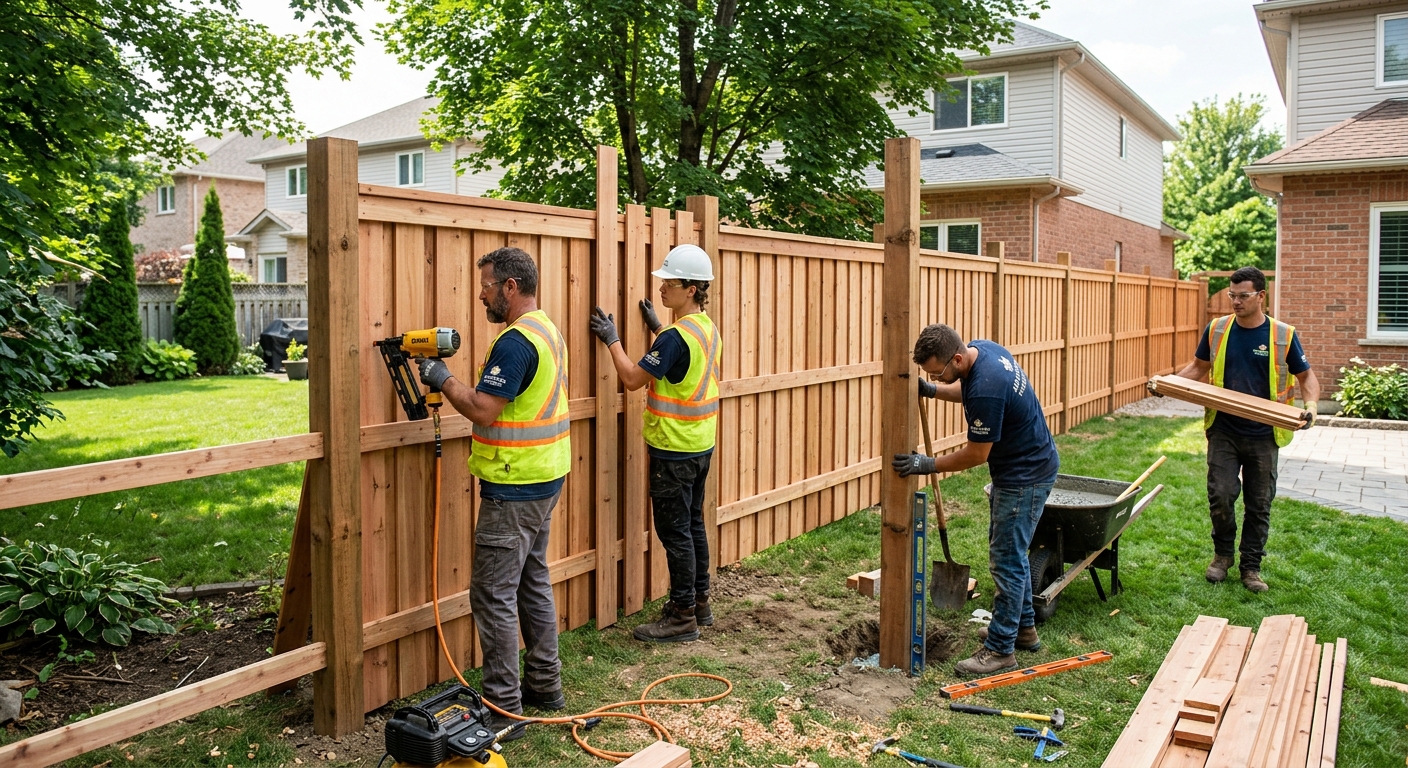
Fencing options and costs in Spallumcheen
Spallumcheen is a fence-friendly community, and if you’re shopping for a new boundary or backyard upgrade you’ll quickly notice why. With 89.7% of dwellings being single-detached houses and 81.1% of households owning their home (Statistics Canada, 2021 Census), most fencing demand here is driven by homeowners maintaining property lines, dogs, gardens, and seasonal privacy. That ownership rate is one reason you’ll find steady contractor availability for standard backyard runs, especially around family residential corridors and older lot neighbourhoods.
In the Thompson–Okanagan, your fence price is shaped by frost depth, soil conditions, and wind exposure. Interior valleys can demand deeper post settings to reduce freeze–thaw heave, and that changes both material quantities and installation time. On exposed benches or areas with stronger wind, crews often brace more, use heavier rails, and tighten spacing to prevent racking—so the “same length of fence” can still land in different price bands. Wood options are also influenced by wetting and drying cycles; without good treatment and proper airflow, boards can grey and wear faster than in very mild coastal microclimates.
In practical terms, many homeowners in East Vernon / Spallumcheen proper (and similar residential pockets with established yards and mature landscaping) choose projects that balance long service life with manageable maintenance. Below is a straightforward comparison to help you budget before we get into what changes your quote the most.
| Material |
Lifespan |
Maintenance |
Privacy Rating |
Price per Linear Foot |
| Pressure-treated pine (standard wood) |
10–15 years |
Stain/seal every 2–3 years |
Medium–High |
$55 – $85 |
| Cedar (natural rot resistance) |
15–25 years |
Seal/stain every 2–4 years |
High |
$65 – $105 |
| Vinyl / PVC (no-maintenance) |
20–30 years |
Rinse as needed |
High |
$75 – $115 |
| Chain-link (galvanized steel) |
20–35 years |
Occasional tension/spot touch-ups |
Low |
$35 – $60 |
| Aluminum ornamental |
25–40 years |
Wash 1–2 times per year |
Low–Medium |
$90 – $150 |
| Composite / recycled material |
25–35 years |
Light cleaning; minimal treatment |
High |
$95 – $140 |
Prices are estimates only and vary by project scope, site access and material selection.
What affects the price of fencing in Spallumcheen
In Spallumcheen and across the Thompson–Okanagan, fence quotes for the “same” job can diverge by 30–50% because post depth, soil conditions, and wind loading change what’s required to make the fence stay straight for years. Even within British Columbia, two nearby lots can behave differently: one may be well-drained and compact, while another has clay or poor drainage that holds moisture around the footing. That moisture is what makes freeze–thaw movement more likely, and it’s the reason contractors spend more time on proper excavation and concrete setting in certain areas.
Frost line depth is the big driver. Local practice is to set posts about 4–6 inches below the design frost depth so the post doesn’t heave during freeze–thaw cycles. In colder parts of the region (and on tougher soils), that can translate to deeper, longer holes and posts, and it often means concrete-set posts instead of gravel backfill. Concrete setting adds auger time, concrete volume, and labour—pushing wood and cedar projects from lower ends of the $55–$85 bands toward the upper end, and sometimes beyond once footing complexity increases.
Wind exposure matters too. Where gusts are common, we typically use closer spacing, heavier rails, and more diagonal bracing, which can nudge costs in both wood and vinyl toward the higher $75–$115 type ranges. As for local examples in Spallumcheen: a sloped yard that requires stepped panels increases material waste and labour; replacing a rotted section full of unstable base posts often adds excavation and disposal; and areas with clay or wet subsoil usually require concrete and deeper footings to reduce movement.
| Price Factor |
Why It Matters |
Cost Impact |
| Fence length in linear feet |
The primary driver—materials and labour scale directly with run length |
Largest swing: longer runs can shift the total by several thousand dollars |
| Post depth required |
Frost line determines how deep holes must go to prevent heaving |
Deeper holes can add auger time and increase both labour and post length costs |
| Post setting method |
Concrete vs. gravel pack vs. driven posts affects stability and durability |
Concrete-set posts typically cost more than gravel-pack, but reduce future movement |
| Material choice |
Vinyl/cedar behave differently with moisture, sun, and temperature |
Switching from chain-link (lower band) to vinyl/cedar (mid-to-upper bands) changes budget materially |
| Gate count and type |
Hinged hardware, framing, and sometimes double gates increase labour |
A couple of gates can add a substantial portion to the total beyond the straight fence price |
| Grade and terrain |
Sloped yards require stepped/raked panels and extra layout time |
Often increases material waste and labour, especially for privacy-style panels |
| Old fence removal and disposal |
Demolition time, hauling, and recycling fees vary by condition |
Rotted posts and buried footings can turn a “simple demo” into a longer day |
| Permit fees and survey / property line locate |
Some installations need documentation; line locating prevents encroachment issues |
Administrative costs can add up, and rework after a mistake is far more expensive |
Permits & regulations in British Columbia
In British Columbia, fencing typically comes with height and location rules, and fences above a common threshold—often 2.0 m (6.5 ft) at the rear and about 1.0–1.2 m (3–4 ft) at the front or corner—may require a building permit depending on where the fence sits and how it relates to your property line and setbacks. Regardless of height, all fences must respect property lines and municipal setback bylaws.
Before any post-hole digging, you should call for utility locates. In BC, use BC 1 Call. This is about preventing dangerous strikes to buried services. Next, confirm your property boundary—either by a survey or by locating your property pins—so you don’t end up encroaching and creating a dispute.
For shared fencing situations, the concept of line-fences is governed by provincial line-fences legislation. That matters if your fence serves two properties or if a neighbour disputes who should pay for repairs.
For licensing and coverage checks in Spallumcheen: ask for the contractor’s business details and verify they’re eligible to do the work they’re advertising (often through online business/contractor registry information), then request a certificate of liability insurance and written proof they’re covered for workplace risk. If you’re using a crew that employs workers, you should also confirm WCB coverage where applicable. Finally, keep copies of clearance letters and insurance certificates in your quote package.
Choosing the right fence material for Spallumcheen
Picking the right fence material in Spallumcheen is mostly matching your priorities—privacy, low maintenance, budget, and lifespan—to how Thompson–Okanagan weather actually treats fencing. Pressure-treated pine is usually the budget starting point, but it needs proper staining to prevent rapid grey weathering and surface checks; in our conditions, many homeowners plan on maintenance every 2–3 years. Cedar has a natural rot-resistance advantage and often looks better longer, but it still benefits from staining/sealing to keep colour and slow fibre breakdown.
Vinyl/PVC is attractive for “set it and forget it,” and it can be an excellent low-maintenance choice in BC when installed correctly. However, in extreme cold snaps, vinyl can become brittle at damaged points, so strong post spacing and good hardware installation are important. Chain-link is the most cost-efficient option in most runs and has a long service life, but it offers minimal privacy—so it’s best when you’re fencing pets, securing a yard, or protecting gardens rather than blocking views.
Aluminum ornamental fencing provides a clean look and won’t rust like steel, but it’s not a privacy solution on its own. Composite/recycled materials can be a strong compromise: high privacy and durability, often with less maintenance than traditional wood.
Post depth also governs material success. Because freeze–thaw cycles are a real factor in interior BC, many Spallumcheen installations use deeper post settings (commonly about 4–6 inches below design frost depth). That’s why concrete-set posts are often recommended where soils are heavy or moisture-prone. Where wind is higher, we may use heavier rails or bracing regardless of material.
Example: if a 50-foot cedar privacy run lands near the middle of the cedar band, you might see a difference of roughly $500–$2,000 compared with pressure-treated pine—an amount that can be justified if you prefer fewer board replacements over time. If you’re comfortable with staining schedules, pine can be the smarter value; if you want long-term stability with less upkeep, cedar or vinyl often earns its cost.
| Material |
Cold Tolerance |
Lifespan |
Annual Maintenance |
Best For |
Price Band |
| Pressure-treated pine |
Good (with proper post depth and ventilation) |
10–15 years |
Light checks; stain/seal every 2–3 years |
Budget privacy and classic wood look |
$55 – $85 |
| Cedar |
Very good (naturally rot-resistant) |
15–25 years |
Seal/stain every 2–4 years |
Longer-lasting privacy with better curb appeal |
$65 – $105 |
| Vinyl / PVC |
Good (install spacing and hardware correctly) |
20–30 years |
Minimal (rinse as needed) |
Low-maintenance privacy |
$75 – $115 |
| Chain-link |
Excellent |
20–35 years |
Occasional tension/spot touch-ups |
Security, pets, and best-value perimeter fencing |
$35 – $60 |
| Aluminum ornamental |
Very good |
25–40 years |
Wash 1–2 times per year |
Decorative boundaries and low rust risk |
$90 – $150 |
| Composite / recycled |
Good (durable boards; avoid damage at posts) |
25–35 years |
Light cleaning; minimal treatment |
Privacy with reduced upkeep |
$95 – $140 |
How to choose a fencing contractor in Spallumcheen
Choosing the right fencing contractor in Spallumcheen starts with verification and clear documentation. In British Columbia, ask for their certificate of liability insurance (you should see your jobsite listed or, at minimum, an active certificate with coverage limits) and confirm their coverage for workplace risk (commonly verified through WCB coverage when workers are involved). Then, verify the contractor’s business standing through the appropriate online registry resources and ensure the contact information and business name match what’s on the quote and invoice.
Next, get 2–3 itemised written quotes. I recommend asking for a breakdown that separates labour, materials, post setting (including concrete quantity if used), gate framing and hardware, and any removal/disposal line. A proper quote should tell you what’s included and what’s excluded—especially hauling away old fencing, utility locate fees, and whether a permit pull is included or done by you. If a contractor gives only a lump sum without line items, it’s harder to spot changes later.
Warranty matters too. Look for a workmanship warranty (often covering post/rail movement and installation defects) and a separate manufacturer product warranty for the material itself. Ask whether warranties are transferable to future homeowners.
For payment schedule: never pay more than 10–15% upfront. Hold back the remainder until the fence is complete, straight, gates function properly, and cleanup is done. Finally, get a start date and completion estimate in writing, including weather contingencies typical for interior BC winters.
- Provide an itemised quote (labour, posts, rails, panels, gate hardware, concrete/gravel, and disposal)
- List post depth and post-setting method (concrete-set vs. gravel pack)
- Show how they’ll handle slopes (stepped vs. raked panels)
- Confirm who orders utility locates and when they’re called
- Include gate sizes, hinge type, and latch hardware in writing
- State whether permits are required and who pulls the permit
- Describe protection for landscaping and surface restoration
- Ask for insurance certificate and verify coverage dates
- Confirm WCB coverage if the contractor uses employees
- Request warranty terms for workmanship and materials separately
- Agree on a payment schedule with a small deposit and holdback until completion
- Get a written start date, estimated finish date, and plan for weather delays
In Spallumcheen, I consider these red flags: (1) a quote that won’t specify post depth or post-setting method, (2) refusing to provide proof of liability insurance and WCB coverage, (3) “cash-only” arrangements with no written scope, (4) vague exclusions like “demo/disposal not included” without details, and (5) pressuring you to pay most of the cost upfront before work begins.
Frequently asked questions — fencing in Spallumcheen
Can I install a fence on a slope in Spallumcheen?
Yes, fencing on slopes is common in Spallumcheen, but it needs the right layout approach to stay straight and stable. Typically, contractors either use stepped panels (where each section is level but the fence “steps” up the grade) or raked panels (slightly angled boards following the slope). For privacy fences, stepped construction is often preferred because it reduces twisting stress on rails and helps the fence remain plumb after freeze–thaw seasons. When soil is moisture-prone, we also pay extra attention to post depth and footing stability below grade. Before digging, confirm property pins or get a locate so your fence stays on-side.
What is the most weather-resistant fence for Spallumcheen's climate?
For interior BC conditions in Spallumcheen, the “most weather-resistant” usually comes down to how well the fence is installed for frost and moisture—not just the brand. Generally, vinyl/PVC and composite/recycled systems handle wetting and sun exposure well, while chain-link performs strongly because it doesn’t rot and resists corrosion when it’s properly galvanized. Cedar and pressure-treated wood can also last a long time if posts are set below frost and you maintain the finish. In Thompson–Okanagan, many homeowners choose cedar because it resists rot better than standard wood, while still providing solid privacy. If you want a budget point of reference, pressure-treated fencing often sits around $55 – $85 per linear foot, while vinyl commonly runs closer to $75 – $115 depending on height and gate count.
How do I prevent wood fence rot in Spallumcheen?
Rot usually starts where water sits—around post bases and trapped moisture in tight, poorly ventilated sections. In Spallumcheen, prevention begins with proper post installation: set posts below the local frost depth so they don’t heave, and use concrete-set posts where soils hold water. Avoid burying raw wood directly in wet contact; proper framing and ground clearance matter. On wood panels, stain/seal on a realistic schedule (often every 2–3 years for pressure-treated pine) helps reduce moisture absorption. Also plan for airflow: don’t pack mulch tight against the fence line where boards stay damp. Finally, remove any failing boards early—waiting turns a small repair into a base-post problem.
What is the cost per linear foot for fencing in Spallumcheen?
Typical installed costs in Spallumcheen follow the Thompson–Okanagan banding. Chain-link is usually the lowest, commonly around $35 – $60 per linear foot. Pressure-treated wood tends to fall near $55 – $85, while cedar privacy often lands higher because of material and longer-lasting boards, commonly around $65 – $105. Vinyl/PVC typically ranges around $75 – $115 depending on height, rails, and gate hardware. Aluminum ornamental generally costs more, often around $90 – $150. Your exact per-foot number can shift with post depth, concrete setting, gate count, slope complexity, and whether old fence removal and disposal are included.
Should I repair or replace my old fence in Spallumcheen?
Repair is usually worth it when the fence rails and posts are still solid and the issue is limited—like a few warped pickets, minor hardware failure, or a small section that needs new boards. Replacement is smarter when posts are leaning from movement, when the base has rotted, or when multiple sections are failing at different heights due to freeze–thaw heave. In older housing areas (and in homes built long before 1981 is common in many parts of BC), you often see older posts that were set too shallow for frost conditions or without proper post protection—so “patching” can delay the inevitable. A good approach is to get a written inspection that pinpoints which posts are stable, then compare the cost of targeted repairs versus full replacement including proper footing depth.
How do I handle a fence dispute with a neighbour in British Columbia?
Fence disputes are stressful, and in British Columbia they often involve boundary lines and shared responsibility. Start by confirming the location: review your property pins or get a survey/locate so you’re working from accurate boundary information. Then document everything—photos, dates, and any previous agreements. If the fence is shared or you believe it was intended as a shared line fence, provincial line-fences legislation may apply to how costs and repairs are handled. The practical step is to communicate in writing and propose solutions that correct the issue (for example, adjusting a fence back to the correct line or replacing failing sections). If you can’t agree, speak with the relevant local authority or obtain professional boundary guidance before proceeding with any changes—especially before digging post holes.