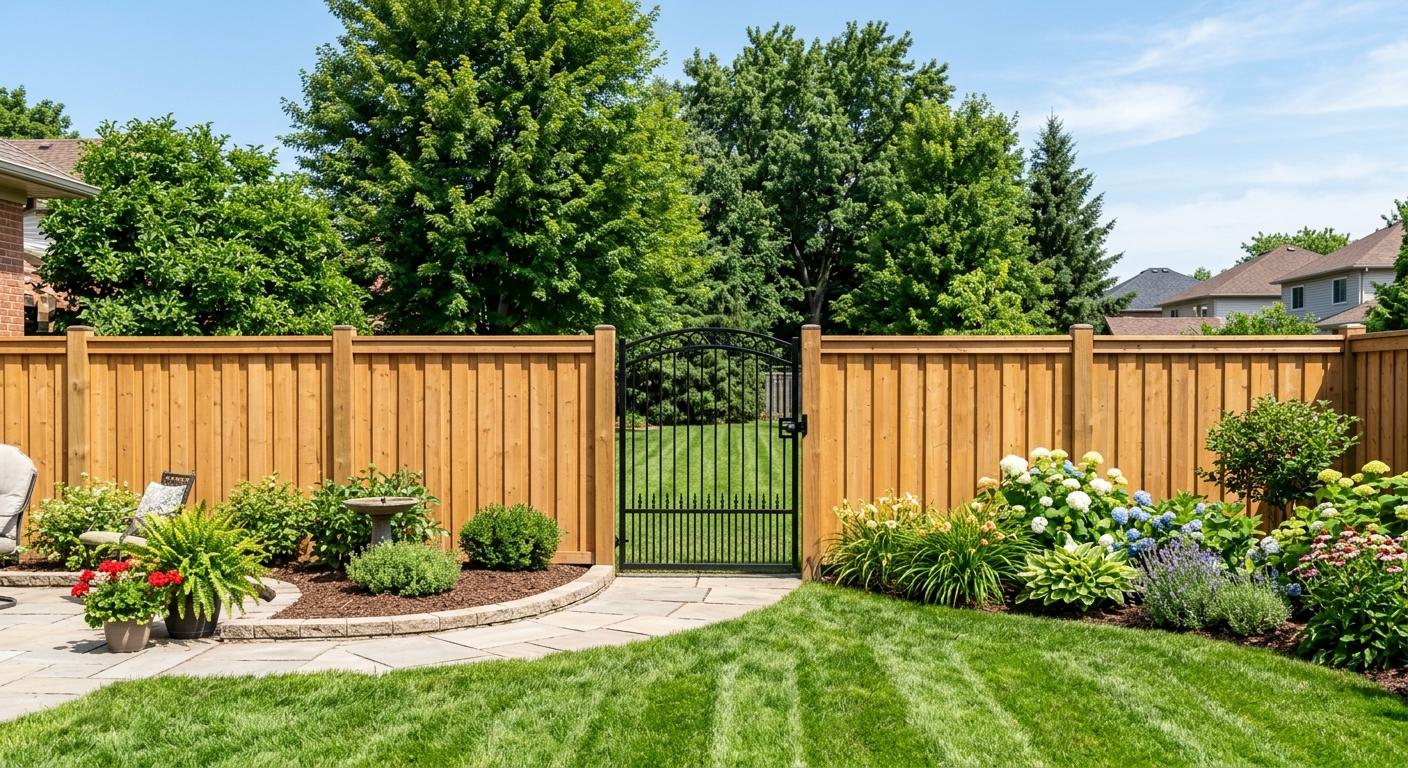
Fencing options and costs in Mackenzie
Mackenzie homeowners often start shopping for fencing by looking at privacy and curb appeal, but in the Cariboo region the installed price is just as strongly shaped by frost depth, soil conditions and how exposed your yard is. With 80.8% of local households owning their homes and single-detached dwellings making up 66.7% of the housing stock (Statistics Canada, 2021 Census), there’s steady demand for back-yard enclosures, side-yard boundary fences and replacement panels. Most wood-and-post work in Mackenzie also reflects the age of the neighbourhood buildout: with 77.3% of homes built before 1981 (Statistics Canada, 2021 Census), it’s common to see older fence lines needing partial rebuilds, post replacement and hardware upgrades.
In Mackenzie, contractors plan around freeze–thaw cycles by setting posts at least about 3 ft (≈0.9 m) below grade, and often deeper depending on local ground and drainage. Concrete-set footings are common, which increases labour and material costs compared with gravel-set approaches. Wind is a secondary driver: open lots and corridors can push crews toward heavier posts, tighter panel spacing and more rigid styles, especially for vinyl and solid wood privacy fences. You’ll notice this demand most often around the residential areas near central services and along busy frontage streets where properties are more exposed and yards are used year-round.
Below is a practical comparison of the options most commonly quoted in Mackenzie, with typical lifespans, upkeep expectations and regional price points to help you interpret bids before you get to the final scope.
| Material |
Lifespan |
Maintenance |
Privacy Rating |
Price per Linear Foot |
| Pressure-treated pine (standard wood) |
10–15 years |
Stain/seal every 2–3 years; check posts after freeze–thaw |
High (solid boards) |
$45 – $80 |
| Cedar (natural rot resistance) |
15–25 years |
Light re-staining every 2–4 years; inspect hardware |
High (solid boards) |
$55 – $95 |
| Vinyl / PVC (no-maintenance) |
20–30 years |
Occasional wash; inspect for impact cracks in extreme cold |
High (privacy styles) |
$65 – $110 |
| Chain-link (galvanized steel) |
20–35 years |
Rinse as needed; tighten fittings; add privacy slats if desired |
Low–Medium (slats optional) |
$35 – $65 |
| Aluminum ornamental |
25–40 years |
Occasional cleaning; hardware checks |
Low–Medium (decorative pickets) |
$70 – $130 |
| Composite / recycled material |
20–30 years |
Minimal cleaning; replace damaged boards if impacted |
High (privacy panel styles) |
$85 – $125 |
Prices are estimates only and vary by project scope, site access and material selection.
What affects the price of fencing in Mackenzie
Even when two contractors price what looks like the same fence, it can land 30–50% apart across the Cariboo and broader British Columbia because the foundation work and installation time vary more than most homeowners expect. In practice, the crew’s post-setting approach, how much levelling or stepping is needed, and whether the quote assumes concrete-set footings all swing labour hours and equipment costs. Material differences matter too, but in Mackenzie the ground and exposure are usually the bigger surprise. That’s why you’ll see a privacy fence quote sit at the lower end of the regional wood range (for example, closer to $45 – $80) when conditions are simple, but move toward the higher end when posts must be longer and set in concrete.
Frost line depth is the main driver. Cariboo contractors typically set posts about 4–6 inches (≈0.1–0.15 m) below the design frost depth requirement for stability; in cold zones this often means longer posts, deeper holes and more concrete. That’s also where you’ll feel time and material costs directly: more excavation, more rebar or post bracing, and longer cure/inspection coordination when concrete is used. Wind exposure can add cost indirectly by requiring heavier posts, tighter spacing and more robust rails—particularly for solid privacy panels and vinyl systems that need proper alignment.
In Mackenzie specifically, costs usually rise when (1) your yard has clay or poor drainage that increases excavation difficulty and footing settling risk, (2) you need frequent fence steps on a sloped lot, and (3) the existing fence must be removed and hauled away. Costs can be closer to the lower bands when (1) there’s easy access for a skid-steer or mini-excavator, (2) the run is straight with minimal corners and (3) you’re building on firmer ground that accepts a clean hole for concrete-set posts.
| Price Factor |
Why It Matters |
Cost Impact |
| Fence length in linear feet — the primary cost driver |
More panels and posts means more excavation, hardware and labour hours |
Directly scales total cost; small changes in length can swing the quote |
| Post depth required — frost line determines post length and hole depth |
Deeper settings reduce heaving during freeze–thaw cycles |
Often increases both material length and excavation volume |
| Post setting method — concrete vs. gravel pack vs. driven posts |
Concrete-set footings improve stability in many Cariboo soil conditions |
Concrete typically raises labour/material cost but improves longevity |
| Material choice — vinyl vs. cedar vs. chain-link |
Different weights, bracket requirements and panel stiffness affect installation time |
Vinyl can add upfront cost; chain-link is often lower per linear foot |
| Gate count and type — walk-through vs. drive-through (double) |
Gates require heavier hinges, latches and stronger frames |
More gates can add significant labour and hardware cost |
| Grade and terrain — sloped yards require stepped or raked panels |
Unlevel ground affects rails, brackets and panel fit-up |
Stepping/raking adds time and increases material waste |
| Old fence removal and disposal |
Hauling and sorting materials adds work beyond new-build assembly |
Can materially increase the total, especially with mixed materials |
| Permit fees and survey / property line locate |
Ensures compliance with setbacks and prevents encroachment disputes |
May add a few hundred dollars and a scheduling delay depending on timing |
Permits & regulations in British Columbia
In British Columbia, fences above a height threshold often require a building permit—commonly around 2.0 m (6.5 ft) for rear yards and about 1.0–1.2 m (3–4 ft) at the front or corner. Exact local thresholds can vary, so in Mackenzie you should confirm with the municipality for your specific address and fence location relative to streets and intersections. All fences must respect property lines and municipal setback bylaws, meaning the “where it goes” matters as much as the “what it’s made of.”
Before you dig any post hole, call for utility locates (BC 1 Call) so crews and equipment can work safely around buried services. Also, obtain a survey or at least a property line locate to confirm where pins are, especially where an older fence may not perfectly match the current boundary. Disputes often start when a replacement fence is built from the prior fence line without verification.
Shared fence ownership is handled through provincial line-fences legislation principles, which generally affect responsibilities for maintenance and cost-sharing when fences are on or near shared boundaries.
Licence and insurance checks (step-by-step for Mackenzie homeowners): Ask for the contractor’s proof of British Columbia licensing/registration where applicable, then request a certificate of liability insurance and verify active coverage limits. For work coverage, ask how they handle workplace safety requirements (commonly WCB clearance or equivalent proof). Review the certificate for named insured, policy effective dates and project address details. If you’re unsure, follow up to obtain a clearance letter showing WCB/WCB account status (or the appropriate proof provided by the contractor).
Choosing the right fence material for Mackenzie
Choosing fence material in Mackenzie is about matching your priorities to Cariboo conditions: cold winters with freeze–thaw, seasonal moisture, and the need for stable posts set below grade. For privacy, a solid wood or vinyl privacy style is usually the top choice, but each option carries different upkeep demands. Pressure-treated pine is the budget-friendly path, yet it typically needs staining or sealing every 2–3 years to slow grey weathering and keep water out of the surface. Cedar looks great and naturally resists rot better, but it still benefits from periodic sealing, especially when fence boards face persistent damp wind.
Vinyl/PVC is popular because it’s marketed as “no-maintenance,” and in Mackenzie it often holds up well—assuming correct installation with proper panel expansion and attention to post depth. Vinyl can crack if stressed or installed too rigidly during temperature swings, so the post and rail alignment matters. Chain-link is the longest-life low-cost option and works well around yards where visibility isn’t a problem, but it won’t give true privacy unless you add slats or a secondary screen. Aluminum ornamental gives rust resistance and a clean look, though it provides limited privacy compared with solid panels. Composite or recycled materials can be a good compromise for homeowners who want less maintenance than wood while keeping a privacy-panel aesthetic.
On frost-depth: regardless of material, post depth matters. In the Cariboo, posts are typically set at least about 3 ft (≈0.9 m) below grade, and crews often go deeper in heavier soils. Concrete-set posts are common when soils are variable or when you want long-term stability—this is where jobs can shift toward the higher end of the regional bands. For example, a homeowner comparing pressure-treated pine (~$45 – $80 per linear foot) to vinyl privacy (~$65 – $110) might justify the extra upfront cost if they value minimal maintenance for 15–20+ years, particularly in a colder freeze–thaw environment.
| Material |
Cold Tolerance |
Lifespan |
Annual Maintenance |
Best For |
Price Band |
| Pressure-treated pine |
Good (if posts are set deep and hardware is rated) |
10–15 years |
Inspect 1–2 times; stain/seal every 2–3 years |
Budget privacy where you’re willing to maintain |
$45 – $80 |
| Cedar |
Good (boards handle moisture better than many woods) |
15–25 years |
Inspect annually; seal/stain every 2–4 years |
Natural look with better rot resistance |
$55 – $95 |
| Vinyl / PVC |
Very good (proper expansion and alignment required) |
20–30 years |
Occasional wash; check post alignment and fittings |
Low-maintenance privacy |
$65 – $110 |
| Chain-link |
Excellent (steel fence system tolerates cold) |
20–35 years |
Minimal; rinse and tighten as needed |
Security with minimal visual obstruction |
$35 – $65 |
| Aluminum ornamental |
Excellent (no rust in normal conditions) |
25–40 years |
Occasional cleaning; tighten hardware |
Front-yard curb appeal and durability |
$70 – $130 |
| Composite / recycled |
Good (designed for moisture and freeze–thaw) |
20–30 years |
Low; occasional wash and spot repairs |
Privacy look with less upkeep than wood |
$85 – $125 |
How to choose a fencing contractor in Mackenzie
Choosing the right fencing contractor in Mackenzie starts with verifying credentials and then controlling scope. In British Columbia, ask for proof of the contractor’s licensing/registration status where applicable, and request a certificate of liability insurance—verify it’s active and that coverage limits are appropriate for the job size. For workplace safety, ask for WCB/WCB clearance documentation or equivalent proof of coverage; don’t accept verbal assurances. Where to check: for licensing/registration, use the relevant online registry search the contractor points you to; for insurance, review the certificate directly; for WCB status, request the clearance letter and confirm the dates match your project timeframe.
Next, get 2–3 itemised written quotes. You want line items for excavation, post installation (including specified embedment depth and footing method), rails/bracing, panels, hardware, concrete supply (if used), gate hardware and any removal/disposal. Avoid single “lump sum” quotes unless you still get a detailed scope attachment—fencing jobs are particularly prone to missing details like how corners are braced or whether the quote includes stepped/raked adjustments for sloped areas. Confirm whether permits are included, whether a property line locate or survey is part of the work, and who is responsible for any utility locate coordination.
Warranty matters for both workmanship and product. Ask for the workmanship warranty length, whether it’s transferable to the next owner, and what falls under manufacturer coverage for rails, posts and panels. For payments, never pay more than 10–15% upfront; use a staged schedule and hold back until substantial completion. Finally, insist on a written start date and a completion estimate so you can plan around winter work constraints and curing times.
- Ask for embedment depth and footing method in writing (e.g., concrete-set vs. gravel pack).
- Confirm how they handle corners, gates and line braces in wind-exposed runs.
- Request insurance certificate and verify effective dates.
- Request WCB clearance/coverage proof matching your job dates.
- Get 2–3 quotes with labour + materials separated.
- Confirm whether permit paperwork and locate coordination are included.
- Specify removal/disposal scope for the old fence.
- Make sure slope handling is included (stepped vs. raked panels).
- Ask for product details: model/style, rail spacing and board thickness.
- Clarify gate type, number of hinges and latch hardware grade.
- Confirm warranty terms: workmanship duration and manufacturer coverage.
- Use a payment schedule with a holdback at substantial completion.
Red flags I commonly see with fencing contractors in Mackenzie: (1) they won’t put post depth and footing method in the quote, (2) they can’t show insurance/WCB proof when asked, (3) they require large upfront payments beyond 10–15%, (4) the quote excludes disposal without clearly stating a haul-away charge, and (5) they provide only a lump sum with no materials list or gate hardware specifications.
Frequently asked questions — fencing in Mackenzie
How do I compare fencing quotes?
Start by comparing the scope line-by-line, not just the final number. In Mackenzie and the Cariboo, quotes can differ a lot because post embedment depth and footing type (concrete-set vs. gravel pack) directly affect labour and materials. Ask each contractor to itemise excavation, post installation, rails/bracing, panel style, gate hardware and whether removal/disposal is included. Ensure the quote states how they handle slope (stepped or raked), and confirm the expected post spacing for wind stability. As a quick reality check, privacy fences made of pressure-treated pine often land near $45 – $80 per linear foot, while vinyl privacy is commonly higher, around $65 – $110, depending on the footing method and gate count. If the numbers are close but the scopes aren’t, you’ll usually find the difference in the hidden details.
How long does fence installation take in Mackenzie?
Typical timelines in Mackenzie depend on length, access, and how much site prep is required. A straightforward run with minimal corners and no old fence removal may move faster, but winter-adjacent schedules can slow down post-hole work and curing for concrete footings. As a general expectation, small projects (for example, shorter backyard runs and one gate) can be completed in a couple of days of on-site labour, while longer runs often take several days. If you need step-raked panels on a slope or you’re removing an existing fence, add time for demolition, disposal and re-measuring boundaries. Also ask whether they expect concrete cure time before rails and panels are fully installed—this is especially important with freeze–thaw conditions in British Columbia. The most reliable way to plan is to request an in-writing start date and completion estimate tied to your scope.
Can I install a fence on a slope in Mackenzie?
Yes—slope fencing is common in Mackenzie—but the installation method affects both appearance and performance. Contractors generally handle slopes using stepped panels (varying height between posts) or raked panels (maintaining a consistent grade angle). For privacy boards, stepped installs often look cleaner when the grade changes noticeably over a short distance. Raked systems can work well too, but rails and panel alignment must be measured carefully so gates still swing properly. In cold Cariboo conditions, the slope also influences how deep posts must be set; the “lowest” side may require deeper embedment to stay stable through freeze–thaw cycles. When you request a quote, confirm which method they will use and whether the pricing includes the extra labour and materials waste that comes with slope adjustments.
What is the most weather-resistant fence for Mackenzie's climate?
“Most weather-resistant” depends on what you’re measuring—rot resistance, impact durability, or long-term stability. For freeze–thaw and moisture, cedar performs well because it naturally resists rot compared to many softwoods, while vinyl systems are valued for low upkeep and moisture resistance. However, the foundation method is what really determines long-term stability in British Columbia: even the best material will struggle if posts aren’t set deep enough or if concrete-set footings aren’t used where soil conditions demand them. Chain-link is also extremely durable in cold weather and is long-lived, but it won’t provide privacy unless you add slats or a secondary screen. If your priority is low-maintenance longevity, many homeowners compare vinyl privacy (often around $65 – $110 per linear foot) versus cedar or treated wood depending on maintenance comfort and budget.
How do I prevent wood fence rot in Mackenzie?
Preventing rot in Mackenzie starts before the boards go up: use correctly rated pressure-treated wood or cedar, and ensure the posts and hardware are installed properly. The biggest mistake I see is cutting corners on post depth or letting posts sit too high above grade—freeze–thaw can loosen them, and trapped moisture accelerates rot at the bottom. For wood fences, concrete-set posts (where appropriate) and proper drainage around footings help keep the timber drier. Also use exterior-rated fasteners and keep board ends sealed or select compatible board systems that shed water. Maintenance matters: even pressure-treated pine usually benefits from staining or sealing every 2–3 years to reduce grey weathering and moisture penetration. Plan on annual visual checks after winter and address loose boards or damaged rails quickly to prevent bigger sections from staying wet.
What is the cost per linear foot for fencing in Mackenzie?
In Mackenzie, pricing is usually quoted per linear foot, and the “per-foot” number changes with material, post setting method and gate complexity. Regional bands that contractors commonly work within for this tier are: chain-link around $35 – $65, pressure-treated pine wood installation about $45 – $80, vinyl/PVC about $65 – $110, and aluminum/metal ornamentals about $70 – $130. Cedar and composite privacy options typically fall between the wood and vinyl ranges depending on style and footing requirements. If your project includes concrete-set footings, steep slopes, or multiple gates, expect the per-foot figure to drift toward the higher side of the band. To get the most accurate number, ask for an itemised quote that specifies embedment depth and post setting method, not just the material line.