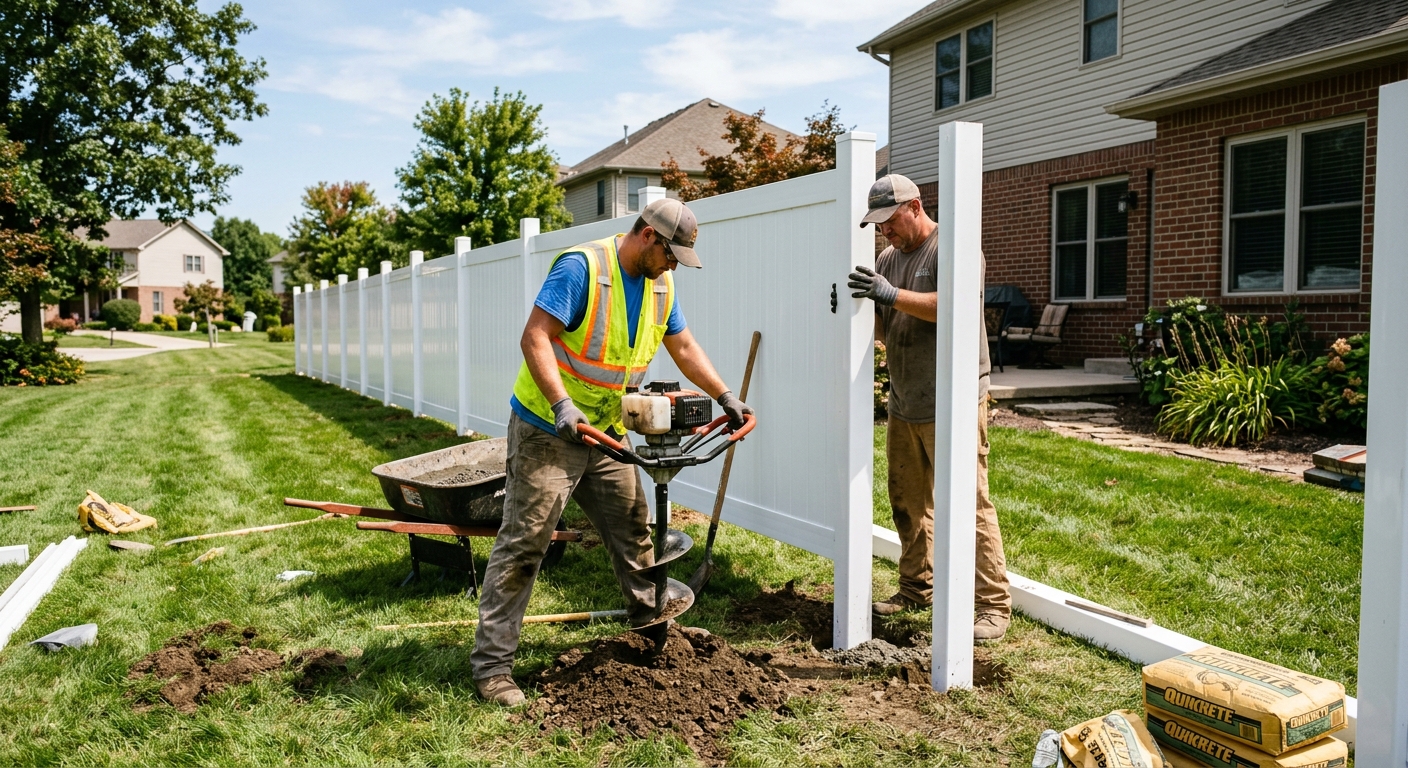
Fencing options and costs in Guildford
Guildford is a fast-growing community in Surrey, and for homeowners there, the right fence is often the difference between a private backyard and an open, windy yard. With 64,985 people in the 2021 Census and a housing stock that includes many detached properties (Statistics Canada, 2021 Census), there’s steady demand for fencing around yards, side lots, and pool areas. That demand is especially noticeable in residential pockets near Bear Creek / Guildford Centre, where homeowners regularly upgrade older fences or extend fencing for new landscaping.
In the Lower Mainland–Southwest, fencing costs are shaped by mild but persistent frost and wind, plus wetter Fraser Valley soils. Even though the freeze isn’t like Ontario or Alberta, contractor estimates still factor in deeper post embedment to help limit heaving, and that often means more concrete, longer posts, and extra labour on every corner and gate location. Availability and pricing can also vary by material: wood crews are common, but vinyl and composite often require more structured installs and stronger post framing for longer runs and gate spans.
Below is a practical cost comparison you can use to sanity-check quotes. After you review it, the next step is understanding why the same length and height fence can land 30–50% apart across the Lower Mainland–Southwest.
| Material |
Lifespan |
Maintenance |
Privacy Rating |
Price per Linear Foot |
| Pressure-treated pine (standard wood) |
10–15 years |
Stain/seal every 2–3 years |
Good to very good (solid boards) |
$55–$95 |
| Cedar (natural rot resistance) |
15–25 years |
Light staining/maintenance every 2–4 years |
Very good (solid cedar boards) |
$75–$115 |
| Vinyl / PVC (no-maintenance) |
20–30 years |
Occasional wash |
Very good (solid privacy panels) |
$75–$130 |
| Chain-link (galvanized steel) |
20–40 years |
Minimal (rinse/repair after impact) |
Low (privacy screen needed) |
$30–$55 |
| Aluminum ornamental |
25–40 years |
Occasional cleaning |
Low to medium (depends on pick spacing) |
$90–$170 |
| Composite / recycled material |
20–30 years |
Minimal (no staining) |
Very good (solid/composite boards) |
$95–$155 |
Prices are estimates only and vary by project scope, site access and material selection.
What affects the price of fencing in Guildford
For the same fence height and style in Guildford, quotes across the Lower Mainland–Southwest and other parts of British Columbia can easily differ by 30–50%. The biggest reason is that fencing pricing is driven by build conditions, not just materials. Two yards can have the same linear footage, yet one requires deeper post embedment, more concrete at corners, extra labour due to wet soil, or additional time for gate framing and slope transitions.
Post embedment is a key driver. Frost line depth sets how deep posts must be set—typically 4–6 inches below the local design frost depth—to limit heaving. In cold Ontario and Alberta regions, this commonly translates to roughly 1.5–2.0 m into the ground, which raises both material and labour costs. In coastal BC and the Lower Mainland–Southwest, embedment is often shallower than the Prairies, but crews still tend to go deeper than a “bare minimum” install, especially in wetter Fraser Valley soils where holes stay unstable and concrete setting takes more time.
Wind exposure also changes how a fence is built. Prairie sites push tighter post spacing and heavier panels; in Surrey and nearby areas, wind gusts still affect how contractors size rails and braces. Coastal BC’s mild but wet conditions accelerate wood rot when pressure-treated or cedar isn’t installed with correct airflow and sealing, which is why many installers prioritize concrete for privacy panels, corner posts, and gates.
Concrete examples from local installs: (1) a backyard behind the Guildford Centre area with heavy clay can require extra excavating, longer posts, and more concrete than a similar job on a drier lot; (2) a sloped side yard may require raked panels and additional rails, raising labour even if the fence length stays similar; and (3) removing an older fence often adds disposal fees and surprise time for rusted hardware removal. If your plan is “mid-range wood,” many projects still land in the wood band (for example, $55–$95 per linear foot), while vinyl privacy fencing usually starts higher (often $75–$130 per linear foot) because materials and structural framing are heavier.
| Price Factor |
Why It Matters |
Cost Impact |
| Fence length in linear feet — the primary cost driver |
More sections means more posts, rails, and fasteners |
High; often the largest swing between quotes |
| Post depth required — frost line determines post length and hole depth |
Deeper holes reduce heaving risk and stabilize corners/gates |
Medium to high; deeper holes increase labour and concrete |
| Post setting method — concrete vs. gravel pack vs. driven posts |
Concrete improves stability in wet soils; gravel can be cheaper but varies by ground |
Medium; concrete-setting typically adds cost and time |
| Material choice — vinyl vs. cedar vs. chain-link |
Material price and structural requirements differ |
High; chain-link generally lowest, vinyl highest among common residential options |
| Gate count and type — walk-through vs. drive-through (double) |
Gates require heavier posts, hardware, and precise alignment |
Medium; gates can add noticeable labour and material costs |
| Grade and terrain — sloped yards require stepped or raked panels |
More cutting, rails adjustments, and layout time |
Medium; can raise labour even when linear footage is the same |
| Old fence removal and disposal |
Demolition time plus hauling/disposal costs |
Low to medium; can become medium if posts are concrete-set or rusted |
| Permit fees and survey / property line locate |
Some higher fences and boundary work require approvals/verification |
Low to medium; can delay scheduling and add admin cost |
Permits & regulations in British Columbia
In British Columbia, fences above a height threshold—typically about 2.0 m (6.5 ft) at the rear and roughly 1.0–1.2 m (3–4 ft) at the front or corner—often require a building permit, depending on the lot location and municipal bylaws. Even when a permit isn’t required for a standard backyard run, you still need to respect property lines and any municipal setbacks that apply to your specific frontage. Before you dig any post hole, call for utility locates through the appropriate service (such as BC 1 Call) to confirm where buried services run.
For Guildford homeowners, the practical best practice is to confirm your property line first: obtain a survey or have pins located to avoid encroachment disputes with neighbours. Fence ownership and shared fence responsibilities are handled under provincial line-fences legislation, so if your fence sits on a boundary or protects a shared amenity area, you’ll want to confirm who maintains what.
What typically requires a permit: taller installations near thresholds (often above 2.0 m at the rear, and higher than front/corner allowances), plus boundary/complex projects that municipal staff flag during review. What typically does NOT require a permit: standard, code-compliant residential fences under the height threshold for your location, assuming they stay within setbacks and property line requirements and you’re not modifying structures requiring approvals.
When verifying a contractor in BC, check: (1) licensing/registration information via the relevant provincial online registry for the trade they claim to perform; (2) liability insurance certificate (make sure it lists you as an additional insured if your quote offers it); and (3) clear documentation of WSIB/WCB coverage where applicable for the crew doing the work. Ask for the certificate before signing; if they can’t provide current documentation, treat it as a major red flag.
Choosing the right fence material for Guildford
Choosing a fence in Guildford is really about matching material to your priorities: privacy, low maintenance, budget control, and lifespan in Lower Mainland–Southwest weather. The region’s mild but wet climate means wood that’s installed incorrectly—or left unstained—can start to grey and soften sooner than homeowners expect. Meanwhile, wind can stress rails and panel spacing, so your post setting and hardware choices matter as much as the board type.
Pressure-treated pine is the budget-friendly option, but it typically needs staining or sealing every 2–3 years to prevent uneven weathering and premature rot at fastener lines. Cedar costs more than pine but holds up better visually because it has natural rot resistance; many homeowners still plan on periodic maintenance, usually every 2–4 years, depending on sun exposure and sprinkler patterns. Vinyl/PVC is popular for low maintenance—usually no staining and only occasional washing—but extreme cold snaps can make some panels feel brittle if the system isn’t designed and installed for winter flex. Chain-link is the lowest-cost and often lasts a very long time, but it won’t give much privacy unless you add slats or screening.
For many Guildford yards, concrete-set posts are a smart choice on corners, gates, and privacy runs because wetter soils can undermine purely gravel-based stability. With frost conditions that still warrant proper embedment (often deeper than an “absolute minimum” install), contractors typically set posts below the local frost influence zone to limit heaving. If you’re comparing options, a vinyl privacy project often starts around the $75–$130 per linear foot band, while wood frequently lands in the $55–$95 per linear foot band—meaning the extra upfront cost can be justified when you want fewer maintenance days and consistent appearance year-round.
| Material |
Cold Tolerance |
Lifespan |
Annual Maintenance |
Best For |
Price Band |
| Pressure-treated pine |
Good with proper staining and sealed top edges |
10–15 years |
Light check + plan for staining every 2–3 years |
Lower budget with traditional look and acceptable maintenance |
$55–$95 |
| Cedar |
Good; resists rot better in wet cycles |
15–25 years |
Inspect annually; stain/light maintenance every 2–4 years |
Premium appearance with moderate maintenance |
$75–$115 |
| Vinyl / PVC |
Good; avoid poor installation in deep freeze—use correct spacing and hardware |
20–30 years |
Occasional wash/visual inspection |
No-maintenance privacy in changing weather |
$75–$130 |
| Chain-link |
Good; galvanized steel tolerates cold and moisture well |
20–40 years |
Minimal; rinse and repair after impacts |
Security/containment where privacy isn’t the main goal |
$30–$55 |
| Aluminum ornamental |
Very good; powder-coated finish resists corrosion |
25–40 years |
Occasional cleaning and tightening hardware |
Attractive curb appeal with low rust risk |
$90–$170 |
| Composite / recycled |
Good; performs well where properly supported |
20–30 years |
Minimal; no staining, periodic cleaning |
Mixed priority: low maintenance + long-term looks |
$95–$155 |
How to choose a fencing contractor in Guildford
Start by verifying British Columbia credentials before you compare price. Ask each contractor for their current liability insurance certificate (and review the coverage limits), then confirm they carry the required worker protection coverage (commonly WSBC for BC-based work). Where a contractor operates in BC, look for proof of coverage documentation dated within the current year. For workmanship accountability, request their permit responsibility in writing if your fence triggers approval requirements.
Next, get 2–3 itemised written quotes. You want labour and materials broken down clearly—posts, rails, panel type, concrete/setting method, gate hardware, and any removal/disposal. A responsible quote also lists whether they’re including utility-locate costs (or at least whether you’re responsible for calling). Scope clarity matters: what’s excluded (for example, landscaping reinstatement, stump/rock removal, or custom raking), is disposal included, and is permit pulling included where applicable.
For warranty, ask for: (1) the workmanship warranty length; (2) the manufacturer’s product warranty terms; and (3) whether warranties are transferable to new homeowners. In Guildford-area work, a shorter workmanship warranty can be a sign they don’t expect to warranty post-setting or alignment issues.
Payment schedule should be conservative: don’t pay more than 10–15% upfront. Hold back a portion until the job is complete and you’ve confirmed line/level, gates swing properly, and post caps are installed (where used). Always request a start date and a completion estimate in writing.
- Confirm liability insurance certificate is current and covers fencing installation on residential sites in BC.
- Check worker coverage documentation (WSBC/WCB) for the crew who will be on-site.
- Verify the contractor’s BC licence/registration information for the type of work they’ll do.
- Request 2–3 itemised quotes (labour + materials), not just one lump-sum number.
- Ask whether permits are required for your planned height and whether they pull the permit.
- Confirm utility locate responsibility (you call vs. they include) before digging.
- Make sure the quote specifies post embedment depth, post setting method, and concrete quantity approach.
- Clarify gate type (walk-through vs. drive-through double), hardware brand/grade, and adjustment plan.
- Confirm how they handle slope—stepped vs. raked panels—and whether layout lines are shown on site.
- Ask if old fence removal, hauling, and disposal are included, and whether concrete-set posts are treated separately.
- Get warranty details in writing: workmanship length, product warranty, exclusions, and transferability.
- Use a payment schedule with only 10–15% upfront and a holdback until final walkthrough acceptance.
Red flags to watch in Guildford: (1) they won’t provide insurance/coverage documentation before you sign; (2) they refuse to itemise material vs labour or won’t specify post setting and embedment; (3) they pressure you into paying most of the job upfront; (4) they promise a “universal fence depth” without inspecting soil; and (5) they can’t explain how gates will be aligned on sloped yards or how disposal is handled.
Frequently asked questions — fencing in Guildford
How long does fence installation take in Guildford?
In Guildford, most typical residential fence installs (around 40–80 linear feet, one run with standard walk gates) are completed in about 1 to 3 working days, assuming weather cooperates and access is reasonable. The timeline stretches when the job includes heavy removal, concrete-set posts from an older fence, or difficult grading where raked/stepped panels are required. In wetter Surrey/Lower Mainland–Southwest soils, crews sometimes need extra time for excavation and concrete setting stability, especially at corners and gate posts. If you’re comparing options, note that materials can change schedule: chain-link is usually faster to assemble, while vinyl privacy panels often require more careful alignment for clean sightlines. Pricing often reflects this pace, with chain-link commonly starting in the $30–$55 per linear foot band and wood/vinyl generally higher because of labour and framing.
Can I install a fence on a slope in Guildford?
Yes, you can install a fence on a slope in Guildford, but you should expect the layout method to be more detailed than on flat ground. Contractors typically use either stepped fencing (posts remain vertical with panels stepping up/down) or raked fencing (panels follow the slope angle). The right approach depends on your preferred look, privacy goals, and how the yard transitions near property lines or between retaining features. Because Surrey-area yards often have uneven grading and drainage patterns, discuss drainage and how post holes will be dug without undermining adjacent soil. Proper planning also matters for gate operation—gates must swing smoothly even when the fence line changes height. If you’re quoted a “flat” install on a sloped lot, ask how they’ll manage spacing, alignment, and rail adjustments; that’s where the real labour cost difference shows up between a low-cost option and one built to last.
What is the most weather-resistant fence for Guildford's climate?
For Guildford’s Lower Mainland–Southwest mix of mild winters, frequent moisture, and wind, the most weather-resistant options are typically chain-link (galvanized steel) and vinyl/PVC privacy systems, provided they’re installed with correct post depth and hardware spacing. Chain-link is resilient against rot because it isn’t wood-based, and galvanized steel tolerates wet cycles well, though it won’t offer privacy without additional screening. Vinyl is also rot-resistant and can be very low maintenance, but it still needs solid post setting at corners and gates for long-term stability through temperature swings and gusts. Cedar and pressure-treated wood are also viable if you choose quality boards and follow proper installation and staining routines—wood fails fastest when water gets trapped at cut ends and fasteners. If you’re targeting long-term performance and fewer maintenance visits, many homeowners accept the cost tradeoff: vinyl privacy commonly falls in the $75–$130 per linear foot range, while chain-link often starts at $30–$55.
How do I prevent wood fence rot in Guildford?
To prevent rot in a Guildford wood fence, focus on installation details as much as board choice. First, ensure posts are set with proper embedment and a stable setting method—wet Fraser Valley–type soils can destabilize holes, leading to wobble and gaps where moisture collects. Second, keep water from sitting on wood: use correct clearance to allow airflow, install end caps where applicable, and avoid burying boards where they can stay damp. Third, cut ends and damaged areas should be sealed (especially for pressure-treated lumber). Finally, maintain the finish: stain/seal typically every 2–3 years for pressure-treated pine, and inspect annually so small issues don’t become structural rot. In practice, rot is often worst near corners and gate posts, where wind and loading flex the fence and concentrate movement. If you’re choosing between wood types, cedar usually offers better natural rot resistance than pine, but it still benefits from routine maintenance.
What is the cost per linear foot for fencing in Guildford?
In Guildford, most realistic per-linear-foot installed pricing typically fits the regional bands for the Lower Mainland–Southwest: chain-link is commonly around $30–$55, wood installation often lands around $55–$95, and vinyl/PVC privacy commonly falls around $75–$130. Aluminum/metal is often higher, commonly $90–$170, because of materials and fabrication demands. Your actual number depends on height, exact style, gate count, slope grading, and how much concrete and labour the job needs for proper post setting in wetter soil. If you’re comparing quotes, make sure each one includes the same items: post depth/setting method, gate hardware, and whether removal/disposal is included. A lower per-foot price can disappear quickly if one quote excludes concrete setting or disposal for an old fence.
Should I repair or replace my old fence in Guildford?
It’s usually worth repairing when the fence is structurally sound—posts are solid, rails aren’t rotted or pulling away, and the damage is limited to a few boards or minor sagging. Replace rather than repair when you see widespread rot at posts, multiple sections leaning, repeated board failure, or rusted chain-link components with loose tensioning that no longer holds alignment. In the Lower Mainland’s wetter conditions, rot can travel from the base upward, so a fence that looks “mostly fine” may still be compromised at the embedment points. Also consider how replacement affects permitting: taller fences or changes in height may trigger permit requirements. If you’re currently spending for repeated patchwork, replacing can be more cost-effective over time. For budgeting, compare the cost bands: if repairs still require significant labour, upgrading from old wood often moves you into wood’s $55–$95 range, while switching to vinyl privacy may put you closer to $75–$130 per linear foot for a more maintenance-free long run.