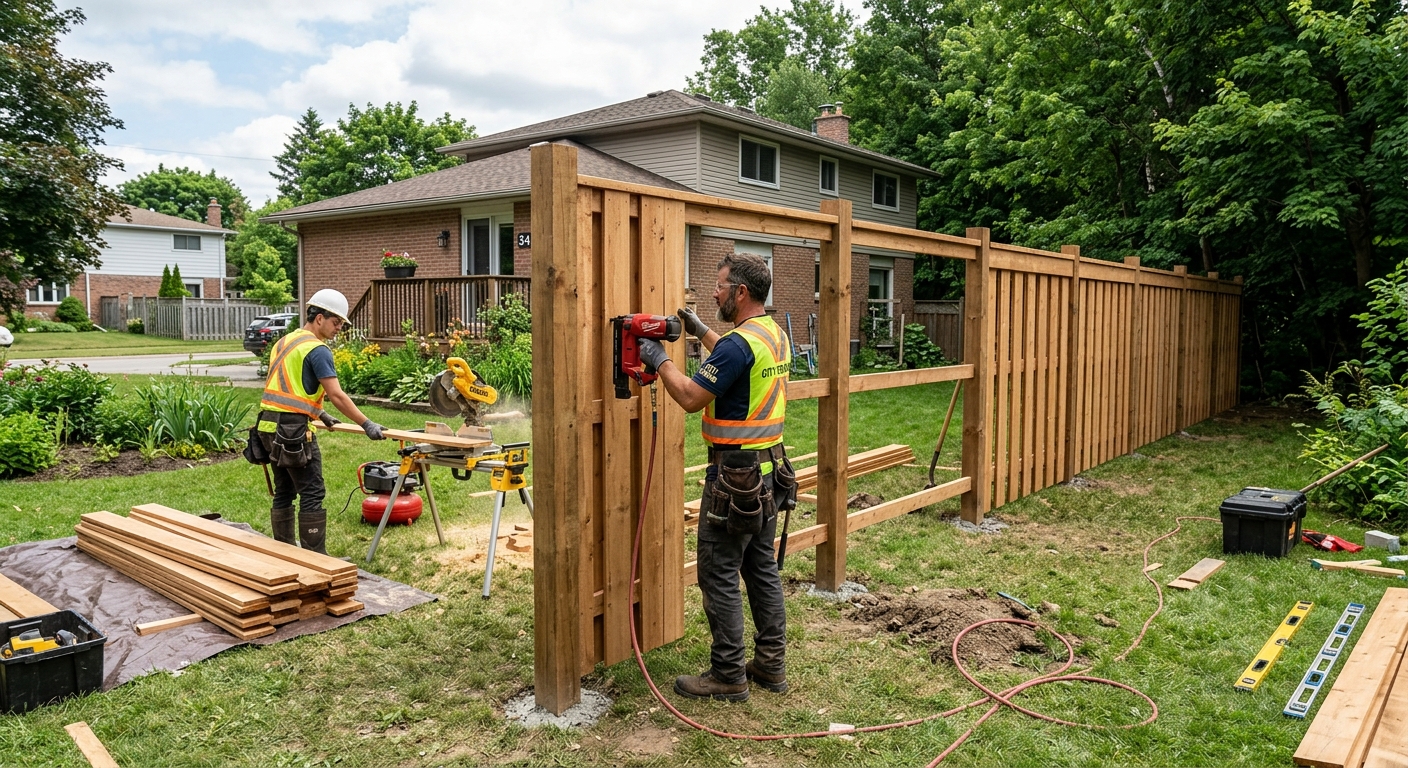
Fencing options and costs in Blundell
In Blundell, choosing a fence is often less about “what looks nice” and more about what fits your yard, your privacy needs, and what the local weather will do to materials over time. With 18,065 residents in the 2021 Census (Statistics Canada, 2021 Census), Blundell is a smaller community within the Lower Mainland–Southwest, so demand is driven by property owners who need boundary definition, pet control, and backyard privacy—especially on detached lots where fences protect landscaping and play spaces.
Here, the Lower Mainland–Southwest climate is typically mild but wet, with wind off open areas and frosty nights that still matter for construction details. That means contractors price fencing around the need to set posts deep enough to limit heaving and to handle moisture in Fraser Valley–style soils. In practice, many installers still go deeper than a bare “minimum,” and they commonly use concrete-setting for privacy panels, corner posts, and gate posts to reduce wobble. If you’re in a busier pocket—like the residential areas near the boundary of Richmond/Steveston access routes—crews are often scheduling builds around school-season yard projects and landscaping timelines.
Because site access and soil conditions can swing labour requirements, you’ll see quotes that land at different points within each material band. Use the comparison table below to sanity-check your estimate before you lock in details like post depth, gate style, and whether old fence removal is included.
| Material |
Lifespan |
Maintenance |
Privacy Rating |
Price per Linear Foot |
| Pressure-treated pine (standard wood) |
10–20 years |
Stain/seal every 2–3 years; inspect for warping |
Good (solid pickets possible) |
$55–$95 |
| Cedar (natural rot resistance) |
15–25 years |
Light maintenance; stain if you want consistent colour |
Good–Excellent (solid styles available) |
$65–$110 |
| Vinyl / PVC (no-maintenance) |
20–30 years |
Wash as needed; check gate hardware |
Excellent (solid privacy panels) |
$75–$130 |
| Chain-link (galvanized steel) |
25–40 years |
Low; occasional tightening/repairs |
Low (privacy slats optional) |
$30–$55 |
| Aluminum ornamental |
20–35 years |
Wash; touch up hardware if needed |
Low–Medium (open picket design) |
$90–$170 |
| Composite / recycled material |
25–35 years |
Minimal; clean and inspect fasteners |
Good–Excellent (solid panels) |
$85–$150 |
Prices are estimates only and vary by project scope, site access and material selection.
What affects the price of fencing in Blundell
Even when two homeowners request the same height and similar materials in the Lower Mainland–Southwest, Blundell fence quotes can differ by roughly 30–50% once you account for build conditions and how contractors manage the extra labour. The biggest reason is that frost-depth considerations, soil moisture, and wind exposure aren’t uniform across the region, and the contractor’s crew efficiency changes with access, slope, and disposal requirements. In addition, Vancouver/Surrey/Richmond supply chains can price materials slightly differently than interior markets, and that cost flows into the final per-linear-foot number.
Post depth is a key driver. Frost line guidance is typically expressed as posts set about 4–6 inches below the design frost depth; to prevent heaving, crews in colder Canadian regions often embed posts far deeper (commonly 1.5–2.0 m) with longer posts and concrete setting—raising both material and labour costs. In coastal BC, the frost risk is often shallower than Ontario and Alberta, but wet soils still demand careful hole prep, compaction, and drainage. That’s why contractors may still go deeper than the “bare minimum” on privacy panels, corner posts, and gates.
Two local examples that raise costs in Blundell are wet-site excavation (so deeper holes require more concrete and better backfill) and gate builds (extra bracing and heavier posts to handle latch loads). A second example is when you need stepped construction on a sloped yard—labour increases because rails must be raked and picket spacing maintained.
Material choice also changes the equation: chain-link often stays closer to the $30–$55 band because it’s light and quick to install, while vinyl/PVC at $75–$130 can cost more due to panel structure, framing, and temperature sensitivity during installation. The housing stock matters too—older lots sometimes need extra time for old fence removal and for locate work near older services.
| Price Factor |
Why It Matters |
Cost Impact |
| Fence length in linear feet — the primary cost driver |
Most labour and materials scale directly with footage |
High (largest portion of the total) |
| Post depth required — frost line determines post length and hole depth |
Deeper holes increase excavation, disposal, and concrete |
Medium–High |
| Post setting method — concrete vs. gravel pack vs. driven posts |
Concrete reduces wobble for gates/privacy; gravel lowers cost where appropriate |
Medium |
| Material choice — vinyl vs. cedar vs. chain-link |
Different framing, panel systems, and expected lifespan change labour and product pricing |
Medium–High |
| Gate count and type — walk-through vs. drive-through (double) |
Gates require stronger posts, hardware, and often diagonal bracing |
Medium–High |
| Grade and terrain — sloped yards require stepped or raked panels |
Extra layout time and custom cutting add labour |
Medium |
| Old fence removal and disposal |
Hauling and dump fees vary; rotten sections can require extra demolition |
Low–Medium (but can jump on larger removals) |
| Permit fees and survey / property line locate |
Some projects need documentation to avoid boundary disputes and ensure compliance |
Low–Medium |
Permits & regulations in British Columbia
In British Columbia, fences above a height threshold—typically around 2.0 m (6.5 ft) at the rear and 1.0–1.2 m (3–4 ft) at the front or corner—often require a building permit. Even when a permit isn’t needed, you still must respect property lines and local setback requirements in your area. In Blundell, where lots can be close to property edges and older services may run near fences, compliance starts before you dig.
Before any post hole is dug, arrange utility locates. In BC, use BC 1 Call so crews can mark buried lines. Next, confirm your layout: obtain a survey or at least verify your property pins/markers before installing, because “fence feel” can lead to encroachment and costly corrections. For shared fence situations, line-fence responsibilities are governed by provincial line-fences legislation, including who may maintain or contribute when fences serve both properties.
What usually requires a permit: higher fences over the common front/corner vs rear thresholds, plus any special structural work tied to height or site conditions. What typically does not require a permit: like-for-like replacement of a fence within standard height limits on the same footprint, assuming it remains within property lines and local bylaws.
To verify a contractor is properly covered in BC, ask for (1) their contractor licence or registry listing (check online with the provincial licensing system), (2) a certificate of insurance showing liability coverage, and (3) proof of coverage for workplace compensation obligations (WSIB/WCB coverage). Your contractor should provide clear, dated documentation and a certificate that matches the legal name of the business on the quote.
Choosing the right fence material for Blundell
Picking fence material in Blundell is about matching your priorities—privacy, low maintenance, budget, and expected lifespan—to a climate that’s mild but wet. Pressure-treated pine is usually the budget-friendly route, but it needs staining/sealing every 2–3 years to reduce grey weathering and keep fasteners and boards performing. Cedar offers a naturally rot-resistant look and tends to age more gracefully in moisture, though it still benefits from periodic maintenance for best appearance.
Vinyl/PVC is a strong low-maintenance choice for privacy panels because it doesn’t rot, but extreme cold snaps and improper installation can lead to cracking—so reputable crews handle temperature and fastening correctly. Chain-link is typically the lowest-cost per foot and lasts a long time, but it offers limited privacy unless you add privacy slats or an adjacent screen. Aluminum ornamental fencing is attractive and won’t rust, yet it’s mostly for boundary definition rather than true privacy.
Post depth matters regardless of material. Even though coastal BC frost depth is typically shallower than colder provinces, contractors in the Lower Mainland–Southwest often set posts below frost heave risk and use concrete for key structural points—corner posts, privacy panel sections, and especially gate posts. Wind and snow loads aren’t as severe as open Prairie regions, but heavy rain can saturate soils, so proper hole prep and backfill still affect longevity.
For a concrete example: if you’re deciding between chain-link at about $30–$55 per linear foot and vinyl/privacy closer to $75–$130, the extra cost is usually justified when you truly need visual screening from neighbours, street views, or backyard activity—especially where you want a “set it and forget it” outcome.
| Material |
Cold Tolerance |
Lifespan |
Annual Maintenance |
Best For |
Price Band |
| Pressure-treated pine |
Good; avoid poor drainage around posts |
10–20 years |
Seal/stain every 2–3 years; quick fastener checks |
Budget privacy with manageable upkeep |
$55–$95 |
| Cedar |
Good; handles moisture better than many softwoods |
15–25 years |
Light staining/cleaning as desired |
Attractive look with better rot resistance |
$65–$110 |
| Vinyl / PVC |
Moderate; can be brittle in extreme cold if installed poorly |
20–30 years |
Wash as needed; check gate hardware |
Low maintenance privacy |
$75–$130 |
| Chain-link |
Good; resilient to weathering |
25–40 years |
Minimal; tighten posts/rails occasionally |
Pet containment and perimeter security |
$30–$55 |
| Aluminum ornamental |
Excellent; non-rusting |
20–35 years |
Wash/inspect annually |
Style and durability with minimal upkeep |
$90–$170 |
| Composite / recycled |
Good; consistent boards in variable moisture |
25–35 years |
Low; clean and inspect fasteners |
Premium low-maintenance privacy |
$85–$150 |
How to choose a fencing contractor in Blundell
Choosing the right contractor in Blundell starts with proof of coverage and details—not just a competitive number. In British Columbia, ask for (1) licensing/registration information for the company (check the provincial online registry for the business name before you pay), (2) liability insurance (request a certificate of insurance and confirm it’s current and includes work at your address), and (3) workplace compensation coverage documentation for the crew. Your contractor should provide clear certificates with the legal business name matching the quote and invoices; if they can’t, treat it as a red flag.
Next, get 2–3 itemised written quotes. Look for a breakdown that separates labour, materials, post setting (including concrete vs gravel pack), gates, and any line-item for disposal/hauling. Avoid “lump sum only” quotes that don’t show how post depth and footing methods are handled. Carefully read the scope: what’s included in permit pulls (if required), what happens if a locate shows an unexpected service, and whether existing fence removal and dump fees are covered.
Warranty matters too. Ask for a workmanship warranty length (not just “manufacturer warranty”) and confirm whether it’s transferable if you sell the property. For payment scheduling, never pay more than about 10–15% upfront; hold back the remainder until the job is complete and cleaned up. Finally, get a written start date and completion estimate so you can plan around rain days, inspection timing (when permits apply), and gate hardware lead times.
- Confirm the contractor’s BC registration/licence status using the business name on the quote.
- Request a current certificate of insurance and verify liability coverage limits.
- Ask for proof of workplace compensation coverage for their workers (not just subcontractor claims).
- Insist on itemised labour and materials—not just one total number.
- Require a clear post-depth plan and setting method (concrete-set at corners/gates where needed).
- Confirm gate type, number, and hardware details (hinges, latches, and whether double gates are braced).
- Ask if disposal/removal of the old fence is included and where the debris is hauled.
- Check how they handle slope: stepped vs raked panels and how they maintain spacing.
- Confirm permit responsibility: will they pull permits if the fence height triggers one?
- Get a written start date and an estimated completion date.
- Review warranty terms for both workmanship and materials; ask if it’s transferable.
- Use a payment schedule with a small deposit and holdback until final walkthrough.
Red flags to watch for in Blundell: vague scope language (“we’ll take care of it”), no proof of insurance/licensing, quotes that ignore post depth or gate structural needs, oversized deposits (beyond ~10–15%), and contractors who won’t put start dates, warranty length, and exclusions in writing.
Frequently asked questions — fencing in Blundell
How much does a fence cost in Blundell?
In Blundell, most residential fence installs land inside the regional British Columbia price bands based on material and complexity. For a typical yard, chain-link is often the lowest at about $30–$55 per linear foot installed, while wood commonly sits around $55–$95. Vinyl/PVC usually costs more because of material and framing demands, often around $75–$130. Your final number can move up or down depending on fence length, gate count, slope, and whether the contractor includes old fence removal and disposal. Wet soils in the Lower Mainland–Southwest can also increase labour when holes need deeper concrete setting for privacy panels and gate posts.
How deep should fence posts be for Blundell's frost?
To reduce heaving risk, fence posts should be set below the design frost depth so the foundation doesn’t lift during freeze-thaw cycles. Practical guidance commonly targets roughly 4–6 inches below the local frost depth; in colder Canadian regions that can mean much deeper embeds (often about 1.5–2.0 m) with concrete setting. In coastal BC, frost is often less deep than Ontario and Alberta, but Blundell soils can stay wet, and contractors still frequently set posts deeper than the absolute minimum—especially for corner posts, privacy rails, and gate posts. Ask your installer to specify the intended embedment depth, hole diameter, and post-setting method (concrete vs gravel pack), and whether they’ll adjust for saturated soil conditions.
Wood vs vinyl vs aluminum fence — which is best?
“Best” depends on what you value most. If budget and a classic look matter, pressure-treated wood (often around $55–$95) is a common choice, but plan on staining or sealing every 2–3 years to keep it looking its best in coastal moisture. Cedar usually costs a bit more but resists rot better; it still needs maintenance for colour and finish. Vinyl/PVC (often $75–$130) is popular for low maintenance and strong privacy; just ensure installation is done correctly for temperature and fastening. Aluminum is durable and won’t rust, but it’s usually more “decorative boundary” than privacy, with pricing often higher (commonly $90–$170). In Blundell’s wet, windy conditions, the right pick often comes down to how much privacy you need and how hands-on you want to be year to year.
Do I need a permit to build a fence in British Columbia?
In British Columbia, permits are commonly triggered when fences exceed typical height thresholds—around 2.0 m (6.5 ft) at the rear and about 1.0–1.2 m (3–4 ft) at the front or corner. Exact requirements can vary by situation and local bylaws, so confirm before you start. Permits aren’t the only factor: you must respect property lines and setbacks, and you should arrange utility locates before digging post holes (BC 1 Call). For your contract, ask whether the quote includes permit pulling if your fence height is above the usual thresholds. A reputable Blundell contractor should also help confirm layout against pins or a survey so you don’t end up with an encroachment dispute.
How long does a wood fence last in Blundell?
A wood fence lifespan in Blundell typically ranges from about 10–20 years for pressure-treated pine when it’s installed correctly and maintained, and roughly 15–25 years for cedar in many coastal moisture conditions. What changes the timeline is how posts are set, how well the design sheds water, and whether staining/sealing is kept up. Wet soil can increase stress at the base of posts, so concrete setting for key structural locations (corners, privacy runs, and gates) can improve long-term performance. Also, if maintenance is skipped—especially early on—greying, cupping, and loose hardware can speed up replacement. When you’re comparing quotes, make sure they specify post setting method and which treatment/grade of lumber is used, not just the fence height.
Who owns and maintains a shared fence?
In British Columbia, shared fence ownership and maintenance are governed by provincial line-fences legislation. In practical terms, it depends on whether the fence is truly on the boundary line and whether both properties treat it as a shared structure. Maintenance responsibilities can be shared, or one side may be responsible depending on the specific arrangement and any agreement in place. The safest approach in Blundell is to confirm the fence location against property pins or a survey before you sign anything. If you plan to repair or replace, communicate early with your neighbour, document the condition with photos, and ask your contractor to note whether their scope is boundary-compliant. If there’s uncertainty about ownership, speak with a professional familiar with line-fence matters before proceeding.