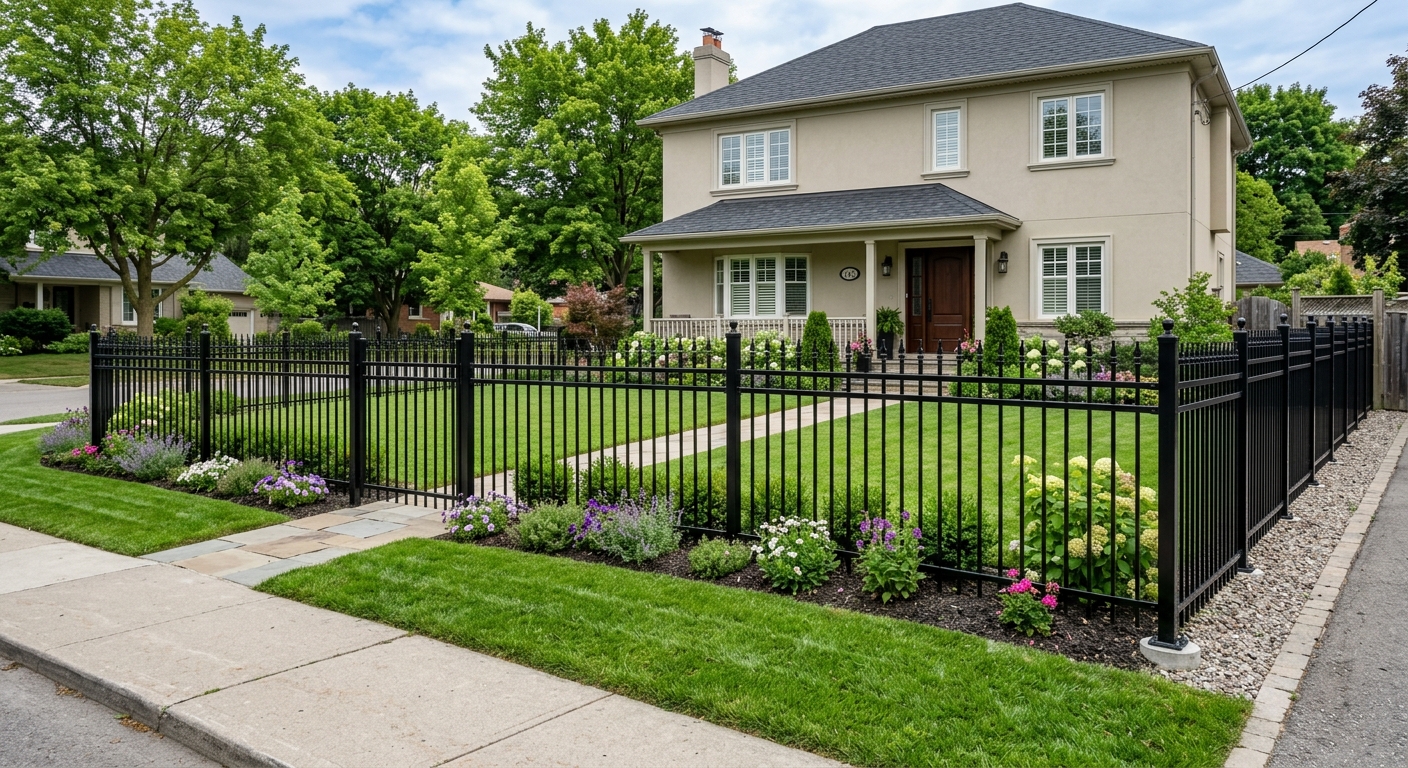
Fencing options and costs in Gold River
Gold River is a smaller community on Vancouver Island, and that affects how fencing projects get planned and scheduled. With 68.9% of local dwellings being single-detached homes (Statistics Canada, 2021 Census), most fencing demand comes from individual homeowners upgrading yards for privacy, pets, and property definition—particularly around practical, everyday areas like the waterfront-access properties where boundary lines and wind exposure matter.
On Vancouver Island and the Coast, fencing costs are shaped by moderate coastal frost and frequent wind. Even though the frost line is relatively shallow (about 45–60 cm), contractors still set fence posts below design frost to reduce heaving and long-term leaning—often burying posts around 75–90 cm. That means extra excavation time and, in many cases, concrete footings where soil is wet, disturbed, or clay-rich.
Material pricing also behaves differently than in the Prairies. Coastal salinity and rain accelerate corrosion on unprotected hardware, so galvanized or powder-coated components (and better-quality fasteners) are worth the upfront cost. Wind-driven loads can also change design: solid privacy panels may need heavier posts or tighter post spacing, while open styles like chain-link handle gusts with standard spacing.
In Gold River, trades are busiest where many older lots were subdivided and fences are due for replacement—commonly seen around the older residential pockets and backyard lanes where homeowners built fences decades ago. Next, compare common fence types side-by-side with typical local cost ranges.
| Material |
Lifespan |
Maintenance |
Privacy Rating |
Price per Linear Foot |
| Pressure-treated pine (standard wood) |
10–15 years |
Stain/seal every 2–3 years |
High |
$55 – $85 |
| Cedar (natural rot resistance) |
15–25 years |
Re-stain 2–4 years (weather-dependent) |
High |
$70 – $105 |
| Vinyl / PVC (no-maintenance) |
20–30 years |
Rinse as needed; avoid impacts |
High |
$70 – $110 |
| Chain-link (galvanized steel) |
20–35 years |
Occasional wash; tighten hardware |
Low–Medium |
$35 – $60 |
| Aluminum ornamental |
25–40 years |
Wash; inspect for loose sections |
Medium–Low |
$80 – $140 |
| Composite / recycled material |
20–30 years |
Minimal; rinse and inspect |
High |
$95 – $150 |
Prices are estimates only and vary by project scope, site access and material selection.
What affects the price of fencing in Gold River
In Gold River and across Vancouver Island and the Coast, you can see fencing quotes for the “same” job vary by roughly 30–50%. The main reason is that fencing is labour-and-site-time heavy: two yards that look similar from the road may have very different post-hole conditions, access limitations, and wind-resistant design requirements.
First, frost control sets how deep posts must be set. In cold Ontario and Alberta, posts often need 1.5–2.0 m of embedment, which drives up both excavation time and material cost. On Vancouver Island, the frost line is shallower (about 45–60 cm), but the practical target still usually lands around 75–90 cm buried depth to prevent heaving and long-term leaning. That still means concrete setting more often than people expect—especially where soil stays saturated through winter.
Second, wind exposure can change the engineering feel of a fence. While the Prairies push for tighter post spacing on heavier panels, coastal BC also benefits from venting or stronger framing when gusts are frequent. Solid privacy fences catch wind like a sail, so contractors may reduce spacing or upgrade posts/rails—raising the cost even if the fence is “just wood.”
Third, weather and maintenance realities matter. Wood in a wet climate can grey and rot faster if treatment is skipped, which is one reason some homeowners choose cedar or vinyl. For reference, pressure-treated wood often comes in around the local wood band of $55 – $85 per linear foot, while vinyl tends to run $70 – $110 per linear foot—an upgrade that can pay back when you factor in lower repeat maintenance.
In Gold River, three common cost swings are: (1) sloped yards that require stepped or raked panels, (2) rocky pockets that slow digging and alignment, and (3) soil that crumbles or drains poorly, which increases concrete footing and disposal time. Housing age plays in too: 77.0% of homes built before 1981 (Statistics Canada, 2021 Census) often have older layouts and mature landscaping that complicate line-of-work.
| Price Factor |
Why It Matters |
Cost Impact |
| Fence length in linear feet |
Labour, posts, rails, and materials scale directly with length |
High (largest driver) |
| Post depth required |
Frost conditions determine embedment and post length |
Medium–High |
| Post setting method |
Concrete vs. gravel pack vs. driven posts affects stability |
Medium–High |
| Material choice |
Vinyl, cedar, and chain-link differ in framing needs and hardware |
Medium |
| Gate count and type |
Drive-through and double gates require stronger framing and hinges |
Medium–High |
| Grade and terrain |
Slopes require stepped frames or custom panel layouts |
Medium |
| Old fence removal and disposal |
Hauling and grinding time can be significant |
Medium |
| Permit fees and survey / property line locate |
Administrative steps can add schedule and labour |
Low–Medium |
Permits & regulations in British Columbia
In British Columbia, fence permitting is commonly triggered by height thresholds—often around 2.0 m (6.5 ft) for rear yards, and roughly 1.0–1.2 m (3–4 ft) for front or corner areas—though the exact local rules depend on the municipality and lot location. Regardless of height, all fences must respect property lines and the applicable municipal setback bylaw. Before any post hole is dug, you should arrange utility locates through BC 1 Call (and follow any required site-marking process). This is essential even for “simple” fences, because services can run closer to property lines than homeowners expect.
A survey or property pin locate is the next practical step. If you’re uncertain where the lot line is, get a locate before installing. That protects you from encroachment disputes—especially on older lots, where fences were sometimes erected using landmarks rather than pins.
Shared fence ownership is handled by provincial line-fences legislation, so if you’re replacing a shared boundary fence, confirm who owns what and how costs may be apportioned.
Licence and coverage checks are part of homeowner due diligence in Gold River and across the coast. Ask for: (1) a valid business/contractor licence number where applicable via the provincial contractor registry your provider uses, (2) certificate of insurance naming you as additional insured if available (or proof of general liability), and (3) WSIB/WCB coverage where the contractor is required to carry it. Request the certificate and clearance letter (or equivalent clearance documentation), and verify it is current before work begins.
Choosing the right fence material for Gold River
Choosing fence material in Gold River is mostly about matching your priorities—privacy, low maintenance, budget, and lifespan—to a wet, windy Vancouver Island climate. For pressure-treated pine, the upfront cost is often the most budget-friendly, but the wood will typically need staining or sealing every 2–3 years to limit grey weathering and protect against moisture. Cedar has natural rot resistance and generally looks better over time, yet it still benefits from periodic maintenance and proper detailing around post tops and gate hardware. Vinyl/PVC is popular for no-fuss upkeep and strong privacy options, but it’s not impact-proof; heavy strikes from vehicles or yard equipment can cause cracking. Chain-link is the lowest-cost choice and tends to last a long time, but it doesn’t provide privacy (it’s more about security and defining boundaries). Aluminum ornamental offers a clean, rust-resistant look with mid-range costs, but it’s also not the privacy-maximizing style unless you add landscaping or choose semi-solid designs.
Post-depth considerations are similar across these options because the ground conditions drive embedment. With coastal frost on Vancouver Island, posts generally require burial around 75–90 cm (often with concrete footings for stability where soils are wet or clay-rich). That’s especially true when wind exposure is high and fences must stay plumb through winter.
Wind and snow load influence framing too. Solid privacy fences usually need stronger rails, sturdier posts, and sometimes closer spacing to resist gusts. In contrast, open styles like chain-link catch less wind and generally require less heavy framing.
As a dollar example: if a pressure-treated wood privacy fence is quoted around $55 – $85 per linear foot, a comparable vinyl privacy fence may land closer to $70 – $110 per linear foot. The difference can be justified in Gold River when you want fewer maintenance days and you’re replacing an older fence that already costs you time every season to repaint or repair.
| Material |
Cold Tolerance |
Lifespan |
Annual Maintenance |
Best For |
Price Band |
| Pressure-treated pine |
Good in coastal cold when properly sealed |
10–15 years |
Inspect and re-seal/stain as needed (often every 2–3 years) |
Budget privacy with willingness to maintain |
$55 – $85 |
| Cedar |
Good; handles damp air better than pine |
15–25 years |
Wash/inspect; re-stain periodically |
Better appearance and rot resistance |
$70 – $105 |
| Vinyl / PVC |
Very good; avoid impacts in freeze-thaw cycles |
20–30 years |
Rinse and check posts/hardware |
Low maintenance privacy |
$70 – $110 |
| Chain-link |
Excellent with galvanized components |
20–35 years |
Minimal; tighten hardware occasionally |
Security, long-term value, airflow yards |
$35 – $60 |
| Aluminum ornamental |
Excellent; no rust with quality coating |
25–40 years |
Wash; inspect for loose sections |
Attractive boundary with moderate upkeep |
$80 – $140 |
| Composite / recycled |
Good; stable in wet coastal conditions |
20–30 years |
Low; rinse and inspect for fasteners |
Privacy with minimal maintenance |
$95 – $150 |
How to choose a fencing contractor in Gold River
When you hire a fencing contractor in Gold River, start by verifying British Columbia compliance and coverage. Request (1) proof of a valid business registration/licence where applicable, (2) liability insurance—then confirm the certificate is current and includes the policy period you’ll have work performed—and (3) WCB/WSIB clearance if the contractor is required to carry it. Don’t be satisfied with “we’re covered”; ask for the actual certificate and clearance letter and check that your project dates fall within the coverage window. If they can’t provide documents quickly, that’s a practical red flag.
Get 2–3 itemised written quotes, not just one number. A good quote breaks down labour and materials (posts, rails, panels/pickets, gates, hardware, concrete/footings, and disposal). It should also say what’s excluded: permit pulling (if applicable), survey costs, tree/rock removal, and whether it includes adjusting for slopes or replacing any rotten fence sections. For Gold River, pay close attention to whether the quote includes concrete-set posts where soils are saturated—this is often where “cheap” bids silently fall short.
Warranty matters. Ask for the workmanship warranty duration and what product warranty covers (and whether it’s transferable if you sell the property). Also confirm how warranty claims are handled—site inspection, replacement timelines, and whether you have to pay shipping or labour.
For payment, never pay more than 10–15% upfront. Use a simple holdback (for example, keep the remainder until the fence is complete, aligned, and gates operate smoothly). Finally, get a written start date and completion estimate so you’re not relying on phone updates.
- Request licence/business registration details and confirm they match the contractor name on the invoice.
- Verify certificate of general liability insurance is current and covers the work described.
- Ask for WCB/WSIB clearance documentation (and check the dates).
- Get itemised quotes with labour and material breakdown, not a lump-sum only.
- Confirm whether permit fees (when required for height) are included or excluded.
- Check if disposal/removal of old fencing is included.
- Ensure post setting method is specified (concrete vs. gravel pack vs. other).
- Confirm how they handle slopes (stepped vs. raked panels) and uneven ground.
- Verify hardware quality: galvanized or powder-coated fasteners and hinge quality for gates.
- Ask about wind-resistant design (post spacing and rail upgrades for solid panels).
- Review the warranty: workmanship length, product warranty, and transferability.
- Lock payment terms in writing: small deposit, holdback until gates and alignment are complete.
Common Gold River red flags: (1) the contractor won’t show you insurance or clearance documents, (2) the quote doesn’t specify post depth and post setting method, (3) they refuse to itemise labour and materials, (4) they demand a large upfront payment beyond 10–15%, or (5) they can’t explain how they’ll keep the fence plumb through wet coastal winters.
Frequently asked questions — fencing in Gold River
How do I find my property line before fencing?
If you’re in Gold River, the safest approach is to start with your property pins or a recent survey. Many older lots were fenced using landmarks, but a modern locate helps prevent encroachment disputes. Before any fence posts go in, arrange utility locates through BC 1 Call so dig crews can confirm where services are running near your boundary.
In practice, I recommend: (1) pull your survey or deed description, (2) have a surveyor or locate service identify pin positions, and (3) mark the proposed fence line with spray paint before materials arrive. If you’re ordering a privacy fence in a height range that typically triggers permits (often around 2.0 m at the rear), having line accuracy matters even more so you don’t end up needing redesign. Getting the line right early is usually cheaper than redoing an installed fence—especially if posts were set in concrete.
What's the most low-maintenance fence?
For low maintenance in British Columbia coastal conditions, vinyl/PVC and quality aluminum are usually the easiest. Vinyl can suit homeowners who want privacy without annual staining, and it typically fits in the local vinyl band of about $70 – $110 per linear foot depending on height, gates, and post supports. Aluminum is also low upkeep and resists rust well in coastal salinity, though it provides less privacy than solid styles unless you choose a semi-solid layout or pair it with landscaping.
Wood can be low maintenance only if you’re diligent upfront: pressure-treated pine still needs periodic sealing/staining (often every 2–3 years) to slow weathering, and cedar also benefits from periodic protection. Also remember: any “no-maintenance” fence still needs inspection after major wind events—checking that posts remain plumb and gates latch correctly.
How tall can my fence be in Gold River?
In Gold River, the height limits depend on whether the fence is in a front/corner area or the rear yard, and on local bylaw. As a general British Columbia rule of thumb, fences around 2.0 m (6.5 ft) are often where a building permit may be triggered for rear areas, while front/corner fences are commonly limited to roughly 1.0–1.2 m (3–4 ft). Because these thresholds and setbacks can vary by municipality and lot context, confirm with local permit requirements before building.
If you’re planning a privacy fence, the permit step can affect timing more than cost. It’s also worth designing for wind exposure: taller solid panels catch gusts, so contractors may adjust post spacing or framing even if the height is within limits.
Should fence posts be set in concrete here?
Not every fence needs concrete in Gold River, but concrete-set posts are common where stability is critical. On Vancouver Island, coastal frost is moderate—about 45–60 cm frost depth—but posts still need to be set below frost to prevent heaving and leaning. That often means burying posts roughly 75–90 cm and using concrete footings where soils are saturated, disturbed, or clay-rich.
Concrete adds labour and material cost, but it can extend fence life—especially for heavier gates, tall privacy fences, or fence lines in wind-exposed areas. A well-written quote should state post depth and the post setting method. If one bid is far cheaper than the others, it’s worth asking whether they’re cutting corners on post embedment depth or assuming dry soil conditions that may not exist on your lot.
What's the best fence for privacy?
For privacy in Gold River, solid-panel styles are typically the best: vinyl/PVC, cedar, or pressure-treated pine privacy fences with closely spaced pickets or solid panels. Vinyl often gets chosen for coastal homeowners because it doesn’t require staining, and it usually falls in the local vinyl band of $70 – $110 per linear foot depending on design and gates. Cedar can look great and resist rot better than pine, while pressure-treated pine is often the budget entry point—commonly in the wood band of $55 – $85 per linear foot—but it usually demands more maintenance to stay looking its best in wet weather.
In windy areas off the Strait of Georgia, solid fences may need heavier posts or closer post spacing to stay plumb. Venting options (like partial-slat designs) can reduce wind pressure if you’re balancing privacy with longevity.
How do I compare fencing quotes?
To compare fencing quotes in Gold River fairly, make sure you’re comparing the same scope. Ask each contractor for an itemised breakdown: material type and grade, post depth, post setting method (concrete vs. gravel pack), rail configuration, gate types (single vs. double drive-through), and whether old fence removal/disposal is included. Also confirm height and total linear footage—quotes can look close until you see how many posts and how much framing each design actually requires.
Check the written scope for exclusions like permit pulling and property-line locating. Review warranty terms for workmanship and products, and confirm payment schedule expectations (a small deposit only, with a holdback). If one bid is much lower, ask directly what changed—often it’s material quality or the stability spec for posts in wet, frost-prone ground.