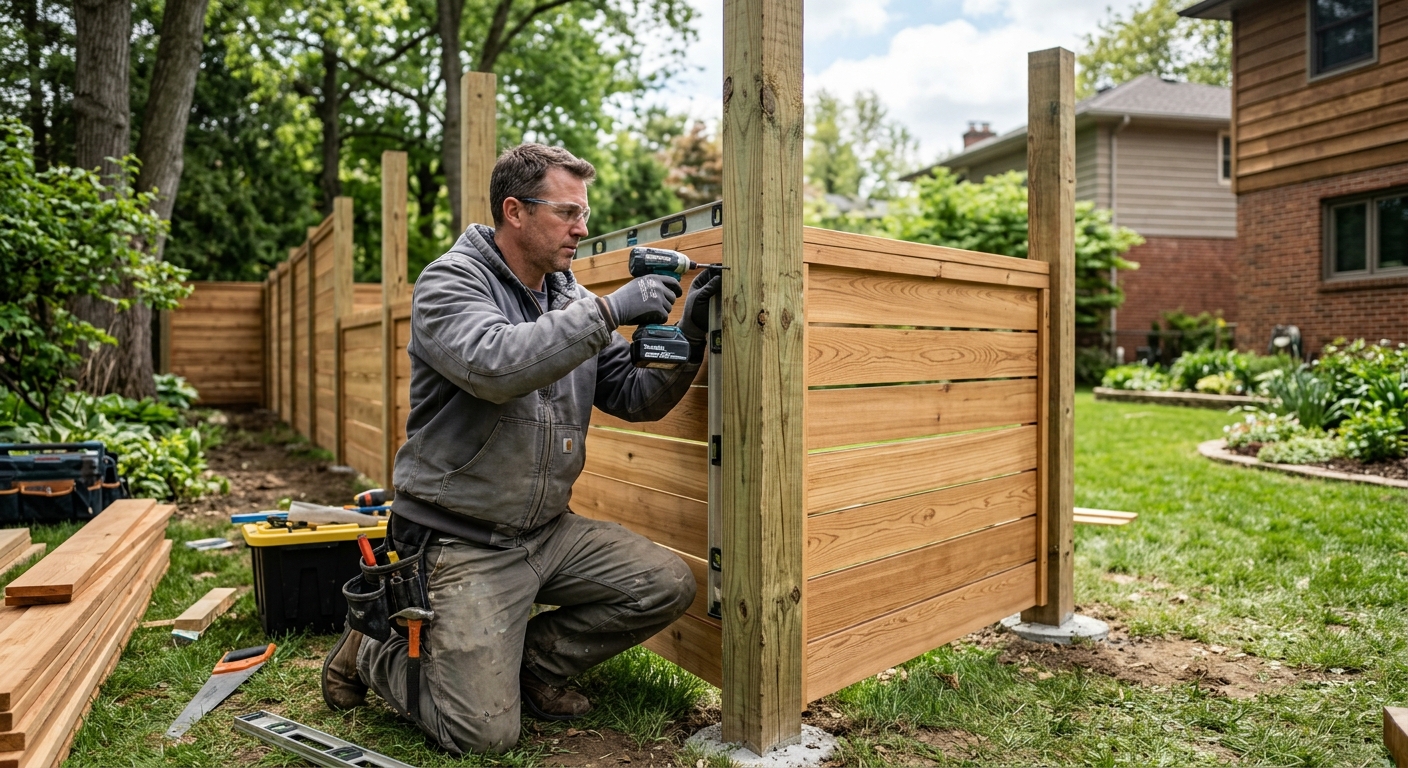
Fencing options and costs in Hatzic
In Hatzic, choosing the right fence usually starts with two things: how much privacy and weather protection you want, and what fits your yard budget. With a population of 2,952 (Statistics Canada, 2021 Census), Hatzic has a smaller but steady base of detached home properties where boundary fences are a long-term “comfort upgrade.” And across the Lower Mainland–Southwest, fenced yards are especially common around family homes and pets, so demand tends to stay consistent—contractors know the local soil and access patterns, which helps keep pricing predictable.
Costs in this part of BC are shaped by a mild but not trivial frost-and-wind reality. Even though coastal BC is generally milder than Ontario and the Prairies, frost still dictates post depth—often with contractors setting posts deeper than the bare minimum to limit heaving in wetter Fraser Valley soils. That translates to deeper holes, more concrete for corner posts, and longer install time for excavation and material handling. Wind exposure also matters for solid panels: crews plan for stronger posts and tighter spacing where gusts can load the fence.
In Hatzic, fence installs are especially in demand in the more established residential stretches along the Hatzic area near Lougheed Highway and the surrounding neighbourhoods where properties have defined yard lines. If you’re comparing options now, the table below will help you translate material choice into lifespan, maintenance, and typical per-foot pricing for the Hatzic market—then we’ll break down what drives your final quote.
| Material |
Lifespan |
Maintenance |
Privacy Rating |
Price per Linear Foot |
| Pressure-treated pine (standard wood) |
10–15 years |
Stain/paint every 2–3 years |
Good (solid rails/pickets) |
$55 – $95 |
| Cedar (natural rot resistance) |
15–25 years |
Light staining every 2–4 years |
Excellent (solid boards) |
$65 – $110 |
| Vinyl / PVC (no-maintenance) |
20–30 years |
Occasional wash; inspect posts |
Excellent (privacy styles) |
$75 – $130 |
| Chain-link (galvanized steel) |
20–35 years |
Low; rinse and check tension |
Low (visibility) |
$30 – $55 |
| Aluminum ornamental |
25–40 years |
Rinse and occasional touch-up |
Low–Medium (open pickets) |
$90 – $170 |
| Composite / recycled material |
20–30 years |
Minimal; clean and spot-check |
Good (board styles) |
$95 – $160 |
Prices are estimates only and vary by project scope, site access and material selection.
What affects the price of fencing in Hatzic
Even when two homeowners ask for the “same” fence, quotes in the Lower Mainland–Southwest can differ by 30–50%. The biggest reasons are local ground conditions, access, and how contractors handle frost depth, wind load, and drainage in wetter soils. In British Columbia, labour and excavation time are often the deciding factor—not just the material. That’s why a chain-link quote may come in closer to the $30–$55 band, while vinyl/PVC often lands in the $75–$130 band once strong post systems, gates, and proper setting are included.
Frost line depth sets how deep posts must be set to prevent heaving. As a practical rule for many Canadian areas, posts are set about 4–6 inches below the design frost depth; in BC coastal conditions the frost can be shallower than inland, but wetter Fraser Valley soils still often push crews to dig deeper than “minimum.” Contractors may also use concrete for privacy panels, corner posts, and gate posts to reduce movement over seasonal freeze-thaw cycles.
Wind exposure changes installation details too. While the Prairies get harsher straight-line wind, open-yards and exposed corners in Hatzic can still create higher lateral loading. That means tighter spacing, stronger posts, and sometimes reinforced rails for solid wood and vinyl privacy fencing.
Concrete examples from common Hatzic scenarios: (1) yards with clay-silt fill or consistently damp topsoil usually require deeper holes and more concrete to stabilize posts; (2) sloped driveways near busier routes can slow down access, increasing labour time; and (3) removing an old fence can add dump fees and extra labour, especially when posts are concreted in. If you’re installing a 60-foot line, those differences can swing your total by several thousand dollars—even before considering whether you choose wood in the $55–$95 range or vinyl/PVC in the $75–$130 range.
| Price Factor |
Why It Matters |
Cost Impact |
| Fence length in linear feet |
The longer the run, the more posts, rails, and labour time. |
Major (primary driver of total price) |
| Post depth required |
Frost depth and soil type determine embedment length and hole size. |
Moderate to major (more digging and material) |
| Post setting method |
Concrete setting typically costs more than gravel pack or driven posts. |
Moderate (often increases quote by hundreds to thousands) |
| Material choice |
Vinyl/PVC and aluminum use different structural components and fastening. |
High (can shift you between $30–$55, $55–$95, and $75–$130+ bands) |
| Gate count and type |
Drive-through and double gates require stronger frames and hardware. |
Moderate to major |
| Grade and terrain |
Slopes require stepped panels or raked layouts to keep sightlines level. |
Moderate (layout time and extra fittings) |
| Old fence removal and disposal |
Hauling and post removal adds labour and dump charges. |
Moderate |
| Permit fees and survey / property line locate |
Complex boundaries can require extra verifying and paperwork. |
Low to moderate (varies by scope) |
Permits & regulations in British Columbia
In British Columbia, fences above a height threshold typically require a building permit—commonly around 2.0 m (6.5 ft) for rear areas and about 1.0–1.2 m (3–4 ft) for the front or corner. Exact requirements can vary by location and bylaws, but the practical homeowner takeaway in Hatzic is this: if you’re planning a tall privacy fence, assume you may need a permit and plan time for review before digging.
All fences must respect property lines and municipal setback bylaws. Before any post hole digging, call for utility locates through the local service (BC 1 Call) so crews can mark buried services. Also consider getting a survey or at least a property-pin locate before installation. That’s one of the best ways to avoid encroachment disputes when neighbours disagree on where the line is.
Shared fence ownership rules are governed by provincial line-fences legislation, which can affect how disputes are handled if a boundary fence becomes damaged or needs replacement.
What typically DOES require a permit: taller fences near the thresholds, substantial structural changes, and some situations involving exterior visibility impacts or complex boundary conditions. What typically does NOT: routine replacement with similar height and location, smaller fences that stay below height thresholds, and like-for-like repairs.
To verify contractor credentials in BC, ask for: (1) licence/registration details through the appropriate online contractor registry available in the province (check the contractor’s business name matches the quote), (2) a certificate of insurance showing liability coverage, and (3) proof of coverage commonly referred to as WCB (Workers’ Compensation Board) coverage. For the clearance letter, confirm whether they can provide a current WCB clearance or payment status letter; keep copies with your contract and scope.
Choosing the right fence material for Hatzic
In Hatzic, the right fence material is the one that matches your priorities—privacy, low maintenance, budget, and lifespan—without fighting the local freeze-thaw and wet-soil conditions. Pressure-treated pine is usually the budget-friendly option, but it needs staining or painting every 2–3 years to reduce grey weathering and keep moisture from breaking down the surface. Cedar has better natural rot resistance and looks warmer, but it still benefits from periodic staining. Vinyl/PVC is popular for low maintenance and privacy styles, though extreme cold snaps can make fasteners and panels less forgiving if the installation details aren’t done correctly. Chain-link is the longest-life low-cost option, but it won’t give you privacy unless you add slats or a screen.
For Lower Mainland–Southwest installation performance, post depth still matters. Even with milder coastal conditions, contractors typically set posts deeper than a bare minimum to reduce heaving in wetter soils. Concrete-set posts are most common for corner posts, gate posts, and often for privacy systems where extra rigidity is required. Wind and snow load considerations are mainly about lateral strength: privacy fences with solid sections need stronger posts and tighter rail alignment so they don’t rack during gusts or heavy accumulation.
Here’s where costs make sense. If your total is likely to fall around the $55–$95 per linear foot band for standard wood, moving to vinyl/PVC in the $75–$130 band can be justified if you want minimal upkeep and longer-term appearance. For example, on a 40-foot run, the material difference alone can be roughly $800 to $2,000+ depending on height and setting method—often worth it for homeowners who don’t want to re-stain for a decade.
| Material |
Cold Tolerance |
Lifespan |
Annual Maintenance |
Best For |
Price Band |
| Pressure-treated pine |
Good when sealed/stained and installed with proper post depth |
10–15 years |
Check for loose boards; stain typically every 2–3 years |
Lower upfront cost with acceptable upkeep |
$55 – $95 |
| Cedar |
Good; performs well with regular surface protection |
15–25 years |
Light staining every 2–4 years; inspect annually |
Natural look and better rot resistance |
$65 – $110 |
| Vinyl / PVC |
Very good; needs correct fastening and post alignment |
20–30 years |
Minimal; rinse and inspect posts/hardware |
Low maintenance and privacy panels |
$75 – $130 |
| Chain-link |
Good; galvanized components tolerate temperature swings |
20–35 years |
Occasional rinse; check tension and posts |
Secure perimeter on a budget |
$30 – $55 |
| Aluminum ornamental |
Excellent; won’t rust in typical BC conditions |
25–40 years |
Low; rinse and touch up if needed |
Front-yard curb appeal and durability |
$90 – $170 |
| Composite / recycled |
Good; stable surface in wet climates |
20–30 years |
Minimal; clean and spot-check hardware |
Long-term look with reduced maintenance |
$95 – $160 |
How to choose a fencing contractor in Hatzic
When hiring a fencing contractor in Hatzic, verify credentials first—then compare quotes based on scope, not just the final total. In British Columbia, ask for proof of a valid contractor profile/registration (so the business name on the quote matches the registry), liability insurance (with the coverage limits shown on a certificate), and Workers’ Compensation Board (WCB) coverage. To check: (1) request an up-to-date certificate of insurance and confirm the dates are current, (2) ask for a current WCB clearance status letter or proof of coverage, and (3) verify the contractor’s business details on the province’s public registry and that they match what’s on your contract.
Next, get 2–3 itemised written quotes. Ideally, each should list labour and materials separately (posts, rails, pickets/boards, hardware, concrete setting, and gate components). Make sure the quote clearly states whether permit applications are included (or who handles them), whether property line locating or survey costs are included, and what removal/disposal covers if there’s an existing fence.
Warranty matters for both workmanship and products. Ask how long the installer’s workmanship warranty lasts (for example, rail straightness, post movement, and gate alignment), whether the manufacturer warranty covers materials only, and whether warranties are transferable if you sell your home.
On payment: don’t pay more than about 10–15% upfront. Use progress payments tied to milestones, and hold back until the job is complete and cleaned up. Finally, insist on a written start date and a completion estimate that reflects weather and excavation realities in the Lower Mainland–Southwest.
- Ask for proof of BC contractor registration and ensure the business name matches the quote.
- Request a current certificate of liability insurance before work begins.
- Confirm WCB coverage with a clearance status letter or equivalent proof.
- Get an itemised quote: labour, materials, concrete, and hardware listed separately.
- Confirm fence height, exact linear footage, and style (privacy, shadowbox, spaced picket).
- Ask how posts will be set (concrete vs gravel pack) and which components get concrete.
- Clarify whether disposal/dump fees for old fence removal are included.
- Ask who handles permits and whether permit pull fees are included or excluded.
- Verify warranty details: workmanship length, manufacturer coverage, and transferability.
- Use a payment schedule with only a small deposit (10–15%) and a completion holdback.
- Get the start date and finish estimate in writing, including allowance for weather.
- Ensure they show a layout plan or measurement method for sloped yards and corners.
Common red flags in the Hatzic area: vague “lump sum only” quotes with no post-setting details; refusing to provide an insurance certificate or WCB clearance; starting work before utility locates are done; warranties that cover materials but not installation; and inconsistent measurements (no site measurement or written linear footage).
Frequently asked questions — fencing in Hatzic
How tall can my fence be in Hatzic?
In Hatzic (British Columbia), fence height limits are typically tied to municipal bylaws and whether you’re above common thresholds that trigger a permit. As a general guide used by many BC homeowners, fences over about 2.0 m (6.5 ft) are often treated as permit-requiring for rear areas, while front/corner fences often have lower thresholds around 1.0–1.2 m (3–4 ft). If you’re aiming for a full privacy height, it’s smart to ask your contractor to confirm the planned height and location relative to the property line and setbacks before you dig. This also helps avoid rebuilding due to zoning or setback conflicts.
Should fence posts be set in concrete here?
In the Lower Mainland–Southwest, concrete setting is commonly used in the exact places that experience the most movement: corner posts, end posts, and gate posts, and sometimes privacy runs depending on soil and panel type. Even in mild BC climates, frost-and-thaw can still lift posts in wetter soils if embedment and setting aren’t done right. A good contractor will explain how deep the holes will be and why (often setting posts below the design frost depth), then recommend concrete where rigidity matters most. If you’re comparing quotes, don’t accept a “no concrete anywhere” approach without discussing your yard’s soil and drainage—because that’s where heaving problems start.
What's the best fence for privacy?
For privacy in Hatzic, solid privacy styles made from wood (pressure-treated pine or cedar) or vinyl/PVC tend to perform best because they block line-of-sight. Vinyl/PVC privacy fences are popular when homeowners want low maintenance; those projects typically fall in the $75–$130 per linear foot range depending on height, gate count, and post setting. Cedar privacy can look great and resist rot, but it still needs periodic staining. Pressure-treated pine is usually the budget option, often in the $55–$95 band, with the trade-off of more frequent staining to stay looking fresh. Whichever you pick, ask about stronger posts and tighter spacing for wind loading so privacy panels don’t rack over time.
How do I compare fencing quotes?
Compare Hatzic quotes like-for-like. Ask each contractor for an itemised breakdown: labour, materials, post count/spacing, post embedment depth, and the setting method (concrete vs gravel pack). Confirm the exact fence style (privacy boards vs shadowbox vs spaced pickets), the fence height, and whether gates are included and how they’re built (hinges, latches, reinforcement). Make sure removal and disposal of an old fence is clearly stated, and ask if permit pull is included if your height may cross the common BC threshold. A quote that looks cheaper but uses different embedment depth or lighter gate framing can cost more later if you need repairs.
How long does fence installation take in Hatzic?
Most residential fence installs in Hatzic can take anywhere from 1 to 3 days, depending on length, access, and whether there’s removal. A longer run with multiple gates, steep grades, or lots of concrete-set posts usually adds time. Wet conditions can also slow excavation in Fraser Valley–type soils, and weather can affect curing when concrete is used for posts. The contractor should give you a start date and written completion estimate after measuring on-site. If a permit is required due to height, plan extra time for approvals before digging. When comparing quotes, ask how each contractor schedules their crew and whether they’re accounting for post-setting and cure times in their timeline.
Can I install a fence on a slope in Hatzic?
Yes, fencing on a slope is common in parts of Hatzic, and most good contractors can build it with stepped or raked layouts. The key is how they keep the top line consistent and how they adjust post lengths and panel heights without creating uneven gaps that reduce privacy or strain the rails in wind. For slope work, the quote should specify the method (stepped vs raked) and include extra layout time for measurements. Because post embedment still needs to follow frost considerations, slope areas don’t automatically mean “shallower holes”—installers usually still set posts to appropriate embedment depth based on local frost and soil conditions.