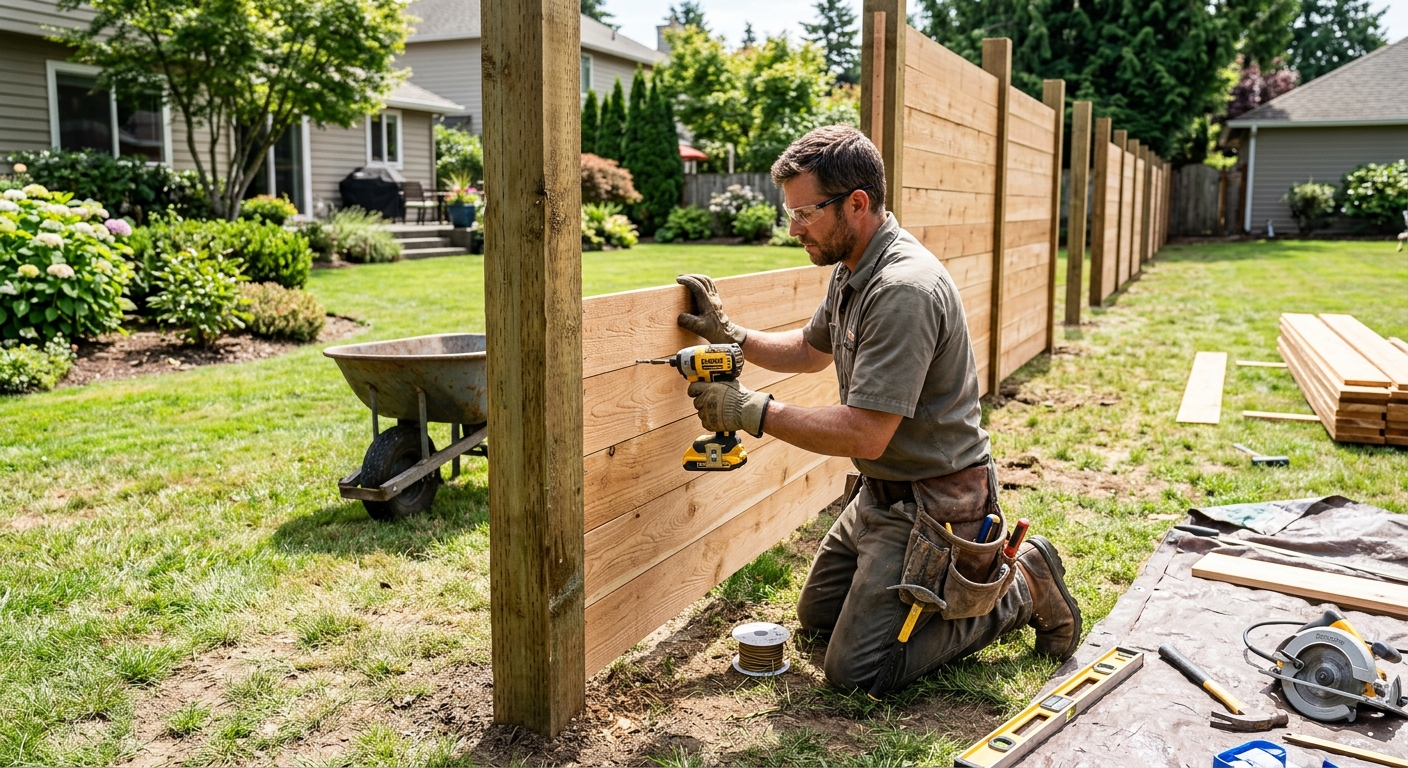
Fencing options and costs in Barriere
In Barriere, choosing the right fence starts with matching your yard to the realities of the Thompson–Okanagan climate. With 1,765 residents (Statistics Canada, 2021 Census) and 680 homeowner households where 89.5% of households own, there’s steady demand for boundary fencing around single-detached properties—80.9% of local dwellings are detached, so most fences are tied directly to private yard maintenance and curb appeal. At the same time, Barriere’s cooler interior conditions (compared with coastal BC) drive up installation complexity: frost depth and freeze–thaw cycles require posts to be set below grade to prevent heaving, and crews typically spend more time on post-holes, drilling, and concrete setting where soil is clay-heavy or poorly drained.
Material choice also matters. If your lot is exposed to wind along open benches or wider valley approaches, you may need tighter post spacing, heavier rails, or a more open panel design to reduce wind load. In Barriere, the trade is especially busy along the area where properties are older and landscaping has matured—homes built before 1981 account for 41.4% of the housing stock (Statistics Canada, 2021 Census), which often means fence replacements rather than new builds. For homeowners comparing quotes, the “same fence” can land differently because post depth, setting method, and site access often change more than the top rail style.
Below is a practical comparison of common options you’ll see in Barriere, including typical lifespan expectations and the budget planning ranges that installers use for local projects. Use this table to move smoothly into an apples-to-apples discussion with contractors.
| Material |
Lifespan |
Maintenance |
Privacy Rating |
Price per Linear Foot |
| Pressure-treated pine (standard wood) |
10–15 years |
Stain/seal every 2–3 years; check posts annually |
Medium–High (solid or close boards) |
$55–$85 |
| Cedar (natural rot resistance) |
15–25 years |
Seal/stain every 3–4 years; occasional boards/posts |
High (solid boards) |
$70–$100 |
| Vinyl / PVC (no-maintenance) |
20–30 years |
Rinse annually; inspect for panel stress in deep freezes |
High (privacy styles) |
$75–$115 |
| Chain-link (galvanized steel) |
25–40 years |
Occasional coating touch-ups; keep gates aligned |
Low (visibility through mesh) |
$35–$60 |
| Aluminum ornamental |
25–35 years |
Wash as needed; tighten hardware |
Low–Medium (ornamental pickets) |
$90–$150 |
| Composite / recycled |
20–30 years |
Wash annually; check fasteners and expansion gaps |
Medium–High (solid or semi-solid) |
$95–$140 |
Prices are estimates only and vary by project scope, site access and material selection.
What affects the price of fencing in Barriere
In Barriere, it’s common to see bids for the “same” fence differ by 30–50% across the Thompson–Okanagan region and wider British Columbia, mainly because post installation requirements change with frost depth, soil drainage, and wind exposure—not just the fence material. A vinyl privacy fence might look straightforward on paper, but if the site needs deeper concrete-set posts, longer auger time, and extra bracing for wind load, labour and materials climb quickly. Similarly, crews operating in remote or tight access lots typically charge more for setup, hauling, and careful layout to avoid utilities.
Frost depth is the biggest driver. Local practice is to set posts below the design frost depth—often roughly 4–6 inches deeper than the frost-line estimate—to prevent heaving during freeze–thaw cycles. While colder interior valleys can require posts set 75–90 cm or more below grade to stay below frost, lower, wetter spots and heavier clay soils in Barriere can push crews toward deeper footings and larger-diameter holes. That affects the cost because concrete setting adds concrete volume, longer posts, and extra labour time. By contrast, a short, well-drained run on firmer ground may reduce concrete quantities.
Wind exposure also changes design and can push the total toward the higher end of the regional ranges. In exposed yards, tighter post spacing and heavier rails help keep panels stable; that’s more material, more fastening, and sometimes a more open-style design to reduce wind pressure. Coastal BC’s mild but wet climate is less about frost heave, but more about rot—so wood fences without proper treatment can fail earlier; in Barriere, correct preservative and installation details can offset rot risk even in wetter spring periods. In practical terms, you might see pressure-treated wood land nearer the $55–$85 range for simple straight runs, while cedar or vinyl privacy projects often approach the upper $75–$115 band when deeper concrete-set posts and extra bracing are needed.
Concrete examples from Barriere jobs: (1) a sloped backyard requiring stepped panels often needs more rails and re-measuring, which adds labour even if length is the same; (2) replacing an older fence with concrete remnants may add disposal and removal time; and (3) clay-heavy spots can require re-drilling and re-setting posts for consistent alignment, adding cost but improving long-term performance.
| Price Factor |
Why It Matters |
Cost Impact |
| Fence length in linear feet |
More runs mean more posts, rails, fasteners and labour. |
Highest driver; often accounts for the majority of total cost. |
| Post depth required |
Frost line depth determines hole depth and post length to prevent heaving. |
Deeper holes increase auger time, concrete, and material length. |
| Post setting method |
Concrete vs. gravel pack vs. driven posts affects longevity and stability. |
Concrete-set posts typically add both labour and material cost. |
| Material choice |
Vinyl, cedar, and chain-link behave differently in cold and wind. |
Material premium plus different install details (e.g., vinyl panel expansion). |
| Gate count and type |
Gates need extra framing, hinges, and alignment control. |
Double drive-through gates usually add the most cost due to hardware. |
| Grade and terrain |
Slopes require stepped or raked panels and careful rail heights. |
More layout time and sometimes more components. |
| Old fence removal and disposal |
Hauling, recycling or landfill fees and time on-site. |
Can add a noticeable bump, especially with concrete or mixed materials. |
| Permit fees and survey / property line locate |
Boundary accuracy and compliance protect against disputes. |
Variable cost; locate work can add time and service fees. |
Permits & regulations in British Columbia
In British Columbia, whether you need a permit depends largely on fence height, location, and local bylaws. As a practical rule, fences above a height threshold—typically 2.0 m (6.5 ft) at the rear and about 1.0–1.2 m (3–4 ft) at the front or corner—often require a building permit. Even when a permit isn’t required, every fence must respect property lines and municipal setback bylaws (setbacks vary by municipality and lot configuration).
Before you dig any post holes, call for utility locates. In BC, use BC 1 Call (and follow any project-specific instructions provided by the locate service). Also, get a survey or confirm your property pins/markers before installing. In Barriere, fence disputes often come down to layout and boundary uncertainty—so verifying the line early protects you from expensive rework later.
Shared fence ownership and responsibilities are governed by provincial line-fences legislation. If you’re planning a shared fence, confirm ownership expectations and who pays for maintenance and replacements in writing.
To verify a contractor in BC, ask for: (1) a valid British Columbia business licence/registration details from their storefront or contractor listing; (2) liability insurance certificate of insurance naming you as an additional insured (if required by contract); and (3) WSIB/WCB coverage confirmation—look for a clearance letter or coverage status on the certificate documentation. Then cross-check the details directly with the relevant online registry sources and the insurer’s paperwork to ensure the coverage matches the work being quoted.
Choosing the right fence material for Barriere
Choosing fencing in Barriere comes down to balancing privacy, low maintenance, budget, and lifespan against the region’s cold winters and Thompson–Okanagan freeze–thaw realities. Pressure-treated pine is often the best starting budget option, but it needs staining or sealing every 2–3 years to slow grey weathering and protect the surface. Cedar looks better for longer and has natural rot resistance, though it still benefits from periodic sealing—especially where snowmelt stays in contact with the lower boards.
Vinyl/PVC is the low-maintenance favourite for many homeowners, yet in deep freezes it can be more sensitive to installation details such as correct expansion gaps and properly set posts. Chain-link is usually the most economical and durable option in the long run—ideal if you want security and minimal upkeep rather than privacy. Aluminum ornamental offers a clean, rust-resistant look with mid-range pricing, but it provides limited privacy compared with board-on-board styles. Composite/recycled panels can deliver privacy with less upkeep than wood, though they still rely on correct post spacing and fastener choices.
Because Barriere sits in an interior climate where frost depth can be substantial, you should plan for posts set below frost depth to prevent heaving. Depending on your soil drainage, that may mean concrete-set posts for more reliable stability. In exposed wind areas, consider sturdier framing and appropriate panel style; open styles reduce wind load, while solid privacy panels may require additional bracing to keep alignment during gusts and winter snow accumulation.
Dollar-wise, it’s common to see a straightforward pressure-treated wood installation come closer to the $55–$85 per linear foot range, while vinyl privacy tends to land in the $75–$115 per linear foot band when proper post installation and hardware are included. For example, if you’re willing to pay roughly $15–$30 per linear foot more for vinyl, the justification is usually reduced annual effort (no staining) and fewer early repairs—particularly on longer runs.
| Material |
Cold Tolerance |
Lifespan |
Annual Maintenance |
Best For |
Price Band |
| Pressure-treated pine |
Good with correct post depth and staining |
10–15 years |
Quick inspect; stain as needed every 2–3 years |
Budget privacy with willingness to maintain |
$55–$85 |
| Cedar |
Good in cold, rot-resistant when installed right |
15–25 years |
Inspect and seal every 3–4 years |
Better appearance and longer wood life |
$70–$100 |
| Vinyl / PVC |
Good if installed with expansion gaps and proper posts |
20–30 years |
Rinse and check hardware occasionally |
Low maintenance privacy |
$75–$115 |
| Chain-link |
Excellent; galvanized steel handles winter cycles |
25–40 years |
Minimal; check tension and gate alignment |
Security on a budget |
$35–$60 |
| Aluminum ornamental |
Excellent (no rust) |
25–35 years |
Wash and tighten fittings as needed |
Curb appeal with visibility |
$90–$150 |
| Composite / recycled |
Good with proper spacing and fasteners |
20–30 years |
Wash annually; check fasteners |
Privacy with reduced wood maintenance |
$95–$140 |
How to choose a fencing contractor in Barriere
When you’re hiring a fencing contractor in Barriere, start with proof of coverage and then require detailed paperwork. In British Columbia, you should verify: (1) liability insurance—ask for a current certificate of insurance and confirm the policy covers fencing installation and property damage; (2) WCB coverage—request confirmation of WSIB/WCB coverage appropriate to the work being performed (and look for a clearance letter or coverage status); and (3) business registration details for the contractor, so you can match the paperwork to the actual company name you’re dealing with. If anything feels vague, pause and ask for updated documents before signing.
Next, get 2–3 itemised written quotes. A proper quote breaks down labour and materials separately and should show line items for posts (including depth), rail lengths, concrete (if used), gate hardware, and any site preparation. Ensure exclusions are clearly listed: permit pulling, utility locate fees, old fence removal, disposal, and surface restoration. If the quote is a single lump sum with no explanation, you can’t compare apples-to-apples.
Warranty matters in fencing because cold-weather performance depends on installation quality. Ask for the workmanship warranty length and whether the manufacturer’s product warranty transfers if you sell your home. Then set a fair payment schedule—never pay more than 10–15% upfront, and hold back the final amount until the fence is complete and aligned, with gates operating smoothly.
Finally, insist on a written start date and realistic completion estimate, especially in Thompson–Okanagan winters when thaw conditions control how quickly holes can be dug and concrete can cure.
- Request COI (certificate of insurance) naming you if required, and confirm current effective dates.
- Get WSIB/WCB coverage confirmation or a clearance letter before work starts.
- Ask how posts are set (concrete vs. gravel pack) and how depth is determined for frost safety.
- Get itemised quotes showing linear feet, number of posts, and number/type of gates.
- Confirm whether permit fees are included or excluded.
- Confirm utility locate responsibility and timing (BC 1 Call process).
- Verify whether old fence removal and disposal are included, including landfill/hauling.
- Ask who provides survey/property line locate if pins are unclear.
- Require a detailed scope for sloped yards (stepped vs. raked panels) and how measurements are taken.
- Check that gates include hinges, latches, and bracing appropriate for width and wind exposure.
- Review warranty terms in writing: workmanship duration, product warranty, and transferability.
- Agree on payment terms: max 10–15% upfront; hold back until completion and cleanup.
In Barriere, common red flags include: contractors who refuse to provide insurance/coverage documentation, quotes that don’t state post depth or setting method, “one-size-fits-all” pricing with no site inspection, payment demands above 10–15% upfront, and vague warranty language like “guaranteed” without written terms.
Frequently asked questions — fencing in Barriere
How do I prevent wood fence rot in Barriere?
To prevent wood fence rot in Barriere, focus on where moisture sits and where air can’t dry boards. First, ensure posts are set below frost depth and that the installation keeps the ground contact portion protected; heaving during freeze–thaw can break boards and hold water at the base. Second, use properly pressure-treated lumber (or cedar where appropriate) and install with correct clearance so panels don’t stay wet against soil or tall grass. Third, maintain the finish: pressure-treated pine typically needs staining or sealing every 2–3 years to slow grey weathering and reduce water penetration, while cedar usually needs periodic sealing too. If your yard is clay-heavy or poorly drained, concrete-set posts and better drainage around the base often reduce early failure—sometimes that pushes cost toward the upper end of typical wood pricing in the $55–$85 band, but it avoids repeated repairs.
What is the cost per linear foot for fencing in Barriere?
For fencing in Barriere, homeowners usually plan within the local Thompson–Okanagan price bands. Wood installation commonly lands around $55–$85 per linear foot depending on post depth, rails, and whether concrete-set posts are required. Vinyl/PVC is typically higher at about $75–$115 per linear foot, especially for privacy styles with heavier hardware and tighter spacing in wind-exposed runs. Chain-link tends to be the lowest, often around $35–$60 per linear foot, while aluminum ornamental commonly falls around $90–$150 per linear foot. Your final price per linear foot can shift because Thompson–Okanagan conditions determine frost-safe post installation, and the labour time to auger deeper holes can be a bigger factor than the fence style itself.
Should I repair or replace my old fence in Barriere?
Repairing can make sense when the majority of posts are still solid and the fence isn’t suffering from widespread rot or major leaning from frost movement. In Barriere’s interior freeze–thaw conditions, though, it’s common for older fences—especially those on damp spots or with shallow post setting—to fail first at the bottoms and then ripple damage through rails and fasteners. A good rule is to inspect: if more than a couple of sections show soft boards, repeated board replacement, or post movement, replacement often becomes more cost-effective than patching. Also consider how long the fence has been in place; homes built before 1981 make up 41.4% of the housing stock (Statistics Canada, 2021 Census), so many yards are due for upgrades rather than repairs. If you do repair, ask for a plan that addresses the cause (post depth, drainage, and treatment), not just the symptoms.
How do I handle a fence dispute with a neighbour in British Columbia?
Fence disputes in British Columbia usually come down to boundary location, responsibility for shared maintenance, or workmanship issues. Start by confirming the property line: if your pins are unclear, request a survey or property pin locate before digging anything further. Keep communication factual and written—photos, measurements, and copies of any prior agreements help. In BC, shared fence ownership and responsibilities follow provincial line-fences legislation, so avoid assuming your neighbour will always pay or always own half without verifying. If the issue is a poorly installed fence causing damage or encroachment, ask for the contractor’s documentation (scope, post depth details, and insurance) so you can discuss a corrective remedy. If the neighbour dispute is serious, consider mediation or professional boundary clarification—acting early helps prevent costly rework, especially in yards where deeper frost-safe posts are required.
What fence style offers the best wind resistance in Barriere?
In Barriere, the “best” wind resistance usually comes from matching the fence’s openness to wind load and ensuring structural rigidity. Solid privacy panels can act like sails in exposed areas, so they often need heavier bracing, sturdier rails, and closer post spacing to stay aligned through gusts and winter weather. Open styles such as chain-link or more open ornamental designs generally catch less wind pressure, which can reduce stress on posts. That said, security needs and privacy goals vary. If you want privacy in windy spots, a board system that isn’t fully solid—paired with correct post depth and properly set gates—can perform better than an uninterrupted slab. Whatever you choose, ensure your contractor uses frost-safe post depth and correct hardware; wind load won’t matter much if posts are heaving from freeze–thaw.
How much does a fence cost in Barriere?
The total cost in Barriere depends mainly on linear feet, gate count, post depth, and whether the site requires concrete-set posts due to soil and frost depth safety. As a planning guide, wood installation is often in the $55–$85 per linear foot range, while vinyl/PVC typically sits around $75–$115 per linear foot. Chain-link can be notably lower at $35–$60 per linear foot, and aluminum ornamental commonly ranges about $90–$150 per linear foot. Your quote may also change if old fence removal and disposal are included, if your lot is sloped (stepped panels increase layout time), or if a permit/property locate is required. A reliable contractor will itemise labour and materials so you can see exactly what’s driving your final number.