Fencing options and costs in Hope
Hope is a small community with a big mix of property types, and that’s why fencing demand is steady: with 74.0% of dwellings being single-detached homes, many lots need boundary, dog, and privacy fencing updates as households maintain their yards. Ownership also plays a role—homeowner households make up 79.3% of households—so upgrades like new gates and privacy panels tend to show up as planned projects rather than short-term rentals. The local housing stock is older too; 48.0% of homes were built before 1981, which often means mature trees near property lines, uneven footing, and existing fence sections that need removal and adjustment.
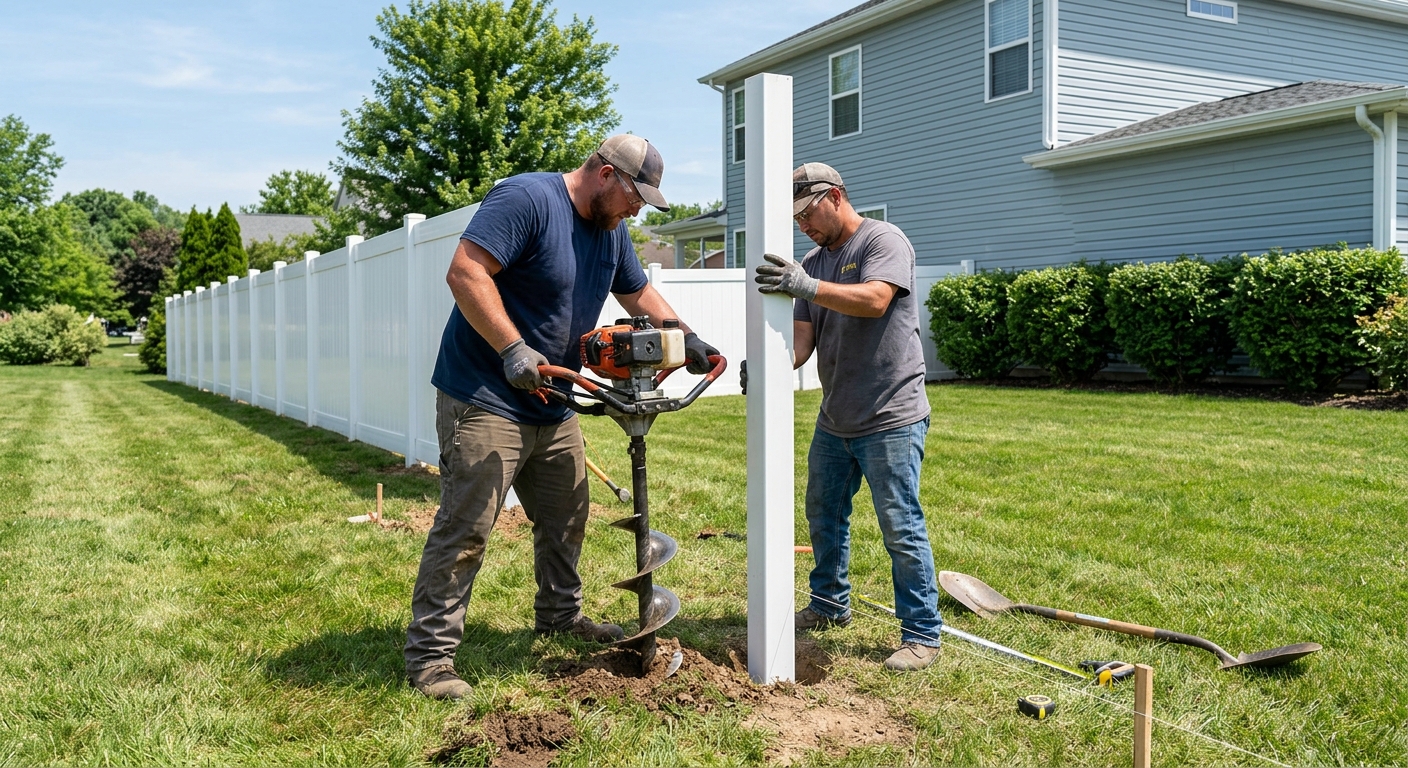
In the Lower Mainland–Southwest, pricing is influenced by mild but not trivial frost and frequent wetting. Even though conditions are gentler than inland provinces, contractors still need posts set below the local frost conditions to limit heaving, especially in wetter Fraser Valley-style soils where deeper holes mean more concrete, longer posts, and more labour. Wind exposure around open areas in the valley also pushes crews toward stronger corner posts and tighter construction, affecting both wood and vinyl prices.
For neighbourhood demand, the “industrial/riverfront corridor” areas and the more established residential pockets near downtown often see fence work as homeowners replace sagging runs and rebuild gates after storm damage or rotting rails. Next, use the comparison below to spot how materials trade off against lifespan, maintenance, and the typical installed price you’ll see in Hope.
| Material |
Lifespan |
Maintenance |
Privacy Rating |
Price per Linear Foot |
| Pressure-treated pine (standard wood) |
10–15 years |
Stain/seal every 2–3 years; replace occasional boards |
High (solid board) |
$55–$95 |
| Cedar (natural rot resistance) |
15–25 years |
Light staining every 2–4 years; periodic board checks |
High (solid board) |
$70–$115 |
| Vinyl / PVC (no-maintenance) |
25–35 years |
Rinse occasionally; inspect posts and fasteners |
High (privacy styles) |
$75–$130 |
| Chain-link (galvanized steel) |
25–40 years |
Occasional rust spot checks at cuts; keep tensioned |
Low–medium (screening needed for full privacy) |
$30–$55 |
| Aluminum ornamental |
25–40 years |
Wash and inspect annually; repaint only if scratched |
Low–medium (best with slats/screens) |
$90–$170 |
| Composite / recycled material |
20–30 years |
Minimal cleaning; check for warping at extreme cold |
High (solid privacy panels) |
$85–$150 |
Prices are estimates only and vary by project scope, site access and material selection.
What affects the price of fencing in Hope
If you’re getting multiple quotes in Hope, it’s normal to see the same project swing by 30–50% across the Lower Mainland–Southwest. Labour availability, how a crew handles wet soil (deep holes and extra concrete), and how they design for wind all change the installed outcome—even when the material looks “similar.” A contractor’s pricing also reflects how they treat foundational work: posts, corner bracing, and gate hardware are where most hidden cost lives.
The biggest driver is frost behavior combined with wet ground. Even in BC, contractors often set posts well beyond the bare minimum so they don’t heave. Practically, that usually means holes that land roughly 4–6 inches below the design frost depth and deeper than a “light” install would use, which can turn into extra labour and concrete. In colder Ontario and Alberta markets, crews commonly go to 1.5–2.0 m with concrete setting and longer posts; Hope is milder, but wetter soils in the Lower Mainland–Southwest can still require deeper embedment and more base prep to keep alignment tight.
Wind exposure also matters: where gusts are higher or fences are more exposed, crews use heavier posts, tighter spacing, and bracing that can bump you from a mid-range wood range into higher end wood or into vinyl pricing. Coastal BC’s mild, wet climate can accelerate rot if pressure-treated pine isn’t properly installed, especially at rail ends and post-to-rail joints.
Concrete examples in Hope: (1) removing an old fence and re-locating posts around mature roots often adds a day of excavation; (2) a wet, heavy clay backyard typically increases concrete volume and rebar needs for larger gate posts; and (3) steep grades can require stepped panels, which adds layout time and trimming. With older housing (48.0% pre-1981), you also more often find non-standard post spacing that needs redesign.
That’s how a straightforward chain-link run might land near the $30–$55 band per linear foot, while privacy fencing with concrete-set posts and solid panels can push toward the $55–$95 (wood) or $75–$130 (vinyl) ranges.
| Price Factor |
Why It Matters |
Cost Impact |
| Fence length in linear feet |
More linear feet means more posts, rails, and material quantities. |
Highest total cost driver; often determines quote size |
| Post depth required |
Frost and wet soil affect how deep posts must be embedded. |
Deeper holes increase concrete, labour, and post length |
| Post setting method |
Concrete setting vs gravel pack vs driven posts changes stability. |
Concrete set usually costs more but reduces future leaning |
| Material choice |
Vinyl vs cedar vs chain-link differ in material cost and structure. |
Can swing by tens of dollars per linear foot |
| Gate count and type |
Gates need stronger frames, hinges, latches, and bracing. |
Each gate adds custom fabrication and more labour time |
| Grade and terrain |
Sloped yards require stepped or raked panels for a clean line. |
More layout time and extra labour; material wastage |
| Old fence removal and disposal |
Demo involves labour, disposal fees, and sometimes additional digging. |
Often adds a noticeable, project-specific cost |
| Permit fees and survey / property line locate |
Requirements depend on height and placement; locating prevents disputes. |
May add fixed fees and scheduling time |
Permits & regulations in British Columbia
In British Columbia, fences above a height threshold—typically 2.0 m (6.5 ft) at the rear and 1.0–1.2 m (3–4 ft) at the front or corner—often require a building permit. Even when a permit is not required, fences must still respect property lines and any municipal setback rules that apply in your specific location in Hope. Before any post hole is dug, you must call for utility locates through the appropriate one-call system (in BC this is BC 1 Call). This is a critical step because crews commonly hit buried services at fence lines.
It’s also wise to obtain a survey or at least a property pin locate before installation. That helps avoid encroachment disputes, which can become expensive if a fence ends up on a neighbour’s side or conflicts with a legal boundary.
Shared fence ownership is handled under provincial line-fences legislation, which affects how repair costs and responsibilities can be assigned when the fence serves both properties.
What usually needs a permit: installing a new tall privacy fence near the thresholds, especially at rear boundaries where heights can exceed common “no-permit” limits, and certain accessory fence structures where height and placement trigger review. What typically does not: smaller, low fences below the applicable height threshold placed in standard back/side configurations, but you should still verify with the municipality.
For contractor vetting in Hope: confirm licensing status and ask for a certificate of insurance (liability) and coverage details for workers (WSIB/WCB clearance letter or equivalent proof). Where to look: ask the contractor for documentation directly, then verify the licence and registration through the provincial online registry pages available for trades/contractors, and ensure your insurance certificate lists the project/territory correctly.
Choosing the right fence material for Hope
Choosing the right fence in Hope is mostly about matching your priorities—privacy, low maintenance, budget, and how long you want to stay ahead of repairs—to what Lower Mainland–Southwest weather does to materials. With our damp winters and mild freeze–thaw, pressure-treated pine can be cost-effective, but it needs staining or sealing every 2–3 years to prevent grey weathering and to keep end-grain protected. Cedar looks better and resists rot naturally, yet it still benefits from periodic maintenance to keep surface checks from opening up.
Vinyl/PVC is the low-maintenance favourite for many homeowners who want minimal upkeep. It’s less affected by wet rot, but in extreme cold it can become more brittle—so quality installation details matter: proper post depth, correct panel alignment, and good hardware spacing. Chain-link is the lowest upfront option and typically lasts the longest because it doesn’t rot; however, it provides limited privacy unless you add slats or a visual screen. Aluminum ornamental offers attractive curb appeal and won’t rust, but it’s usually a mid-range to premium choice and, like chain-link, it typically won’t give full privacy without infill.
For the foundation: even with BC’s shallower coastal frost than inland regions, posts still need solid embedment below local frost conditions to limit heaving. That’s why concrete-set posts are common for corner posts, privacy panels, and gate hardware in Hope—especially on wetter soils where deeper holes and extra prep are required.
Wind also plays into your material choice. Solid panels catch gust loads and need sturdy bracing. That’s one reason vinyl privacy systems often price closer to the $75–$130 range, while basic wood privacy fencing commonly lands in the $55–$95 range.
A practical example: if you’re building a small privacy run and comparing pressure-treated pine versus cedar, the cedar may cost more up front, but it’s often justified when you want a longer “hands-off” appearance cycle in Hope’s damp weather. If budget is the priority and you’re prepared to stain, wood is usually the better value.
| Material |
Cold Tolerance |
Lifespan |
Annual Maintenance |
Best For |
Price Band |
| Pressure-treated pine |
Good (with proper sealing) |
10–15 years |
Inspect 1–2 times; stain/seal as needed every 2–3 years |
Budget privacy with regular upkeep |
$55–$95 |
| Cedar |
Good (natural rot resistance) |
15–25 years |
Light clean and stain every 2–4 years |
Attractive privacy and better rot resistance |
$70–$115 |
| Vinyl / PVC |
Moderate (installation-quality dependent) |
25–35 years |
Occasional rinse; check fasteners after freeze–thaw season |
Low-maintenance privacy |
$75–$130 |
| Chain-link |
Very good |
25–40 years |
Occasional check and tension adjustment |
Security on a budget (add screening for privacy) |
$30–$55 |
| Aluminum ornamental |
Very good |
25–40 years |
Wash and inspect annually |
Curb appeal and long-term rust resistance |
$90–$170 |
| Composite / recycled material |
Moderate (watch for cold brittleness) |
20–30 years |
Minimal cleaning; inspect for warping at extreme cold |
Privacy with reduced rot risk |
$85–$150 |
How to choose a fencing contractor in Hope
When you hire a fencing contractor in Hope, start with proof. Ask for the contractor’s British Columbia licence (if applicable to their scope), general liability insurance, and proof of workers’ coverage (WSIB/WCB clearance letter or equivalent). To check: (1) request the certificate of insurance and verify the policy limits are appropriate and that the certificate includes your address or project type; (2) confirm coverage documents are current and match the company name you’re hiring; and (3) verify registration/licence status using the provincial online registry search tools or documentation the contractor provides.
Next, get 2–3 itemised written quotes. Prefer quotes that list labour and materials separately (posts, rails, panels, gate hardware, concrete/fasteners, and disposal). Avoid lump-sum pricing where exclusions are vague. Carefully review what’s included: permit pull (if required), property line locate/survey responsibility, temporary fencing, old fence removal, and disposal. On a wet-site job, the difference between “standard post holes” and “deep embedment with concrete set for corners and gates” is where costs can diverge.
Warranty matters: ask for a workmanship warranty length (how long the contractor stands behind alignment, sagging rails, and post movement) and the manufacturer’s product warranty. Also ask if the warranty is transferable to future owners.
Payment schedule: in BC residential work, keep it conservative—never pay more than 10–15% upfront. Use a holdback until the final walk-through is complete and everything is cleaned up.
Finally, timeline: get a start date and realistic completion estimate in writing, including weather contingencies for digging in wet ground and curing time for concrete at frost-season embedment depths.
- Request licence/registration details and verify they match the quoted company name.
- Confirm liability insurance certificate is current and adequate for residential fencing work.
- Ask for WSIB/WCB clearance documentation for workers before work begins.
- Get 2–3 itemised quotes (materials and labour broken out), not just totals.
- Ensure quotes specify post depth approach and where concrete is used (corners, gates, privacy runs).
- Confirm whether old fence removal and disposal are included.
- Check how gates are engineered (hinge type, latching, bracing), not just “gate added.”
- Verify warranty terms: workmanship duration and manufacturer warranty conditions.
- Require a written scope: line/height measurements, panel style, and finish details.
- Make sure grade handling is addressed (stepped/raked panels for slopes).
- Agree on a payment schedule with a 10–15% maximum deposit and final holdback.
- Confirm start and completion timelines in writing, including weather delays.
Red flags I commonly see around Hope jobs: contractors who won’t provide insurance or proof of workers’ coverage, “too-good-to-be-true” pricing that excludes concrete setting for gate posts/corners, quotes that don’t state post depth or spacing, vague scopes like “new fence, materials included,” and pressure to pay most of the total upfront before any layout or utility locate is done.
Frequently asked questions — fencing in Hope
How do I compare fencing quotes?
To compare fencing quotes in Hope (and across the Lower Mainland–Southwest), focus on scope and foundation details, not just the total. Ask each contractor to itemise materials and labour: posts, rails, panels, gate hardware, concrete/gravel, and disposal. Confirm post embedment approach—because even with BC’s milder frost, wetter soils often require deeper holes to reduce heaving. Also compare fence height, privacy style, and whether the quote includes corner/bracing upgrades. If you’re comparing materials, look at realistic installed price bands: for example, chain-link often comes in around $30–$55 per linear foot, while vinyl privacy is commonly higher (around $75–$130). Finally, check warranty terms and payment schedules; the best quote is usually the one that’s specific and complete.
How long does fence installation take in Hope?
Typical fence installs in Hope often take anywhere from one to several days, but it depends heavily on length, gate count, access, and how wet the ground is during digging. A straight chain-link run with minimal grading can be faster, while wood or vinyl privacy fences take longer because crews must align panels carefully and brace corners for wind loads. Post embedment also affects scheduling—concrete-set posts may require additional time before rails and panels are fully installed. If you’re removing an old fence, demo and disposal can add a day or more. In older neighbourhoods where mature roots are common, excavation can slow down too. For planning, ask for a written start date, expected completion estimate, and weather contingency note, especially for jobs requiring deeper holes below frost heave risk.
Can I install a fence on a slope in Hope?
Yes—most fencing can be installed on a slope in Hope, but the approach must match the grade. The most common solutions are stepped panels or raked (sloped) alignment, and which one is used can depend on the fence style and how “line level” you want the top rail. For privacy fences, stepped panels typically keep the visual line cleaner and avoid excessive cutting waste. The key is proper layout: you can’t just measure from one end, because post embedment depth still needs to account for stable footing and frost heave risk. A good contractor will include grade handling in the quote and may adjust post lengths and panel cuts rather than trying to force a flat top line. Make sure your quote states how slopes are treated so you know what you’re getting.
What is the most weather-resistant fence for Hope's climate?
For Hope’s damp, mild-wet climate with occasional freeze–thaw, vinyl/PVC and cedar are often strong performers, provided posts are set correctly. Vinyl resists rot and doesn’t require the same staining cycle as wood, which is a real advantage in wet conditions. Cedar also naturally resists rot and usually holds up well to moisture, though it still benefits from periodic maintenance to manage surface checks. Chain-link is also very weather-resistant because it doesn’t rot, but it won’t offer privacy without screening. Whichever you choose, the “weather resistance” outcome is largely about installation quality: proper post embedment depth, correct concrete use at corners/gates/privacy sections, and keeping wood end-grain protected where it meets rails.
How do I prevent wood fence rot in Hope?
Rot prevention in Hope starts with the details most homeowners don’t see: post embedment, concrete contact points, and joint protection. Use treated posts and boards rated for ground contact, and ensure posts are set deep enough to limit frost heaving—when posts move, rails get stressed and water collects at joints. Avoid leaving wood end-grain exposed to constant moisture; make sure caps, rails, and fasteners are installed correctly. For pressure-treated pine, plan on staining or sealing every 2–3 years to reduce grey weathering and moisture penetration. For cedar, you still want routine maintenance—typically lighter staining on a schedule that depends on sun exposure. Also check drainage: if the fence line holds water, even the best wood will deteriorate faster. If you’ve got an older fence section (common in homes built before 1981), repairs should address water-trapped areas, not only the surface boards.
What is the cost per linear foot for fencing in Hope?
In Hope, installed fencing costs commonly fall within regional British Columbia price bands based on material, height, access, and site conditions. As a baseline, chain-link typically ranges around $30–$55 per linear foot installed, while pressure-treated pine wood fencing often lands around $55–$95 per linear foot. Vinyl/PVC privacy commonly prices higher at about $75–$130 per linear foot due to material and structural needs. Aluminum ornamental is often the premium end of fencing for materials and fabrication, commonly around $90–$170. Keep in mind that wet soil, deeper post embedment, gate count, and old fence removal can raise your effective per-foot cost—especially when concrete-set corner and gate posts are included.