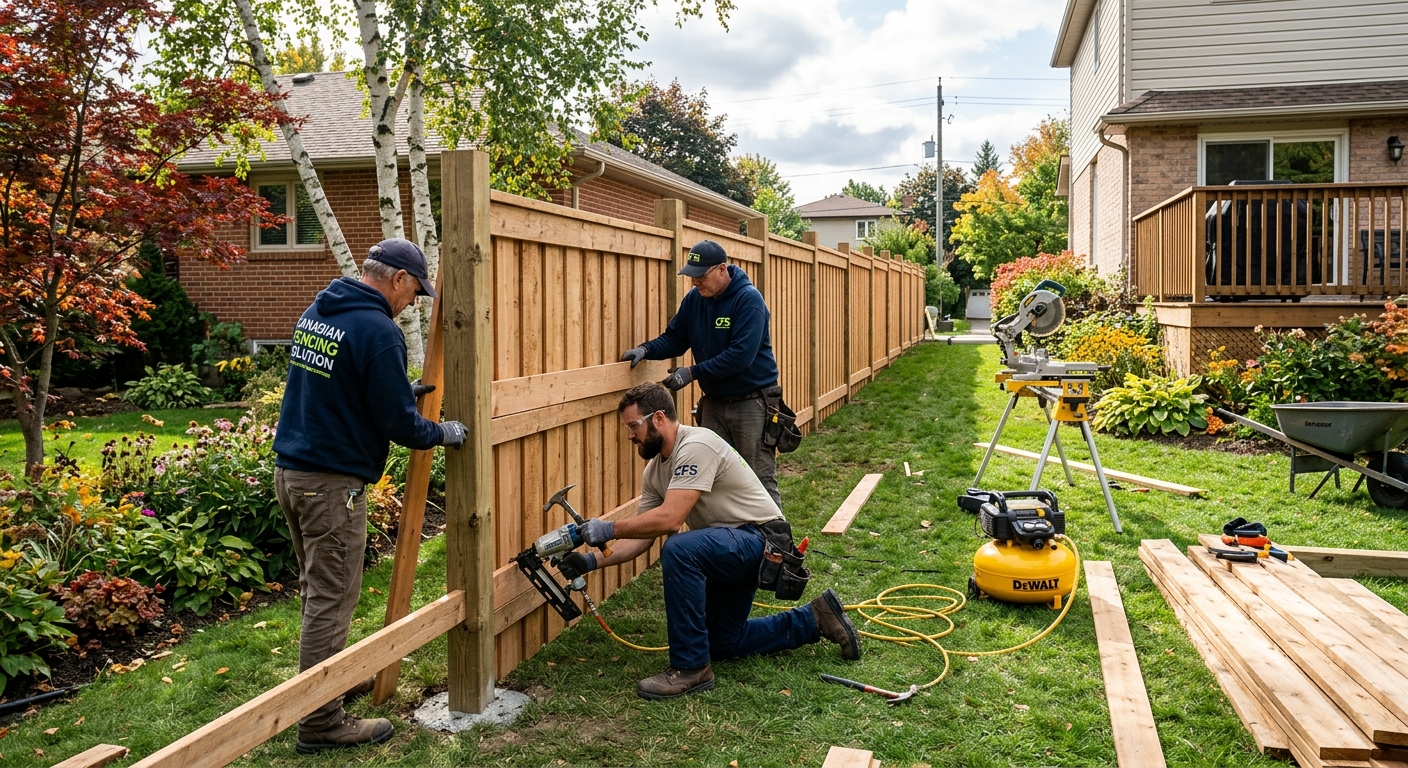
Fencing options and costs in Blueridge
In Blueridge, British Columbia, the right fence choice usually comes down to privacy versus budget, and the local property mix makes those decisions especially relevant. With a small community population of 2,245 (Statistics Canada, 2021 Census), most fencing work is driven by owner-occupied backyards and steady replacement cycles rather than constant new subdivisions. Blueridge sits within the Lower Mainland–Southwest market, where winter is mild but not trivial: posts still need to be set below frost influence to limit heaving, and wetter ground conditions in many areas often mean deeper holes and more concrete than people expect. That combination nudges labour time up, especially on sloped lots or when access is tight near lanes and driveways.
Contractor availability is generally good in the Lower Mainland corridor, but pricing can still swing when crews are busy with privacy fence demand and when projects require extra staging for gates, stairs, or neighbour coordination. In practice, the trade tends to be particularly busy in family-focused pockets around nearby residential corridors, where homeowners often upgrade aging boundary fences for better screening and wind protection.
To compare the options fairly, use the ranges below as a starting point—then we’ll break down what pushes a quote up or down in your exact yard.
| Material |
Lifespan |
Maintenance |
Privacy Rating |
Price per Linear Foot |
| Pressure-treated pine (standard wood) |
10–15 years |
Stain or seal every 2–3 years; check rails annually |
Good to very good (solid boards) |
$55 – $95 |
| Cedar (natural rot resistance) |
15–25 years |
Seal or stain every 2–4 years |
Very good (solid boards) |
$65 – $110 |
| Vinyl / PVC (no-maintenance) |
20–30 years |
Occasional wash; inspect top rails after storms |
Very good (privacy panels) |
$75 – $130 |
| Chain-link (galvanized steel) |
20–40 years |
Minimal; rinse and inspect tension annually |
Low to moderate (not a privacy screen) |
$30 – $55 |
| Aluminum ornamental |
25–40 years |
Rinse and spot-check hardware |
Low (open pickets) |
$90 – $170 |
| Composite / recycled material |
20–35 years |
Low; occasional cleaning; check for warping on extreme cold days |
Good to very good (solid styles) |
$85 – $150 |
Prices are estimates only and vary by project scope, site access and material selection.
What affects the price of fencing in Blueridge
In Blueridge and across the Lower Mainland–Southwest, it’s common to see the “same” fence quoted 30–50% apart. The difference usually isn’t the material name—it’s the build details: how deep posts must be set for local frost influence, whether crews must use concrete in wetter soils, and how many hours are needed for gates, slopes, or disposal. British Columbia’s coastal conditions also mean wood can degrade faster if it’s not built and treated correctly, which shifts the labour time into proper post setting, bracing, and panel design.
One of the biggest cost drivers is post depth required. Even though BC coastal frost is generally shallower than colder provinces, crews still typically set posts about 4–6 inches below the design frost influence to limit heaving. Where ground stays wet in the Fraser Valley–style soils, holes tend to be deeper in practice and require more concrete for privacy panels, corner posts, and gate posts. That increases both material and labour time. In contrast, a drier site with easier access can land near the low end of wood or vinyl ranges—especially when chain-link is an option.
Wind exposure also matters in this region. While it’s not Prairie-level, coastal BC events can drive gusts that stress rails and fasteners, so we often tighten post spacing and choose stronger panel bracing. For homeowners, the typical effect is that a privacy fence built “stiff” for wind costs more upfront but reduces early sag. A cedar or vinyl privacy install can be higher per foot (often aligning to the $75–$130 band for PVC and $55–$95 for standard wood jobs), while chain-link usually stays closer to the lower band, such as $30–$55.
Concrete examples from Blueridge projects: (1) a sloped backyard often requires raked or stepped sections, adding layout time and off-cuts; (2) wet, clay-rich spots can force crews to use more concrete to stabilize posts; (3) replacing a failing gate frequently adds reinforced hardware, not just lumber—so the “gate zone” gets priced differently than straight runs.
| Price Factor |
Why It Matters |
Cost Impact |
| Fence length in linear feet |
Most materials and labour scale directly with total run length. |
High (primary driver) |
| Post depth required |
Frost influence affects hole depth and post length. |
Medium to high |
| Post setting method |
Concrete vs. gravel pack vs. driven posts changes cost and rigidity. |
Medium to high |
| Material choice |
Vinyl and composite cost more; cedar costs more than pressure-treated. |
Medium to high |
| Gate count and type |
Double driveway gates require stronger frames and hardware. |
Medium to very high |
| Grade and terrain |
Slopes require stepped rails or raked panel systems. |
Medium |
| Old fence removal and disposal |
Demolition time, dump fees, and hauling affect total budget. |
Low to high (varies widely) |
| Permit fees and survey / property line locate |
Some height configurations need permitting and documented setbacks. |
Low to medium |
Permits & regulations in British Columbia
In British Columbia, fences above a height threshold—typically around 2.0 m (6.5 ft) at the rear and about 1.0–1.2 m (3–4 ft) at the front or corner—often require a building permit, but the exact trigger can depend on location and how the fence is classified (frontage, corner lots, and similar site conditions). Regardless of permit requirements, all fences must respect property lines and municipal setback bylaws.
Before any digging, it’s essential to call for utility locates using the applicable one-call system for your province area (Ontario One Call, BC 1 Call, or Alberta One-Call). Even though this guide is for Blueridge, British Columbia homeowners should still treat locates as mandatory: post holes and buried lines can be in unexpected places.
To avoid boundary disputes, homeowners should obtain a survey or at least a locate of property pins before installing, particularly when existing fencing may be offset. Shared fence ownership and line-fence arrangements are governed by provincial line-fences legislation, so it’s wise to confirm who owns and maintains which section.
Licence and insurance checks (where contractors commonly stumble): verify the contractor’s British Columbia licence/registration (if applicable to their trade), confirm general liability insurance and that the certificate of insurance names the correct project address, and ask for workers’ compensation coverage documentation (WSBC/WCB clearance or equivalent coverage proof). Keep copies of the insurance certificate and any clearance letter in your project file.
Choosing the right fence material for Blueridge
Choosing a fence material in Blueridge is easiest when you match it to your priorities: privacy, low maintenance, budget, and lifespan. In the Lower Mainland–Southwest climate, wood can last well, but only if it’s installed with proper post depth and treatment so moisture doesn’t sit in the wrong spots. That “how it’s built” piece often matters as much as the material label.
Pressure-treated pine is usually the budget-friendly option, but it commonly needs staining or sealing every 2–3 years to prevent grey weathering and surface degradation. Cedar offers a more attractive finish and better natural rot resistance, yet it still benefits from regular sealing to keep it looking good. Vinyl/PVC is popular for low maintenance—most homeowners just wash it occasionally—but it can become brittle if panels are cut improperly or installed without allowing for thermal movement, especially after cold snaps. Chain-link provides the longest life per dollar and excellent cost predictability, but it won’t give meaningful privacy without slats or screening. Aluminum ornamental fencing is rust-resistant and clean-looking, but it’s typically more expensive and won’t provide privacy unless combined with screening.
Regarding post depth and concrete-set posts: even in BC, crews often set posts deeper than “minimum” guidance to reduce heaving—commonly about 4–6 inches below the local frost influence—and concrete is frequently used for corner posts, gate posts, and privacy panels where stability matters. If you’re building a solid privacy fence, concrete setting often pays off by reducing early sag and wobble after wet winters and wind events. For example, if a cedar privacy fence costs you roughly $10–$20 more per linear foot than pressure-treated for similar heights and layouts, that difference can be justified where you expect 15–25 years of service and want fewer aesthetic touch-ups.
| Material |
Cold Tolerance |
Lifespan |
Annual Maintenance |
Best For |
Price Band |
| Pressure-treated pine |
Good (but needs proper coating and ventilation) |
10–15 years |
Inspect hardware; spot-seal/sanitize as needed; stain every 2–3 years |
Budget privacy fencing |
$55 – $95 |
| Cedar |
Good (rot-resistant with correct installation) |
15–25 years |
Inspect annually; seal/stain every 2–4 years |
Natural look with better rot resistance |
$65 – $110 |
| Vinyl / PVC |
Very good (avoid improper cutting; allow for movement) |
20–30 years |
Quick wash; inspect top rails and connections after storms |
Low-maintenance privacy |
$75 – $130 |
| Chain-link |
Excellent (material tolerates cold) |
20–40 years |
Minimal; rinse and check tension/posts |
Security on a budget |
$30 – $55 |
| Aluminum ornamental |
Excellent (no rust) |
25–40 years |
Rinse; tighten fittings |
Front-yard appearance and durability |
$90 – $170 |
| Composite / recycled |
Good (depends on brand; can shift if not installed correctly) |
20–35 years |
Low; occasional cleaning; check warping after extreme cold |
Durable, privacy-style panels |
$85 – $150 |
How to choose a fencing contractor in Blueridge
When you hire a fencing contractor in Blueridge, you want proof—not promises—that the builder can legally work and will stand behind workmanship. In British Columbia, ask for their contractor licensing/registration details (where applicable), general liability insurance, and workers’ compensation coverage documentation (WSBC/WCB clearance or equivalent proof). The fastest checks are: (1) the contractor’s name and licence/registration information listed in the applicable online registry, (2) a current certificate of insurance showing the correct address and appropriate coverage limits, and (3) the WSBC/WCB clearance letter or proof they’re in good standing.
Get 2–3 itemised written quotes instead of one lump sum. A good quote separates labour and materials (posts, rails, panels, fasteners, concrete, hardware, removal/disposal) and clarifies installation method. Read the scope line-by-line: what’s excluded (tree trimming, uneven grading, buried stump removal, concrete removal), whether permits are included, and whether disposal is part of the price. If they can’t explain how posts will be set for local frost influence and wet soil conditions, that’s a red flag.
Warranty also matters. Look for a clear workmanship warranty length (often separate from product warranties) and confirm whether the manufacturer warranty transfers to you if you sell the property. For payments, avoid paying more than about 10–15% upfront; hold back remaining funds until key milestones are complete. Finally, ask for the start date and completion estimate in writing so scheduling doesn’t drift.
- Ask for licence/registration proof and verify it via the BC online registry (where applicable).
- Request a current certificate of insurance (liability) naming your address/job site.
- Confirm WSBC/WCB clearance or workers’ compensation proof before work begins.
- Ensure quotes are itemised: labour, materials, posts, gates, concrete, hardware, and removal.
- Check whether permit pull is included for fences that exceed typical height thresholds.
- Confirm who handles utility locates and excavation responsibilities.
- Verify post-setting method (concrete setting vs gravel pack vs driven posts) and the expected depth approach.
- Confirm how slopes will be handled (stepped vs raked) and whether you’ll be charged for adjustments.
- Ask for details on rail height, panel spacing, and bracing for wind conditions.
- Clarify warranty: workmanship term and product manufacturer coverage, plus transferability.
- Use a payment schedule with a small deposit (10–15%) and holdback until completion.
- Get a written timeline including start date, days on site, and estimated completion.
In Blueridge, concrete red flags include: contractors who won’t provide insurance/coverage documentation, quotes that only list a total price with no measurements or post-setting method, vague “allowances” for disposal/permits that get added later, refusal to put the timeline in writing, and inconsistencies between the site dimensions you measure and what’s used in the quote.
Frequently asked questions — fencing in Blueridge
How do I prevent wood fence rot in Blueridge?
Wood rot risk in British Columbia is mostly about moisture management at the post and bottom-rail level, not just the lumber type. In Blueridge’s Lower Mainland–Southwest conditions, even though winters are mild, wetter ground and wind-driven rain can keep bases damp. To reduce rot, insist on correct post depth below frost influence (often about 4–6 inches beyond design frost influence) and a proper post-setting method—concrete set is commonly used for corner posts, gate posts, and privacy panel posts for stability. You should also separate wood from standing water by keeping bottom rails slightly off soil where the design allows, and ensure proper staining/sealing on pressure-treated pine or cedar every 2–3 years (or as maintenance schedules require). Choosing cedar can slow rot compared with basic pressure-treated pine, but both need good installation and ongoing surface protection.
What is the cost per linear foot for fencing in Blueridge?
For Blueridge, typical installed pricing aligns with the Lower Mainland–Southwest bands depending on the material and how complex your yard is (gates, slope, access, and whether removal/disposal is included). As a practical benchmark, chain-link often comes in around $30 – $55 per linear foot installed, while pressure-treated wood fencing is commonly $55 – $95. Vinyl/PVC privacy fencing usually lands around $75 – $130, and aluminum ornamental fencing typically sits higher at $90 – $170. Final numbers vary with post depth requirements, the number and type of gates, and how wet the soil is where posts must be set. If your yard has slope or tight access, expect some labour add-ons even when materials are the same.
Should I repair or replace my old fence in Blueridge?
In British Columbia, a fence is usually worth repairing when posts are sound and the damage is limited to panels, rails, or missing pickets. If the bottom of the posts is soft, if panels are leaning due to lost bracing, or if gate hardware has worn the framing, replacement often costs less over time. For Blueridge homeowners, wet-season soil and coastal moisture can accelerate rot where posts sit in damp ground, so even “small” issues may indicate hidden structural problems. A contractor should inspect post integrity, fasteners, and how well the fence line follows the property grade. If your quote is close between repair and replacement, consider replacement when you want consistent privacy, improved wind performance, or a rebuild that includes correct post setting below frost influence.
How do I handle a fence dispute with a neighbour in British Columbia?
Fence disputes in British Columbia are usually about boundary position, shared maintenance expectations, or cost responsibility for shared fencing. In Blueridge, start by documenting the existing fence location, any survey information, and where your property pins sit (a survey is often the quickest route to clarity). Since shared fence ownership is governed by provincial line-fences legislation, it helps to understand what portion each side owns and what obligations apply for repairs or replacement. Before any new digging, confirm property lines to avoid encroachment issues and keep records of measurements. Then try a written agreement with your neighbour about scope, materials, and who pays for what—especially if you’re changing fence height or upgrading from chain-link to privacy panels. If you can’t resolve it, consult the appropriate local information resources and consider legal advice based on your documentation.
What fence style offers the best wind resistance in Blueridge?
In the Lower Mainland–Southwest, “best wind resistance” usually means a fence that’s braced properly and built with stability at the post and gate zones—not just a thicker material. For Blueridge, solid privacy styles can catch wind load like a sail if they’re poorly braced or widely spaced at posts, so contractors often design with tighter post spacing, reinforced rails, and solid corner/gate framing. Vinyl and wood privacy fences can perform very well when installed with correct post depth below frost influence and when the framing is rigid enough to resist gusts. If you want more airflow (and lower wind sail effect), a semi-open style such as a well-braced picket or certain chain-link configurations can reduce pressure on the fence plane. Either way, ask your contractor how they handle gust conditions and whether they use stronger hardware and bracing at corners and gates.
How much does a fence cost in Blueridge?
In Blueridge, total fencing cost depends on length, height, material, gate count, and whether the site is sloped or has wet soil that requires deeper post setting and more concrete. Using the region’s typical installed ranges, a chain-link fence often starts around $30 – $55 per linear foot, while standard pressure-treated wood is commonly $55 – $95. If you’re upgrading to vinyl/PVC privacy, plan around $75 – $130 per linear foot installed, and aluminum ornamental is commonly higher at $90 – $170. A wet site can add cost because it often requires longer posts and heavier setting for stability. If you’re budgeting, ask for an itemised quote that separates labour, posts setting, gate hardware, and removal/disposal so you can compare apples-to-apples.