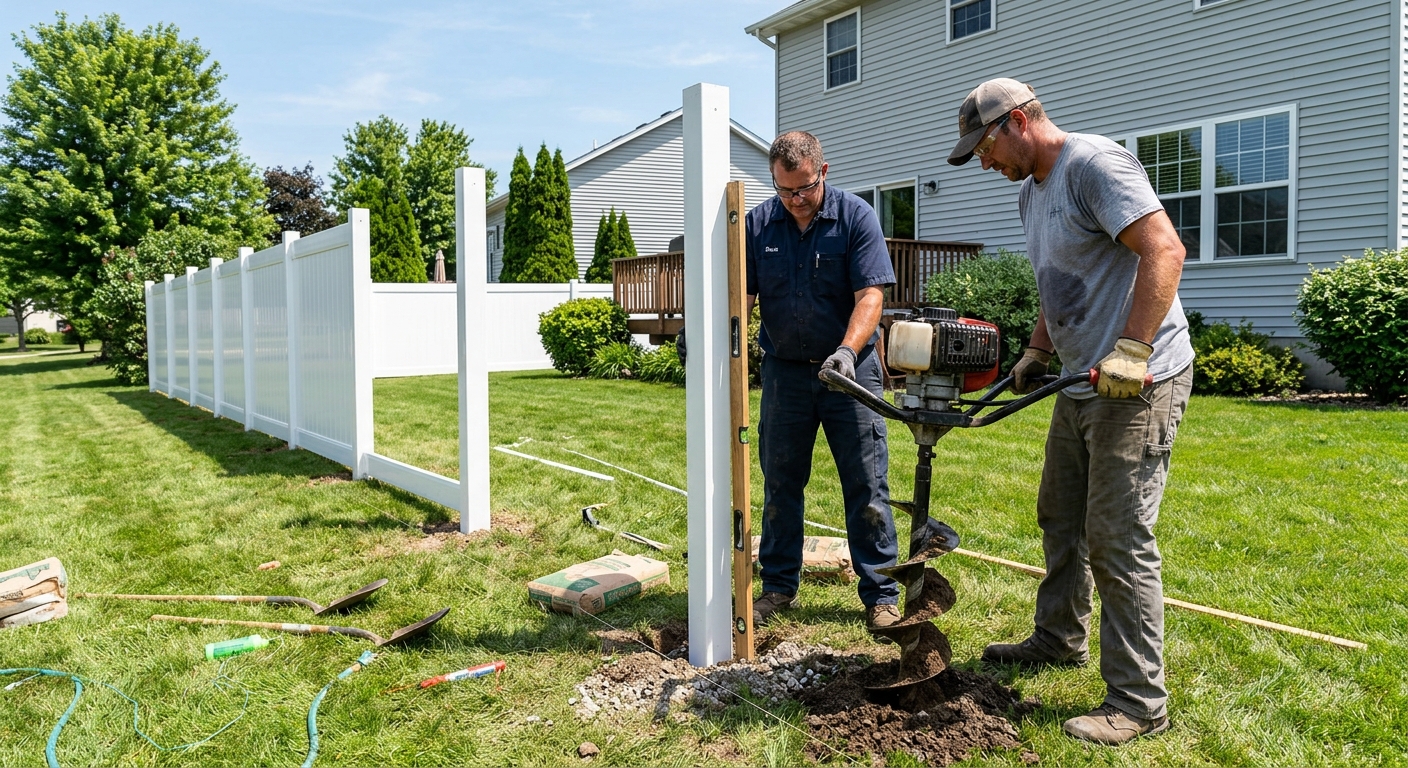
Fencing options and costs in Courtenay
Courtenay homeowners have plenty of fence options, but the best pick depends on how much privacy you want, how much upkeep you’re willing to do, and how coastal wind and wet winters affect materials. With 28,420 residents and 9,280 homeowner households (Statistics Canada, 2021 Census), demand is strongest where single-detached houses are common, since detached properties typically need boundary fencing for pets, privacy, and yard definition. Locally, 50.1% of dwellings are single-detached, so it’s easy to see why fencing work stays active around family-oriented neighbourhoods like Anderton and the Willow Point area.
On Vancouver Island and the Coast, costs tend to run a bit higher than you’d expect from “mild” temperatures alone. Frost depth is relatively shallow (about 45–60 cm), but posts still must be set below frost to prevent heaving and long-term leaning—often translating to 75–90 cm of ground burial for typical residential fences. Add frequent wind off the Strait of Georgia and Juan de Fuca Strait, and you’ll often see tighter post spacing for solid privacy styles. If your soil is wet, clay-rich, or you hit rock pockets, labour time increases due to longer digging, concrete footings, and alignment adjustments.
Below are current Courtenay market cost bands to help you compare materials before you get itemised quotes from contractors. Use these as budgeting anchors when you’re planning a full yard run or a privacy upgrade.
| Material |
Lifespan |
Maintenance |
Privacy Rating |
Price per Linear Foot |
| Pressure-treated pine (standard wood) |
12–18 years |
Stain or seal every 2–3 years; inspect fasteners annually |
High (solid board configurations) |
$15–$24 |
| Cedar (natural rot resistance) |
18–25 years |
Typically stain every 3–4 years; cleaning as needed |
High (solid board configurations) |
$20–$32 |
| Vinyl / PVC (no-maintenance) |
25–30 years |
Rinse occasionally; replace damaged sections as needed |
Medium–High (depends on panel style) |
$22–$36 |
| Chain-link (galvanized steel) |
20–35 years |
Minimal; rinse salt residue; tighten hardware |
Low (open mesh) |
$11–$18 |
| Aluminum ornamental |
25–35 years |
Occasional wash; inspect gates and latches |
Low–Medium (ornamental pickets) |
$18–$35 |
| Composite / recycled material |
25–30 years |
Low; wash and spot-check for warping or impact damage |
High (solid privacy boards) |
$28–$45 |
Prices are estimates only and vary by project scope, site access and material selection.
What affects the price of fencing in Courtenay
In Courtenay, two quotes for what looks like the “same” fence can still differ by about 30–50% once you include post depth, concrete setting, wind-rated framing, and site conditions. That spread is common across Vancouver Island and the Coast, and it’s also why regional labour and disposal costs matter in BC compared with other parts of Canada. On Vancouver Island, the market often has fewer fence crews than the bigger metro areas, so scheduling, travel time, and scheduling urgency can move pricing even before materials are considered.
One of the biggest drivers is frost behaviour. Frost lines on the Coast are shallow (roughly 45–60 cm), but contractors still typically set posts 4–6 inches below the design frost depth to prevent heaving—then account for local soil saturation. In practice, that means you’ll often see posts buried around 75–90 cm with concrete footings where soils are wet, clay-rich, or disturbed. Those extra excavation steps and longer posts can add meaningful cost. For context, wood installation in this tier commonly lands around $55–$85 per linear foot equivalent for typical residential setups, while vinyl/PVC tends to track higher at $70–$110 for many comparable privacy projects (materials and labour blended).
Wind exposure is another pricing lever. Unlike some sheltered backyards, coastal sites can push you toward stronger posts, closer spacing, and more rigid rails—especially with solid privacy designs that catch wind like a sail. A few concrete examples in Courtenay: (1) an older fence replacement in a yard built before 1981 often means removing rotted posts, hauling debris, and fixing uneven ground—turning a “straight run” into a longer job; (2) sloped lots in the Willow Point area or near the Courtenay River valley may require raked or stepped panels; (3) wet winter soils can make gravel backfill less stable, nudging projects toward concrete set posts for long-term alignment. Those choices connect directly to the reality that older housing stock makes upgrades more common—especially where 30.2% of homes were built before 1981 (Statistics Canada, 2021 Census).
| Price Factor |
Why It Matters |
Cost Impact |
| Fence length in linear feet |
Materials and labour scale directly with total run |
Usually the largest portion of the quote |
| Post depth required |
Frost depth determines hole depth and post length |
Deeper holes increase labour time and material waste |
| Post setting method |
Concrete vs. gravel pack affects stability in wet/clay soils |
Concrete footings typically raise costs |
| Material choice |
Vinyl and cedar need different framing and install details than chain-link |
Switching from chain-link to vinyl can materially increase budget |
| Gate count and type |
Drive-through (double) gates require stronger posts/hinges |
Gates often add significant labour and hardware cost |
| Grade and terrain |
Slopes require stepped/raked rails for proper alignment |
More layout time and more cut labour |
| Old fence removal and disposal |
Haul-away adds time; concrete footings increase demo effort |
Can add a noticeable percentage to total cost |
| Permit fees and survey / property line locate |
Some heights and locations require added documentation |
Costs vary; missing locates can prevent or delay installs |
Permits & regulations in British Columbia
In British Columbia, fences are typically regulated based on height, location on the property (rear vs. front/corner), and compliance with municipal setback rules. As a practical guideline, fences above about 2.0 m (6.5 ft) at the rear and about 1.0–1.2 m (3–4 ft) at the front or corner often trigger a building permit requirement, depending on the municipality and exact conditions. Even when a permit isn’t required, you still must keep the fence on your own property and respect setbacks.
Before any digging, call for utility locates. In BC, this is done through BC 1 Call to mark buried services so your post holes don’t become an expensive safety issue. If you’re unsure about the exact boundary, get a survey or property pin locate before installing—shared disputes are common when markers are unclear. Shared fence ownership and responsibilities are governed by provincial line-fences legislation, so know whether you’re building on a boundary, replacing an existing shared fence, or maintaining a fence that benefits both neighbours.
Permits vs. “usually not”: a permit is more likely needed for taller fence builds (commonly those exceeding the rear/front height thresholds) and certain corner or boundary situations; routine low-height repairs, cosmetic replacements, and like-for-like sections on the same footprint typically do not require a new permit, but you should confirm with your contractor or the municipality.
To verify a Courtenay-area contractor, check: (1) their provincial licence (and trade registration where applicable) via the appropriate online registry; (2) certificate of insurance showing general liability; and (3) worker coverage (WSIB/WCB equivalent). Ask for a clear certificate number, coverage dates, and an endorsement showing they are insuring the work at your address.
Choosing the right fence material for Courtenay
Choosing a fence in Courtenay is mostly about matching material to how your yard behaves in coastal BC: frequent wind, wet winters, salt air exposure, and freeze-thaw cycles that stress posts and fasteners. Pressure-treated pine is usually the best budget starting point. However, it needs staining or sealing every 2–3 years to keep it from greying and weathering, and it benefits from proper hardware for corrosion resistance. Cedar looks great and resists rot naturally, but it still requires maintenance—typically staining every few years—especially where it stays damp.
Vinyl/PVC is popular because it’s genuinely low maintenance, but it has trade-offs. In extreme cold snaps, vinyl can become brittle; that’s less common than in harsher continental climates, yet you should still choose a system designed for coastal temperature swings and wind load. Chain-link is the lowest-cost and longest-life “workhorse,” but it won’t provide privacy unless you add screening. Aluminum ornamental is attractive and won’t rust like untreated steel; it sits in the mid-range and works well for front yards where appearance matters more than privacy.
For Vancouver Island and the Coast, frost depth is shallow (about 45–60 cm), yet posts are still typically buried around 75–90 cm to stay below frost heave zones. Concrete-set posts are often the smart choice for taller fences, heavier privacy panels, gates, or yards with wet/clay soil—so the savings aren’t just in materials. That’s why you may see wood vs vinyl price differences justify themselves: if a wood privacy fence is around $55–$85 per linear foot equivalent but vinyl runs $70–$110, vinyl can be worth the premium when you want minimal maintenance and you don’t want repeat staining after a few damp seasons.
Wind and snow load matter too: solid fences catch wind, so they may need closer post spacing or stronger rails on exposed lots, especially near open coastal corridors.
| Material |
Cold Tolerance |
Lifespan |
Annual Maintenance |
Best For |
Price Band |
| Pressure-treated pine |
Good for coastal BC; protect cut ends |
12–18 years |
2–3 year stain/seal cycle; annual inspection |
Budget privacy where you’re okay maintaining it |
$55–$85 |
| Cedar |
Good; stable in wet coastal conditions with care |
18–25 years |
Stain or seal every 3–4 years; clean as needed |
Natural look with better rot resistance |
$60–$95 |
| Vinyl / PVC |
Good with quality hardware and proper system |
25–30 years |
Minimal; rinse and inspect fasteners |
Low-maintenance privacy with coastal corrosion resistance |
$70–$110 |
| Chain-link |
Very good; galvanized resists corrosion |
20–35 years |
Low; occasional wash and hardware checks |
Security and pets with open visibility |
$35–$60 |
| Aluminum ornamental |
Excellent; won’t rust |
25–35 years |
Low; rinse and inspect gate alignment |
Front-yard curb appeal without corrosion concerns |
$80–$140 |
| Composite / recycled |
Good; choose systems rated for temperature swings |
25–30 years |
Low; periodic wash and spot checks |
Privacy fences that balance looks and minimal upkeep |
$75–$125 |
How to choose a fencing contractor in Courtenay
Choosing a fencing contractor around Courtenay is about verifying credentials, then confirming the job details in writing. In British Columbia, you want a contractor who can show proper licensing for the work they’re doing (where applicable), general liability insurance, and worker coverage (WSIB/WCB coverage equivalent). How to check: request their certificate of insurance and verify it’s current with your jobsite/address listed or endorsed; confirm coverage dates and that the policy covers fencing installation work. Next, ask for proof of worker coverage clearance. A reputable contractor will provide documents without hesitation and won’t try to rush you into approvals.
Then get 2–3 itemised quotes, not lump sums. Make sure the quote breaks out labour and materials separately, and that it lists post type, post depth assumptions, gate hardware, rail spacing, and whether concrete footings are included. Read the scope for exclusions: is fence removal included, is disposal included, are utility locates the homeowner’s responsibility, and is permit pulling included if required? For warranty, confirm workmanship warranty length and whether it’s transferable if you sell your home. Product/manufacturer warranty matters too—especially for vinyl components, gate hinges, and rails.
Payment schedule matters. Never pay more than 10–15% upfront, and use a holdback until the fence is complete, aligned, and gate operation is demonstrated. Finally, insist on a start date and completion timeline in writing so you’re not left waiting through wet-weather delays.
- Ask for itemised line-by-line pricing for posts, rails, panels, gates, and hardware.
- Confirm post depth assumptions (typical coastal practice is below frost heave risk, often 75–90 cm).
- Clarify whether posts are concrete-set and in which locations (gates, corners, wet soil areas).
- Check if removal/disposal is included (old fence and concrete footings).
- Verify utility locate responsibility and scheduling.
- Confirm they will respect property lines and will use a survey/locate if needed.
- Ensure gate hardware is specified (hinge type, latch type, steel thickness, closers if needed).
- Ask about wind-load handling for solid privacy fences in exposed Courtenay yards.
- Review warranty terms in writing: workmanship duration, product coverage, and exclusions.
- Confirm schedule: start date, expected duration, and what happens in rain/wind.
- Use a payment schedule with 10–15% max deposit and a holdback until final inspection.
- Look for a clear cleanup plan and site protection for landscaping and driveways.
Red flags I see in Courtenay include: vague “materials included” language without specifying fence height, spacing, and post setting; refusing to provide certificates of insurance and worker coverage proof; quoting a price that excludes removal/disposal and then adding it as a change order; promising “no concrete required” for gates or heavy panels without showing soil assumptions; and asking for a large upfront payment (beyond 10–15%) before you’ve even confirmed scope.
Frequently asked questions — fencing in Courtenay
How deep should fence posts be for Courtenay's frost?
For Courtenay and most of Vancouver Island and the Coast, frost is relatively shallow, but posts still need to be set below the frost heave zone to prevent long-term leaning. In practice, contractors commonly bury residential posts around 75–90 cm, and they typically set below the design frost depth (often leaving roughly 4–6 inches under it) to account for wet soil and seasonal movement. The exact depth should match your soil conditions—wet or clay-rich areas may need concrete-set posts and extra consideration for stability. If your fence will have a gate, heavier privacy panels, or it’s on an exposed wind-swept lot, it’s especially important to get the post depth and setting method right. Don’t accept “minimum depth” without seeing how the contractor is calculating frost risk.
Wood vs vinyl vs aluminum fence — which is best?
There isn’t one “best” material for all Courtenay yards—your priorities decide. Wood (pressure-treated pine or cedar) can be the best value, with wood installs often landing around $55–$85 per linear foot equivalent depending on height and gate count. Cedar looks excellent and resists rot better than basic treated pine, but both still need periodic maintenance (staining/sealing) to prevent rapid weathering in our wet coastal winters. Vinyl/PVC is a strong low-maintenance choice if you want minimal upkeep; it commonly comes higher, often around $70–$110 in this market tier, and it tolerates coastal corrosion well. Aluminum is a solid, rust-resistant option with good longevity and curb appeal, typically in the $80–$140 band, but it provides less privacy than solid board wood or vinyl.
Do I need a permit to build a fence in British Columbia?
In British Columbia, permits are often tied to fence height and location. A common rule of thumb is that fences above about 2.0 m (6.5 ft) at the rear and about 1.0–1.2 m (3–4 ft) at the front or corner may require a building permit, depending on the municipality and the fence’s exact position. Even when a permit isn’t needed, setbacks and property line compliance still apply. Before installing, ensure utility locates are completed (through BC 1 Call) so you can dig safely. If you’re replacing an existing fence, it may be simpler if the new fence matches the original height and footprint, but you should confirm with your contractor and the municipality for your exact project in Courtenay.
How long does a wood fence last in Courtenay?
A properly built wood fence in Courtenay can last roughly 12–18 years for pressure-treated pine and about 18–25 years for cedar, assuming good post setting and maintenance. Our coastal winters are wet and windy, so fences that don’t get periodic staining/sealing typically grey and deteriorate faster. The bigger longevity factor is how posts are installed: posts set too shallow can heave slightly over time even with the Coast’s shallow frost line, especially in saturated soils, leading to leaning and faster board wear. If your fence includes gates, alignment and hardware quality affect lifespan too. If you’re buying a “low initial cost” pine fence, budget for maintenance—otherwise the long-term value can disappear quickly.
Who owns and maintains a shared fence?
Shared fence ownership and maintenance responsibilities in British Columbia are governed by provincial line-fences legislation. Practically, that means if a fence is on or benefits a boundary, the neighbour relationship can determine who pays for repairs, replacement, or upkeep—often based on whether the fence is a boundary fence and whether it benefits both properties. In Courtenay, disputes usually come from unclear placement, missing survey details, or assumptions about who built what years ago. Before you replace or modify a shared fence, confirm the location against property pins (or a survey) and document the agreement in writing. A contractor can often advise on best practice for boundary compliance, but the legal responsibility framework is set by provincial rules.
How do I find my property line before fencing?
To find your property line in Courtenay, start with your property pins or survey documents. Many homes have markers or plan references from prior surveys; if you can locate them, you can string-line the fence location accurately before digging. If pins aren’t clear or you inherited the home without paperwork, hire a surveyor for a proper locate—this is the safest route to avoid encroachment disputes. Before any post-hole digging, ensure utility locates are called through BC 1 Call, since even a correct boundary line doesn’t protect you from buried services. When you get quotes, ask the contractor whether they assume a survey locate or if they’ll build to your staked line. Good fencing companies will align their layout process with boundary verification, not just “eyeballing” a line.