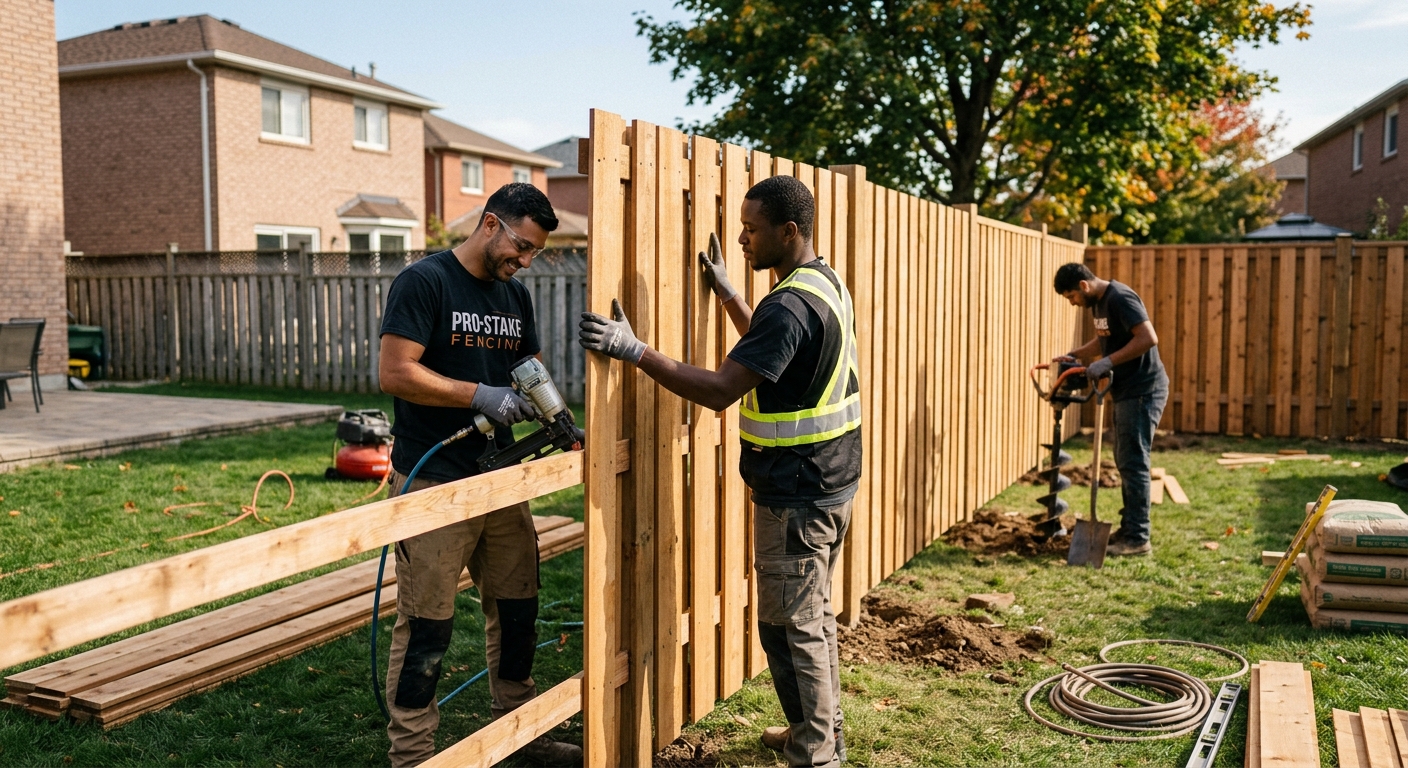
Fencing options and costs in North Saanich
Fencing options and costs in North Saanich are shaped by a very homeowner-heavy market: in 2021, the community had 12,235 residents and 4,405 homeowner households (87.9% of households own). With detached homes making up 79.2% of dwellings, many properties have driveways, yards, and side-lot boundaries where families typically want upgrades—dog runs, privacy panels, and updated gate hardware. That consistent demand is especially noticeable around neighbourhoods with higher redevelopment and backyard projects, such as parts of Saanichton and the more established pockets near the Butchart / Harbour Road corridors.
On Vancouver Island and the Coast, pricing isn’t just about the board or panel style. The region has moderate coastal frost—around 45–60 cm—so posts still need to be buried below frost depth to prevent heaving and long-term leaning. Practically, that usually means excavating deeper holes and often using concrete set posts, particularly where soils stay wet, are clay-rich, or where access makes accurate alignment harder. The Strait of Georgia wind also matters: solid privacy fences catch more wind, which can mean closer post spacing or heavier framing to keep the fence tight and straight. Coastal salt air then influences hardware and finishes, favouring powder-coated metals and better corrosion resistance in every material choice.
For budgeting, most North Saanich projects land in the region-wide price bands for wood, vinyl, chain-link, and aluminum—then flex up or down based on digging conditions, gate count, and whether any old fence must be removed and disposed. Use the comparison below to estimate material performance and typical installed cost per linear foot.
| Material |
Lifespan |
Maintenance |
Privacy Rating |
Price per Linear Foot |
| Pressure-treated pine (standard wood) |
10–15 years |
Stain or seal every 2–3 years |
High (solid panels) |
$55 – $85 |
| Cedar (natural rot resistance) |
15–25 years |
Light annual inspection; stain as needed |
High (solid boards) |
$70 – $110 |
| Vinyl / PVC (no-maintenance) |
20–30 years |
Occasional wash; no staining |
High (solid privacy styles) |
$70 – $110 |
| Chain-link (galvanized steel) |
20–35 years |
Rinse as needed; replace damaged sections |
Low–Medium (privacy slats optional) |
$35 – $60 |
| Aluminum ornamental |
25–40 years |
Minimal; clean and inspect hardware |
Low–Medium (decorative infill) |
$80 – $140 |
| Composite / recycled material |
20–30 years |
Wash; inspect posts/fasteners |
Medium–High (depends on design) |
$90 – $140 |
Prices are estimates only and vary by project scope, site access and material selection.
What affects the price of fencing in North Saanich
In North Saanich, the same fence can come in with noticeably different quotes—often 30–50% apart—because the cost drivers are rarely the material alone. On Vancouver Island and the Coast, labour availability, excavation difficulty, and coastal wind demands can push framing and post requirements up or down. At the same time, provincial-wide differences in disposal fees, trucking, and material sourcing can shift total installed prices compared with other regions of British Columbia.
One of the biggest variables is frost. Even though coastal BC has a shallow frost line (about 45–60 cm), posts still need to be set below the design frost depth—commonly 4–6 inches (10–15 cm) below it—to prevent heaving and long-term leaning. That means deeper hole excavation and longer posts than homeowners expect, and in many yards it also means concrete setting for stability. For comparison, heavier cold-region fence posts can require deeper installation (often 1.5–2.0 m in colder Ontario/Alberta practices), which is why those markets see higher concrete and material costs; North Saanich is milder, but the “do it below frost” rule still increases labour compared with a shallow setback.
Wind exposure is another local reality. Solid privacy fences catch more wind than open styles, so contractors may reduce post spacing and beef up bracing, especially near exposed lots. Wood also faces fast turn-over issues if it’s not treated properly—North Island moisture can accelerate rot when installations miss good drainage and proper hardware.
Concrete examples from typical North Saanich jobs: (1) A 60 linear foot privacy fence with two gates often costs more because gates require stronger posts and hinges under wind load; (2) A property with clay-rich or saturated winter soils usually increases costs because concrete set posts and cleanup/disposal take longer; (3) Removing an old fence that’s tangled with vines and embedded posts can add hours even when the new fence material is the same. If you’re comparing vinyl / PVC privacy at roughly $70 – $110 per linear foot versus pressure-treated wood at $55 – $85, the justified premium is usually fewer future repairs and better finish stability in coastal conditions.
| Price Factor |
Why It Matters |
Cost Impact |
| Fence length in linear feet |
Most materials and labour scale directly with total run. |
Major increase; often the #1 driver |
| Post depth required |
Frost considerations determine excavation depth and post length. |
Higher if concrete set and deeper holes are needed |
| Post setting method |
Concrete vs. gravel pack affects stability in wet or clay soils. |
Concrete set typically adds time and disposal costs |
| Material choice |
Vinyl/cedar/aluminum weigh differently and have different hardware needs. |
Shifts installed range (wood vs. aluminum are commonly far apart) |
| Gate count and type |
Drive-through and double gates require stronger framing and hardware. |
Can add significant labour/material per gate |
| Grade and terrain |
Slope requires stepped or raked panels to keep spacing consistent. |
More layout time and extra materials/cutting |
| Old fence removal and disposal |
Embedded posts and mixed materials increase labour and hauling. |
Can add hours and dump fees |
| Permit fees and survey / property line locate |
Boundary accuracy avoids encroachment and redo work. |
Optional in some cases but can add several hundred to over a thousand dollars |
Permits & regulations in British Columbia
In British Columbia, fence rules are typically tied to height limits, location, and local bylaws, and fences above a height threshold—often around 2.0 m (6.5 ft) at the rear and about 1.0–1.2 m (3–4 ft) at the front or corner—may require a building permit. Exact thresholds can vary by municipality and by where the fence sits on the property (front yard vs. rear yard), so in North Saanich you’ll want to confirm your specific location in the bylaw provisions before ordering materials.
Regardless of height, fences must respect property lines and setbacks. Before any digging, homeowners should arrange utility locates using the applicable “call before you dig” service (BC 1 Call). If there’s any question about the boundary, it’s smart to obtain a survey or at least a documented locate of property pins so your fence line doesn’t drift onto a neighbour’s lot. Shared fence ownership issues are commonly handled under the provincial framework for line fences, but the practical step for you is to confirm where the shared line sits and who maintains which sections.
Licensing and insurance checks: ask your contractor for (1) proof of the applicable BC licence/registration (as required for their scope), (2) certificate of liability insurance showing adequate coverage, and (3) confirmation of coverage for workers (WSIB/WCB coverage as applicable to their work). Where to look: request the certificate of insurance directly and verify the policy is current; for licensing, use the relevant online registry lookup provided by the province or the contractor’s listing; for clearance letters, ask the contractor for a copy showing coverage status at the start of work and again before invoicing final amounts.
Choosing the right fence material for North Saanich
Choosing a fence material in North Saanich is really about matching your priorities to coastal Vancouver Island conditions: frequent moisture, moderate coastal frost, and wind off the Strait of Georgia. Pressure-treated pine is the budget-friendly option, but it’s not “set it and forget it”—to avoid grey weathering and to slow surface degradation, plan to stain or seal about every 2–3 years. Cedar has better natural rot resistance and looks great in coastal settings, yet it still benefits from periodic maintenance (especially at the bottom rails and post zones). Vinyl / PVC offers the biggest maintenance advantage; you’ll generally wash it as needed, but extreme cold can be harsher on some plastics—so quality products and correct installation matter.
Chain-link is typically the lowest upfront cost and has excellent longevity because it’s galvanised, but it provides limited privacy unless you add privacy slats or top screens. Aluminum ornamental fencing is corrosion-resistant and won’t rust like steel, but it usually sits at a mid-to-higher cost and won’t give full privacy with typical open designs.
Post depth is another key part of material choice. Even with a shallow coastal frost line (about 45–60 cm), posts generally need to be set below frost depth—often with around 75–90 cm bury depth plus concrete footings in wet or clay soils—to prevent heaving and leaning. Concrete-set posts are especially recommended where you’re installing heavier privacy systems, multi-rail framing, or wider gate openings that take wind and frequent operation loads.
Where price differences are justified: if your goal is true privacy and low upkeep, vinyl privacy can be a good “pay more once” choice. For example, if pressure-treated pine privacy is around $55 – $85 per linear foot and vinyl / PVC privacy lands around $70 – $110, the difference often comes down to fewer expected repairs, more consistent panel appearance in salt air, and less labour for re-staining over time. If your budget is tighter and you’re comfortable maintaining wood, cedar can also be a strong middle ground with longer natural durability than pine.
| Material |
Cold Tolerance |
Lifespan |
Annual Maintenance |
Best For |
Price Band |
| Pressure-treated pine |
Good (with proper finishing and fastening) |
10–15 years |
Inspect; stain/seal every 2–3 years |
Budget-focused residential privacy runs |
$55 – $85 |
| Cedar |
Good (natural rot resistance) |
15–25 years |
Inspect; stain as needed |
Natural look with better durability than pine |
$70 – $110 |
| Vinyl / PVC |
Good (choose quality product for temperature swings) |
20–30 years |
Wash/inspect; no staining |
Low-maintenance privacy and long-term appearance |
$70 – $110 |
| Chain-link |
Very good (galvanized) |
20–35 years |
Rinse; patch damaged areas |
Security with budget control (dog area, side yard) |
$35 – $60 |
| Aluminum ornamental |
Excellent (powder-coated) |
25–40 years |
Minimal; inspect hardware annually |
Front yard curb appeal with durability |
$80 – $140 |
| Composite / recycled |
Good (varies by product) |
20–30 years |
Wash; inspect posts/fasteners |
When you want wood-like look with less upkeep |
$90 – $140 |
How to choose a fencing contractor in North Saanich
In North Saanich and across British Columbia, start with verification before you compare prices. Ask for their licence/registration for the work they’re performing (where applicable), proof of liability insurance, and confirmation of workers’ coverage (WSIB/WCB as applicable). How to check: (1) request a current certificate of insurance and ensure the coverage dates match your start date, (2) confirm the insurer lists the contractor named exactly as on the quote, and (3) verify licensing via the relevant online registry lookup and cross-check the business name/address. If they can’t provide documentation quickly, assume your project risk is higher.
Next, get 2–3 itemised written quotes—not lump sums. The quote should break out labour, materials, post depth/setting method, gate framing hardware, and any removal/disposal. Confirm whether a permit pull is included or excluded, and whether survey/property line locating is included if the contractor is proposing to fence near a boundary. A proper scope will also state which elements are omitted (for example: trimming landscaping, stump grinding, rock removal, or replacing rotted posts).
Warranty matters in coastal wind and moisture. Look for a workmanship warranty length (often a defined term such as several years), plus the manufacturer’s product warranty for the fence components. Ask whether the warranty is transferable if you sell your home. For payment, a typical safe schedule is no more than 10–15% upfront, with the remainder tied to milestones; keep a holdback until the fence line is complete, levelled, and gates are operating correctly. Get start and completion dates in writing and clarify what weather delays mean for scheduling.
- They provide itemised labour + materials (not just “installed fence”).
- They state post depth and whether holes are concrete-set vs gravel pack.
- They document gate hardware model/finish and hinge/latched construction.
- They include removal and disposal scope for old fencing, posts, and debris.
- They confirm they will call BC 1 Call / arrange utility locates before digging.
- They show you a boundary plan or how they’ll confirm the property line.
- They give a clear warranty statement for workmanship and materials.
- They provide current liability insurance documents before work starts.
- They confirm workers’ coverage status (WSIB/WCB as applicable).
- They agree to a written timeline with a start date and estimated completion.
- They limit upfront payment to 10–15% and allow a holdback until completion.
- They won’t pressure you into signing before you’ve reviewed the scope.
Red flags in North Saanich: vague quotes that don’t specify post depth or concrete setting; refusal to provide insurance or coverage documents; “we’ll figure out the property line later” language; offering unusually low pricing without explaining excavation/rock or disposal; and skipping written timelines or warranties—especially when they’re installing taller privacy panels that must resist coastal wind load.
Frequently asked questions — fencing in North Saanich
Who owns and maintains a shared fence?
In North Saanich, when a fence is considered a “line fence” between properties, ownership and maintenance responsibilities are generally handled under the provincial line-fences framework, but the exact division can depend on where the fence sits and whether neighbours agreed on construction and upkeep. Practically, the best way to avoid disputes is to confirm the fence line location (survey pins or documented locate) before installation and to keep clear records of who paid for what sections. If you’re sharing a fence, ask your contractor to note which posts are on which side of the property line and to provide as-built measurements. If you’re replacing an older fence, expect additional scope for removal and disposal, which can shift pricing within the same material band (for example, $55 – $85 for pressure-treated wood vs $70 – $110 for vinyl).
How do I find my property line before fencing?
Before you install any fence posts in British Columbia, don’t rely on “it looks like the line.” In North Saanich, the reliable approach is to use a survey or locate your pins so you can measure from accurate boundary points. If you have documentation from a prior survey, start there; otherwise, hire a surveyor or request a formal locate of property pins. While your contractor can often help with site layout, you should still verify boundary control points yourself or through the survey provider so you don’t end up on a neighbour’s land. Also, call BC 1 Call/utility locates before digging so you don’t hit buried services. This matters because fence re-dos after boundary corrections can be expensive, even if your material pricing is still within the usual local ranges.
What's the most low-maintenance fence?
For low-maintenance in North Saanich and coastal BC conditions, vinyl / PVC privacy styles are usually the easiest to live with: they don’t require staining and typically just need a seasonal rinse and quick hardware checks. Powder-coated aluminum is also low-maintenance, but it usually won’t deliver the same privacy level as solid wood/vinyl panels. Chain-link is low maintenance too, but you often need slats or a separate privacy screen if privacy is the goal. If you’re comparing budgets, installed vinyl commonly sits in the $70 – $110 per linear foot band, whereas pressure-treated wood often comes in around $55 – $85. The “better value” depends on whether you’ll actually maintain wood; coastal moisture can make neglected wood look tired sooner than homeowners expect.
How tall can my fence be in North Saanich?
Fence height limits in British Columbia depend on where the fence is located (front yard/corner vs rear yard) and the applicable municipal bylaw. As a rule of thumb, fences above about 2.0 m (6.5 ft) at the rear and roughly 1.0–1.2 m (3–4 ft) at the front or corner may require a building permit. Because North Saanich rules can vary by exact location and site context, don’t assume a neighbour’s height is automatically compliant. Ask your contractor to confirm the intended height, yard location, and whether the design triggers a permit requirement before they order materials. Getting this right helps avoid having to remove or redesign the fence—an expensive problem when you’re already investing in deeper post set requirements for coastal frost stability.
Should fence posts be set in concrete here?
In North Saanich, concrete-set posts are often the best choice for long-term stability, especially for privacy fences, gate posts, and any install where soils are wet, clay-rich, or disturbed. Even though the coastal frost line is relatively shallow (about 45–60 cm), posts still need to be buried below frost depth to reduce heaving and leaning over the years. In many real Vancouver Island yards, that means excavating deeper holes (often roughly 75–90 cm bury depth for typical residential runs, depending on design and conditions) and using concrete footings where it improves alignment and durability. Concrete does increase labour and disposal, but it can prevent costly re-leveling later. A well-written quote should state the post depth and setting method—don’t accept “standard posts” without details.
What's the best fence for privacy?
For privacy in North Saanich, solid panel designs usually perform best: vinyl / PVC privacy boards, cedar privacy boards, or pressure-treated pine privacy (with proper sealing) typically give the highest privacy rating. On Vancouver Island and the Coast, solid fences also catch more wind, so your contractor should design for wind exposure—often by using stronger framing, appropriate post spacing, and correct post setting below frost depth. If you choose wood, plan for maintenance every couple of years to keep the boards looking consistent in the wet marine climate; if you want the lowest upkeep, vinyl privacy tends to be the practical winner. Budget-wise, compare your options: pressure-treated pine privacy can be around $55 – $85 per linear foot, while vinyl / PVC privacy commonly lands in the $70 – $110 band. The “best” choice is the one that stays straight and tight for your site conditions, not just the one with the lowest initial cost.