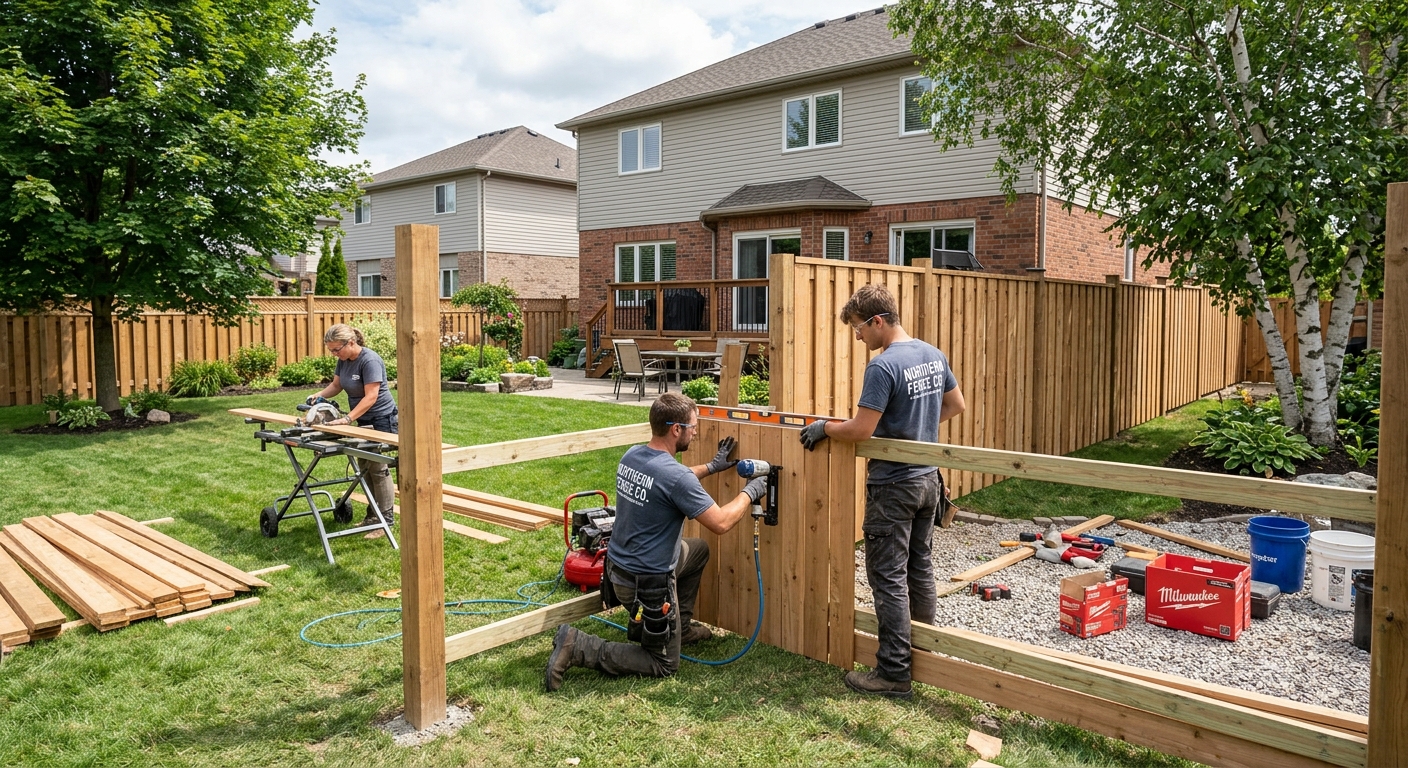
Fencing options and costs in South Clearbrook
In South Clearbrook, homeowners typically choose a fence style based on privacy, curb appeal, and how much upkeep they want in our Lower Mainland–Southwest weather. With a population of 10,120 (Statistics Canada, 2021 Census), demand is steady year-round, and fencing contractors often see repeat work as households upgrade older boundary lines. Lower Mainland–Southwest areas with more established residential streets—especially around the Clearbrook corridor near shoppers’ hubs—tend to have more backyard upgrades because many lots sit close to mature trees, play areas, or driveways where wind protection and visual screening matter.
Local climate is a cost-shaper here. South Clearbrook experiences mild but wet conditions, so wood needs proper treatment to resist moisture-driven rot, and posts often require deeper setting than “minimum” guidance to reduce heaving during frost swings. While frost can be shallower than in Ontario or Alberta, crews still commonly set posts deeper and use concrete for corner posts, privacy runs, and gate hardware to keep the fence square through freeze-thaw cycles and damp Fraser Valley soils. Access and grading also matter: sloped yards and soft ground may increase excavation time and concrete use. Because of that mix, two quotes for the “same fence” can land in different price bands based on embed depth, rail count, and whether demolition and haul-away are included.
Below is a practical comparison of common materials you’ll see quoted in South Clearbrook, followed by cost expectations per linear foot.
| Material |
Lifespan |
Maintenance |
Privacy Rating |
Price per Linear Foot |
| Pressure-treated pine (standard wood) |
10–15 years |
Stain/seal every 2–3 years; inspect for warping |
Medium–High |
$22–$34 |
| Cedar (natural rot resistance) |
15–25 years |
Light sealing every 2–4 years (helps appearance and longevity) |
High |
$28–$46 |
| Vinyl / PVC (no-maintenance) |
20–30 years |
Rinse as needed; inspect posts for impact |
High |
$30–$55 |
| Chain-link (galvanized steel) |
25–40 years |
Occasional coating touch-ups if scratched |
Low |
$14–$26 |
| Aluminum ornamental |
25–40 years |
Wash annually or as needed |
Low–Medium |
$27–$60 |
| Composite / recycled material |
20–30 years |
Minimal cleaning; check for surface wear |
Medium–High |
$26–$50 |
Prices are estimates only and vary by project scope, site access and material selection.
What affects the price of fencing in South Clearbrook
Fence pricing in South Clearbrook (and the wider Lower Mainland–Southwest) can swing by about 30–50% for the same overall look because the hidden variables are very real: post depth and embed method, soil conditions, rail count, wind reinforcement, and whether the contractor is also handling demolition and disposal. In British Columbia, crews also price for wet ground and frost-related movement—so even when the fence height and length match your neighbour’s, your quote can differ if excavation is harder or if corners and gates need heavier hardware.
First, post depth is a major driver. Published guidance often cites minimum embedment around 3 feet in much of Canada, and while BC’s coastal conditions can be less severe than inland regions, many contractors still set posts about 4–6 inches below the design frost depth to limit heaving. In Lower Mainland soils, that frequently means deeper holes than homeowners expect, longer posts, and more concrete—especially for privacy fences, corner posts, and gate frames.
Second, wind exposure influences spacing and reinforcement. Chain-link can be cheaper partly because it uses lighter elements, but solid privacy designs (wood/vinyl) may require tighter spacing, sturdier rails, and stronger corner bracing to resist wind load and movement.
Finally, wet-site realities in South Clearbrook can either raise or lower costs. Example: soft, saturated soil may require more excavation support and extra concrete to prevent posts from shifting; firm ground with good drainage can reduce labour time. If your yard is sloped, stepped panels or raked grading add labour and sometimes extra posts.
To anchor this: wood installations often land in the $55–$95 installed range, while vinyl/PVC typically comes higher—often around $75–$130 installed—mainly due to heavier structural requirements, post reinforcement, and material cost.
| Price Factor |
Why It Matters |
Cost Impact |
| Fence length in linear feet |
More fence means more posts, rails, fasteners and labour time. |
Usually the largest swing in total cost. |
| Post depth required |
Frost movement risk depends on local conditions; deeper embed limits heaving. |
Can add concrete and longer materials. |
| Post setting method |
Concrete setting resists shifting; gravel pack/driven methods differ in performance. |
Concrete increases material and labour costs. |
| Material choice |
Vinyl and composite require different structural and fastening systems; cedar differs in rot resistance. |
Material price differences drive major portions of the quote. |
| Gate count and type |
Gates need stronger posts, hinges, and hardware; drive-through gates are heavier. |
Commonly adds significant cost over run sections. |
| Grade and terrain |
Slopes require racking/stepped construction and extra layout time. |
More labour, more posts, more labour-hours. |
| Old fence removal and disposal |
Haul-away and disposal fees plus labour for dismantling and disconnecting posts. |
Can materially increase total even when new materials stay the same. |
| Permit fees and survey / property line locate |
Documentation and locating pins prevent costly encroachment disputes. |
Variable but often a noticeable add-on on larger projects. |
Permits & regulations in British Columbia
In British Columbia, fence rules are often tied to height thresholds and local bylaws. As a practical starting point for South Clearbrook homeowners, fences above roughly 2.0 m (about 6.5 ft) at the rear and around 1.0–1.2 m (3–4 ft) at the front or near corners often trigger a building permit requirement, depending on the site and jurisdictional interpretation. Even when a permit isn’t required, you still must respect property lines and municipal setback bylaws.
Before you dig any post holes, call for utility locates. In British Columbia, that typically means using BC 1 Call (utilities are marked so crews can avoid underground lines). If you have any doubt about where your property line sits, get a survey or property line locate before installing—this protects you from encroachment disputes with neighbours and helps contractors lay out accurately.
Step-by-step, to verify your contractor and reduce risk: (1) request their licence details and confirm they are permitted to do the work as required; (2) ask for a current certificate of liability insurance and ensure the coverage is active for your project dates; (3) request proof they have applicable worker coverage (WSIB/WCB equivalent coverage depending on the contractor’s registration) and that it applies to the crew working on your site; and (4) verify any clearance letter documentation if the contractor uses it in their process.
For shared boundary fences, line-fence principles in provincial legislation can affect responsibilities—so it’s wise to confirm who owns which portion before ordering materials.
Choosing the right fence material for South Clearbrook
Choosing the right fence material in South Clearbrook is mostly about matching your priorities—privacy, low maintenance, and lifespan—to our wet, freeze-thaw capable conditions. Pressure-treated pine is usually the budget-friendly start, but it typically needs staining or sealing every 2–3 years to prevent grey weathering and to keep moisture out of the wood. Cedar offers better natural rot resistance and often looks better as it ages, but you still shouldn’t “set and forget” because surface maintenance helps it perform longer.
Vinyl/PVC is popular for homeowners who want minimal upkeep. In Lower Mainland–Southwest conditions, it can perform well for 20–30 years, but it requires correct post alignment and structural reinforcement—especially where winter cold snaps and spring thaw can stress fasteners. Chain-link is the longest-life low-cost solution in most residential budgets, but it offers little privacy unless you pair it with slats or plant screening. Aluminum ornamental fencing resists rust and is low maintenance, but it’s generally a privacy compromise due to the open design. Composite/recycled materials can be a good “wood-like” middle ground with reduced rot risk, though cost is typically closer to cedar or vinyl depending on the board system.
On post depth: even though BC can be less frost severe than the Prairies, many projects still benefit from deeper embedment than “minimum.” Contractors often set posts deeper to reduce heaving risk and use concrete-set posts for corner posts, privacy panels, and gates where stability matters. Wind and snow impact also matter: stronger posts, tighter spacing, and proper bracing can prevent racking in heavier winds.
As a simple budget example, an installed wood fence often falls around $55–$95 per linear foot, while vinyl/PVC commonly lands closer to $75–$130. The higher vinyl cost can be justified if you value long-term appearance and want to avoid recurring staining schedules in a wet cycle environment.
| Material |
Cold Tolerance |
Lifespan |
Annual Maintenance |
Best For |
Price Band |
| Pressure-treated pine |
Good with correct seal/stain and proper post embedment |
10–15 years |
Low to moderate (stain/seal every 2–3 years) |
Budget privacy with workable long-term upkeep |
$55–$95 |
| Cedar |
Good; best results with routine surface care |
15–25 years |
Low to moderate (seal or stain every 2–4 years) |
Better aesthetics and natural rot resistance |
$70–$110 |
| Vinyl / PVC |
Good; needs correct structure to avoid stress at cold snaps |
20–30 years |
Very low (rinse as needed; inspect hardware) |
Low-maintenance privacy and clean appearance |
$75–$130 |
| Chain-link |
Very good in wet and freeze-thaw climates |
25–40 years |
Very low (spot touch-ups if damaged) |
Security and pet control without privacy screening |
$30–$55 |
| Aluminum ornamental |
Good; powder-coating holds up in coastal moisture |
25–40 years |
Very low (wash annually) |
Curb appeal with visibility |
$90–$170 |
| Composite / recycled |
Good; boards designed for moisture resistance |
20–30 years |
Low (cleaning, inspect posts and fasteners) |
Wood-like look with reduced rot risk |
$75–$130 |
How to choose a fencing contractor in South Clearbrook
When hiring a fence contractor in South Clearbrook, start by verifying the credentials that protect you if something goes wrong. In British Columbia, ask for (1) proof of liability insurance (a current certificate of insurance naming your project or owner where applicable); (2) proof of applicable worker coverage (WSIB/WCB coverage as applicable to the contractor’s registration) for the crew doing the work; and (3) licence/registration details that apply to the specific scope. You can also confirm documentation validity by checking the contractor’s official business listings and requesting the certificate be issued/dated for the current policy period.
Next, get 2–3 itemised written quotes. “Itemised” matters: look for line items for fence labour, materials, post embedment method (concrete vs. gravel pack), gate hardware, rails and pickets, and removal/disposal. Avoid quotes that only show a final lump sum without describing what’s included. Also confirm whether permits or surveys/property line locate are included or billed separately.
Warranty should be clear: ask for a workmanship warranty length, and separate it from the manufacturer’s product warranty (if applicable). Confirm whether any warranty is transferable if you sell the property—this is often overlooked. Payment schedule is another key point: never pay more than about 10–15% upfront. A solid contractor will accept progress payments and hold back a portion until the fence is complete and cleaned up.
Finally, timeline: ask for a written start date and a completion estimate that reflects site conditions, post embedment curing time (if concrete-set), and any weather-related delays typical to the Lower Mainland–Southwest.
- Request itemised quotes (labour, materials, posts, rails, gates, and hardware listed separately).
- Confirm post setting method in writing (concrete placement at corners/gates and embed depth).
- Ask whether removal/disposal of the old fence is included.
- Verify permit responsibility: included or extra, and who submits documentation.
- Check for a workmanship warranty and confirm what it covers (e.g., post movement, rail alignment).
- Get manufacturer warranty terms for vinyl/wood/composite components.
- Confirm insurance certificate is current and covers your project dates.
- Request proof of applicable worker coverage for the crew.
- Review the quote for measurement basis (linear feet, fence height, gate count).
- Make sure the scope includes grading/stepped or raked sections on sloped yards.
- Ask who is responsible for utility locate marking if excavation is required (you should still call BC 1 Call).
- Agree on a payment schedule with a holdback until final walkthrough.
If a contractor in South Clearbrook pushes a large upfront payment, refuses to itemise materials and labour, won’t provide a current certificate of insurance/worker coverage, avoids discussing post embedment depth and setting method, or gives only verbal promises about permits and warranty, treat that as a red flag and get another quote.
Frequently asked questions — fencing in South Clearbrook
What's the most low-maintenance fence?
In South Clearbrook and across British Columbia, the lowest-maintenance options are typically vinyl/PVC and chain-link. Vinyl/PVC is built to resist moisture-driven rot and usually needs only rinsing and basic hardware checks; it often sits in the higher installed band of about $75–$130 per linear foot depending on height, post structure, and gate complexity. Chain-link is also very low maintenance—galvanized steel performs well in wet, freeze-thaw conditions—but it won’t provide privacy unless you add slats or mesh privacy inserts. If you’re comparing wood versus vinyl, remember that pressure-treated pine and cedar still require periodic staining/sealing to keep them looking good and to slow surface breakdown in damp cycles common to the Lower Mainland–Southwest.
How tall can my fence be in South Clearbrook?
Fence height rules in British Columbia depend on where the fence sits (front/corner versus rear) and local bylaw interpretation. A common planning benchmark is that fences above about 2.0 m (6.5 ft) in the rear and around 1.0–1.2 m (3–4 ft) near the front or corners may require a building permit, and they must also respect setbacks from property lines. For your specific South Clearbrook location, the safest approach is to share your intended height, survey pins or property line details, and neighbour-facing layout with the contractor and confirm what permit—if any—will be required before you order materials. This avoids situations where a cheaper initial quote increases after revisions due to compliance.
Should fence posts be set in concrete here?
Often, yes—especially at corner posts and gate posts in South Clearbrook—because stability is critical in wet, freeze-thaw capable soils. Even though BC’s coastal conditions are milder than inland provinces, frost swings still call for proper embedment to limit heaving. Many contractors therefore set posts deeper than a bare minimum, and they commonly use concrete setting at high-stress locations (corners, end posts, privacy runs, and gates) to keep the fence aligned. For the rest of a run, the choice between concrete versus gravel pack or other methods depends on soil conditions, drainage, and the fence type. A good quote will specify post depth and setting method rather than leaving it vague.
What's the best fence for privacy?
For privacy in South Clearbrook, you’ll typically get the best results with a solid-panel fence like cedar, pressure-treated pine, vinyl/PVC, or composite. Privacy also depends on board spacing (zero/limited gaps) and correct bracing at corners and gates so the fence doesn’t rack in wind. Vinyl/PVC generally offers strong privacy with low upkeep, often priced in the $75–$130 installed band. Cedar and pressure-treated pine can be mid-range depending on height and style, with pressure-treated wood often landing around $55–$95 installed. Chain-link can be made more private with slats or screens, but it won’t match solid fences for full visual privacy.
How do I compare fencing quotes?
Start by making sure each quote covers the same scope. Compare linear footage, fence height, number and type of gates, panel style (including picket/board spacing), and the post embedment method (concrete versus alternative settings). Look for line items rather than a lump sum, including removal/disposal of your old fence, any stepped/raked sections for slopes, and whether utilities locate or permits are included. Because South Clearbrook soil can be damp and frost movement is still a factor, pay close attention to post depth and how corners and gates are reinforced—these can explain why two “similar” quotes differ by 30–50%. If one quote is much lower, ask what they’re excluding.
How long does fence installation take in South Clearbrook?
For an ordinary residential fence, installation timelines are usually about a few days to a week, depending on length, number of gates, terrain, and whether there’s old fence removal. In South Clearbrook, wet ground and scheduling can add time for excavation and cleanup. If concrete-set posts are used, the crew may need extra handling time around curing windows before they fully assemble heavier gate hardware. Your contractor should provide a start date and completion estimate in writing, and they should explain sequencing (layout, locates, post holes, set posts, rails/panels, gate install, final walk-through). If weather delays occur, a reputable contractor should communicate and document schedule changes rather than leaving you guessing.