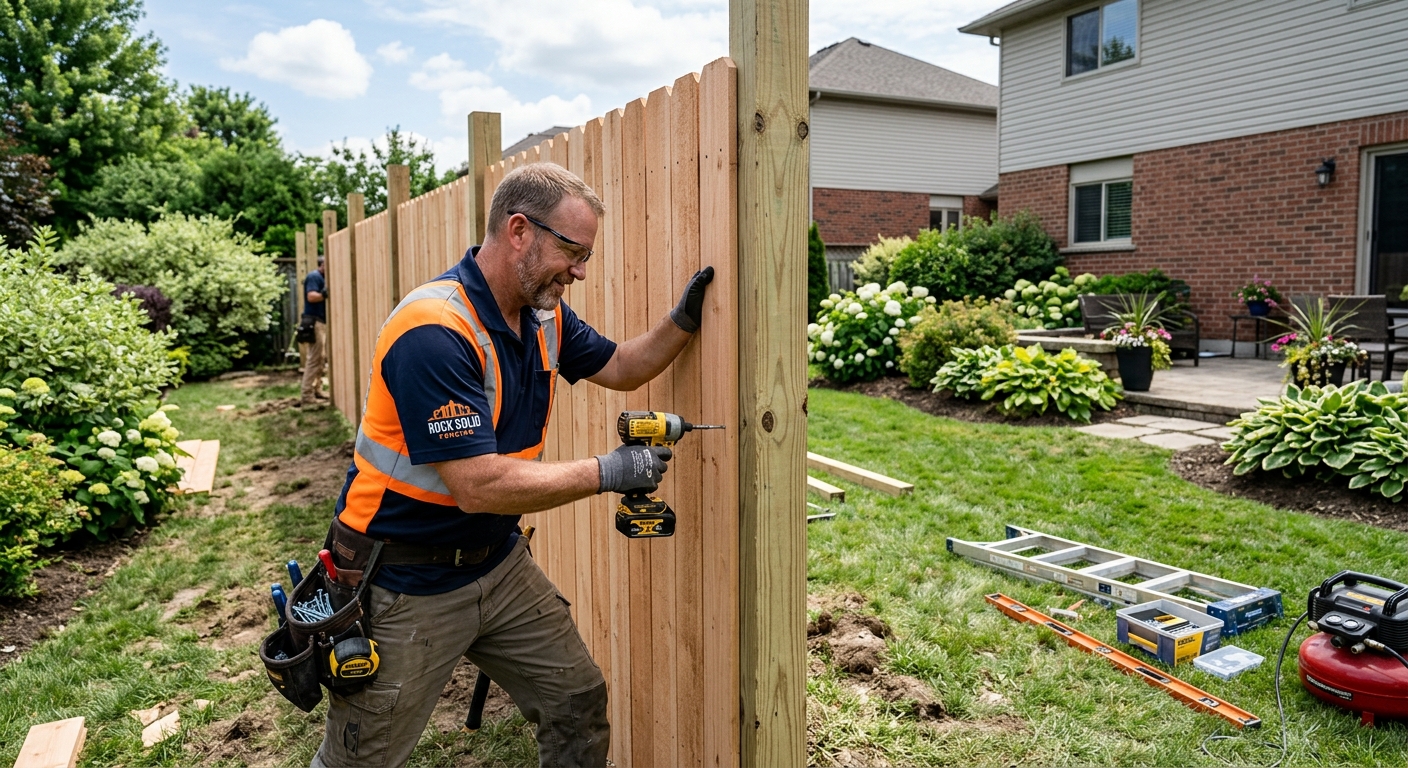
Fencing options and costs in Fort St. John
Fort St. John has a lot of yard fencing demand, and it’s easy to see why: with 49.9% of dwellings being single-detached homes and 57.7% of households owning their property, many homeowners are actively improving curb appeal and boundary control. Each detached lot is essentially a “fencing project waiting to happen,” especially as families update aging yards and outdoor spaces.
In Northeast British Columbia, quotes often land higher than generic BC averages because frost penetration commonly exceeds 4 ft around the Peace River districts. That means posts are typically set 4–5 ft deep (often with belled footings and concrete) to reduce frost heave and seasonal movement. Strong, prairie-style wind exposure also changes design choices: contractors tighten post spacing and may recommend less sail-like panels (or stronger post dimensions) to help fences stay plumb through winter gusts.
Trade activity is particularly steady around areas like the Pineview and North Peace area where new builds and renovations are more common, and where wind exposure across open lots drives demand for better anchoring. Contractors who routinely excavate deeper holes and install wind-rated structures generally have fuller schedules in colder months, so labour can price differently than in milder regions.
Below is a practical snapshot of common material choices and what homeowners typically budget for Fort St. John projects—use it to compare quotes before you ask questions.
| Material |
Lifespan |
Maintenance |
Privacy Rating |
Price per Linear Foot |
| Pressure-treated pine (standard wood) |
10–15 years |
Stain/coat every 2–3 years; inspect posts after freeze-thaw |
Medium–High (solid or close board spacing) |
$80–$120 |
| Cedar (natural rot resistance) |
15–25 years |
Seal/stain every 3–4 years; replace any damaged bottom rails early |
High (boards close together) |
$95–$135 |
| Vinyl / PVC (no-maintenance) |
20–30 years |
Rinse as needed; avoid impact damage; check post hardware |
High (privacy styles) |
$95–$140 |
| Chain-link (galvanized steel) |
20–30 years |
Minimal; occasionally tighten fittings and refresh tension |
Low–Medium (privacy slats optional) |
$55–$85 |
| Aluminum ornamental |
25–40 years |
Minimal; rinse; inspect gate alignment after wind events |
Low–Medium (open picket styles) |
$105–$155 |
| Composite / recycled material |
20–30 years |
Low; occasional cleaning; check for warping near footing |
High (solid composite panels) |
$100–$145 |
Prices are estimates only and vary by project scope, site access and material selection.
What affects the price of fencing in Fort St. John
In Fort St. John and the wider Northeast BC Peace region, two quotes for what looks like “the same fence” can easily differ by 30–50%. The biggest reason is how contractors handle Northeast conditions—especially deep frost and wind—because those factors change post depth, post spacing, and sometimes the entire framing approach, not just the material list. In practice, contractors who routinely excavate for 4–5 ft deep settings and engineer for wind exposure often charge more upfront, but you usually get fewer seasonal issues like leaning, heaving, and gate sag.
Frost is a direct cost driver: typical practice is setting posts 4–6 inches below the design frost depth. Where frost penetrations are deeper (commonly exceeding 4 ft locally), holes get larger and posts need to be longer to keep the fence stable—often with concrete in belled footings. That additional labour time (augers/excavation + concrete + re-leveling) and extra material length pushes budgets up. On the other hand, if your fencing run is shorter, the terrain is flat, and you have good access for a small excavator, the price can sit closer to the lower end of the regional bands.
Wind exposure on open prairie-style lots also increases costs. Contractors may reduce post spacing and upsize posts to resist gust loads; heavier privacy panels can require upgraded concrete footings or stronger posts. Coastal-influenced BC areas can be milder, but wood rot can advance quickly without proper treatment; in Fort St. John the protection needs to address both freeze-thaw and moisture cycles.
Concrete examples: (1) a vinyl privacy fence with tight spacing in a windy corner lot tends to land near the vinyl band of $95–$140 per linear foot because of hardware and post upgrades; (2) a chain-link perimeter on a flat yard can remain near $55–$90 per linear foot because it needs less material bulk and less wind resistance; (3) removing an old fence that’s been set shallow or has frost-damaged posts can add time for demolition, disposal, and rework of line/grade—often increasing the effective labour component by hundreds of dollars even on “small” runs.
| Price Factor |
Why It Matters |
Cost Impact |
| Fence length in linear feet |
Most fencing costs scale directly with total linear footage and the number of line posts |
High (can change the total by thousands) |
| Post depth required |
Frost line determines the hole depth and post length needed to prevent heaving |
High (deeper frost settings add labour + concrete) |
| Post setting method |
Concrete provides more stability than gravel pack on frost-prone soils |
Medium–High (concrete increases both materials and time) |
| Material choice |
Vinyl and cedar cost more than chain-link; metal hardware differs by style |
Medium–High (drives per-foot price band) |
| Gate count and type |
Drive-through gates require heavier frames, hinges, and often stronger posts |
High (gates can add significant labour and steel) |
| Grade and terrain |
Slopes require stepped sections or raked rails/panels to stay level |
Medium (more layout, cutting, and labour) |
| Old fence removal and disposal |
Demo adds labour, dump fees, and often uncovers frost-damaged posts |
Medium (can add hundreds to over a thousand) |
| Permit fees and survey / property line locate |
Front/corner height and exact boundary location can trigger administrative steps |
Low–Medium (varies by scope and documentation) |
Permits & regulations in British Columbia
In British Columbia, fence permit requirements commonly depend on fence height and location. A practical rule of thumb is that fences above roughly 2.0 m (6.5 ft) at the rear and around 1.0–1.2 m (3–4 ft) at the front or corner often require a building permit, and you must also respect property lines and any municipal setback bylaws that apply to your lot. Before any digging, call for utility locates through the applicable one-call system (BC 1 Call) and confirm your exact fence line, ideally with a survey or a locate of your property pins. This is important because Peace River district lots can have older boundary markers, and encroachment disputes are a common headache when the “assumed line” isn’t the real one.
Before hiring, verify who is responsible for permits. Many reputable fence contractors include permit pulling only if it’s clearly written in the quote and includes associated admin fees; others will build without a permit if you confirm eligibility and height/location fall below thresholds.
To verify a contractor in Fort St. John, ask for (1) proof of licensing/registration where applicable for the work they’re doing; (2) a certificate of insurance naming you as an additional insured (liability); and (3) proof of coverage for workers—commonly through the provincial workers’ compensation system coverage. Then check: the certificate’s policy period, the coverage limits, and that the clearance is current. If anything is missing or “paperwork is later,” that’s a sign to slow down and request the documents before booking the install date.
Choosing the right fence material for Fort St. John
Choosing a fence in Fort St. John is mostly about matching material to wind, frost, and the amount of maintenance you want to handle. Pressure-treated pine is usually the lowest-ticket wood option, but it needs staining or sealing about every 2–3 years to slow grey weathering and protect boards from moisture cycling. Cedar looks better for longer and has better natural rot resistance, but it still benefits from periodic sealing—especially if the fence bottom rails sit near snow-melt and splash zones.
For low maintenance, vinyl/PVC is popular, and in Northeast BC it can perform well when posts and hardware are installed for deep frost conditions. The key is ensuring correct post depth and proper hardware so the system stays rigid during freeze-thaw. Vinyl can crack if struck, and very cold snaps can make panels more brittle, so you’ll want a contractor who uses the right spacing and keeps supports aligned in high-wind runs. Chain-link is the budget-friendly and longest-lived perimeter option because it’s light and resists wind load well, but it offers little privacy unless you add privacy slats. Aluminum ornamental is rust-resistant and mid-range in cost, but it’s typically open—great for security and visibility rather than seclusion.
On local frost requirements: if frost penetration is commonly over 4 ft around the Peace River districts, concrete-set posts are often necessary for stability—meaning deeper holes, correct post length, and concrete in belled footings to reduce heave and seasonal movement. Wind and snow load also matter: privacy panels act like sails, so stronger framing and tighter post spacing are usually worth the cost where you’re exposed.
A concrete budgeting example: if you price a cedar privacy fence versus chain-link, you might see a difference that puts cedar in the $95–$135 range while chain-link often sits closer to $55–$90 per linear foot. That extra cost is justified if you need real privacy and a solid boundary; if your priority is simply keeping pets contained, chain-link may deliver the better value.
| Material |
Cold Tolerance |
Lifespan |
Annual Maintenance |
Best For |
Price Band |
| Pressure-treated pine |
Good (with proper staining and robust post setting) |
10–15 years |
Light (inspect, minor touch-ups; stain every 2–3 years) |
Budget privacy when you’re okay with periodic upkeep |
$80–$120 |
| Cedar |
Very good (naturally rot-resistant, still needs protection) |
15–25 years |
Light (seal/stain about every 3–4 years) |
Longer-lasting wood appearance and good privacy |
$95–$135 |
| Vinyl / PVC |
Good (best when hardware and spacing suit deep frost) |
20–30 years |
Minimal (rinse; check posts/hardware after severe seasons) |
Low-maintenance privacy with consistent appearance |
$95–$140 |
| Chain-link |
Excellent (wind-tolerant by design) |
20–30 years |
Minimal (tighten fittings as needed) |
Pet/security fencing with low wind-risk |
$55–$90 |
| Aluminum ornamental |
Excellent (corrosion-resistant metal) |
25–40 years |
Minimal (occasional rinse and alignment checks) |
Decorative security and long service life |
$105–$155 |
| Composite / recycled |
Good (as long as bottom airflow and footings are correct) |
20–30 years |
Low (cleaning; monitor for impact damage) |
Solid privacy with low upkeep |
$100–$145 |
How to choose a fencing contractor in Fort St. John
Choosing the right fencing contractor in Fort St. John is largely about proof and clarity. Start by verifying British Columbia eligibility and insurance: ask for their certificate of liability insurance (current policy date, coverage limit, and that it covers fencing installation work), then confirm workers’ compensation coverage for their employees through the provincial system (commonly referred to as WCB). Don’t accept screenshots of “coverage” without the policy details—ask the contractor to provide the actual certificate document and clearance information.
Next, get 2–3 itemised written quotes—not lump sums. You want labour broken out (excavation/footings, framing, installation, gate hardware work) and materials broken out (posts, rails, panels, fasteners, concrete, and disposal). Ask whether permit pulling is included if it applies, and whether old fence removal and dump fees are part of the price. In Northeast BC, disposal and rework can swing the final cost, so make sure exclusions (rock removal, locating utilities, replacing damaged supply lines, survey fees) are spelled out.
Warranty matters too: ask for the workmanship warranty length (how long they stand behind straightness, post movement, and proper anchoring), plus the manufacturer warranty for the product itself. Also ask if warranties are transferable to a future owner, since many homeowners sell before the full lifespan.
For payment, never pay more than 10–15% upfront. Use a holdback until the final inspection/walk-through is complete, especially for gate alignment and bottom clearance. Finally, get a start date and completion estimate in writing, including weather caveats for deep frost excavation and concrete curing times.
- Confirm they understand deep frost-style post settings (depth, footing type, and concrete use) for Northeast BC conditions.
- Request proof of liability insurance and confirm the certificate is active for your install dates.
- Verify workers’ compensation coverage (WCB) for any employees involved.
- Ask for the exact scope: line posts, corner/terminal posts, rails, and gate frame details.
- Require a detailed materials list (fasteners, hardware grade, concrete amount, and post dimensions).
- Check whether the quote includes disposal of old fencing and offcuts.
- Ask who pulls permits (if required) and whether permit fees are included.
- Confirm how they handle slopes: stepped vs. raked sections, and who measures grade.
- Get their plan for utility locates and what happens if lines are found in the excavation path.
- Review the warranty: workmanship vs product warranty; ask for durations in writing.
- Use a payment schedule with a holdback until gates close properly and panels are level/plumb.
- Insist on a written timeline with realistic completion dates and weather-impact notes.
Concrete red flags I see in Fort St. John: (1) they can’t clearly explain post depth and footing approach for frost; (2) they quote “gravel only” for exposed lots where concrete-set posts are expected; (3) they provide only a lump-sum price with no breakdown for excavation/concrete/materials; (4) they ask for large upfront payments (more than 15%) before any work begins; and (5) their insurance paperwork is missing, expired, or doesn’t cover the scope of fencing installation.
Frequently asked questions — fencing in Fort St. John
Can I install a fence on a slope in Fort St. John?
Yes, you can install fencing on a slope in Fort St. John, but the layout method matters. Most contractors will use stepped panels (small “steps” as the grade changes) or raked rails (a consistent slope across the fence line), depending on the material system. For privacy boards and vinyl/PVC, stepped construction is often cleaner because it keeps the top profile consistent while preventing gaps from creeping in at the bottom. Because Northeast BC has freeze-thaw cycles, make sure the footings are sized and set to the correct depth at each section—don’t “shortcut” by using shallow holes on the lower side. If you’re near a property line, confirm your boundary pins before starting so you don’t end up adjusting the design after excavation. (Statistics Canada, 2021 Census)
What is the most weather-resistant fence for Fort St. John's climate?
For Northeast BC exposure, chain-link and aluminum tend to be the most forgiving over time, because they resist wind load better and don’t trap moisture the way solid wood panels can. Chain-link is also less vulnerable to wind “sail” effects that can stress posts when snow and gusts hit. That said, wood can be very durable if it’s installed correctly with proper post depth and treated materials—especially pressure-treated pine or cedar with solid footing. If you want a balance of low maintenance and privacy, vinyl privacy fences can work well when installed with frost-appropriate post settings and quality hardware. In budget terms, you might see chain-link around $55–$90 per linear foot, while vinyl commonly sits closer to $95–$140 per linear foot depending on height and wind-exposed design.
How do I prevent wood fence rot in Fort St. John?
Wood rot prevention in Fort St. John comes down to two things: material protection and good bottom-of-fence detailing. First, use pressure-treated lumber for budget runs or cedar for longer-lasting appearance, but don’t skip staining/sealing schedules—pressure-treated wood typically benefits from re-staining every 2–3 years, while cedar usually needs sealing around every 3–4 years. Second, ensure posts are installed at the right depth for frost, usually with concrete setting where needed in deeper frost-prone soils, so the fence doesn’t heave and leave gaps that trap water. Keep bottom rails slightly off the ground when the design allows and avoid planting dense shrubs right against the fence line, which can keep moisture against the boards. A good contractor will also use corrosion-resistant fasteners and check alignment after the first heavy freeze-thaw cycle.
What is the cost per linear foot for fencing in Fort St. John?
In Fort St. John, fencing costs are commonly driven by deep frost installation, wind exposure, and project complexity. As a realistic guide, wood fencing installation often lands in the $80–$130 per linear foot range, while chain-link is typically lower at $55–$90 per linear foot. Vinyl/PVC privacy fences often price higher, commonly $85–$140 per linear foot, because of material cost and more complex post/hardware requirements in exposed yards. Aluminum ornamental fencing commonly falls in the $95–$150 per linear foot range. Your exact number depends on fence height, gate count, how many corner/terminal posts are needed, whether old fence removal is included, and whether concrete-set footings are required for your site conditions.
Should I repair or replace my old fence in Fort St. John?
It usually comes down to how widespread the damage is and whether the posts are still solid. If the fence has a few broken boards or minor rail sag, repairs are often cost-effective. But if posts have shifted from frost movement, if bottoms are rotting, or if multiple sections are leaning after winter winds, replacement is frequently the better long-term value because the foundation problem will keep resurfacing. When you get quotes, ask the contractor to inspect and specifically note post movement, how deep the existing posts were set, and whether the rail alignment can be restored without re-footing. A replacement may cost more upfront, but it avoids repeated repair visits during freeze-thaw seasons. As a quick check: if your current fence is already near the end of its service life (for wood, often 10–15 years depending on conditions), budgeting for replacement is commonly more predictable.
How do I handle a fence dispute with a neighbour in British Columbia?
Fence disputes in British Columbia usually start with clarifying the exact boundary line and the responsibilities for shared fencing. First, gather your documents: any survey, property pin information, and the original fence agreement if one exists. Then, speak with your neighbour calmly and propose a joint site visit with accurate measurement—don’t rely on “what it looks like” because older markers can be off. If the fence is encroaching or the boundary is uncertain, arrange for a survey or a proper property line locate before spending on materials. For shared fence responsibilities, line-fences legislation principles generally apply, but the practical step is to agree in writing on who pays for what. In exposed Fort St. John areas, disputes can also come from unequal maintenance (one side replacing posts earlier, the other leaving older posts to heave), so ensure the foundation details like post depth and footing approach are consistent across the shared line.