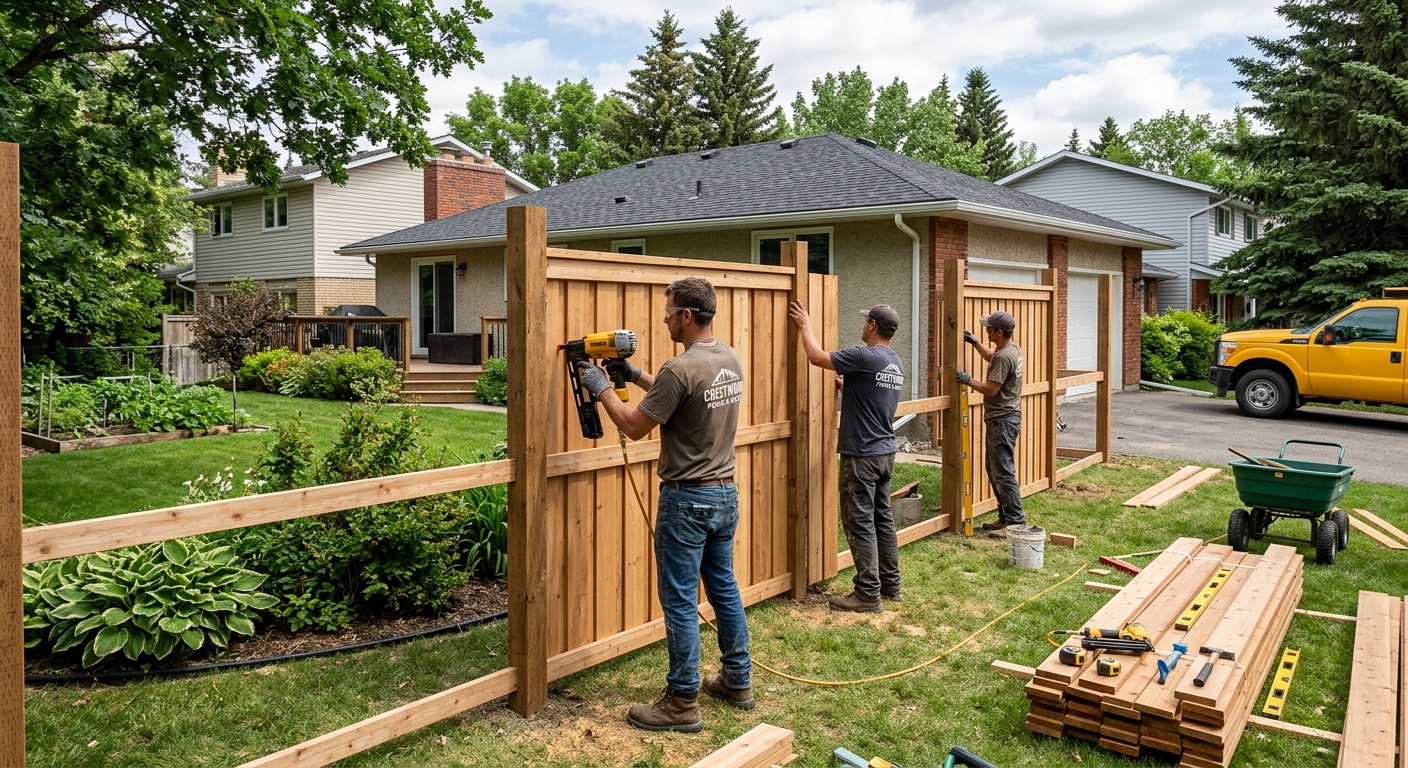
Fencing options and costs in Creston
Creston homeowners typically have a clear choice of fence materials, but the “right” pick depends on how long you want it to last through Kootenay freeze–thaw. With Creston’s population at 5,583 (Statistics Canada, 2021 Census) and 74.0% of dwellings being single-detached homes, there’s steady demand for perimeter and backyard fencing—every detached property is effectively a potential fencing project. A large share of local housing stock was built before 1981 (57.5% of dwellings), which often means older fence lines, older posts, and more frequent upgrades when homeowners replace deteriorated rails or correct sagging runs.
In the Kootenays, fence pricing is shaped by the frost line and how posts are installed. Posts often need to be set close to or below typical design frost depth to prevent frost heave, which means deeper augering, more excavation time, and more concrete per post than what you might see in milder regions. Wind and snow also matter: even if Creston isn’t as exposed as open Prairie sites, tall panels can rack during winter storms, so contractors may use tighter post spacing and stronger framing on privacy runs. You’ll especially see trade activity around residential pockets like the Creston East and Downtown neighbourhood areas, where infill lots and accessible back lanes are common for fence replacements.
Below are typical options and realistic budget ranges to help you compare apples to apples before you request a quote.
| Material |
Lifespan |
Maintenance |
Privacy Rating |
Price per Linear Foot |
| Pressure-treated pine (standard wood) |
12–18 years |
Stain or seal every 2–3 years; fastener checks |
High (solid boards) |
$45–$75 |
| Cedar (natural rot resistance) |
15–25 years |
Stain/seal every 2–4 years depending on sun exposure |
High (solid boards) |
$60–$95 |
| Vinyl / PVC (no-maintenance) |
20–30 years |
Rinse annually; no staining |
High (solid pickets/panels) |
$70–$110 |
| Chain-link (galvanized steel) |
25–35 years |
Occasional wash; tighten hardware if needed |
Low to medium |
$30–$55 |
| Aluminum ornamental |
25–40 years |
Wash as needed; hardware inspection |
Low (open design) |
$80–$140 |
| Composite / recycled material |
20–30 years |
Minimal cleaning; inspect bottom edges |
Medium to high (solid styles) |
$90–$130 |
Prices are estimates only and vary by project scope, site access and material selection.
What affects the price of fencing in Creston
Even when two homeowners describe the “same” fence, quotes can land 30–50% apart across Kootenay communities and across British Columbia because the big cost drivers aren’t just the material—they’re the installation requirements. Post depth is the most common reason. In many cold regions of B.C., contractors must treat frost protection seriously: posts are typically set 4–6 inches below the design frost depth to help resist heaving, which pushes excavation deeper and increases concrete and labor. That deeper work can move a project from “standard wood” toward “structural build” pricing, especially on corners and gate posts.
Wind exposure also changes engineering choices. Prairie-style wind patterns are why some regions tighten post spacing and specify heavier panels, and while Creston is generally less severe than the open Prairie, exposed lots still experience racking forces—especially for 6 ft privacy fences. On the other end, coastal milder but wetter climates can accelerate wood rot if treatment isn’t done correctly, which is why cedar and pressure-treated choices can vary in maintenance requirements. In Creston, the freeze–thaw cycle is usually the bigger driver than constant rain saturation, but the result is similar: you pay for proper footing and good detailing.
Concrete examples from local pricing: a 60 ft pressure-treated pine privacy run can sit around the wood band ($45–$75 per linear foot) when post holes are straightforward. The same length in vinyl/PVC can jump toward $70–$110 per linear foot because of higher material costs plus reinforced rails needed for cold-weather rigidity. If you add a second gate for dog or utility access, hardware and a stronger frame can add cost even on “simple” layouts.
Finally, local housing age matters: with many homes older than 1981 (57.5% of dwellings), you often see uneven fence lines, rotted posts, and extra removal/disposal work that adds labor before new materials even arrive.
| Price Factor |
Why It Matters |
Cost Impact |
| Fence length in linear feet |
Directly drives material quantity, post count, rails and fasteners |
Largest driver of total cost |
| Post depth required |
Frost line determines hole depth and overall post length to prevent heaving |
Can increase excavation time and concrete per post |
| Post setting method |
Concrete set resists uplift and lateral pressure; gravel packs reduce concrete volume |
Concrete-set typically increases labor/materials |
| Material choice |
Vinyl, cedar, and chain-link have different rigidity, gauge, and framing requirements |
Shifts projects into different price bands |
| Gate count and type |
Gates need stronger posts, hinges, latches and often diagonal bracing |
Double gate frames are notably more expensive |
| Grade and terrain |
Slope requires stepped panels or raked frames, affecting rail layout and labour |
More custom cuts and fittings |
| Old fence removal and disposal |
Demo time, hauling, and disposal fees vary with the structure |
Often adds a meaningful labour surcharge |
| Permit fees and survey / property line locate |
Required documentation can be needed before digging or for boundary clarity |
Varies by scope; can add setup time and admin cost |
Permits & regulations in British Columbia
In British Columbia, fence rules are tied to property lines and, in many cases, height. As a practical guideline, fences above a typical threshold—often around 2.0 m (6.5 ft) at the rear and roughly 1.0–1.2 m (3–4 ft) at the front or corner—may require a building permit. Setbacks can also apply based on municipal bylaws, and every fence must stay within your property boundaries. For Creston homeowners, the safest approach is to treat any tall privacy fence or corner visibility fencing as “permit-first” until your contractor confirms the requirements.
Before any post holes are dug, utility locates are non-negotiable. Use the proper provincial/utility service request system for locates (commonly referred to as BC 1 Call), because striking buried lines can create expensive delays and safety risks. If you have boundary uncertainty, obtain a survey or property line locate using your pins so you don’t build on a neighbour’s lot.
Shared fencing and line-fence responsibilities are addressed through provincial line-fences legislation, so know whether you’re building a new dividing fence or replacing one that’s already shared.
Licence/insurance verification (step-by-step): Ask the contractor to provide (1) their business/labour licence details as applicable for B.C., (2) a current certificate of liability insurance naming you as additional insured where possible, and (3) confirmation of WCB/WSIB coverage appropriate to the province. Where to look: request the insurance certificate PDF and any clearance/coverage documentation directly, and verify their registry details through the appropriate online business/licensing resources. For peace of mind, cross-check the certificate dates match your start date, not last year’s policy.
Choosing the right fence material for Creston
Choosing a fence in Creston is mostly about matching material performance to your priorities: privacy, low maintenance, budget, and lifespan. Creston’s freeze–thaw and seasonal temperature swings favour materials and detailing that don’t shift at the base. When post depth and footing are correct, the “best” material becomes the one you’ll realistically maintain.
Pressure-treated pine is the budget-friendly option, typically landing around the local wood range ($45–$75 per linear foot). The trade-off is maintenance: expect staining or sealing roughly every 2–3 years to slow grey weathering and protect exposed boards. Cedar costs more upfront but resists rot better, and it often looks better longer; still, it needs periodic maintenance in sunny, wind-exposed runs. Vinyl/PVC is popular for low upkeep and usually performs well when installed with reinforced rails; however, in extreme cold it can be more sensitive to improper installation spacing, so choose a contractor who frames for cold rigidity.
Chain-link is the longest-lasting low-cost system and a good choice for keeping pets contained, but it provides limited privacy. Aluminum ornamental offers a tidy, no-rust look, though it’s not a privacy fence. Composite/recycled can be a strong middle ground: durable and easier to maintain than wood, though it may cost closer to the higher bands.
On post depth: because frost heave is the real enemy in the Kootenays, concrete-set posts are often justified for privacy fences and gate structures to resist uplift and lateral forces during freeze–thaw. For a dollar example, if you’re comparing pressure-treated pine versus vinyl/PVC on a long run, you may pay an extra amount per foot to move from the wood band ($45–$75) into the vinyl band ($70–$110)—that difference is usually justified when you want near-zero maintenance and a consistent look through winter.
| Material |
Cold Tolerance |
Lifespan |
Annual Maintenance |
Best For |
Price Band |
| Pressure-treated pine |
Good (with proper staining and detailing) |
12–18 years |
Light inspection; plan stain/seal every 2–3 years |
Budget privacy runs |
$45–$75 |
| Cedar |
Good (strong rot resistance) |
15–25 years |
Inspection and stain/seal every 2–4 years |
Natural look with better rot resistance |
$60–$95 |
| Vinyl / PVC |
Very good (if framed and installed correctly) |
20–30 years |
Rinse annually; no staining |
Low-maintenance privacy |
$70–$110 |
| Chain-link |
Excellent (galvanized steel) |
25–35 years |
Occasional wash; hardware checks |
Pet containment and security |
$30–$55 |
| Aluminum ornamental |
Excellent (powder-coated) |
25–40 years |
Wash as needed; inspect fasteners |
Curb appeal without rusting |
$80–$140 |
| Composite / recycled |
Good (durable boards; needs good base detailing) |
20–30 years |
Minimal cleaning; inspect bottom edges |
Maintenance-light boards that look like wood |
$90–$130 |
How to choose a fencing contractor in Creston
In Creston and across British Columbia, you’ll want a fencing contractor who can prove they’re insured, accountable, and experienced with frost-depth and footing details. Start by verifying liability insurance: request a current certificate of insurance and confirm it covers fencing work at your address and includes appropriate coverage limits. Next, check workers’ coverage appropriate to the province—ask for proof of WCB/WSIB coverage and any clearance or evidence the contractor can work on job sites with covered employees. Where to look: ask for documents directly (PDF certificates) and confirm details like policy dates; if you’re unsure, contact the insurer for verification or ask for updated paperwork close to your start date. Finally, verify business registration/licensing details through the appropriate online registry resources in B.C. (and don’t rely on word-of-mouth).
Then get 2–3 itemised written quotes—not a lump sum. Your quote should break down labour (excavation, post setting, framing, installation, gate build) and materials (posts, rails, mesh/boards, hardware). Read the scope for exclusions: is permit pulling included (if required), is old fence removal included, and is disposal/hauling included? Warranty also matters: ask for the workmanship warranty length and the manufacturer product warranty, and whether either is transferable if you sell the home.
For payment schedule, never pay more than 10–15% upfront. Use a holdback until completion and walk-through are finished. Require a written start date and completion estimate.
- Ask for post-depth and footing method in writing (concrete-set vs gravel pack) for your specific line.
- Confirm whether corner and gate posts receive extra bracing and structural posts.
- Ensure the quote includes utility locate responsibility and scheduling.
- Get total linear feet and post count per run listed.
- Check that gate hardware matches your use (self-latching, latch height, swing direction).
- Verify whether the contractor handles fence line re-stretching/tensioning for chain-link.
- Confirm material grade/spec (board thickness, vinyl gauge, chain-link gauge) not just “type.”
- Make sure soil conditions are acknowledged (rocky ground can increase labour).
- Read what’s excluded: stump removal, landscaping touch-up, grading/leveling.
- Ask how they handle slopes—stepped panels or raked rails should be described.
- Require proof of insurance and WCB coverage before any work starts.
- Get a dated schedule and a contact person for day-of issues.
In Creston, red flags I see include: quotes that don’t specify post depth or footing method, vague scopes that omit disposal/removal, missing or outdated insurance/WCB coverage documents, “cash only” payment requests with no written agreement, and warranties that cover materials but not workmanship.
Frequently asked questions — fencing in Creston
Should fence posts be set in concrete here?
In Creston and the wider Kootenay region, concrete-set posts are often the safer choice for privacy fences and any run with gates because frost heave and freeze–thaw cycles can loosen poorly installed posts. Practically, many installations aim to place posts below the design frost depth, commonly with holes drilled 4–6 inches below that target, then set with concrete—especially at corners, end posts, and gate locations. That structural approach helps resist uplift and lateral pressure from frozen soils. A gravel pack can work for some low-height, low-load applications, but if your goal is a long-lived 6 ft privacy fence, concrete setting is typically worth discussing.
What's the best fence for privacy?
For privacy in Creston, solid-board pressure-treated pine or cedar, and vinyl/PVC solid privacy styles are usually the top picks. Wood can look great, but it requires upkeep: staining or sealing every 2–3 years for pressure-treated, and periodic maintenance for cedar to avoid weathering. If you want the lowest ongoing effort, vinyl/PVC privacy panels tend to be the most “set it and forget it” option—especially because they don’t rot like untreated wood. Budget-wise, wood privacy installs often align with the local wood band ($45–$75), while vinyl privacy commonly sits higher, around the vinyl band ($70–$110), reflecting both materials and the reinforced framing needed for winter performance.
How do I compare fencing quotes?
Start by ensuring you’re comparing the same fence design and installation details. Ask each contractor for an itemised quote with linear feet, post count, spacing, post depth target, and the setting method (concrete vs gravel pack). Confirm material specs: board thickness for wood, gauge for chain-link, and vinyl/PVC rail reinforcement details. Also compare gates—one quote can hide cost in the “gate price” and hardware upgrades. Finally, check inclusions: permit pulling (if needed), removal and disposal, and whether grading/landscaping touch-ups are included. When quotes differ by 30–50%, it’s usually because one company is building to frost-line footing requirements while another is using shallower posts or lighter framing.
How long does fence installation take in Creston?
For typical residential jobs in Creston, a straightforward run can take anywhere from 1 to 3 days, depending on length, ground conditions, and whether you’re removing an old fence. Deeper post drilling and concrete setting can add time because excavation and setting cure-related scheduling are real factors in winter-affected soils. If you have multiple gates, sloped terrain requiring stepped or raked panels, or rocky ground, expect longer. The best contractors will give you a written start date and a completion estimate that reflects your site conditions. Since many homes were built before 1981 (57.5% of dwellings), replacement projects can take extra time for demo and re-alignment of fence lines.
Can I install a fence on a slope in Creston?
Yes, you can install a fence on a slope in Creston—just plan for a stepped or raked layout rather than forcing panels to “bridge” uneven ground. How it’s done depends on the fence type: wood privacy fences are commonly stepped at the bottom to keep the top line consistent, while some frames are raked for a more continuous slope effect. Stepped/raked installation usually increases labour because it requires extra measuring, cut planning and rail adjustments. If you also need concrete-set posts at the right depth for frost protection, slopes can make post layout slightly more complex, but it’s still a common job in the Kootenays.
What is the most weather-resistant fence for Creston's climate?
For Creston’s winter freeze–thaw and snow load conditions, the most weather-resistant choices are the ones with strong footing and durable materials: vinyl/PVC privacy with reinforced rails, cedar with correct installation and periodic maintenance, and properly installed galvanized chain-link for long service life. Vinyl and cedar both handle cold well when posts are set to appropriate depth and the base isn’t left vulnerable to frost heave. Chain-link is often the longest-lived low-maintenance option overall, though it won’t provide privacy—so you may need privacy slats if that’s your goal. If you want a clear cost reference, vinyl privacy commonly falls in the $70–$110 per linear foot range, while chain-link is often closer to $30–$55, with the trade-off being privacy and visual screening.