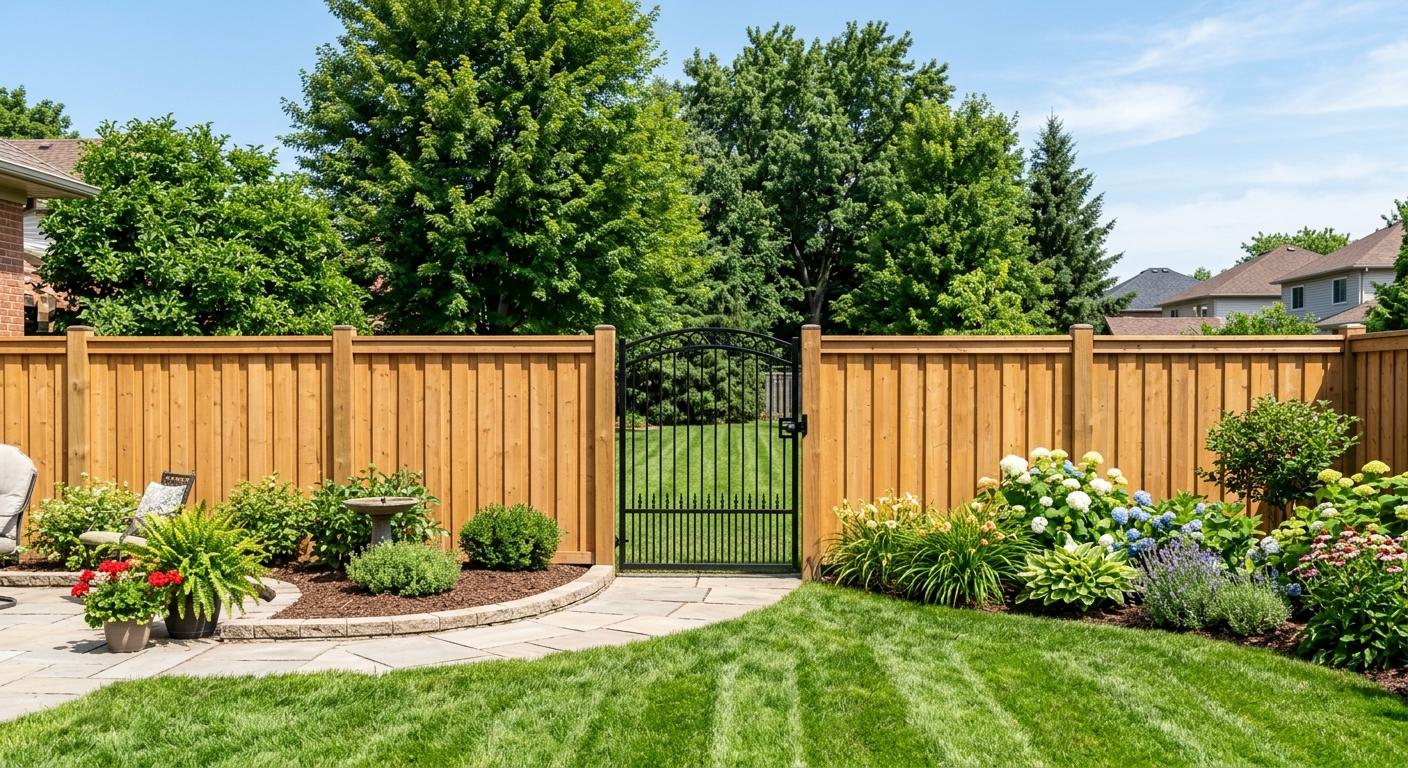
Fencing options and costs in Summerland
Summerland homeowners are often planning their yards around long-term privacy, pet safety and curb appeal, and the local housing mix strongly shapes fence demand. With 12,042 people (Statistics Canada, 2021 Census) and 82.4% of households owning their homes, a lot of properties are “fence-ready”—meaning contractors can count on repeat projects as older sections weather out. Detached homes make up 71.5% of dwellings, and each detached property is typically a potential perimeter-fence customer for side yards, backyards, or pool-area upgrades. Another useful planning signal: since 50.7% of homes were built before 1981 (Statistics Canada, 2021 Census), many properties have older, less-secure fence lines that need replacement to improve stability in the freeze–thaw cycle.
In the Thompson–Okanagan, fencing costs are driven by frost depth, soil drainage and wind exposure. Post holes must be set below the regional frost depth so posts don’t heave during freeze–thaw cycles; in interior valleys this often means deeper, longer posts and more auger time. On exposed lots (common around Summerland Bench and toward more open valley views), wind load can also influence spacing, hardware quality and whether you need stronger rails and bracing. These realities typically keep fencing pricing above the mildest coastal BC microclimates, while still avoiding the very high costs seen in the coldest Prairie markets.
Below is a practical comparison of common materials you’ll see quoted for Summerland projects, including typical lifespan, upkeep and price per linear foot. Use it to sanity-check bids before you lock in a design and post depth.
| Material |
Lifespan |
Maintenance |
Privacy Rating |
Price per Linear Foot |
| Pressure-treated pine (standard wood) |
10–15 years |
Stain or seal every 2–3 years |
Medium–High (solid boards) |
$55 – $85 |
| Cedar (natural rot resistance) |
15–25 years |
Light maintenance; stain optional but recommended |
High (solid boards) |
$75 – $115 |
| Vinyl / PVC (no-maintenance) |
20–30 years |
Occasional wash; inspect for impact damage |
Medium–High (solid or lattice styles) |
$75 – $115 |
| Chain-link (galvanized steel) |
25–40 years |
Minimal; rinse and spot-check tension |
Low (privacy not inherent) |
$35 – $60 |
| Aluminum ornamental |
20–35 years |
Occasional rinse; repaint only if custom powder-coat |
Low–Medium (open pickets) |
$90 – $150 |
| Composite / recycled material |
20–30 years |
Low; clean with mild soap |
High (solid board styles) |
$95 – $145 |
Prices are estimates only and vary by project scope, site access and material selection.
What affects the price of fencing in Summerland
Two quotes for what looks like the “same fence” can swing by 30–50% across the Thompson–Okanagan and the rest of British Columbia because the real cost drivers are often below-grade and site-specific. Post depth, soil conditions and wind exposure change labour time and material weight. In colder parts of the province, contractors also have to price in longer auger work, more concrete or larger-diameter footings and sturdier hardware—so the labour and material totals move even if the fence height stays constant.
Start with frost: in the Thompson–Okanagan, common practice is to set posts about 4–6 inches (10–15 cm) below the design frost depth so posts don’t heave during freeze–thaw cycles. While coastal systems may need roughly 45–60 cm of depth, interior valleys often require posts set 75–90 cm or more below grade, and that depth is what drives concrete-set posts, longer posts and additional excavation time. In colder Ontario and Alberta regions, posts can require 1.5–2.0 m into the ground, which is why you’ll see some of the steepest material and labour pricing there compared with Summerland-style interiors.
Then consider wind exposure: open benches and more exposed valley-bottom lots can require tighter post spacing, heavier rails, and sometimes open-style panels to reduce wind load. In Summerland, a practical example is a backyard fence near wide-open views on the Bench—upgrading to stronger posts and extra bracing can move a job upward within the wood band of roughly $55–$85 per linear foot, especially if concrete is required. Another example: if you’re replacing an older fence in clay or poorly drained soil, you may need deeper, larger footings (higher concrete and auger time). On the other hand, a sheltered lot with well-drained soil and short runs behind existing hedges can keep costs closer to the lower end of the budget wood or chain-link bands (for instance, chain-link around $35–$60 per linear foot), because the footing and bracing demands are often less.
| Price Factor |
Why It Matters |
Cost Impact |
| Fence length in linear feet |
Labour, posts, rails and material quantities scale directly with length |
Highest driver; a 20% longer run often increases total cost by ~20%+ |
| Post depth required |
Frost depth dictates how deep holes must go to prevent heaving |
Deeper posts can add auger time and increase post/concrete costs |
| Post setting method |
Concrete-set posts resist movement better in heavier soils |
Concrete vs gravel pack vs driven posts can shift pricing by a wide margin |
| Material choice |
Vinyl, cedar and chain-link carry different material and hardware costs |
Switching from chain-link (~$35–$60/ft) to vinyl/wood mid-grade (~$75–$115/ft) can be major |
| Gate count and type |
Gates need extra bracing, hinges, and stronger posts |
Adding a second gate can add disproportionately more cost than just length |
| Grade and terrain |
Slopes require raked or stepped panels and extra measuring labour |
Can increase labour time and sometimes reduce panel efficiency |
| Old fence removal and disposal |
Hauling and demo add time, and damaged material can be heavier |
Often adds a meaningful line item, especially on obstructed sites |
| Permit fees and survey / property line locate |
Some higher fences or corner/yard locations trigger permitting and locating costs |
Delays and extra admin can raise total project cost |
Permits & regulations in British Columbia
In British Columbia, fence rules are generally tied to height thresholds, property line setbacks and how the fence is positioned (for example, front yard vs rear yard). As a homeowner in Summerland, plan on the idea that fences above a typical threshold—often around 2.0 m (6.5 ft) at the rear and roughly 1.0–1.2 m (3–4 ft) toward the front or a corner—may require a building permit. Even if a permit isn’t required, all fences must respect property lines and municipal setback bylaws.
Before digging any post hole, the safety and compliance step is utility locates. In BC this means calling BC 1 Call (or the appropriate regional locate service), so buried lines are marked before your contractor augers. Next, confirm property boundaries: obtain a survey or at least locate your property pins so your contractor is installing on the correct line. This reduces disputes and “redo” costs. For shared fence ownership, BC line-fences legislation governs how responsibility and costs are handled when a fence serves a boundary and neighbours have an interest in it.
To verify a contractor’s readiness in BC, check three things in writing: (1) licence/registration details through the relevant online credential registry for fencing-related work (where applicable), (2) liability insurance—ask for the certificate of insurance naming your property address or showing adequate limits—and (3) coverage for workers, commonly represented as WSIB/WCB coverage confirmation or a clearance letter. A reputable Summerland fence contractor should provide these documents before scheduling major excavation.
Choosing the right fence material for Summerland
Choosing a fence in Summerland is mostly about matching your priorities to materials that can handle interior BC cycles: freeze–thaw movement, spring moisture, and periodic dry summer winds. Pressure-treated pine is the budget-friendly option, but it typically needs staining or sealing every 2–3 years to keep it looking consistent and to slow weathering. Cedar has better natural rot resistance and an attractive look from day one; it still benefits from light maintenance, but it usually ages more gracefully than pine. Vinyl/PVC is a “set it and forget it” choice—low maintenance and easy cleaning—yet it can crack if struck hard, and extreme cold can make it more brittle, so proper post support and panel alignment matters. Chain-link is the lowest cost for long-term durability and a long service life, but it doesn’t provide privacy unless you add slats or plant screening. Aluminum ornamental looks sharp and won’t rust, but it’s not a privacy fence by default.
Post depth is where Thompson–Okanagan climate turns into cost and performance. Because interior valleys often require posts set below the frost depth, concrete-set posts are frequently used when soil is heavy, drainage is poor, or where you have longer freeze–thaw exposure. The right question isn’t only “does my fence need concrete?” but “what footing method keeps your posts stable for the long term here?” On sloped yards, stepped or raked panels add labour, and in wind-exposed runs you may need heavier rails and closer post spacing.
For a concrete dollar example: if a chain-link option pencils out near $35–$60 per linear foot, a vinyl or cedar privacy fence can come closer to $75–$115 per linear foot depending on height, gates and post method. That extra cost is justified when you want true enclosure, wind/sight buffering and longer-term curb appeal—especially on detached homes (71.5% of dwellings) where side-yard visibility is more common.
| Material |
Cold Tolerance |
Lifespan |
Annual Maintenance |
Best For |
Price Band |
| Pressure-treated pine |
Good with correct post depth and sealing |
10–15 years |
Inspect + spot seal; stain every 2–3 years |
Budget privacy with periodic upkeep |
$55 – $85 |
| Cedar |
Good; holds up well through wet winters |
15–25 years |
Light staining/maintenance as needed |
Attractive privacy that ages well |
$75 – $115 |
| Vinyl / PVC |
Good; avoid impact and ensure proper installation |
20–30 years |
Minimal (wash/inspect) |
Low-maintenance privacy |
$75 – $115 |
| Chain-link |
Excellent; steel resists winter conditions |
25–40 years |
Minimal; check tension and coatings |
Security, pets and budget control |
$35 – $60 |
| Aluminum ornamental |
Excellent (powder-coat system) |
20–35 years |
Occasional rinse; repaint only if needed |
Perimeter definition with style |
$90 – $150 |
| Composite / recycled |
Good; stable boards when properly supported |
20–30 years |
Low (wash; inspect for hardware) |
Long-lasting privacy with reduced upkeep |
$95 – $145 |
How to choose a fencing contractor in Summerland
Hiring the right fence contractor in Summerland starts with verifying that they’re set up to do the work safely and legally in British Columbia. Ask for proof of liability insurance (certificate of insurance) and confirm that their workers are covered under the appropriate provincial coverage system, often provided as WSIB/WCB documentation or a clearance letter. Then, verify credentials/registration details relevant to their trade through the appropriate online registry and confirm the contractor name matches the quote and invoices. If they can’t provide paperwork, consider it a compliance red flag.
Next, request 2–3 itemised written quotes. You want labour and materials clearly broken out (posts, rails, panels, gates, concrete/gravel, hardware, and disposal). A quote that only shows a lump sum makes it harder to compare post depth, concrete setting method and disposal—those are the exact items that can change your cost by 30–50% in the Thompson–Okanagan. Carefully check what’s excluded: are permits included if required, is a property line locate included, and is old fence removal/haul-away part of the scope?
Warranty matters too. Look for a workmanship warranty stated in plain terms (often ranging from a year or more depending on the contractor) and a separate manufacturer/product warranty for materials where applicable. Also ask whether the warranty is transferable to a future homeowner. For payment, use a schedule that keeps risk low—never pay more than 10–15% upfront, and hold back a portion until the fence is complete, cleaned up, and any adjustments are done. Finally, insist on a written start date and completion estimate so you can plan around excavation and curing times for concrete-set posts.
- Request certificate of liability insurance and confirm coverage limits
- Ask for proof of provincial workers’ coverage (WSIB/WCB) or clearance letter
- Verify credentials/registration through the appropriate BC registry before signing
- Get 2–3 itemised quotes (labour, materials, concrete/gravel, gates, hardware)
- Confirm post depth plan in writing (frost-safe depth) and footing method
- Clarify gate hardware: hinges type, latching, and reinforcement
- Check whether fence includes brace panels on wind-exposed runs
- Confirm slope handling (stepped vs raked panels) and how the layout is measured
- Ask if permit pull and inspections (if required) are included or billed separately
- Ensure utility locate costs are included (BC 1 Call) and that work starts only after marking
- Confirm disposal/haul-away of old fence materials is included
- Use a payment schedule: 10–15% max upfront; holdback until completion
Red flags to watch for in Summerland: (1) a contractor who won’t discuss frost depth/post depth and just “digs and sets,” (2) missing insurance or workers’ coverage documentation, (3) quotes that don’t specify footing method or gate reinforcement, (4) asking for large upfront payments, and (5) refusing to put start date, completion timing and warranty details in writing.
Frequently asked questions — fencing in Summerland
How tall can my fence be in Summerland?
In Summerland and across British Columbia, fence height limits are typically tied to where the fence sits on the property (front yard/corner vs side or rear). A common guideline used in permitting discussions is that rear fences may be allowed up to around 2.0 m (6.5 ft), while front or corner areas are often lower, roughly 1.0–1.2 m (3–4 ft). If you plan a taller privacy fence, don’t guess—ask your contractor to confirm whether your design needs a building permit before construction. This matters because post depth and wind bracing are also evaluated during planning for safety and stability. If the permitted height drives your design, you’ll likely still be choosing between privacy options in the $75–$115 per linear foot band (vinyl/cedar depending on style) and budget options closer to $55–$85 (pressure-treated wood).
Should fence posts be set in concrete here?
Often, yes—particularly in the Thompson–Okanagan where frost heave is a real risk and where soils can hold moisture. In Summerland, correct post depth is the priority: posts are typically set below the regional frost depth (often using practice that’s roughly 4–6 inches below design frost depth) so they don’t heave during freeze–thaw cycles. Concrete-set posts are commonly used when soils are clay-like, drainage is poor, or when you’re building a heavier privacy fence that needs stronger rigidity against wind. That said, some projects with well-drained soil and certain fence types may use alternative footing methods if they still meet frost-safe depth and stability. Your quote should explicitly state the footing method; if it’s not clear, compare it with other bids—because the difference between concrete-set and lighter setting methods can be a large portion of the cost swing within the $55–$85 (wood) to $75–$115 (vinyl/cedar) pricing bands.
What's the best fence for privacy?
The best privacy fence in Summerland is usually one with solid panels and boards that can stand up to interior BC weather cycles and wind. Cedar and vinyl/PVC privacy fences are popular because they provide consistent sightline blocking; cedar also resists rot naturally, while vinyl is low maintenance. Pressure-treated pine can be a good budget path, but you’ll likely need to stain or seal every 2–3 years to keep it looking good and slowing weathering. Chain-link is durable and secure, but privacy isn’t inherent unless you add slats or screening, so it’s rarely the first pick when privacy is the main goal. When you compare costs, remember that higher privacy options often fall around $75–$115 per linear foot (vinyl/cedar mid-range), while budget wood privacy can be closer to $55–$85 per linear foot. The right choice also depends on post depth and bracing requirements for your specific wind exposure.
How do I compare fencing quotes?
Start by comparing apples to apples: ask each contractor for an itemised quote with labour and materials separately. Make sure they specify footing details—post depth and the setting method (concrete vs gravel pack vs another approach). Confirm whether the quote includes gate hardware and whether the posts are reinforced for gate loads. Also check inclusions/exclusions: permit pull (if needed), utility locates (BC 1 Call), property line locate/survey provisions, and disposal of the old fence. In Thompson–Okanagan conditions, these below-ground and scope items are where quotes diverge, leading to the 30–50% swings many homeowners notice even when the fence height looks identical. As a quick sanity check, if one quote lands near the chain-link range ($35–$60 per linear foot) and another is for full privacy vinyl/cedar (~$75–$115 per linear foot), they likely aren’t comparable designs. Finally, confirm the timeline and warranty details are in writing so you know what you’re actually paying for.
How long does fence installation take in Summerland?
For many typical Summerland backyards, fence installation is often measured in days rather than weeks, but the timeline depends heavily on footing conditions, gate count and whether you’re removing an old fence. Concrete-set posts can also influence scheduling because the crew needs to complete installs carefully and allow enough time for curing before final adjustments. A straightforward run with fewer gates on accessible ground may move faster; an exposed lot on Summerland Bench with heavier bracing, deeper frost-safe excavation, or sloped grade requiring raked/stepped panels will take longer due to measuring, layout and additional hardware work. If permits or a property line locate are required, expect extra lead time before the crew can dig. When comparing quotes, ask for a written start date, estimated completion date, and whether the quote includes utility locates and demo/disposal. That clarity helps you avoid project delays that can inflate cost.
Can I install a fence on a slope in Summerland?
Yes, you can install a fence on a slope in Summerland, and it’s fairly common—many lots in the valley require stepped or raked panel layouts. The key is choosing the right approach for your fence type and ensuring the base stays stable on the footing depth required to resist frost heave. On slopes, a contractor should explain whether they’ll step the fence in sections (maintaining a more uniform panel height) or rake panels to follow the ground. Both can work, but each changes how rails and pickets align, and it can affect material efficiency and labour time. For privacy boards, you’ll usually see careful raking/stepping so the fence still provides consistent sight blocking. Be sure your quote includes the slope solution in the scope; if it doesn’t, you might get surprise costs later within the same general $55–$85 (standard wood) or $75–$115 (vinyl/cedar) bands depending on your material selection.