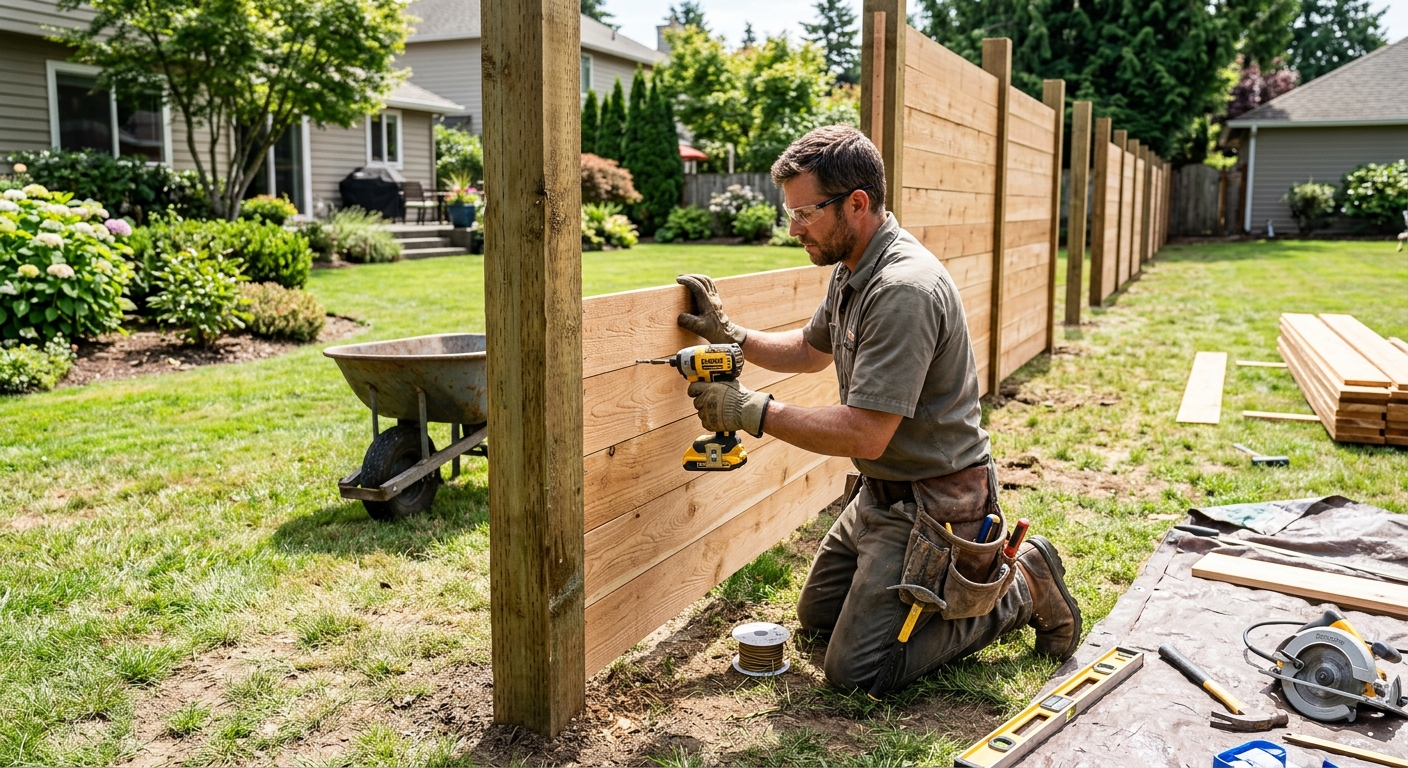
Fencing options and costs in Willingdon Heights
In Willingdon Heights, choosing a fence is more than curb appeal—it’s a practical decision for privacy, pet safety, and wind protection in a neighbourhood where demand stays steady. With a total population of 12,443 (Statistics Canada, 2021 Census), the Lower Mainland–Southwest market has constant turnover in property boundaries, renovations, and backyard upgrades. The strongest predictor of local fence demand is still the prevalence of family homes and detached properties, because every lot corner and garden line tends to become a “must-finish” project when homeowners replace aging railings or add privacy around decks.
Lower Mainland–Southwest pricing reflects a climate that is mild but not trivial for contractors. You’ll typically see frost conditions that still matter for post stability: crews often dig deeper than the bare minimum to limit heaving, then use concrete-setting more often on corner posts, gate posts, and privacy runs where extra rigidity is needed. Soil in wetter areas can be heavier and more labour-intensive than drier sites, so the same fence height can land 10–20% higher once you factor in deeper holes, additional concrete, and longer set times. Competition is good around well-populated areas, and installs are especially in demand around Brentwood/nearby pockets where new landscaping and driveway refinishing frequently coincide with boundary upgrades.
Below is a practical comparison of common materials and what homeowners usually pay per linear foot in Willingdon Heights, BC. Use it to sanity-check quotes before you compare contractor scopes.
| Material |
Lifespan |
Maintenance |
Privacy Rating |
Price per Linear Foot |
Price Range |
| Pressure-treated pine (standard wood) |
10–20 years |
Stain/seal every 2–3 years; inspect posts annually |
6/10 (depends on board spacing) |
$55–$95 |
$1,650–$3,200 |
| Cedar (natural rot resistance) |
15–25 years |
Light sealing/staining every 2–3 years (to extend colour) |
7–9/10 (solid boards) |
$65–$110 |
$1,950–$3,850 |
| Vinyl / PVC (no-maintenance) |
20–30 years |
Wash as needed; no staining |
7–9/10 (solid styles) |
$75–$130 |
$2,250–$4,600 |
| Chain-link (galvanized steel) |
20–40 years |
Occasional rinse; check tension at gates |
3/10 (visibility)\u00a0 |
$30–$55 |
$900–$1,900 |
| Aluminum ornamental |
25–40 years |
Rinse as needed; no rust |
4–6/10 (open pickets)\u00a0 |
$90–$170 |
$2,700–$6,100 |
| Composite / recycled material |
20–30 years |
Minimal washing; occasional rinse |
7–9/10 (solid composite boards) |
$80–$145 |
$2,400–$5,200 |
Prices are estimates only and vary by project scope, site access and material selection.
What affects the price of fencing in Willingdon Heights
In Willingdon Heights and across the Lower Mainland–Southwest, two quotes for what looks like the “same fence” can differ by 30–50%. The usual reasons aren’t the material label—they’re how each crew handles post depth, soil conditions, access, and wind requirements. On many BC jobs, mild temperatures still come with wet cycles that soften ground, so digging and setting posts is slower. Labour availability also matters: when trades are booked and crews are running multiple sites, scheduling efficiency changes, which can move pricing.
Frost depth and post embedment is the big technical driver. In colder Ontario and Alberta, published guidance often pushes embedment deeper (commonly around 1.5–2.0 m in those regions) to prevent heaving, using concrete and longer posts—this is where you see higher material and labour costs. In coastal BC the frost depth is generally shallower, but the frost heave risk still exists; that’s why local installers typically place posts below the design frost depth—often about 4–6 inches deeper than the design frost depth for stability—then adjust hole size based on soil moisture. Wind exposure also changes the design: while the Prairies push for tighter spacing and heavier bracing, Lower Mainland–Southwest wind can still be enough to require sturdy corner posts and reinforcement on solid wood and vinyl privacy fencing.
Concrete examples of cost shifts in Willingdon Heights: (1) a backyard with saturated soil can mean extra auger time and more concrete to stabilize corner and gate posts; (2) a slope or retaining edge can require stepped racking and additional rails, increasing labour compared with a flat run. If you’re comparing wood at the $55–$95 per linear foot band against vinyl at the $75–$130 band, the difference is often justified when the extra stiffness and durability reduce future repairs—especially on posts that must be properly set to handle frost and wet ground.
| Price Factor |
Why It Matters |
Cost Impact |
| Fence length in linear feet |
The more runs, rails, and posts, the more labour and hardware. |
Typically 40–70% of total cost |
| Post depth required |
Embedment is set below local frost depth to limit heaving. |
Can change cost by 10–25% |
| Post setting method |
Concrete vs. gravel pack vs. driven posts affects stability and labour time. |
Concrete-setting often adds 5–15% |
| Material choice |
Vinyl/PVC and metal have higher material costs and structural requirements. |
Major swing: wood vs. vinyl can be 20–60% |
| Gate count and type |
Gates require heavier frames, hinges, and more precise alignment. |
Often adds 10–35% depending on width/type |
| Grade and terrain |
Slope means stepped or raked panels and extra measuring/rail cuts. |
Commonly adds 5–20% |
| Old fence removal and disposal |
Dismantling, hauling, and disposal time can be substantial. |
Can add 5–25% |
| Permit fees and survey / property line locate |
Where required, documentation affects the start timeline and administration. |
Often adds 0–10% to project total |
Permits & regulations in British Columbia
In British Columbia, fences above a height threshold typically require a building permit—often about 2.0 m (6.5 ft) for the rear and roughly 1.0–1.2 m (3–4 ft) for the front or corner, depending on the specific municipal context and location. Even when a permit isn’t required, your fence must still respect property lines and any municipal setback bylaws. Before any post holes are dug, homeowners should arrange utility locates (BC 1 Call) to protect gas, power, and communication lines.
Step one: confirm where your property line is. If you don’t have a recent survey, request a property line locate or use survey pins to avoid encroachment disputes. Step two: ask the contractor whether their fence plan matches the height and placement rules for your lot and whether the permit process applies to your design (for example, solid privacy fences tend to hit the height thresholds more often). In BC, shared fence ownership and maintenance responsibilities are guided by provincial line-fences legislation, so it’s wise to document agreements if you’re replacing a shared boundary fence.
Licence and insurance verification (do this before work starts): in BC, check the contractor’s business details through the appropriate provincial registry/online listings, request a certificate of insurance (general liability) and verify the policy covers fencing installation. For worker coverage, confirm their coverage status for workplace injury protection and ask for their clearance documentation. A reputable crew should hand these over quickly—no pressure, just paperwork.
Choosing the right fence material for Willingdon Heights
For Willingdon Heights, match your material to your priorities: privacy, low maintenance, lifespan, and budget—while respecting the Lower Mainland–Southwest moisture/wet cycles and wind exposure. Pressure-treated pine is usually the budget entry point, but it needs staining or sealing every 2–3 years to slow down grey weathering and keep water out of board ends. Cedar offers better natural rot resistance and a nicer look, and it also benefits from periodic staining if you want to preserve colour. Vinyl/PVC is a popular “set-and-forget” option because it doesn’t need staining; however, installers still need correct post spacing, proper reinforcement, and good panel fit so it won’t feel loose under wind. Chain-link stays the lowest cost long-term—durable and low maintenance—but it won’t give you privacy unless you add screening. Aluminum ornamental is strong and won’t rust, but it’s open picket by nature, so it’s best when security and appearance matter more than privacy.
On post depth: even with BC’s generally milder frost compared to inland provinces, posts often need to be set below the local frost depth—commonly achieved by burying them deeper and using concrete for stability on corner, gate, and privacy runs. That approach matters on wetter Fraser Valley–type soils because saturated ground can soften quickly and heave or shift less predictably. Wind and snow loads aren’t as punishing as in the Prairies, but open areas still benefit from sturdier posts and tighter framing on solid panels.
A simple cost example: if your run sits in the wood band (roughly $55–$95 per linear foot) and you jump to vinyl (roughly $75–$130), the premium can be worth it when you want fewer future trips for stains and replacements around fence lines that see heavy rainfall. If your main goal is privacy, a well-built cedar or pressure-treated wood privacy fence can also make sense—provided the posts are properly set and the boards are spaced/trimmed to shed water.
| Material |
Cold Tolerance |
Lifespan |
Annual Maintenance |
Best For |
Price Band |
| Pressure-treated pine |
Good when posts are set below frost and ends are sealed |
10–20 years |
Inspect annually; stain/seal every 2–3 years |
Budget privacy on stable post footings |
$55–$95 |
| Cedar |
Excellent for rot resistance with proper installation |
15–25 years |
Inspect annually; light stain/seal every 2–3 years |
Better appearance and longer wood life |
$65–$110 |
| Vinyl / PVC |
Good; avoid poor fits and weak bracing in cold/wind |
20–30 years |
Wash as needed; no staining |
Low maintenance privacy |
$75–$130 |
| Chain-link |
Very good; wire and coating handle freeze cycles well |
20–40 years |
Occasional rinse; check gate hardware |
Security and pet containment on a budget |
$30–$55 |
| Aluminum ornamental |
Very good |
25–40 years |
Wash as needed; occasional hardware check |
Curbs and front boundaries where rust resistance matters |
$90–$170 |
| Composite / recycled |
Good; needs correct mounting to prevent movement |
20–30 years |
Minimal washing; inspect fasteners |
Privacy with reduced staining |
$80–$145 |
How to choose a fencing contractor in Willingdon Heights
Choosing a contractor in Willingdon Heights starts with verification. Ask for their current business credentials in British Columbia and confirm general liability insurance is active for fencing installation (request a certificate of insurance showing the effective dates). For worker protection, verify their workplace injury coverage status and ask for the clearance documentation they use in BC jobs. A reliable fencing contractor will provide these without delay and will match the name and address on the paperwork to the quote.
Next, get 2–3 itemised written quotes. You want labour and materials broken out separately (posts, rails, fasteners, concrete, gates, labour hours, and any traffic control). Avoid “all-in” numbers that don’t list what’s included. Read the exclusions: Is permit pulling included (when required)? Is old fence removal included, or is it “by others”? Is disposal/hauling included, or is there a separate fee? Make sure they describe post setting method explicitly—concrete-set posts at corners and gate points are common in this region because wet soils and frost stability matter.
Warranty should be clear: confirm the workmanship warranty length and whether the manufacturer warranty applies to materials. Ask if warranties are transferable if you sell the home. Payment schedule: never pay more than 10–15% upfront; keep a holdback until the fence is complete and checked. Finally, get the start date and completion estimate in writing, including a weather contingency approach common to Lower Mainland installs.
- Ask for proof of BC business registration and confirm it matches the quote paperwork.
- Request a current certificate of general liability insurance (effective dates shown).
- Verify workplace injury coverage status and ask for clearance documentation used for BC projects.
- Get 2–3 itemised quotes (labour + materials, not one lump sum).
- Confirm whether permit pulling is included if your fence exceeds height thresholds.
- Ensure the quote states post embedment and the frost-related installation approach.
- Confirm concrete quantities/method for corner, gate, and privacy runs (if applicable).
- Check if removal/disposal is included, and how debris is hauled away.
- Make sure gates are listed separately with hardware specs (hinges, latches, tension).
- Ask how they handle slopes (stepped or raked panels) and whether that changes pricing.
- Review warranty terms in writing: workmanship length and product warranty coverage.
- Use a payment schedule with 10–15% max upfront and a holdback until acceptance.
Red flags to watch for in Willingdon Heights: (1) a contractor who won’t show insurance/clearance documentation; (2) quotes that don’t state post setting depth or whether concrete is used at gate/corner posts; (3) “lowest price wins” bids that omit fence line layout, property line locating, or permit responsibilities; (4) requests for large upfront payments (beyond 10–15%); and (5) lack of a written schedule and incomplete scope descriptions for slopes, gates, or removals.
Frequently asked questions — fencing in Willingdon Heights
Can I install a fence on a slope in Willingdon Heights?
Yes, you can install a fence on a slope in Willingdon Heights, but the details matter. Most crews use stepped sections or raked panels so the fence stays level relative to itself while following the natural grade. Because sloped yards require extra measuring, cuts, and sometimes additional rails, the job can cost more than a flat run. Also, slope often changes drainage at the base, which is important in the Lower Mainland–Southwest where wet ground can soften. If your design includes privacy boards, proper spacing and stronger bracing help it resist wind. When you request quotes, ask whether the contractor is planning stepped or raked installation and whether the price reflects that extra labour.
What is the most weather-resistant fence for Willingdon Heights's climate?
For most homeowners in British Columbia, the most weather-resistant choice is either vinyl/PVC or properly installed cedar, because both are better at resisting rot than standard unfinished wood. Vinyl/PVC is low-maintenance and designed to handle moisture cycles; the key is correct post setting and reinforcement so panels don’t loosen in wind. Cedar naturally resists rot and looks great, but it still performs best with periodic sealing and correct installation at posts and board ends. Chain-link also performs extremely well outdoors in wet climates, but it won’t give privacy. In terms of typical pricing, vinyl often lands around the $75–$130 per linear foot band, while wood privacy options usually start closer to the $55–$95 band depending on cedar vs. pressure-treated pine.
How do I prevent wood fence rot in Willingdon Heights?
Preventing rot comes down to installation quality and how water is managed. First, posts must be set below the local frost depth so the ground doesn’t heave and pull the wood out of position—this is crucial in the Lower Mainland–Southwest, where wet soil can shift more noticeably. Second, use proper post setting methods (commonly concrete-setting at corner and gate posts for stability) rather than relying on surface-level supports. Third, make sure board orientation and spacing allow drainage; avoid trapping standing water on horizontal members and ends. Finally, stain/seal pressure-treated pine every 2–3 years (and cedar as needed) rather than waiting until boards look grey or softened. Even on wet lots, these steps are what keep a wood fence lasting years longer than a “standard” quick install.
What is the cost per linear foot for fencing in Willingdon Heights?
In Willingdon Heights, common installed price bands typically run as follows: chain-link at roughly $30–$55 per linear foot, wood installation around $55–$95, vinyl/PVC around $75–$130, and aluminum/metal around $90–$170. Your final number depends on how many posts are required, whether your yard is sloped, how accessible the fence line is for digging and hauling, and what needs reinforcement for wind. Gate count and whether removal/disposal is included can also move the per-foot figure. If you’re getting bids, ask contractors to quote the same fence height, post spacing, and post setting method so the comparison is apples-to-apples.
Should I repair or replace my old fence in Willingdon Heights?
Often you can repair if the posts are still solid and the fence boards haven’t rotted through at ground contact. In Willingdon Heights, the most common “repair vs. replace” decision hinges on post stability: if corner posts or gate posts have loosened due to frost movement or long-term moisture, repairs tend to fail because the fence will keep racking. Also check for extensive rot along the bottom rails and repeated fastener pull-out. If only a section is damaged (like wind-blown boards or a localized storm area), patching can be worthwhile. But if several runs have sagging rails, widespread board softness, or heavy rust in metal components, replacement is usually the better long-term value. Ask your contractor to assess which sections are structurally sound and request a written plan comparing repair scope versus full replacement cost.
How do I handle a fence dispute with a neighbour in British Columbia?
Start by confirming the fence location relative to the property line. In British Columbia, it’s easy for misunderstandings to escalate when fences aren’t aligned with pins or an older survey. Before any changes, request a property line locate or use your survey pins so you’re working from the same reference point. If the fence is shared, responsibilities and maintenance are guided by provincial line-fences legislation, but local practice matters, so keep communication calm and documented. Document everything: photos, measurements, and any written agreements. If a dispute persists, consider mediation or legal advice rather than starting work that could be seen as encroachment. For your contractor, provide the confirmed fence line so they build to the correct location—this is one of the most effective ways to prevent repeat disputes around replacements.