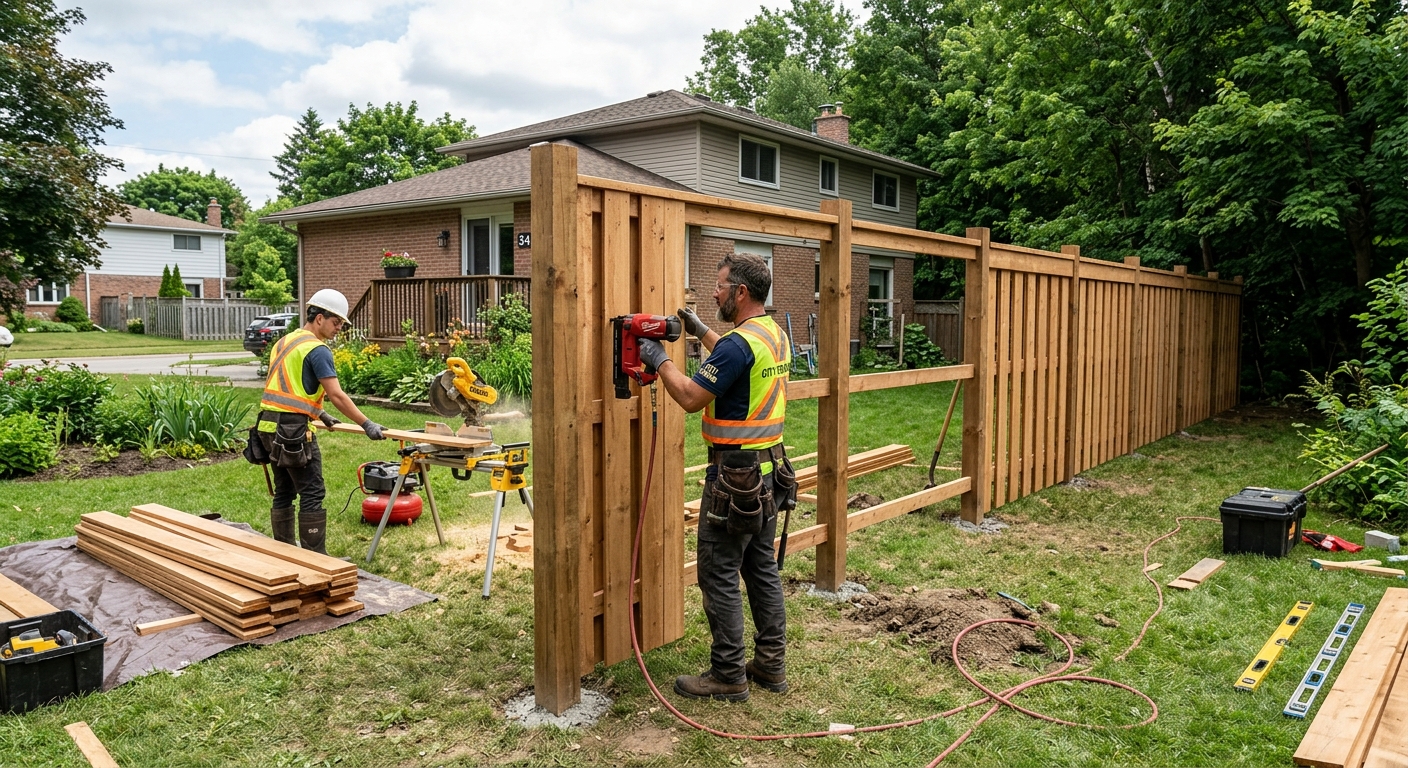
Fencing options and costs in Cape Horn
Cape Horn homeowners typically have several practical fencing paths, and the “right” one usually comes down to privacy needs, maintenance tolerance, and how much wind-driven rain and coastal moisture you’re willing to plan for. With a population of 12,680 (Statistics Canada, 2021 Census), demand is steady year-round, and fencing work often spikes when older residential properties need replacements. The Lower Mainland–Southwest housing mix also means you’ll see plenty of detached yards where fence upgrades are common, especially in established pockets like the Cape Horn/Burnside area where lots tend to be more developed and boundaries are well-defined. (Statistics Canada, 2021 Census)
In the Lower Mainland–Southwest, frost is mild but not trivial. Posts still need to be set below the design frost depth to limit heaving, and wetter Fraser Valley soils often require deeper holes, more concrete, and more labour than a dry-site install. That is why two quotes for the “same” 6 ft fence can differ meaningfully: not only materials, but also hole depth, concrete volume, and the complexity of gates and slopes. Contractor availability is also seasonal—crews can be busier after wetter stretches, and that can affect scheduling and final pricing.
If you want a quick cost benchmark, chain-link is usually the lowest-cost installed choice, wood lands mid-range, and vinyl/PVC and aluminum tend to cost more because of material strength and structural requirements. Use the table below to compare typical lifespans, privacy performance, and installed price ranges for Cape Horn projects.
| Material |
Lifespan |
Maintenance |
Privacy Rating |
Price per Linear Foot |
| Pressure-treated pine (standard wood) |
10–15 years |
Seal/stain every 2–3 years; inspect for warping and fastener corrosion |
Good (solid panels) |
$55 – $95 |
| Cedar (natural rot resistance) |
15–25 years |
Stain/finish every 2–4 years; wash mildew and check posts |
Good to very good (board-on-board) |
$65 – $110 |
| Vinyl / PVC (no-maintenance) |
20–30 years |
Rinse occasionally; avoid impact damage; check footing settlement |
Very good (solid/privacy styles) |
$75 – $130 |
| Chain-link (galvanized steel) |
20–35 years |
Occasional tighten/repair; treat any damaged coatings |
Low (open mesh) |
$30 – $55 |
| Aluminum ornamental |
25–40 years |
Wash seasonally; inspect gates and hinges |
Low to moderate (typically open) |
$90 – $170 |
| Composite / recycled material |
20–30 years |
Low; rinse and check for fastener issues |
Good to very good (solid boards) |
$95 – $155 |
Prices are estimates only and vary by project scope, site access and material selection.
What affects the price of fencing in Cape Horn
In Cape Horn and across the Lower Mainland–Southwest, it’s common to see the same fencing project land 30–50% apart in price—especially when contractors estimate embedment depth, the amount of concrete, and how many rails and posts are needed for the finish style. The larger differences aren’t only materials; they’re usually labour intensity (digging, setting, aligning) and structural requirements driven by local conditions. Coastal BC is mild, but it’s wet: wood can fail faster if the wrong treatment or detailing is used, while proper post setting and corrosion-resistant hardware cost more upfront but pay off later.
Frost line depth also matters. While it’s not as severe as Ontario or Alberta, posts still need to be set below the design frost depth to prevent heaving—commonly about 4–6 inches below the design frost depth. In practice, that often means deeper holes and longer posts, and contractors may use concrete-set posts for corner posts, gate posts, and privacy panels. That deeper excavation raises material costs (longer posts) and labour time. If your estimate falls within the wood band of $55 – $95 per linear foot, a big portion of the variability is whether your site needs deeper embedment and more concrete than a “typical” backyard.
Wind exposure isn’t Prairie-level, but open lots and coastal exposure still require tighter spacing and sturdier bracing for solid wood and vinyl privacy fences. Wet Fraser Valley soils can also make digging harder, increasing crew time. For example: (1) a sloped yard with stepped panels often costs more because alignment and raking labour increases; (2) a gate setup (especially a drive-through double gate) can add costs quickly due to heavier frames and more hardware; (3) replacing an old fence with buried posts can add disposal costs and extra excavation when remnants won’t lift cleanly.
Finally, material choice interacts with these factors. Vinyl/PVC in this region typically sits above the wood band (often $75 – $130), largely because panels and post systems are engineered differently and depend on solid, level footings to avoid long-term warping or cracking in extreme cold snaps.
| Price Factor |
Why It Matters |
Cost Impact |
| Fence length in linear feet — the primary cost driver |
Every extra foot adds posts, rails, and installation time |
Large; typically scales directly with total footage |
| Post depth required — frost line determines post length and hole depth |
Deeper embedment reduces heaving risk in frost/wet soils |
Medium to large; deeper holes increase labour and materials |
| Post setting method — concrete vs. gravel pack vs. driven posts |
Concrete increases stability for privacy panels and gates |
Medium; concrete volume can noticeably raise the total |
| Material choice — vinyl vs. cedar vs. chain-link |
Materials have different strength requirements and hardware needs |
Medium to large; vinyl usually costs more than wood |
| Gate count and type — walk-through vs. drive-through (double) |
Gates require stronger frames, hinges, latches, and bracing |
Medium; gates can add a disproportionate amount |
| Grade and terrain — sloped yards require stepped or raked panels |
Alignment and panel fitting take extra time and may increase waste |
Medium; slopes can push costs up quickly |
| Old fence removal and disposal |
Buried posts and demolition impacts trucking and time |
Medium; can be small or large depending on removal conditions |
| Permit fees and survey / property line locate |
Some fence heights and locations trigger administrative steps |
Low to medium; still matters for accurate totals |
Permits & regulations in British Columbia
In British Columbia, fence rules are typically tied to height and location. As a practical benchmark for Cape Horn homeowners, fences above a height threshold—often around 2.0 m (6.5 ft) at the rear and roughly 1.0–1.2 m (3–4 ft) at the front or corner—may require a building permit. Regardless of height, your fence must respect property lines and municipal setback bylaws. Because bylaw language and exceptions vary by municipality, confirm your specific requirements before excavation or ordering materials.
Before you dig any post hole, call for utility locates. In BC, you’ll typically use BC 1 Call to mark buried services so crews can avoid damage. Also consider obtaining a survey or having your property pins located before installation; this is one of the most common reasons fences end up in disputes, especially when older boundary monuments have shifted or been obscured by landscaping.
Shared fence ownership and maintenance obligations are handled under provincial line-fences legislation, but disputes are still resolved around what was agreed and what’s “reasonable maintenance” for the shared boundary.
To verify a contractor in Cape Horn: (1) check their British Columbia business registration and professional licence/number where applicable; (2) request a certificate of insurance (general liability) showing your address/interest if possible; (3) confirm workers’ compensation coverage (WSIB/WCB equivalent—provide proof/clearance documentation). Where to look: ask the contractor for their certificate and clearance letters directly, and verify insurer and clearance details by referencing the document numbers provided.
Choosing the right fence material for Cape Horn
The best fence material for Cape Horn is the one that matches your priorities—privacy, low maintenance, lifespan, and budget—while still coping with Lower Mainland–Southwest conditions: wet winters, coastal-style damp, and periodic cold snaps. Pressure-treated pine is usually the most budget-friendly way to get a solid privacy look, but in a moist climate it still needs staining or sealing every 2–3 years to limit grey weathering and surface checking. Cedar is a popular step up: it resists rot better and looks warmer on the property, but it still benefits from maintenance to prevent mildew staining and to protect end grain.
Vinyl/PVC is the low-maintenance headline option. It typically doesn’t require staining, and with solid/privacy styles you can achieve excellent screening. The trade-off is upfront cost and the need for solid, properly set posts—especially where frost heave risk means deeper embedment. In extreme cold, vinyl can become more brittle than wood; good installation (straight alignment, correct fasteners, and proper spacing/footings) matters. Chain-link is the lowest-cost and longest-life option in many cases, but it offers minimal privacy unless you add privacy slats or grow-through solutions. Aluminum ornamental fencing is strong and rust-resistant and generally has a mid-range install cost, but it’s usually open by design, so privacy depends on your panel style and height.
For Lower Mainland–Southwest frost conditions, many installs still set posts below frost depth (often by a few inches beyond the design line) and concrete-set is commonly used for corner posts, gate posts, and privacy systems. If your yard has noticeable slope or poor drainage, that’s when concrete-set posts or reinforced systems become more cost-justified.
Example: if you’re comparing a mid-range wood privacy fence near $55 – $95 per linear foot to vinyl around $75 – $130, paying the higher band is justified when you want to avoid repeated staining, you need long-term privacy, and your site can support correct post setting so the vinyl system performs for decades.
| Material |
Cold Tolerance |
Lifespan |
Annual Maintenance |
Best For |
Price Band |
| Pressure-treated pine |
Good with proper end protection and hardware |
10–15 years |
Light wash and inspect (stain/seal every 2–3 years) |
Budget-first privacy with acceptable maintenance |
$55 – $95 |
| Cedar |
Very good; stable when installed correctly |
15–25 years |
Wash/mildew control; stain/finish every 2–4 years |
Attractive appearance and better rot resistance |
$65 – $110 |
| Vinyl / PVC |
Good; can be brittle in extreme cold if poorly installed |
20–30 years |
Rinse as needed; periodic check of alignment and footings |
Low maintenance and long-term privacy screening |
$75 – $130 |
| Chain-link |
Excellent; metal tolerates freeze-thaw |
20–35 years |
Tighten/repair; coating checks |
Security boundaries at lowest cost (no privacy) |
$30 – $55 |
| Aluminum ornamental |
Excellent; non-rusting materials |
25–40 years |
Wash and inspect hinges/gates |
Durable front yard fencing with curb appeal |
$90 – $170 |
| Composite / recycled |
Good; performance depends on post/fastener system |
20–30 years |
Rinse; check fasteners and support posts |
Privacy with minimal upkeep and consistent boards |
$95 – $155 |
How to choose a fencing contractor in Cape Horn
Choosing the right fencing contractor in Cape Horn starts with proof, not promises. In British Columbia, confirm their licensing/business credentials (ask for their business registration details), then request liability insurance documentation and workers’ compensation coverage proof. For the workers’ comp piece, contractors should provide current clearance documentation from the relevant workers’ compensation system for the province where they work; don’t accept an outdated clearance date. Also ask for their certificate of insurance and make sure it’s valid—your quote should reflect that they’re insured to cover job-site incidents.
Next, get 2–3 itemised written quotes. You want a breakdown that separates labour and materials (posts, rails, fasteners, panels, gate hardware), and that states what they include for excavation, post depth/setting method, and site prep. Ask whether permit pulls are included where required, and whether old fence removal and disposal are part of the price or an add-on. A good quote will specify panel style, height, and footing approach (for example, concrete-set gate posts and corner posts).
Warranty matters too: ask for (1) workmanship warranty length, (2) product/manufacturer warranty terms, and (3) whether the warranty is transferable to a new owner if you sell. Payment schedules should be conservative—never more than 10–15% upfront. Keep a holdback until the job is complete and gates operate properly. Finally, insist on a written timeline with a start date and a realistic completion estimate, especially in winter when wetter ground can slow digging and alignment.
- Use a written quote with material and labour lines, not a one-line lump sum.
- Confirm post embedment/setting method in writing (depth and concrete vs gravel pack).
- Verify they handle gate hardware upgrades (hinges, latches, bracing) and not “basic” substitutions.
- Ask who schedules utility locates before digging and confirm it’s included or your responsibility.
- Request insurance certificate validity dates and coverage amount (not just a photo of a certificate).
- Verify workers’ compensation clearance is current (ask for the latest clearance document).
- Check warranty details separately: workmanship vs manufacturer product warranty.
- Confirm permit responsibility if the fence height/location triggers one in BC.
- Clarify disposal: landfill tipping fees and hauling included or billed separately.
- Ensure scope includes slope handling (raked vs stepped panels) and finish grade details.
- Confirm they’ll locate property pins/survey marks or at least document your boundary confirmation.
- Lock in payment terms (10–15% max deposit; holdback until final walkthrough).
Concrete red flags I see in Cape Horn include: quoting a “standard” post depth without looking at your site; excluding gate framing/bracing while assuming it’s included; offering vague warranties like “covered if material is defective” without workmanship terms; asking for most of the money upfront; and not providing a clear insurance/clearance document timeline or itemised breakdown for labour versus materials.
Frequently asked questions — fencing in Cape Horn
Wood vs vinyl vs aluminum fence — which is best?
In Cape Horn, “best” usually means matching the material to your tolerance for maintenance and your privacy expectations. Wood (pressure-treated pine or cedar) is typically the mid-range choice and can land around $55 – $95 per linear foot depending on height, style, and post setting. Vinyl/PVC is often the go-to if you want low maintenance and solid privacy; it commonly prices higher, often near $75 – $130, because the system depends on sturdy, level footings and properly set posts below frost depth. Aluminum ornamental fencing is durable and non-rusting, but it’s usually open, so privacy is limited unless you choose taller/solid-adjacent designs. If you’re unsure, decide first whether you need privacy, then choose the material that fits your willingness to stain/inspect wood every couple of years in BC’s damp winters.
Do I need a permit to build a fence in British Columbia?
In British Columbia, permits can be required for fences above certain height thresholds and in certain locations (commonly rear fences around 2.0 m, and front/corner areas around 1.0–1.2 m). Even when a permit isn’t required, your fence must follow property line rules and municipal setback bylaws. For a Cape Horn project, the best approach is to ask your contractor to confirm the applicable threshold based on your fence height and placement, then confirm with the municipality before digging. Also remember that you should not proceed with post holes until utility locates are done (via BC 1 Call). If a contractor doesn’t ask about height, location, or whether the fence is replacing an existing boundary feature, that’s a sign they’re not scoping compliance properly.
How long does a wood fence last in Cape Horn?
A wood fence’s lifespan in Cape Horn depends heavily on post embedment, how corners/gates are treated, and whether the boards are maintained in BC’s wetter seasons. Properly installed pressure-treated pine commonly lasts around 10–15 years, while cedar often runs longer, roughly 15–25 years, when it’s stained/finished periodically and checked for fastener corrosion and warping. In the Lower Mainland–Southwest, mild but non-trivial frost means posts still need to be set below design frost depth to reduce heaving, and that deeper setting usually improves longevity. Maintenance also matters: if you skip staining for too long, surface checking and mildew can accelerate cosmetic and structural deterioration.
Who owns and maintains a shared fence?
For shared fences in British Columbia, ownership and maintenance obligations are generally guided by provincial line-fences legislation and what was agreed between adjoining owners. Practically, that means disputes often hinge on which side installed the fence, how it was maintained historically, and what constitutes reasonable repair versus full replacement. In Cape Horn, I recommend documenting condition and any past agreements (photos, invoices, and written notes) before you request a shared repair. If you’re replacing a fence, ask your contractor to confirm exactly what will be replaced (posts, rails, panels, and gate hardware) and to keep measurements tied to your boundary or survey marks. This keeps costs and responsibilities clearer when more than one property is involved.
How do I find my property line before fencing?
The safest way in Cape Horn is to start with your survey or property pins and have them located if the markers aren’t visible or reliable. Many homeowners proceed by reviewing their lot plans and then confirming boundary points with a surveyor or pin-locate service before installation. That matters because even small encroachments can lead to disagreement, especially for tall privacy fences. Your contractor should also be willing to work with your boundary confirmation and document measurements. Before digging, arrange utility locates through BC 1 Call to avoid hitting underground services. If you don’t have a current survey, consider getting one before you buy materials—moving a fence after installation is far more expensive than verifying the line up front.
What's the most low-maintenance fence?
For the Cape Horn climate, vinyl/PVC is usually the most low-maintenance option because it doesn’t need staining and typically only requires occasional rinsing and visual checks for alignment and gate operation. Many homeowners choose vinyl when they want long-term privacy without repeated maintenance work in BC’s damp, mildew-prone seasons. Chain-link is also very low-maintenance and can last a long time, but it doesn’t provide privacy on its own unless you add slats or plantings. Wood can be maintained effectively, but it’s still the highest recurring effort—expect periodic washing and staining/finishing. Cost-wise, vinyl commonly sits in the $75 – $130 installed band, so the decision is often whether you’d rather pay more upfront or handle ongoing maintenance.