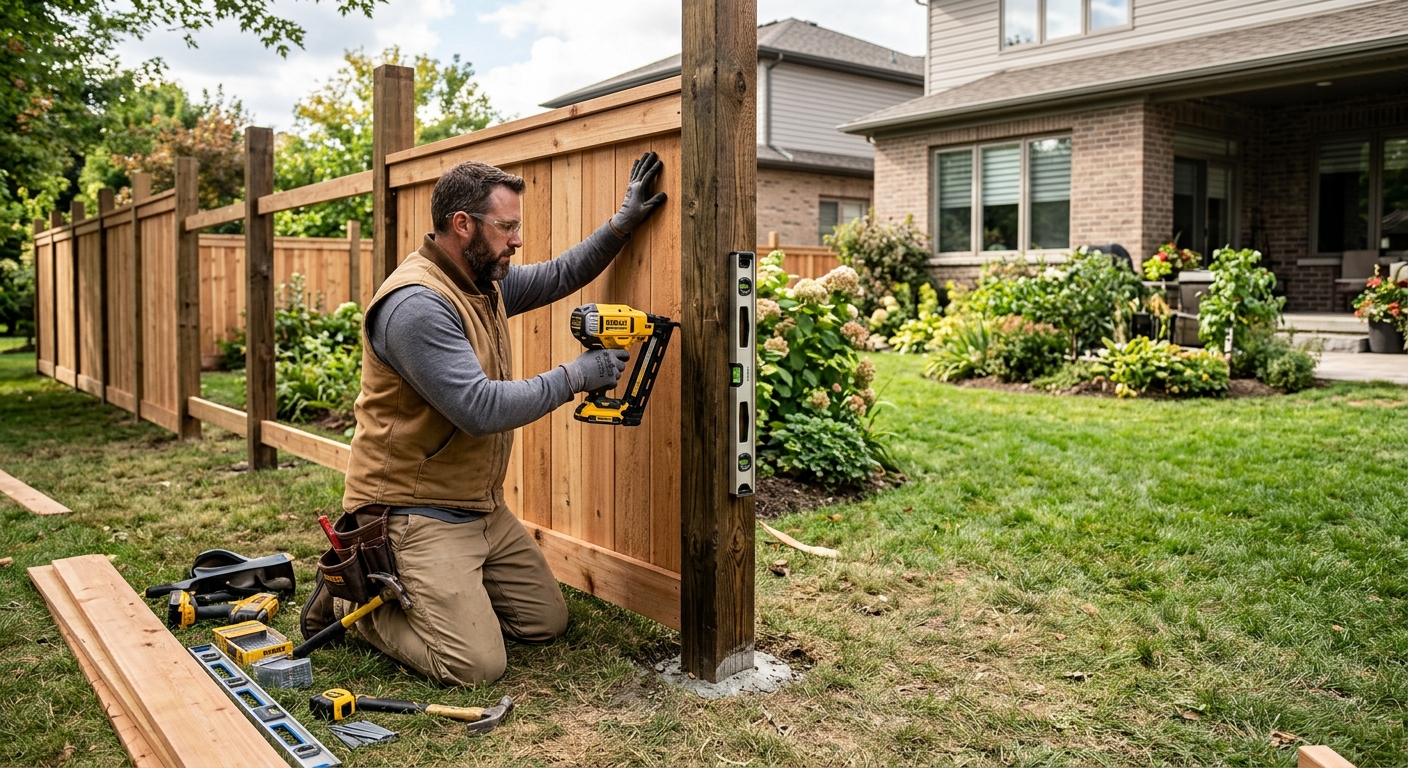
Fencing options and costs in Canyon Springs
Canyon Springs homeowners typically shop for fencing around what they want most: privacy, curb appeal, or a lower-maintenance backyard boundary. With a population of 7,528 (Statistics Canada, 2021 Census), demand tracks closely to how many properties are active in family living and outdoor use. The strongest local driver of fence projects is the mix of detached housing—each detached property is effectively a potential boundary-job customer—so you’ll see steady contractor availability in the Lower Mainland–Southwest.
In this region, pricing is shaped by mild but not trivial frost-and-wind conditions: crews still need to set posts below local frost risk to limit heaving, and wet Fraser Valley soils often mean deeper holes and more concrete than a dry, hardpan site. That combination affects both labour time and material choices, especially for privacy panels, corner posts, and gates. If your yard sits near a windier edge of Canyon Springs or your fence line follows a longer exposure, expect stronger framing and tighter alignment for wood and vinyl.
In practice, trade activity is often highest around larger residential corridors and busy streets where access is easy for trucks and equipment—so if you’re in an area with straightforward drive-up access, you may find quotes coming in closer to the low end of the range. From there, the easiest way to compare options is by how each material performs in our climate and what it typically costs installed; see the table below for practical benchmarks.
| Material |
Lifespan |
Maintenance |
Privacy Rating |
Price per Linear Foot |
| Pressure-treated pine (standard wood) |
10–15 years |
Stain/seal every 2–3 years (typical) |
Good to very good (solid rails) |
$28 – $48 |
| Cedar (natural rot resistance) |
15–25 years |
Light staining or oiling every 2–4 years |
Very good (solid boards) |
$33 – $60 |
| Vinyl / PVC (no-maintenance) |
20–30 years |
Rinse as needed; minor panel/rail replacement if damaged |
Very good (solid or tight pickets) |
$32 – $75 |
| Chain-link (galvanized steel) |
20–35 years |
Occasional cleaning; straighten posts if hit |
Low to fair (mesh) |
$18 – $34 |
| Aluminum ornamental |
25–40 years |
Wash annually or as needed |
Low (decorative visibility) |
$30 – $70 |
| Composite / recycled material |
20–30 years |
Little to none; inspect and replace damaged boards |
Good (when built as solid panels) |
$35 – $80 |
Prices are estimates only and vary by project scope, site access and material selection.
What affects the price of fencing in Canyon Springs
In Canyon Springs and across the Lower Mainland–Southwest, it’s normal to see fence quotes for the “same-looking” job vary by 30–50%. The biggest reason is that fencing pricing isn’t just material cost—it’s how much time it takes to install in our specific soil and weather conditions, plus what the crew must do for stability around gates, corners, and post lines. In other words, two fences with the same length can differ if one line is flat and easy to access while the other is sloped, wet, or requires removal of an old fence and hauling.
Frost risk sets how deep posts must be set, even in milder BC climates. A common rule of thumb is to set posts roughly 4–6 inches below the design frost depth to help prevent heaving—so crews may still dig deeper than you’d expect and use longer posts. In Ontario and Alberta, posts often go 1.5–2.0 m into the ground and that drives costs up; while Canyon Springs typically doesn’t require that full depth, deeper holes and concrete setting still happen when soil is wet or when the line includes multiple gate openings. Wind exposure also matters: tighter spacing and heavier framing reduce bounce on higher solid panels, which is why privacy fences can cost more than “same height” decorative styles. Finally, coastal BC’s wet climate accelerates wood weathering and rot if treatment and post bases aren’t done correctly—so contractors price in proper hardware and preparation.
Concrete examples that often raise cost in Canyon Springs: (1) wetter-than-average soils that need additional concrete to stabilize corner posts, (2) longer driveways or limited access that require more labour time to stage materials, and (3) sloped yards that need stepped panel layouts or raked frames (more measuring and board cutting). When you switch from chain-link to a vinyl/PVC privacy style, the starting point moves from around the $30 – $55 chain-link band toward the $75 – $130 vinyl/PVC band—an increase that’s usually justified when you actually need privacy and wind-stable solid sections.
| Price Factor |
Why It Matters |
Cost Impact |
| Fence length in linear feet — the primary cost driver |
Labour scales directly with footage; material count follows the same line |
Often determines most of the total cost |
| Post depth required — frost line determines post length and hole depth |
Deeper holes increase labour time, excavation, and post material |
Can add noticeable cost on wet sites |
| Post setting method — concrete vs. gravel pack vs. driven posts |
Concrete improves stability on wet/soft soils and for corners/gates |
Generally increases price versus gravel-pack only |
| Material choice — vinyl vs. cedar vs. chain-link |
Different material weights, framing requirements, and assembly details |
Shifts you between typical regional bands |
| Gate count and type — walk-through vs. drive-through (double) |
Gates require stronger posts, hinges, and latch hardware |
May add a big chunk of the budget |
| Grade and terrain — sloped yards require stepped or raked panels |
More cutting, measuring, and custom alignment |
Can add labour and material waste |
| Old fence removal and disposal |
Demolition, hauling, and disposal fees |
Can add cost even when new material is similar |
| Permit fees and survey / property line locate |
Paperwork and professional locating reduces encroachment risk |
Variable, sometimes modest but important |
Permits & regulations in British Columbia
In British Columbia, fences above a height threshold—typically around 2.0 m (6.5 ft) at the rear and roughly 1.0–1.2 m (3–4 ft) at the front or corner—often require a building permit. You also have to respect property lines and any municipal setback requirements that apply to your lot. Before you dig a single post hole, arrange utility locates through the appropriate service (in BC you’d use BC 1 Call). A lot of fencing delays happen when a crew starts digging and then has to stop for corrections, so utilities and a clear fence line plan are part of good project management.
Step-by-step, here’s how a Canyon Springs homeowner verifies a contractor and reduces risk: (1) confirm the contractor is properly licensed for the work they’re doing and that their contact details match the quote, (2) ask for a certificate of insurance showing liability coverage appropriate for residential construction, and (3) request proof of coverage for work staff (in the relevant provincial workers’ coverage system for the workers who will be on-site). Where provided, a clearance letter should match the company name on your agreement. Then, before installation begins, obtain a survey or property pin locate so you can confirm where the fence should sit. Shared fence ownership and responsibilities are also governed by provincial line-fences legislation, so it’s worth documenting who maintains what before the first panel goes up.
What typically does require a permit: tall privacy fences above the height thresholds, fences that require any special variance, or projects that involve non-standard placement near property lines or rights-of-way. What typically does not require a permit: small, basic replacement fences that stay under the common height limits and stay within the usual setback and property-line boundaries (still verify with your municipality).
Choosing the right fence material for Canyon Springs
Choosing the right fence material in Canyon Springs comes down to your priorities—privacy, low maintenance, and how long you want it to look “finished”—within a climate that’s mild but wet and occasionally frost-affected. Pressure-treated pine is usually the budget-friendly path, but you should expect staining or sealing every 2–3 years to prevent grey weathering and to protect the board edges. Cedar is a step up visually and can resist rot better, which helps it handle BC’s damp stretches; it still needs periodic maintenance to keep it looking even and to protect fasteners. Vinyl/PVC is the classic low-maintenance option: it doesn’t need painting or staining, but it can become brittle if exposed to repeated extreme cold and impacts—so it’s best with proper post setting and good rail alignment. Chain-link is the lowest upfront cost and can last a long time, but it’s not a privacy fence unless you add slats or screen; in windy spots, mesh can also provide less visual shielding. Aluminum ornamental fencing gives a clean, rust-resistant look and typically doesn’t need coatings, but it’s mainly decorative rather than private.
For Lower Mainland–Southwest installation, post depth is still important. Even though the frost risk is less severe than in the Prairies, crews commonly set posts below local frost risk and often use concrete-set methods for corners, posts supporting gates, and privacy panel lines, especially where soils are wetter. If you want solid privacy with good wind performance, that’s where the higher upfront options make sense.
For a concrete budget example: if wood-installed pricing lands around the $55 – $95 range and you’re considering vinyl/PVC at $75 – $130, the extra cost often pays back when you want fewer maintenance cycles over 10–15 years and you’re building a longer run of solid privacy panels that would otherwise require frequent staining and board-level touchups.
| Material |
Cold Tolerance |
Lifespan |
Annual Maintenance |
Best For |
Price Band |
| Pressure-treated pine |
Good (with proper sealing and hardware) |
10–15 years |
Seal/stain check; plan 2–3 year cycles |
Best budget option for privacy |
$55 – $95 |
| Cedar |
Good (naturally rot-resistant) |
15–25 years |
Light maintenance 2–4 year cycles |
Premium look with better natural durability |
$65 – $105 |
| Vinyl / PVC |
Moderate to good (avoid impact damage) |
20–30 years |
Rinse; occasional hardware/panel checks |
No-paint, long-term privacy |
$75 – $130 |
| Chain-link |
Good (galvanized steel) |
20–35 years |
Occasional wash and inspections |
Security or pet containment on a budget |
$30 – $55 |
| Aluminum ornamental |
Good (powder-coated) |
25–40 years |
Wash annually |
Curbs appeal without rust concerns |
$90 – $170 |
| Composite / recycled |
Good (built for outdoor durability) |
20–30 years |
Minimal; inspect for impact damage |
Low-maintenance, solid-panel privacy |
$80 – $160 |
How to choose a fencing contractor in Canyon Springs
Choosing the right fencing contractor in Canyon Springs means you should verify coverage, not just experience. In British Columbia, ask for their business licence details (where applicable), a current certificate of liability insurance, and proof of workers’ coverage for anyone doing installation on your property. To check: (1) request the COI and confirm the company name and address match the quote and the certificate is current, (2) verify the policy limits are appropriate for construction-site work, (3) ask for evidence that workers are covered under the relevant workers’ system for the province, and (4) if they subcontract any part of the work, require the same proof for subcontractors—don’t assume it’s covered under your main contractor.
Next, get 2–3 itemised written quotes. A good estimate separates labour (digging, setting, framing, finishing) and materials (posts, rails, panels, fasteners, hardware, concrete). Watch for omissions: some quotes exclude permit fees (if needed), property line locate costs, disposal of the old fence, or the concrete and aggregate required for proper post setting. Ask whether the quote includes utility locating coordination, any stepped/raked adjustments for slope, and how they handle gate hardware upgrades.
Warranty matters too. Request the workmanship warranty length and whether product/manufacturer warranty applies to you directly or is transferable. For payment, avoid large up-front payments; a safe rule is no more than 10–15% deposit, with a holdback until the work is complete and any punch-list items are addressed. Make sure you receive a start date and a completion estimate in writing, so you’re not guessing if weather delays happen.
- Verify liability insurance is current and matches the contracting company.
- Request proof workers are covered for on-site work (not just the owner).
- Ask whether they’ll use concrete-set methods for corners and gate posts where soil requires it.
- Require an itemised quote showing labour vs materials, not only a single total.
- Confirm whether permit pulling is included or is homeowner responsibility.
- Clarify whether old fence removal and disposal is included.
- Ask for post spacing details and whether fence line will be plumb/level on slope (stepped vs raked).
- Confirm gate type hardware (hinges, latches) and whether it’s included in the base price.
- Get confirmation of height measurements and where height is measured (front/corner vs rear).
- Ask about cleanup: haul-away, surface restoration, and how they deal with damaged landscaping.
- Review warranty: workmanship duration, manufacturer warranty coverage, and transferability.
- Confirm payment schedule: deposit cap and holdback until completion.
Local red flags I see in Canyon Springs include: crews refusing to provide insurance documentation up front, quoting as a lump sum without explaining post depth or setting method, ignoring slope/stepping details and promising “it’ll be fine later,” and offering unusually low pricing (especially for vinyl/PVC or privacy-style fences) with no line-by-line material breakdown. Also, be cautious if they won’t discuss utility locating and how they’ll protect buried services before digging.
Frequently asked questions — fencing in Canyon Springs
Wood vs vinyl vs aluminum fence — which is best?
In Canyon Springs and the Lower Mainland–Southwest, “best” usually depends on whether you want privacy and how much maintenance time you’re willing to spend. Wood (pressure-treated pine or cedar) is often the mid-range option—commonly around the $55 – $95 installed band for standard wood—while vinyl/PVC typically lands higher, around $75 – $130, because of material and structural framing. Aluminum ornamental is usually the priciest per installed scope, often in the $90 – $170 range, but it’s excellent for curb appeal and rust resistance and generally needs minimal upkeep. If you need maximum privacy and want to avoid staining cycles in our wet climate, vinyl or solid-panel cedar is usually the practical choice. If you want security with the lowest cost and can accept lower privacy, chain-link (not asked here) typically beats all three on upfront price.
Do I need a permit to build a fence in British Columbia?
In British Columbia, many fences above common height thresholds will require a building permit—typically around 2.0 m (6.5 ft) at the rear and roughly 1.0–1.2 m (3–4 ft) at the front or corner—though the exact requirement can depend on municipal rules. For Canyon Springs homeowners, the safest approach is to ask your contractor to confirm the intended fence height and location relative to your property lines, setbacks, and any corner/front yard rules. Also, all fences must stay within property line limits, and you should follow utility locate requirements before post holes are dug. A good contractor should tell you whether they handle permits or whether you must. If someone guarantees “no permit needed” without asking the height and placement, I’d treat that as a warning sign and request a written confirmation.
How long does a wood fence last in Canyon Springs?
Wood longevity in Canyon Springs is strongly tied to maintenance and installation quality in our wet-but-mild coastal climate. Properly pressure-treated pine fences often last roughly 10–15 years when they’re stained/sealed on a regular schedule (commonly every 2–3 years) and when posts/corner bases are set correctly. Cedar typically lasts longer—often 15–25 years—because of natural rot resistance, but it still benefits from periodic oiling or staining to keep colour even and to protect exposed edges and fasteners. If a wood fence is installed with inadequate post setting or poor drainage at the base, the damp conditions can shorten its life. When comparing quotes, pay attention not only to the wood type, but also to post depth, post setting method (concrete for key posts), and how the contractor plans for frost heave risk and wind loads.
Who owns and maintains a shared fence?
Shared fence ownership and responsibilities are governed by provincial line-fences legislation in British Columbia, not by each neighbour’s preference. In Canyon Springs, the most practical approach is to document what exists before work starts: confirm whether the fence is actually shared, and clarify which sections are considered party-fence boundaries. Maintenance obligations are typically shared in a way that reflects who benefits from the fence and who installed it, but the exact responsibility can vary based on your lot history and agreements. If you’re planning a replacement, ask your contractor to provide a written scope that identifies which sections are being removed and reinstalled, and consider taking photos and keeping copies of any past agreements or communications with the neighbour. If there’s confusion about who pays for improvements, pause and sort it out before starting work to avoid disputes after installation.
How do I find my property line before fencing?
To avoid encroachment disputes in Canyon Springs, you should confirm property lines before digging. The most reliable method is to obtain a survey or have your property pins located so the fence line can be marked accurately. Your contractor can often coordinate fence-line staking after you provide the locate details, but don’t rely on assumptions like “the old fence was there last time.” If you’re fencing near a front/corner area or changing fence height, property-line accuracy becomes even more important because setbacks and height thresholds can be interpreted differently depending on the location on your lot. Also, schedule utility locates before any post-hole excavation—utility markings help prevent service strikes that can create delays and costs.
What's the most low-maintenance fence?
For most Canyon Springs homeowners, the most low-maintenance option is usually a vinyl/PVC fence because it doesn’t require staining or painting. In the Lower Mainland–Southwest market, vinyl/PVC commonly falls around the $75 – $130 installed band, which is higher upfront than standard wood but often reduces ongoing labour and materials over time. Aluminum ornamental is also low-maintenance in this climate—typically in the $90 – $170 range—because it doesn’t rust and usually only needs periodic washing. If you’re comparison-shopping for privacy, note that chain-link can be low-maintenance and long-lasting, but it won’t provide privacy unless you add slats or screening. Finally, remember that “low maintenance” still requires proper post setting and hardware installation; if posts aren’t stabilized in wet soil, any fence can shift and need adjustments.