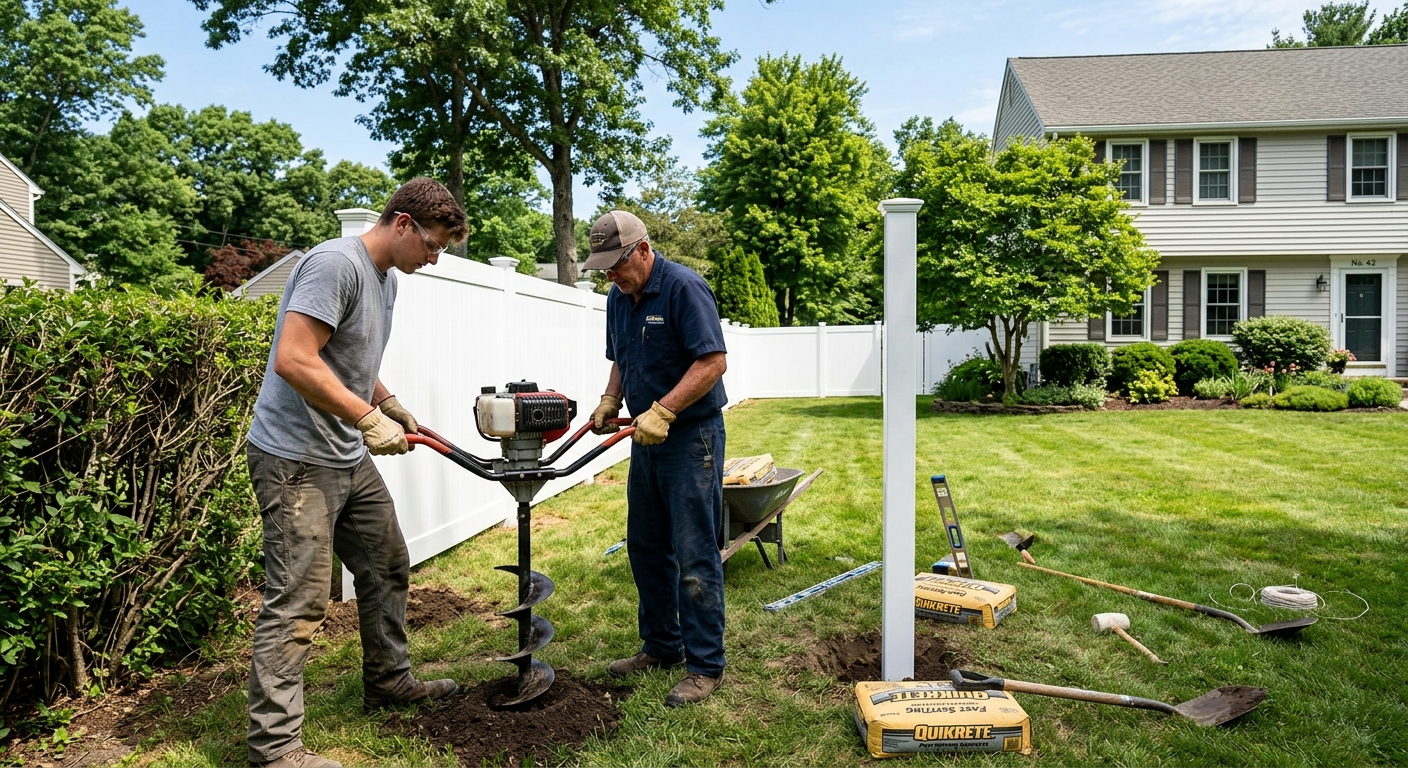
Fencing options and costs in Shawnigan Lake
Shawnigan Lake is a scenic community on Vancouver Island where homeowners regularly upgrade backyard privacy and boundary fencing as properties change hands and landscaping matures. With 3,908 residents recorded in the 2021 Census (Statistics Canada, 2021 Census), demand is driven by a steady flow of private yards that need screening for wind, pets, and summer gatherings. In practice, nearly every detached home plot becomes a potential fencing project, making “typical residential” estimates useful for comparing quotes.
In the Lower Mainland–Southwest market, fence pricing tends to reflect mild but not trivial frost and wind conditions. Posts still need to be set below the design frost depth to limit heaving, and the wetter Fraser Valley soil conditions (a common pricing reference point across the region) often translate into deeper holes, more concrete, and more labour than dry-site installs. That’s why two fences with the same height can differ noticeably when one yard has heavier access constraints, clay-like soil, or required post-depth upgrades.
Contractors in Shawnigan Lake are especially busy around the lakefront-adjacent neighbourhoods and older established subdivisions, where property lines are tight and gates are frequently added or replaced. If you’re choosing between chain-link, wood, vinyl, or aluminum, the “best” option depends less on style and more on your tolerance for maintenance and how much privacy you want. The table below compares common materials for lifespan, upkeep, and realistic installed costs so you can transition directly into pricing discussions with contractors.
| Material |
Lifespan |
Maintenance |
Privacy Rating |
Price per Linear Foot |
| Pressure-treated pine (standard wood) |
10–15 years |
Stain/seal every 2–3 years |
High (solid pickets) |
$55–$95 |
| Cedar (natural rot resistance) |
15–25 years |
Light stain every 2–4 years |
High (solid or close spacing) |
$70–$110 |
| Vinyl / PVC (no-maintenance) |
20–30 years |
Wash as needed (no staining) |
High (privacy panel style) |
$75–$130 |
| Chain-link (galvanized steel) |
20–40 years |
Occasional tension checks |
Low–Medium (with slats only) |
$30–$55 |
| Aluminum ornamental |
25–40 years |
Rinse/wash seasonally |
Low–Medium (open pickets) |
$90–$170 |
| Composite / recycled material |
20–30 years |
Wash; no staining |
High (board/solid designs) |
$95–$155 |
Prices are estimates only and vary by project scope, site access and material selection.
What affects the price of fencing in Shawnigan Lake
In Shawnigan Lake (and across British Columbia), two contractors can price the “same” fence 30–50% apart because costs are driven by how your specific yard behaves—not just the finish. Labour rates, truck time, how difficult it is to access the post line, and what your soil does during wet seasons all change the installation method. Material pricing also varies: vinyl and aluminum require structural-grade components, while wood and chain-link are more straightforward but still depend heavily on proper post depth and bracing.
One of the biggest drivers is how frost affects post depth. Even though coastal BC is milder than interior regions, published guidance used across Canada commonly puts minimum embedment around about 3 feet in much of Canada; local crews often set posts deeper than the bare minimum and typically aim for about 4–6 inches below the design frost depth to reduce heaving risk. In colder Ontario and Alberta regions, posts may need to be set roughly 1.5–2.0 m into the ground, often requiring longer posts and more concrete. While Shawnigan Lake isn’t as extreme, the regional pricing mindset still pushes crews to dig deeper than “minimum” for reliability—especially for privacy panels, corner posts, and gates.
Wind exposure adds another cost lever. Open BC sites and exposed corridors can require tighter post spacing and stronger rails, which pushes wood toward braced framing and vinyl toward reinforced styles. In wetter conditions, improper soil drainage can accelerate rot, so pressure-treated pine may need better base prep and cedar needs proper ventilation gaps. For example: (1) a clay-heavy yard with soft footing often increases concrete volume and hole rework; (2) a sloped backyard may require stepped panels, extra rails, and more time; and (3) removing an old fence with buried posts typically adds disposal labour and lifting/transport charges.
As a practical reference, many homeowners compare mid-range wood at roughly $55–$95 per linear foot versus vinyl/PVC around $75–$130 per linear foot—those differences can be justified when the contractor’s post-setting plan reduces future movement and repairs. The local housing stock also matters: older properties often have uneven ground and older fence foundations, which can add hundreds to the final total once removal is included.
| Price Factor |
Why It Matters |
Cost Impact |
| Fence length in linear feet |
Every style scales directly with feet of lineal fencing and bracing needs. |
High (primary driver) |
| Post depth required |
Frost depth considerations control hole size, post length, and stability. |
High (more labour + material) |
| Post setting method |
Concrete vs. gravel pack changes labour, curing time, and cost of materials. |
Medium–High |
| Material choice |
Vinyl vs. cedar vs. chain-link affects price of components and how they’re installed. |
High (material-driven) |
| Gate count and type |
Drive-through (double) gates need heavier hardware, framing, and often extra posts. |
Medium–High |
| Grade and terrain |
Slopes require stepping/raking; uneven ground increases cutting and alignment time. |
Medium |
| Old fence removal and disposal |
Disassembly, hauling, and dumping fees can be significant—especially with buried posts. |
Medium |
| Permit fees and survey / property line locate |
Some fence heights and conditions require approvals and/or a locate to avoid disputes. |
Low–Medium (job-dependent) |
Permits & regulations in British Columbia
In British Columbia, fences above a height threshold often require a building permit. As a practical rule of thumb, rear fences are commonly regulated around 2.0 m (6.5 ft), while front or corner-area fences are frequently around 1.0–1.2 m (3–4 ft). Exact requirements can vary based on location and context, so you should confirm with the local permitting process before ordering materials. Regardless of height, all fences must respect property lines and municipal setback bylaws.
Before digging any post hole, utility locates are essential. In BC, call BC 1 Call (and ensure the contractor references the locate tickets). You should also obtain a survey or locate your property pins before installation. That step reduces the risk of building on an easement or misaligned boundary, which is a common source of disputes even in established Shawnigan Lake areas.
Shared fence ownership is handled under provincial line-fences rules. If your fence serves as a shared boundary, you may need to coordinate with neighbours on scope and cost-sharing.
Licence and insurance checks: for BC fencing contractors, verify the contractor’s business registration status and confirm liability insurance with a current certificate of insurance. WSIB/WCB: BC coverage is generally through WCBBC (WorkSafeBC). Ask for proof of clearance (or an up-to-date account status letter) and keep it with your contract documents.
Choosing the right fence material for Shawnigan Lake
Choosing a fence in Shawnigan Lake comes down to matching material performance to your priorities—privacy, low maintenance, budget, and how long you want to avoid major repairs. Coastal BC conditions are mild but can be wet, so untreated or poorly finished wood will weather faster than expected. The best choice for many homeowners is pressure-treated pine when budget matters, cedar when appearance and rot resistance are priorities, vinyl/PVC when you want minimal upkeep, and aluminum when you want longevity with an ornamental look (but typically less privacy).
Pressure-treated pine: it’s usually the budget option, but it typically needs staining or sealing every 2–3 years to reduce grey weathering and to keep water from penetrating deeply. Cedar: it resists rot naturally and often looks better as it ages, but it still benefits from periodic staining for colour and surface protection. Vinyl/PVC: it’s low maintenance and popular for privacy styles, but extreme cold snap can make some lower-quality products brittle; in coastal BC it’s usually a good fit, especially when installed with correct thermal expansion allowance. Chain-link: it’s the lowest-cost, longest-life structure, but it won’t provide real privacy unless you add slats or vegetation screening. Aluminum: it won’t rust and works well for open designs, but it costs more and doesn’t block sightlines like solid wood or vinyl.
Regarding post depth: crews still set posts below the frost-influenced zone to limit heaving, and in the Lower Mainland–Southwest pricing context that often means digging deeper than “minimum” and using concrete for corner posts and gate posts. That’s one reason a wood fence at roughly $55–$95 per linear foot may hold up better than a cheaper install—proper hole depth and bracing costs time and labour.
For a tangible comparison: if you’re choosing between a vinyl/PVC privacy line at about $75–$130 per linear foot and pressure-treated wood at $55–$95, the extra upfront cost can be worth it when you want to skip staining, especially along lanes where rain exposure is constant and access is awkward. If you’re planning a long-term ownership timeline, vinyl and composite can also reduce the “maintenance cycle” cost.
| Material |
Cold Tolerance |
Lifespan |
Annual Maintenance |
Best For |
Price Band |
| Pressure-treated pine |
Good (with proper treatment and finishing) |
10–15 years |
Inspect annually; stain every 2–3 years |
Best budget balance for solid privacy |
$55–$95 |
| Cedar |
Good (natural rot resistance) |
15–25 years |
Light seal/stain every 2–4 years |
Appearance + rot resistance |
$70–$110 |
| Vinyl / PVC |
Very good (installed correctly) |
20–30 years |
Wash as needed |
Low-maintenance privacy panels |
$75–$130 |
| Chain-link |
Very good |
20–40 years |
Occasional tension checks |
Security with minimal sight blocking |
$30–$55 |
| Aluminum ornamental |
Excellent |
25–40 years |
Rinse/wash seasonally |
Long life with curb-appeal styling |
$90–$170 |
| Composite / recycled |
Very good |
20–30 years |
Wash; check fasteners |
Privacy with low staining effort |
$95–$155 |
How to choose a fencing contractor in Shawnigan Lake
When you hire a fencing contractor in British Columbia, the checks matter just as much as the price. Start with licensing/business registration status (ask them for their BC registration details), then confirm liability insurance and proof of WorkSafeBC (WSIB/WCB equivalent in BC) coverage. To verify, request a current certificate of insurance and look for the coverage limits and effective dates; it should name the correct legal entity and list you as an additional insured if offered. For WorkSafeBC, ask for a clearance letter or account status documentation showing the contractor is in good standing. If they won’t provide documents, treat that as a serious red flag.
Get 2–3 itemised written quotes that break out labour and materials separately. You want to see line items like post type and length, concrete quantity (if used), rails, pickets/panels, gate hardware, and disposal/removal. Avoid lump sums that don’t explain what’s included—especially around permits, property line locate/survey allowances, and whether the contractor removes and hauls away the old fence.
Warranty is also important. Ask for the workmanship warranty length and what it covers (post movement, panel warping, gate sag, hardware replacement). Also confirm the manufacturer’s product warranty and whether it’s transferable if you sell the home.
Finally, payment schedules should protect you. Never pay more than about 10–15% upfront; hold back the remaining balance until the job is complete and cleaned up. A professional contractor should provide a start date and a realistic completion estimate in writing, accounting for weather delays common in coastal BC.
- Confirm they provide proof of insurance and WorkSafeBC good-standing documentation before work begins.
- Ask for an itemised quote: labour, posts, concrete, hardware, panels, gate(s), removal, and disposal.
- Check that post depth and setting method are specified (concrete-set at corners/gates is common).
- Verify they plan for sloped yards (stepped vs. raked panels) rather than “making it fit.”
- Ensure gate framing and latch hardware are described by model/grade, not just “standard hardware.”
- Ask who pulls permits (if required) and whether permit fees are included or extra.
- Confirm whether property line locates/survey are included or if you provide a locate ticket.
- Request a workmanship warranty term in years, in writing.
- Confirm product warranty terms and whether they transfer to future owners.
- Review the payment schedule and insist on a small deposit (10–15%) only.
- Ask for a start date and finish date window, plus what happens if weather delays occur.
- Check cleanup/disposal is included—especially for old posts and buried footings.
Red flags in Shawnigan Lake include: (1) quoting without site measurement or a walk of the post line, (2) refusing to show insurance/WorkSafeBC documentation, (3) vague scopes like “fence supply and install” with no post-depth or setting method details, (4) demanding a large upfront payment, and (5) promising solid privacy without describing bracing, spacing, and gate reinforcement.
Frequently asked questions — fencing in Shawnigan Lake
How do I compare fencing quotes?
To compare fencing quotes in Shawnigan Lake, ask each contractor to measure and propose the same scope: fence length (linear feet), height, material type, gate count, and whether the old fence is removed. Then compare post details—especially post depth and post setting method (concrete vs. gravel pack), since that’s what prevents movement and heaving. Make sure the quote includes hardware grade, rail count, and whether the system is designed for wind exposure and wet-season drainage. Finally, line up the price band: if one quote is closer to chain-link at roughly $30–$55 per linear foot and another is vinyl/PVC closer to $75–$130, confirm they’re not mixing different materials or under-specifying posts. Itemised quotes reduce surprises and make differences easier to justify.
How long does fence installation take in Shawnigan Lake?
Most residential fence installs in British Columbia take a few days to about a week, depending on length, gate complexity, and site conditions. A straightforward run (uniform grade, no major slope, minimal obstacles) often goes faster, while yards with slopes that need stepped panels or installations requiring extra reinforcement for solid privacy take longer. Wet soil can slow excavation and concrete setting because crews need stable footing for post alignment. If old fence removal and disposal are included, that typically adds time for disassembly and hauling. To plan properly, request a written start date and a completion estimate that includes weather allowances—coastal conditions can change quickly and may affect cure times.
Can I install a fence on a slope in Shawnigan Lake?
Yes, you can install a fence on a slope in Shawnigan Lake, but the method matters. Contractors usually choose either stepped panels (the fence follows the grade with distinct “steps” between sections) or raked panels (continuous slope adjustments, depending on the system). Stepped installations are common for privacy styles and can look cleaner where there’s a noticeable grade change, but they still require careful layout to keep the fence level and maintain consistent visual alignment. Ask whether the contractor will brace the rails to prevent bowing and whether gate openings will be level and plumb at the latch height. Good quotes should describe how they’ll handle the slope rather than assuming a “flat” installation is possible.
What is the most weather-resistant fence for Shawnigan Lake's climate?
Weather resistance in British Columbia depends on how well the fence is built for wet-season conditions, proper post setting, and material durability—not just the material label. Vinyl/PVC and aluminum are generally the most resistant to rot and corrosion, while chain-link is also very long-lasting structurally. For solid privacy where you want strong performance with low upkeep, vinyl/PVC is often a top choice, and pricing typically aligns with the $75–$130 per linear foot band. Wood can perform well if it’s pressure-treated or cedar and properly stained/finished, but it requires regular maintenance to prevent moisture-driven grey weathering and surface breakdown. In all cases, correct post depth and drainage planning are what most affect long-term stability.
How do I prevent wood fence rot in Shawnigan Lake?
Preventing wood rot in Shawnigan Lake starts at the base and continues through the finish. Use quality pressure-treated framing or cedar and ensure the contractor sets posts correctly for frost and moisture stability—often with concrete at key posts like corners and gates to limit movement. Good installers also keep bottom rails and pickets elevated away from standing water where possible, and they avoid trapping soil against the wood face. After installation, stain or seal pressure-treated wood every 2–3 years and re-check fasteners annually. For cedar, a light staining schedule helps maintain surface protection and reduces moisture penetration. Also, address sprinklers and drainage: if downspouts or irrigation spray the fence line constantly, rot risk rises quickly.
What is the cost per linear foot for fencing in Shawnigan Lake?
In Shawnigan Lake, fencing costs generally follow the regional installed price bands for British Columbia. Chain-link is often the lowest, roughly $30–$55 per linear foot for a typical residential run. Pressure-treated wood commonly lands around $55–$95 per linear foot depending on height, post depth, and whether gates and disposal are included. Vinyl/PVC privacy fences usually cost more, about $75–$130 per linear foot due to material and structural requirements. Aluminum ornamental fences are commonly higher, about $90–$170 per linear foot. Your final quote can shift based on slope, access, required permit height, and how deep posts must be set for heaving resistance. Always request itemised quotes so you’re comparing like for like.