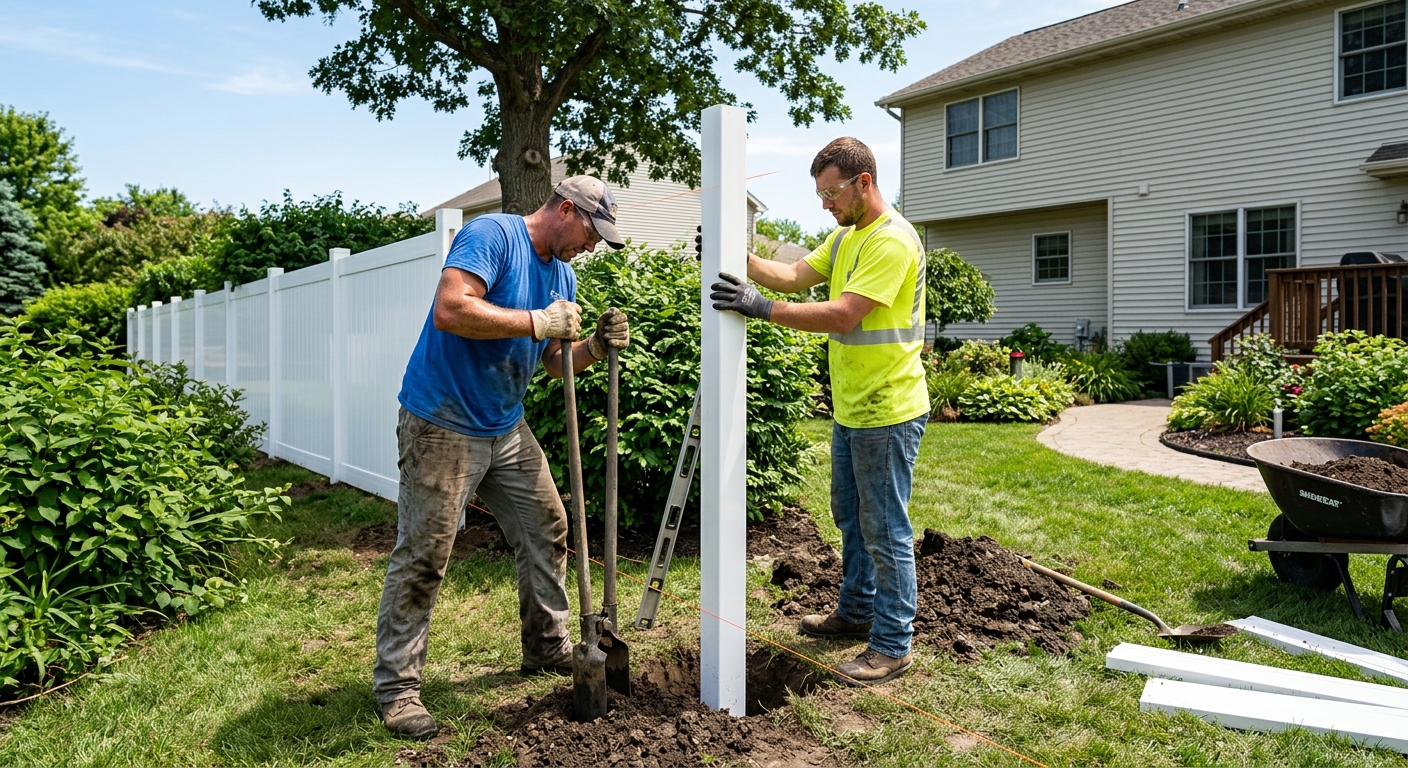
Fencing options and costs in Sunshine Hills
Sunshine Hills residents typically start shopping for fencing by balancing curb appeal, privacy, and how often they want to maintain a perimeter. With a 2021 population of 9,900 (Statistics Canada, 2021 Census), demand is steady for routine repairs and full fence replacements—especially around family-oriented streets where more homeowners are updating yards for pets, gardens, and outdoor living. In the Lower Mainland–Southwest, detached properties are the strongest predictor of active fencing projects, because each detached lot often needs a complete run, not just a corner fix. (Statistics Canada, 2021 Census).
Lower Mainland–Southwest pricing reflects the region’s “mild but not trivial” frost and wind conditions. Even though it’s coastal BC rather than a deep-freeze province, posts still need to be set below the practical frost influence to limit heaving, and wetter Fraser Valley–type soils can mean deeper holes, more concrete, and longer labour time than a dry-site install. Wind exposure also affects how contractors space posts and choose panel thickness—particularly for solid wood and vinyl privacy fences. Availability can be higher than more remote areas, but premium scheduling still shows up when multiple crews are booked ahead for peak summer fence installs.
In Sunshine Hills, demand is especially strong around the neighbourhood pocket near the main residential corridors where backyards are often bordered by lanes and private driveways—those layouts make gate hardware, privacy panels, and fence alignment a bigger part of the scope. Once you know which material matches your goals, the next step is comparing realistic installed ranges across common options.
| Material |
Lifespan |
Maintenance |
Privacy Rating |
Price per Linear Foot |
Price Range |
| Pressure-treated pine (standard wood) |
10–20 years |
Stain or seal every 2–3 years |
High (solid-board styles) |
$23–$38 |
$55–$95 |
| Cedar (natural rot resistance) |
15–25 years |
Light stain/sealer every 2–3 years |
High (solid-board styles) |
$28–$46 |
$70–$115 |
| Vinyl / PVC (no-maintenance) |
20–30+ years |
Occasional wash only |
High (privacy picket or solid panels) |
$28–$55 |
$75–$130 |
| Chain-link (galvanized steel) |
20–35 years |
Minimal (wash; occasional tension check) |
Low–Medium (see-through) |
$14–$22 |
$30–$55 |
| Aluminum ornamental |
25–40 years |
Minimal (rinse; touch-up if damaged) |
Medium (decorative spacing) |
$30–$70 |
$90–$170 |
| Composite / recycled material |
20–30 years |
Very low (wash; no staining) |
High (solid privacy styles) |
$26–$60 |
$85–$140 |
Prices are estimates only and vary by project scope, site access and material selection.
What affects the price of fencing in Sunshine Hills
In Sunshine Hills and across the Lower Mainland–Southwest, two quotes for the same yard can differ by 30–50% because the scope “invisible to the eye” changes—grading, access for equipment, the number of posts and gates, and whether the contractor must pour concrete in wetter soil. BC’s coastal-and-wet influence also drives different material choices and more labour for proper post setting, even when the weather looks mild day-to-day. That’s why a project that fits the wood fence installation band in favourable conditions can still trend higher if you need deeper post holes and heavier reinforcement for privacy panels.
A key driver is frost behaviour around the Fraser Valley and Lower Mainland: contractors commonly set posts about 4–6 inches below the design frost depth, then choose longer posts to maintain correct embedment. In colder provinces, guidance often results in 1.5–2.0 m of embedment and concrete setting; in BC this is typically shallower than Ontario and Alberta, but crews still often go deeper than bare minimum because wetter soils hold water and increase heave risk. For solid styles, wind exposure matters too—if your lot sits more open to gusts, contractors tighten spacing and add bracing, raising material and labour.
Concrete examples from Sunshine Hills installs: (1) a backyard with heavy clay or consistently damp soil often needs deeper holes and more concrete than a drier front lot; (2) a sloped boundary usually means raked/stepped rails and more labour time to keep top lines straight; (3) a gate replacing a narrow driveway entrance can add hardware cost and alignment time. These factors also influence whether you land closer to the $55–$95 wood range or closer to the $75–$130 vinyl/PVC range, even when fence length is similar.
| Price Factor |
Why It Matters |
Cost Impact |
| Fence length in linear feet |
Every extra foot adds posts, rails, fasteners, and finishing time. |
High (often the largest single line item) |
| Post depth required |
Frost influence determines embedment to reduce heaving and wobble. |
Medium–High (longer holes and longer posts) |
| Post setting method |
Concrete vs. gravel pack vs. driven posts changes labour and materials. |
Medium (concrete can noticeably increase totals) |
| Material choice |
Vinyl structure and fabrication differ from cedar/pressure-treated and chain-link. |
High (drives the broad price band) |
| Gate count and type |
Walk-through gates cost less than drive-through; double gates add hinges and hardware. |
Medium–High |
| Grade and terrain |
Slopes require stepped or raked panels and extra layout time. |
Medium |
| Old fence removal and disposal |
Demolition, haul-away, and patching can be labour-heavy. |
Medium |
| Permit fees and survey / property line locate |
Some fence builds trigger permitting and/or require a locate before excavation. |
Low–Medium (can be High on complex lots) |
Permits & regulations in British Columbia
In British Columbia, fences above a height threshold often require a building permit. A common rule of thumb homeowners run into is around 2.0 m (6.5 ft) at the rear and roughly 1.0–1.2 m (3–4 ft) at the front or corner; exact requirements still depend on where the fence sits (front, corner, rear) and local bylaw details. Regardless of permitting, fences must respect property lines and municipal setback bylaws. If you’re replacing an existing fence, permitting may still apply if you’re changing height or moving the line.
Before you dig any post holes, call for utility locates (BC 1 Call) so crews can confirm safe digging zones for buried hydro, telecom, and irrigation lines. Also, obtain a survey or locate your property pins before installing. That step protects you from encroachment disputes and “mystery gaps” that show up after neighbours notice the fence is on the wrong side of the line. Shared fence ownership typically follows provincial line-fences legislation, so if you’re planning a boundary fence, it’s smart to confirm responsibilities for ongoing maintenance with the adjoining owner before work begins.
Licence and coverage checks (step-by-step): (1) Ask for the contractor’s proof of registration/licensing information in BC and verify it through the applicable online registry entry; (2) request a current certificate of insurance showing liability coverage and confirm dates are valid; (3) obtain confirmation of worker coverage (WSBC/WCB) for anyone on-site—look for a clearance letter or policy confirmation and ensure it matches the work period; (4) keep copies with your contract and estimate so you can verify eligibility if something goes wrong.
Choosing the right fence material for Sunshine Hills
Choosing the right fence material in Sunshine Hills is mostly about matching your priorities—privacy, low maintenance, budget, and lifespan—to how BC yards behave in wind, rain, and occasional cold snaps. Pressure-treated pine is the budget-friendly starting point, but it typically needs staining or sealing about every 2–3 years to prevent grey weathering and to maintain a uniform look. Cedar is naturally more rot resistant and often looks better as it ages, though it still needs regular maintenance to keep it performing well in BC’s damp climate. Vinyl/PVC is genuinely low maintenance—wash it and move on—but in extreme cold it can be more prone to cracking if the installation is too rigid or posts aren’t set correctly. Chain-link is the cheapest and longest-lived option for durability, but it won’t provide the privacy many homeowners want. Aluminum ornamental offers a clean appearance, resists rust, and needs little upkeep, but it’s usually more about style than full privacy.
Post depth is still a deciding factor for every material in the Lower Mainland–Southwest. Even with milder coastal conditions, crews often set posts below practical frost influence and frequently use concrete-set posts for privacy panels, corner posts, and gate posts—especially in wetter soils where water can weaken the base. Wind and snow loads matter because gusts can rack panels; for solid fencing, stronger posts and closer rail alignment reduce bounce. If you’re deciding between materials, a practical example: moving from pressure-treated wood (often within the $55–$95 installed band) to vinyl/PVC (typically $75–$130) can be justified when you want true low maintenance and long-term appearance—otherwise, wood can be a smart value if you’re willing to re-stain on schedule.
| Material |
Cold Tolerance |
Lifespan |
Annual Maintenance |
Best For |
Price Band |
| Pressure-treated pine |
Good for coastal BC when properly sealed |
10–20 years |
Low to moderate (check and stain/seal every 2–3 years) |
Best budget option with acceptable privacy |
$55–$95 |
| Cedar |
Good; performs well against rot in wet seasons |
15–25 years |
Low to moderate (stain/sealer every 2–3 years) |
Attractive privacy with natural character |
$70–$115 |
| Vinyl / PVC |
Good; requires correct installation to avoid cold brittleness issues |
20–30+ years |
Minimal (rinse/clean as needed) |
Low-maintenance privacy |
$75–$130 |
| Chain-link |
Excellent (steel and galvanizing hold up well) |
20–35 years |
Minimal (periodic tension/visual checks) |
Security and long service life |
$30–$55 |
| Aluminum ornamental |
Excellent (powder-coated performance) |
25–40 years |
Minimal (wash and inspect) |
Front-yard appearance with boundary definition |
$90–$170 |
| Composite / recycled |
Very good; stable boards when installed with proper hardware |
20–30 years |
Very low (wash; no staining) |
Long-life privacy with minimal upkeep |
$85–$140 |
How to choose a fencing contractor in Sunshine Hills
Choosing a fencing contractor in Sunshine Hills is less about flashy ads and more about verifying coverage, getting comparable quotes, and making sure the scope is spelled out. In British Columbia, start by confirming licensing and registration where applicable, then request proof of liability insurance (so you’re protected if a crew damages property) and worker coverage (WSBC/WCB) for anyone working on your site. Practically, you should look for a current certificate of insurance and a clearance/policy confirmation letter that matches the job’s dates, not something expired. Ask for these documents before the first workday.
Next, get 2–3 itemised written quotes, not one lump sum. A good quote breaks down labour and materials line-by-line (posts, rails, panels, gate frames, hardware, fasteners, concrete and excavation, and disposal). Carefully review what’s excluded: for example, whether disposal of old fencing is included, whether utility locates are coordinated, and whether a permit is pulled when required. Ask about warranty details: workmanship warranty length (and what it covers), product/manufacturer warranty (what defects are covered), and whether the warranty is transferable to the homeowner.
For payment, avoid paying more than 10–15% upfront. Use a holdback until the job is complete and inspected. Finally, insist on a written start date and an estimated completion timeline so you know when materials will be ordered and when gates and final alignments will be installed. In a region where crews plan around weather windows, a clear schedule is what keeps your project from drifting.
- Request contractor’s BC licensing/registration proof and confirm it matches the business name on the contract.
- Get a current certificate of liability insurance before signing.
- Confirm WSBC/WCB coverage with a clearance letter or policy confirmation for the crew and the work dates.
- Use 2–3 itemised quotes that separate labour, materials, excavation, concrete, and disposal.
- Ensure utility locates (BC 1 Call) are addressed before digging post holes.
- Ask whether an on-site property line locate/survey is included or excluded.
- Confirm who supplies and sets corner posts, line posts, and gate hardware (hinges/latches/strikes).
- Verify post setting method: concrete where required, gravel pack where allowed, and embedment depth notes.
- Check if the quote includes removal and disposal of your old fence materials.
- Confirm permit handling: who pulls it, who pays fees, and what happens if permit conditions change.
- Clarify warranty terms for workmanship and the product; ask if it’s transferable.
- Agree on a payment schedule with only 10–15% upfront and a holdback until completion.
Red flags I see around Sunshine Hills include contractors who won’t provide insurance/WSBC documentation on request, quotes that only give a single lump sum with no material breakdown, vague scope language that omits disposal or gate hardware specifics, refusal to commit to a start date and completion window, and “cash-only” payment terms that don’t match a written contract.
Frequently asked questions — fencing in Sunshine Hills
How long does a wood fence last in Sunshine Hills?
In Sunshine Hills and the Lower Mainland–Southwest, a well-built wood fence typically lasts about 10–20 years for pressure-treated pine and closer to 15–25 years for cedar, assuming posts are set properly and the fence receives maintenance. BC’s wet seasons can speed up surface wear and can stress fasteners if you don’t seal or stain on a consistent schedule (often every 2–3 years). The biggest lifespan difference usually comes from the installation: correct post embedment and drainage around the base matter as much as the wood species. If you maintain the finish and keep the bottom rails from trapping water, wood can be a strong value option inside the installed wood pricing band of $55–$95. If you want “set it and forget it,” that’s where vinyl/PVC usually becomes the better long-term choice.
Who owns and maintains a shared fence?
In British Columbia, shared fence ownership and responsibilities are generally handled under provincial line-fences legislation. Practically, many boundary fences are treated as shared—meaning both neighbours may have rights and obligations related to repair, replacement, and ongoing maintenance. The key is clarity up front: confirm who owns the fence line, which side the finished face belongs on, and how decisions are made if one homeowner wants changes to height, material, or style. If you’re upgrading a shared privacy fence in Sunshine Hills, it’s smart to communicate early about cost sharing before any posts are dug, because once concrete is poured, it can become harder to negotiate. A good contractor should help you document the scope, materials, and alignment so both parties understand what is being installed and what ongoing maintenance is expected.
How do I find my property line before fencing?
Before fencing in Sunshine Hills, you should verify your property line instead of relying on visual guesses. The safest method is to get a survey or a professional property line locate based on your property pins so you know exactly where the boundary is. You can also ask your contractor to confirm the layout using the locate/survey documents you receive. Remember: even a small offset can lead to disputes after installation, especially along rear and side yards where fences often define access lanes. Also, before any post hole digging, arrange utility locates through BC 1 Call so you don’t accidentally hit buried services. If a contractor tries to start excavation before you confirm the boundary, that’s a serious risk. A clear boundary decision helps avoid rework—rework is one of the quickest ways projects climb above typical fence price bands.
What's the most low-maintenance fence?
For low maintenance in British Columbia, vinyl/PVC is often the top choice for homeowners who want minimal upkeep. It typically won’t require staining and usually needs only periodic washing, which fits wet, coastal conditions better than untreated or poorly sealed wood. Chain-link is also low maintenance because it’s durable and easy to inspect, but it won’t provide privacy. Aluminum ornamental is low maintenance too (powder-coated finishes resist rust), though its openness means you usually get less privacy. In terms of cost, vinyl/PVC commonly lands in the $75–$130 installed band, while pressure-treated wood tends to be lower, often $55–$95, at the expense of ongoing staining/sealing. If you’re balancing time and long-term appearance, the higher upfront cost of vinyl/PVC can be justified—especially if you’re replacing a fence that’s been hard to maintain.
How tall can my fence be in Sunshine Hills?
Fence height limits in Sunshine Hills follow BC rules and local municipal bylaws, which can vary based on whether the fence is at the front, corner, or rear. A common threshold homeowners hear is that fences above about 2.0 m (6.5 ft) at the rear and roughly 1.0–1.2 m (3–4 ft) at the front or corner may require a building permit. Even if height is permitted, setbacks and sight-line rules still apply in some areas. If you’re considering privacy panels or solid wood/vinyl, it’s worth verifying requirements before ordering materials so you don’t end up with a rework situation. Your contractor should also tell you whether the plan triggers a permit and what documents they need. In practical budgeting, permitting can add time and administration costs even when the materials are within a typical $55–$95 or $75–$130 range.
Should fence posts be set in concrete here?
In Sunshine Hills, concrete-set posts are often recommended, especially for corner posts, line end posts, and gate posts, and many contractors use concrete when soil is wetter or when extra rigidity is needed for privacy panels. Lower Mainland–Southwest frost influence still means embedment depth matters to reduce heaving, and wet soils can soften around a post base without solid setting. That said, whether you must use concrete for every post depends on site conditions, drainage, and the fencing system being installed—some crews use gravel packs or alternative methods in certain circumstances, but you should not assume “one method fits all.” A good quote will specify the post setting approach and how deep posts are set relative to the frost influence. If you’re pricing, concrete tends to push totals upward slightly, but it can prevent early leaning and costly repairs.