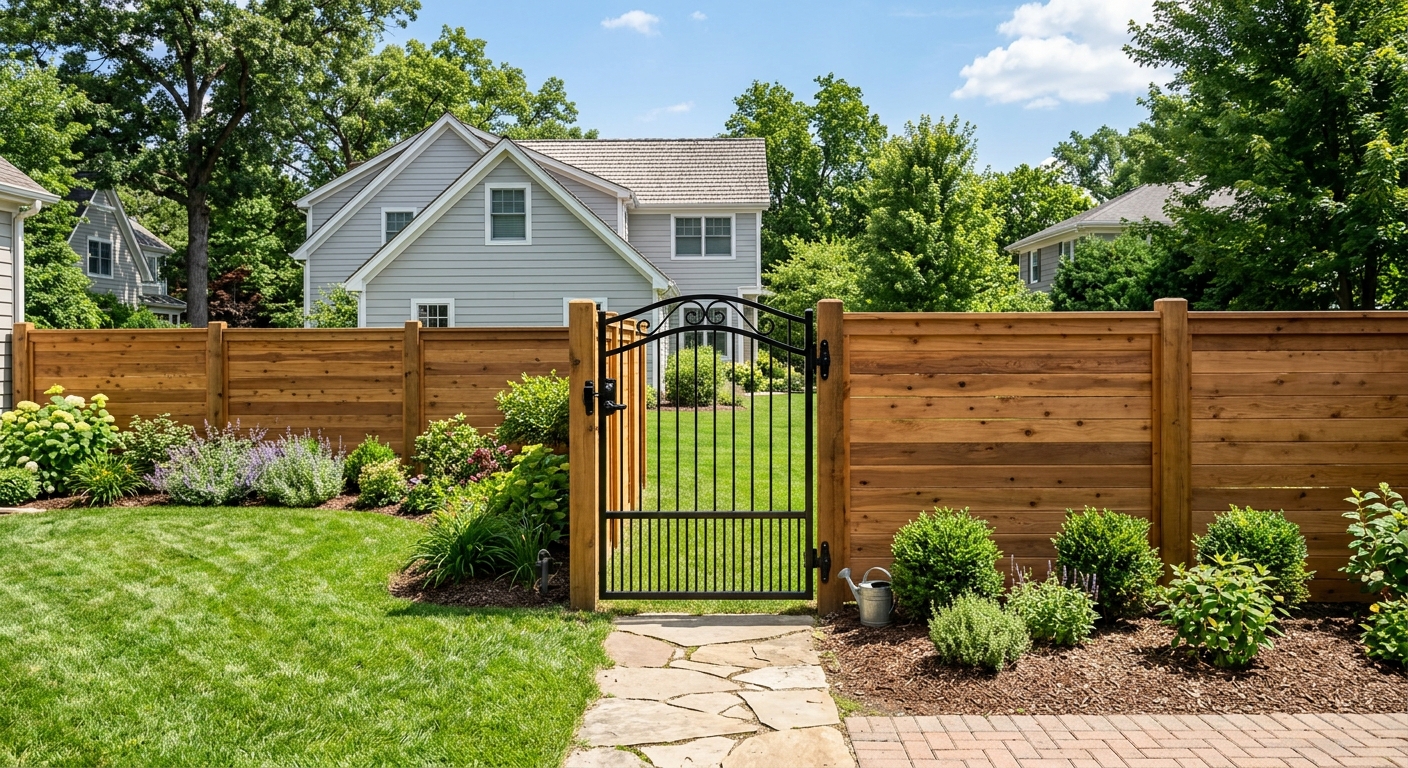
Fencing options and costs in Sechelt
In Sechelt, the right fence choice starts with understanding what the yard needs—privacy, safety, or curb appeal—and what your home can realistically support. With 75.3% of local dwellings being single-detached homes and an owner-occupancy of 80.7% of households (Statistics Canada, 2021 Census), there’s steady demand for backyard privacy, dog fencing, and front yard upgrades that match how long families stay in place. That demand shows up especially around Sechelt Peninsula and the more established pockets near Lower Road / South Fletcher Road, where many properties have older boundary fencing or are replacing wind-worn rails.
In the Lower Mainland–Southwest, pricing is shaped by mild but not trivial frost and frequent coastal moisture. Posts still need to be set below local frost depth to limit heaving, and wetter soils often mean deeper holes, more concrete at key locations (corner posts, gate posts), and extra labour compared with drier sites. Wood, while mid-range, is also sensitive to staying power: untreated surfaces grey quickly in salty air and damp cycles, so proper sealing is part of the real cost of ownership. Meanwhile, vinyl/PVC and chain-link shift the cost mix toward materials and structural requirements rather than ongoing maintenance.
Contractor availability can also affect turnarounds—peak-season crews sometimes price higher if they’re scheduling multiple longer jobs on steep lots. To help you compare apples to apples, use the table below as your starting point, then we can narrow it down based on your length, gate count, and whether you need privacy panels or a more open design.
| Material |
Lifespan |
Maintenance |
Privacy Rating |
Price per Linear Foot |
| Pressure-treated pine (standard wood) |
10–15 years |
Stain/seal every 2–3 years |
High (solid pickets) |
$20 – $30 |
| Cedar (natural rot resistance) |
15–25 years |
Stain/seal every 3–4 years |
High (solid boards) |
$28 – $45 |
| Vinyl / PVC (no-maintenance) |
20–30 years |
Minimal wash-down |
Medium to high (solid styles) |
$30 – $55 |
| Chain-link (galvanized steel) |
20–35 years |
Occasional tension check / coating touch-ups |
Low (open mesh) |
$15 – $25 |
| Aluminum ornamental |
30–40 years |
Occasional rinse |
Low to medium (ornamental infill) |
$28 – $60 |
| Composite / recycled material |
20–30 years |
Minimal wash-down; avoid harsh cleaners |
High (board-style systems) |
$32 – $60 |
Prices are estimates only and vary by project scope, site access and material selection.
What affects the price of fencing in Sechelt
In Sechelt and across the Lower Mainland–Southwest, you can easily see 30–50% swings between quotes for what looks like the same fence. The difference usually isn’t the “brand”—it’s the installation realities: how long the run is, how hard the ground is to dig, how many gates you want, and whether crews must deal with slope, drainage, or a lot of removals. In British Columbia, coastal weather also pushes more attention to post setting and wood detailing than homeowners expect.
First, frost line depth governs how deep posts must be set. In most Canadian contexts, guidance often lands around an embedment of about 4–6 inches below the design frost depth to reduce heaving risk, which typically results in deeper holes than “minimum.” In colder regions (Ontario and Alberta), that can mean roughly 1.5–2.0 m into the ground, often requiring concrete setting and longer posts—those are the material and labour drivers behind higher fencing costs. Sechelt’s coastal conditions are milder than interior provinces, but contractors still frequently set posts deeper than the bare minimum on wet sites, especially for privacy panels, corner posts, and gates.
Second, wind exposure matters for structure. While we don’t get the same Prairie wind loads, coastal gusts and open yard layouts can still force tighter post spacing and sturdier rails—especially for solid wood and vinyl privacy fences. Third, wet Fraser Valley–type soils (common in the region) raise the cost by slowing excavation and increasing concrete usage for stability.
Here are a few concrete examples of how local conditions raise or lower cost in Sechelt: (1) a 6 ft privacy run on softer soil may require more concrete than a similar run on firm base rock; (2) a yard with standing water often needs additional drainage considerations or revised post depths; and (3) removing an old fence that’s been embedded for decades can double labour time. Those factors are why wood installations commonly land in the broader local band of $55 – $95, while vinyl/PVC often sits higher at $75 – $130, even before upgrades like gates or decorative tops.
| Price Factor |
Why It Matters |
Cost Impact |
| Fence length in linear feet |
Labour and materials scale directly with total footage |
Highest driver; longer runs multiply every cost item |
| Post depth required |
Frost protection affects hole depth and post length |
More depth means more digging time and more concrete |
| Post setting method |
Concrete vs. gravel pack vs. driven posts impacts stability |
Concrete set typically increases material and labour |
| Material choice |
Different materials require different rails, brackets, and fixing details |
Switching materials can shift the job by tens of percent |
| Gate count and type |
Gates need reinforced posts and heavier hardware |
Every gate adds framing, hardware, and extra build time |
| Grade and terrain |
Slopes require stepped or raked panel systems |
Custom fitting increases labour and can add off-cuts |
| Old fence removal and disposal |
Demolition time varies with age and embedment |
Often a major hidden cost if not quoted clearly |
| Permit fees and survey / property line locate |
Paperwork and locate services can add time and verified layout work |
May add a fixed fee; reduces rework if lines are confirmed |
Permits & regulations in British Columbia
In British Columbia, fences above a height threshold—typically around 2.0 m (6.5 ft) for the rear and 1.0–1.2 m (3–4 ft) for the front or corner—often require a building permit. Regardless of permit requirements, all fences must respect property lines and any municipal setback rules that apply in Sechelt. If you’re planning something tall (common for privacy panels), assume permitting may come into play and confirm height measurements from final grade.
Before any digging, you should arrange utility locates. In BC, you can use BC 1 Call for underground services. This matters because fence post holes are deep enough to hit power, telecom, or irrigation lines. Also, obtain a survey or locate your property pins before installing—boundary uncertainty is a major cause of neighbour disputes and costly redo work.
Shared fence ownership and boundary responsibilities are governed by provincial line-fences legislation. That means your “who pays” question depends on where the fence sits on the boundary and whether it’s considered a shared structure.
To verify your contractor in BC, check three items: (1) licensing status through the relevant online registry for the trade they claim (where applicable); (2) liability insurance—request a current certificate of insurance that matches the jobsite address; and (3) coverage for workers—ensure they carry required provincial worker coverage (WCB) if they employ workers. A reputable fencing contractor should provide these documents up front or within the quote package.
Choosing the right fence material for Sechelt
Choosing the right fence material in Sechelt is about matching your priorities to how our coastal climate behaves: damp air, salt exposure, and freeze-thaw cycles that can stress joints. Pressure-treated pine is usually the budget choice, but it needs staining or sealing every 2–3 years to limit grey weathering and keep the top layer protected. Cedar looks better longer and has natural rot resistance, but it still benefits from regular maintenance. Vinyl/PVC is popular for low maintenance—no sanding or staining—yet it can become brittle if installed incorrectly or if exposed to extreme conditions without proper expansion and bracing. Chain-link is the lowest cost and longest-lived in many yards, but it offers almost no privacy. Aluminum ornamental is rust-resistant and attractive, though it typically costs more and doesn’t block sightlines much.
For post depth, Lower Mainland–Southwest installations still account for frost heaving. While Sechelt is milder than the Prairies, wetter soils and coastal conditions often mean contractors set posts deeper than “bare minimum,” especially for privacy layouts where solid panels act like sails. Concrete-set posts are commonly used for corner posts, gate posts, and runs that need extra stiffness; on very soft ground, concrete helps keep posts plumb over time. Wind and snow load considerations also play into rail sizing and the spacing of posts—solid fences generally require stronger structure than open mesh.
One practical way to justify the price difference: if a vinyl privacy fence is coming in closer to the $75 – $130 band versus wood at $55 – $95, the extra cost can be worth it when you want fewer maintenance days and a cleaner long-term look—particularly if your property is shaded and stays damp. If you’re willing to maintain wood properly, pressure-treated or cedar often delivers better value per dollar in Sechelt.
| Material |
Cold Tolerance |
Lifespan |
Annual Maintenance |
Best For |
Price Band |
| Pressure-treated pine |
Good when stained/sealed |
10–15 years |
Light inspection; stain as needed (often every 2–3 years) |
Budget-friendly privacy with regular upkeep |
$55 – $95 |
| Cedar |
Very good with proper sealing |
15–25 years |
Inspect; stain every 3–4 years |
Natural look and better rot resistance |
$65 – $115 |
| Vinyl / PVC |
Good; avoid overly rigid installation |
20–30 years |
Minimal wash-down; check hardware annually |
Low maintenance privacy |
$75 – $130 |
| Chain-link |
Good with galvanized steel |
20–35 years |
Occasional tension/hardware checks |
Security for pets/side yards |
$30 – $55 |
| Aluminum ornamental |
Good; panel stiffness matters in wind |
30–40 years |
Rinse off debris and check fasteners |
Curb appeal and long-term rust resistance |
$90 – $170 |
| Composite / recycled |
Good |
20–30 years |
Minimal cleaning; inspect posts and caps |
Privacy with low upkeep |
$85 – $160 |
How to choose a fencing contractor in Sechelt
Start by confirming that your fencing contractor is properly set up for work in British Columbia. Request their BC business/licensing details where applicable for the trade scope they’re performing, then verify their liability insurance certificate is current and names your jobsite (or shows project coverage). If they employ workers, ask for proof of provincial worker coverage (WCB) and make sure the certificate is not expired. You should be able to see these documents before you sign anything.
Next, get 2–3 itemised written quotes instead of one lump sum. A good fence quote breaks labour and materials into clear line items: posts, rails, pickets/panels, hardware, concrete, gate framing, and (if applicable) removal/disposal. Ask whether a permit pull is included or billed separately, and whether the quote includes survey/property line locate work if boundary uncertainty exists.
Warranty matters for both workmanship and product. Confirm the workmanship warranty length, whether it covers posts and settlement, and whether the manufacturer warranty applies to components (rails/panels) and is transferable to you. Also confirm payment schedule: never pay more than 10–15% upfront; the rest should be tied to progress milestones, with a small holdback until final inspection and cleanup.
Finally, insist on a written timeline with a start date estimate and completion window. Scheduling issues are normal in Sechelt, but dates without a plan usually lead to delays.
- Ask for their written scope: what’s included and what’s excluded (removal, disposal, hardware upgrades).
- Confirm whether post setting uses concrete at corners and gates (and how much).
- Request an itemised price for labour vs materials (no “mystery line” costs).
- Verify liability insurance and ensure it covers you as additional interest if offered.
- Confirm provincial worker coverage (WCB) if they’re employing installers.
- Check their workmanship warranty in writing (length and what it covers).
- Confirm manufacturer warranty coverage and whether it transfers to you.
- Get gate hardware details: latch style, hinges, and gate post reinforcement.
- Ask how they handle sloped grades (stepped vs raked panels).
- Confirm the disposal plan for old fencing and construction debris.
- Review payment milestones; keep a holdback until final walk-through.
- Require a start date and completion estimate in the contract or email confirmation.
Red flags we see in Sechelt: quotes that don’t specify embedment depth or post setting method; no itemisation between materials and labour; vague warranty language like “guaranteed” without a duration; asking for large upfront payments; and skipping utility locate confirmation while planning to dig immediately.
Frequently asked questions — fencing in Sechelt
Can I install a fence on a slope in Sechelt?
Yes, you can install on a slope in Sechelt, but you’ll want the design to match the grade change rather than forcing a “straight line.” Most fencing on sloped yards uses either stepped panels (discrete height changes) or raked panels (a continuous angle), depending on the material. Privacy fences with solid boards usually look best with stepped designs that follow the contour while maintaining consistent top lines. Because the Lower Mainland–Southwest can be wet, ensure the contractor addresses drainage and keeps posts plumb—especially where the ground is soft or uneven. If your fence height triggers permitting thresholds (common at higher privacy heights), plan for that earlier, before the layout is set.
What is the most weather-resistant fence for Sechelt's climate?
For Sechelt’s damp coastal conditions, the most weather-resistant options tend to be materials with strong rot/corrosion resistance and stable structural systems. Vinyl/PVC and aluminum can perform well because they don’t rot like wood and are less affected by moisture. Cedar is also a strong choice thanks to natural rot resistance, but it still needs periodic maintenance to keep it looking sharp. Chain-link is typically very durable in British Columbia and has long service life, though it doesn’t provide privacy. If you’re comparing costs, many homeowners choose vinyl privacy in the $75 – $130 per foot band when they want minimal upkeep, while wood privacy commonly sits in the $55 – $95 range but requires staining/sealing every few years.
How do I prevent wood fence rot in Sechelt?
Preventing rot in Sechelt starts with how the fence is built: proper post setting and keeping the bottom of boards from staying wet. Ask your contractor about embedment and drainage—posts should be set below frost heave risk and handled in a way that reduces trapped moisture. Concrete setting is often used for corner posts and gate posts because those areas experience higher stress and movement. Next, use the correct grade for exterior use (pressure-treated where applicable) and ensure all cut ends are protected. For the finish, plan on staining or sealing pressure-treated wood every 2–3 years and cedar roughly every 3–4 years so water isn’t repeatedly absorbed and the surface doesn’t grey and crack. Finally, keep vegetation trimmed so airflow reduces lingering dampness.
What is the cost per linear foot for fencing in Sechelt?
In Sechelt, installed fencing costs typically fall within broad provincial price bands driven by material, height, and site conditions. For an “ordinary residential” run in the Lower Mainland–Southwest, chain-link is often the lowest-cost option, generally around $30 – $55 per linear foot. Wood installation commonly lands in the $55 – $95 per foot range, depending on style and maintenance requirements. Vinyl/PVC is usually higher at $75 – $130 per foot, because of material and structural demands. Aluminum/metal tends to be highest, roughly $90 – $170 per foot. Your final number will depend on length, number of gates, slope, soil conditions, and whether old fence removal/disposal is included.
Should I repair or replace my old fence in Sechelt?
Often you can repair instead of replace, but Sechelt’s moisture and coastal exposure can accelerate hidden failure, so it’s worth a careful inspection. Repair makes sense when fence posts are still solid (not loose or leaning), panels are intact, and only localized sections need replacing—like a few rotten boards near the ground. Replacement is usually the better long-term move when multiple posts have deteriorated, the fence is significantly out of plumb, or more than a small section has widespread rot. If the fence is old (many homes in the area have structures built before 1981), it’s common to find hardware corrosion and inconsistent post embedment. If your fence sits near the property line, confirm it before doing major changes to avoid boundary disputes and permit issues for taller sections.
How do I handle a fence dispute with a neighbour in British Columbia?
For a fence dispute in British Columbia, start by confirming facts, not feelings. First, locate property pins or obtain a survey/locate to verify the boundary line—BC fence problems often come from assumptions. Next, review whether the fence is considered shared and what line-fence responsibilities apply under provincial legislation. If the dispute involves height or location, check whether the planned fence height crosses the typical permit thresholds (often around 2.0 m for rear and 1.0–1.2 m for front/corner). Keep communication calm and written: take photos, document agreed dimensions, and ask contractors to mark the proposed line on-site. If you hire a contractor, ensure their work scope clearly states where posts will be set relative to the confirmed boundary to prevent “rebuild” arguments.