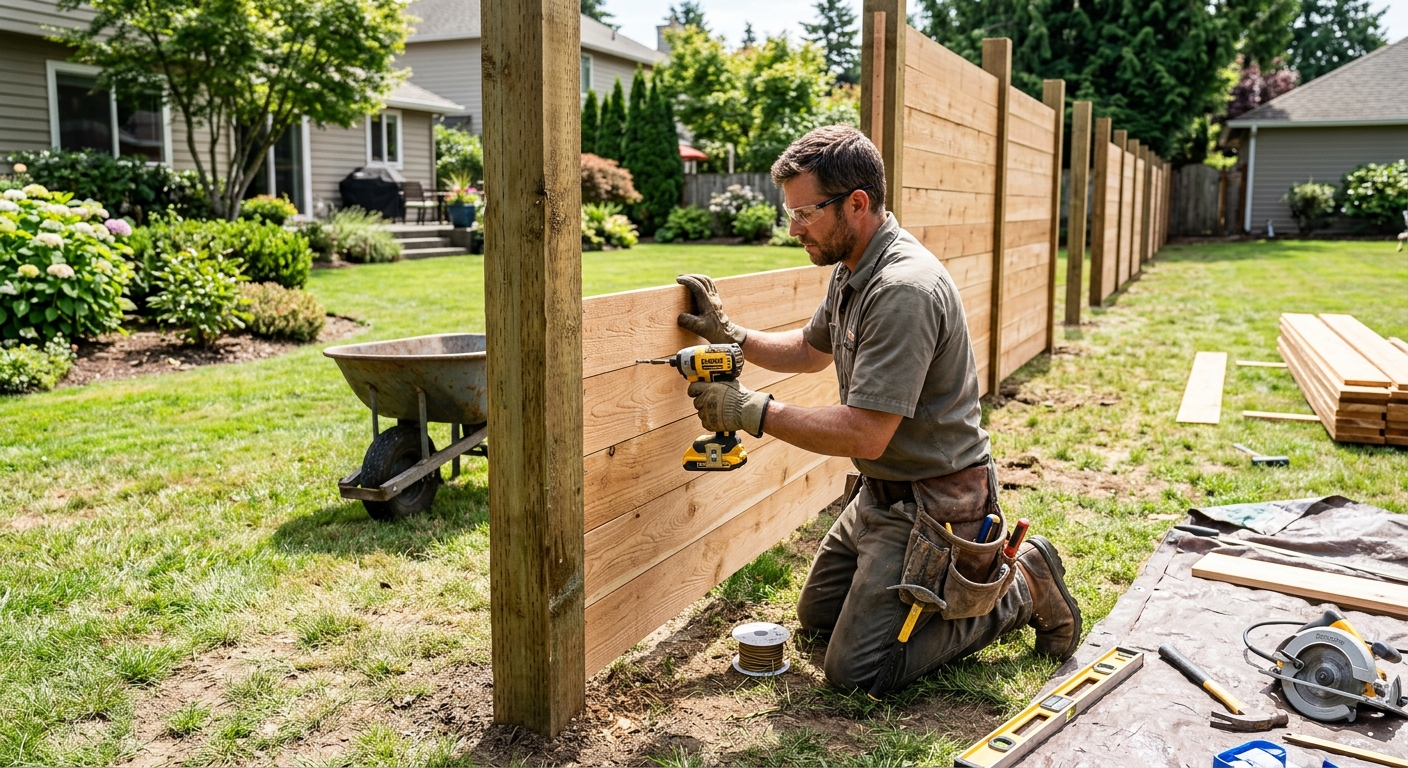
Fencing options and costs in Cove Cliff
Cove Cliff homeowners typically look at fencing as both a privacy upgrade and a property boundary safeguard. With a 2021 population of 1,778 in the area (Statistics Canada, 2021 Census), contractor schedules can feel busier in peak spring installs, so it’s smart to book early if you’re planning around landscaping season. Demand also tracks local housing patterns—each detached property can represent a new fence project, making fence work a recurring need in many Lower Mainland–Southwest neighbourhoods (Statistics Canada, 2021 Census).
Pricing in the Lower Mainland–Southwest is shaped by a mild but not trivial frost-and-wind reality. While coastal BC isn’t as deep-freeze as Ontario or Alberta, wetter Fraser Valley soils commonly mean deeper holes, more concrete at key posts, and extra labour for accurate set-backs and line work on uneven lots. Wind exposure matters here too: even “coastal” sites can experience gusty conditions that push crews toward stronger posts and tighter panel bracing, particularly for solid privacy designs.
If you’re in or near the more active residential pockets around the Cove Cliff waterfront-access areas, fence and gate replacements tend to be in higher demand because properties often face open winds and frequent weather exposure. The same style fence can price differently based on access (back-lane vs. front), slope, and finish height, so comparing materials side-by-side is the fastest way to understand what you’re actually paying for. Use the table below as a practical baseline before you request itemised quotes.
| Material |
Lifespan |
Maintenance |
Privacy Rating |
Price per Linear Foot |
| Pressure-treated pine (standard wood) |
10–15 years |
Stain/seal every 2–3 years |
Good (solid boards) |
$55–$95 |
| Cedar (natural rot resistance) |
15–25 years |
Light staining/sealing every 2–4 years |
Good to very good (solid styles) |
$70–$110 |
| Vinyl / PVC (no-maintenance) |
20–30 years |
Wash as needed |
Very good (solid privacy panels) |
$75–$130 |
| Chain-link (galvanized steel) |
20–40 years |
Occasional cleaning; check tension |
Low (visibility through mesh) |
$30–$55 |
| Aluminum ornamental |
25–40 years |
Wash as needed; inspect fittings |
Low to moderate (open pickets) |
$90–$170 |
| Composite / recycled material |
20–30 years |
Minimal; occasional rinse |
Good (if solid panels) |
$95–$160 |
Prices are estimates only and vary by project scope, site access and material selection.
What affects the price of fencing in Cove Cliff
For the same fence line, bids across the Lower Mainland–Southwest can swing by roughly 30–50% because contractors price for risk: soil conditions, access constraints, and how much labour is required to get posts plumb and set without future heaving. Material availability also plays a role—when crews need longer lead-time components (privacy panels, gate hardware, or specialty colours), the quote reflects that schedule and handling cost.
In Cove Cliff, frost protection is less severe than inland Canada, but posts still need to be set deeper than the bare minimum to reduce heaving. A practical rule contractors follow is drilling with holes that land about 4–6 inches (10–15 cm) below the design frost depth, then adjusting for wetter soil pockets. When you compare regions: in colder Ontario and Alberta, contractors often set posts 1.5–2.0 m into the ground and use concrete more consistently; in BC the frost depth is shallower, but deeper holes and more concrete at high-stress points (corners, gate posts, and certain privacy runs) are still common—especially in Fraser Valley-style soils.
Wind exposure can add cost too. More open lots and gusty edges often require tighter post spacing, heavier rails, or reinforced privacy framing. Coastal BC’s mild-but-wet weather also accelerates rot risk for untreated or lightly treated wood, which means better prep, faster drying, and proper staining details—labour that doesn’t show up in the “materials only” part of the estimate.
Concrete examples: (1) if your fence line crosses wetter ground, crews may switch from gravel packing to more concrete setting for stability; (2) a sloped driveway approach often needs stepped panels or a racked bottom rail; both take extra layout time. In budget planning, chain-link can land near the $30–$55 band, while vinyl privacy commonly moves into the $75–$130 band once gates and reinforced corners are included.
| Price Factor |
Why It Matters |
Cost Impact |
| Fence length in linear feet |
Most materials and labour scale directly with length |
Highest driver of total cost |
| Post depth required |
Frost line sets hole depth and post length to prevent heaving |
More depth = more concrete and longer posts |
| Post setting method |
Concrete vs. gravel pack vs. driven posts affects stability and downtime |
Concrete typically adds labour and material cost |
| Material choice |
Vinyl, cedar, and chain-link have different structural and install requirements |
Changes both parts price and installation labour |
| Gate count and type |
Gates require heavier hardware, framing, and alignment |
Each gate can add substantial cost vs. standard fence runs |
| Grade and terrain |
Sloped yards need stepped/raked panels and more layout time |
Typically increases labour |
| Old fence removal and disposal |
Existing posts, rot, and debris handling add work |
Can add cost even if the new materials are the same |
| Permit fees and survey / property line locate |
Verification avoids encroachment and ensures correct setbacks |
Often a small-to-medium cost but prevents costly redo |
Permits & regulations in British Columbia
In British Columbia, fence rules are typically tied to height thresholds and location on the property. In practice, many fences above a height threshold—often around 2.0 m (6.5 ft) for the rear and roughly 1.0–1.2 m (3–4 ft) for the front/corner—may require a building permit. Even when a permit isn’t required, all fencing must respect property lines and any municipal setback bylaws that apply in your area. In Cove Cliff, the practical step is to confirm the fence location on your lot before any post digging starts.
Before digging any post holes, you should call for utility locates (BC 1 Call). Then, confirm boundaries using a survey or by locating your property pins so you don’t end up building on or near an adjacent parcel. Shared fence ownership is addressed through provincial line-fences legislation, so if you’re replacing a shared boundary fence, clarify who owns which side and how costs and future repairs are handled.
Licence and insurance checks are homeowner best practice and should happen before the crew starts. To verify a contractor in British Columbia, look for: (1) a valid business/contractor listing in the relevant online registry for trades that apply to your scope, (2) a current certificate of liability insurance naming you as the certificate holder/ additional insured where appropriate, and (3) proof of worker coverage (WSIB/WCB coverage as applicable). Ask for the documents and verify dates match the installation window—don’t rely on “we’ll get it later.”
Choosing the right fence material for Cove Cliff
In Cove Cliff’s coastal climate, your best material choice is the one that matches your priorities while resisting moisture, wind, and the freeze-thaw stress that comes with spring weather. Pressure-treated pine is usually the budget-friendly path, but it demands staining or sealing every 2–3 years to avoid greying and board checking. Cedar looks great and naturally resists rot, yet it still benefits from periodic maintenance to keep colour and prolong surface life.
For low maintenance, vinyl/PVC stands out: it typically needs only rinsing, and it won’t rot like wood. The trade-off is cost—vinyl privacy often sits in the $75–$130 band in this region—plus extreme cold can make some plastics more brittle, so quality installation matters (proper expansion allowance and well-set posts). Chain-link is the lowest-cost long-life option, generally in the $30–$55 band, but it offers minimal privacy unless you add slats or a planted screen. Aluminum ornamental is attractive and won’t rust, but it usually provides low to moderate privacy due to open spacing and is commonly priced higher (often $90–$170) because of material and fabrication.
Post depth still matters in Lower Mainland–Southwest conditions. Even where frost is shallower than inland Canada, crews commonly set posts deeper than a “bare minimum” and use concrete at corners and gate posts for alignment and stability. Where wind load is higher—exposed lots or solid privacy panels—reinforcement and tighter bracing can justify the higher spend because it reduces wobble and premature rail failures.
Example: if a chain-link run comes in near the $30–$55 band but you later add privacy slats, the overall result often ends up costing less than vinyl but still changes airflow and tension requirements. If privacy is your goal and your line has a gate or corner-heavy layout, vinyl can be the more justified upgrade because it stays clean and consistent through wet winters.
| Material |
Cold Tolerance |
Lifespan |
Annual Maintenance |
Best For |
Price Band |
| Pressure-treated pine |
Good (with proper coatings) |
10–15 years |
Inspect and clean; plan stain/seal every 2–3 years |
Budget-conscious projects |
$55–$95 |
| Cedar |
Good |
15–25 years |
Clean; light stain/seal every 2–4 years |
Natural appearance with rot resistance |
$70–$110 |
| Vinyl / PVC |
Very good (avoid low-quality panels) |
20–30 years |
Wash as needed (typically 0–1 times/year) |
Low maintenance privacy and consistency |
$75–$130 |
| Chain-link |
Excellent |
20–40 years |
Occasional rinse; check tension after storms |
Security on a tight budget |
$30–$55 |
| Aluminum ornamental |
Very good |
25–40 years |
Wash as needed; inspect fittings |
Decorative boundaries with durability |
$90–$170 |
| Composite / recycled |
Good |
20–30 years |
Minimal; rinse to remove algae/mildew |
Clean modern look with low upkeep |
$95–$160 |
How to choose a fencing contractor in Cove Cliff
Start by verifying that your fencing contractor in British Columbia can actually back the job. For licensing, check the contractor’s business registration details and confirm they’re properly set up for the specific work they’ll perform. Ask for a certificate of liability insurance and verify the policy covers property damage and bodily injury, with coverage active during your installation window; you can also request you be added as a certificate holder or additional insured where feasible. For worker coverage, request proof of WSIB/WCB coverage (as applicable) so you’re not left paying if a worker is injured on your property.
Get 2–3 itemised written quotes. You want labour and materials broken out (posts, rails, panels, hardware, concrete, gate frames, and any special bracing), not just a single lump sum. Read the scope: is permit handling included (if required), is old fence removal and dump/disposal included, and what exactly counts as “fence line” versus clearing or backfill? Confirm the method for post holes and setting (concrete vs gravel pack) so you can compare apples to apples.
Warranty matters. Ask for the workmanship warranty length, and separate it from product/manufacturer warranties. If something fails, is the warranty transferable if you sell the home? Payment schedules should protect you: never pay more than 10–15% upfront, and hold back a portion until you’re satisfied with completion, cleanliness, and hardware alignment. Finally, require a written start date and a completion estimate, including what weather delays are allowed in the schedule—BC weather can shift quickly around spring rain and wind.
- Request itemised quotes with separate line items for materials, labour, gates, concrete, and disposal.
- Confirm post-setting method (concrete at corners/gates, and depth targets) in writing.
- Ask how they handle sloped yards (stepped vs raked panels) and who measures the grade.
- Verify liability insurance is current and request a certificate copy before work starts.
- Verify WSIB/WCB coverage proof for their workers (as applicable) before the first day on site.
- Check the permit approach: whether they pull it, or if it’s your responsibility (and who pays).
- Clarify property line confirmation: survey/locate pins used or boundary assumed.
- Ensure gate hardware and hinges are specified (number of hinges, gate latch type, adjustable stops).
- Confirm warranty terms: workmanship duration, manufacturer warranty duration, and who covers what.
- Require a payment schedule with 10–15% maximum upfront and holdback after completion.
- Get an estimated timeline and what weather conditions can pause the schedule.
- Ask for a site protection plan (driveway mats, soil protection, and cleanup standards).
Red flags to watch for in Cove Cliff: (1) a quote that’s “too good to be true” and doesn’t specify post depth or setting method; (2) promises to “handle permits” without stating whether they’re included in the price; (3) refusal to provide insurance/WSIB-WCB paperwork; (4) lump-sum pricing with no gate hardware details; and (5) asking for most of the payment upfront before materials are on site.
Frequently asked questions — fencing in Cove Cliff
What's the most low-maintenance fence?
In Cove Cliff and the broader Lower Mainland–Southwest area, vinyl/PVC is usually the most low-maintenance choice because it doesn’t rot or require annual sealing like wood. Typical homeowner upkeep is mostly rinsing or washing off coastal grime and checking that hardware stays tight after windy weather. If you want a wood look without frequent re-staining, cedar still needs periodic maintenance to protect the surface, but it’s generally easier on appearance over time than standard pine. Chain-link is also very low-maintenance mechanically, but it won’t give privacy unless you add slats or plant screens. Pricing-wise, vinyl privacy commonly lands in the $75–$130 band installed in this region, while pressure-treated pine is often closer to the $55–$95 band—so the higher upfront cost is often what you’re paying for convenience.
How tall can my fence be in Cove Cliff?
Fence height limits in British Columbia usually depend on location (front/corner vs rear) and whether the fence triggers a permit requirement. A common approach is that fences over about 2.0 m (6.5 ft) at the rear and around 1.0–1.2 m (3–4 ft) at the front or corner often require a building permit, but the exact requirements can follow local bylaws. In Cove Cliff, the best move is to confirm where your fence sits relative to property line and setbacks before ordering materials, especially if you want a solid privacy style. If your plan is a tall privacy fence in the front yard or at a corner, expect extra review and more paperwork. A reputable contractor will ask for your target height and then outline whether a permit is likely required.
Should fence posts be set in concrete here?
Often, yes—at least at key structural points. In the Lower Mainland–Southwest, posts still need stable embedment to limit heaving from seasonal ground movement, and wet soils can make simple gravel packing less consistent. Many contractors set corners and gate posts in concrete for alignment and long-term rigidity, and they may also use concrete for privacy runs where wind load is higher. You may not always need concrete for every single post the same way across the entire line, but the quote should specify the method clearly rather than leaving it vague. When contractors omit concrete without explaining their stability approach, you can end up with leaning or loose rails after heavy rain or freeze-thaw cycles. For accuracy, confirm post depth targets and setting method in writing in your Cove Cliff estimate.
What's the best fence for privacy?
For privacy in Cove Cliff, solid-panel designs typically perform best, and vinyl/PVC privacy is a common top pick because it resists rot and maintains a consistent look through wet winters. Cedar also provides strong privacy with a natural appearance, but you should budget for maintenance every few years to keep it looking sharp. Pressure-treated pine can deliver good privacy at a mid-range price, often aligning with the $55–$95 band installed depending on height, line length, and how many gates/corners you have. Chain-link is usually the least private option unless you add slats or pair it with fast-growing screening plants, which can change the wind behaviour and require thoughtful tensioning. If privacy is your priority, ensure the contractor specifies solid board density, post spacing/bracing, and gate construction quality—not just the material label.
How do I compare fencing quotes?
To compare quotes fairly in British Columbia (including Cove Cliff), focus on like-for-like scope. Ask each contractor for an itemised breakdown: linear footage, post spacing, post depth/set method, concrete quantity (if used), rail count/size, gate type and hardware, and whether old fence removal and disposal are included. Ensure permit pull responsibility is clear if your design is above typical thresholds. Check that warranties are written separately for workmanship versus product. Price is important, but avoid comparing only the bottom line—two quotes that both reference the “vinyl band” (often $75–$130 installed) can still differ massively if one includes reinforced corners, a heavy gate frame, or concrete setting. Finally, confirm the site plan: how they measure the line, handle slope (stepped vs raked), and protect your driveway/landscaping during install.
How long does fence installation take in Cove Cliff?
Typical fence install time in Cove Cliff depends on length, number of gates, site access, and whether the crew is removing an old fence. For a typical residential run, crews often complete a straightforward replacement in a day to a few days, but wet ground conditions can slow post-hole drilling and alignment. If your fence requires a lot of concrete setting, more layout steps for slope, or reinforced corners and a double drive gate, timeline can extend—especially if access requires moving materials through a narrow side yard. If permits are required (often for taller fences), planning time is separate from installation time, so ask for the schedule in writing. The most helpful quote will provide a start date, a completion estimate, and what weather delays they account for in the Lower Mainland–Southwest.