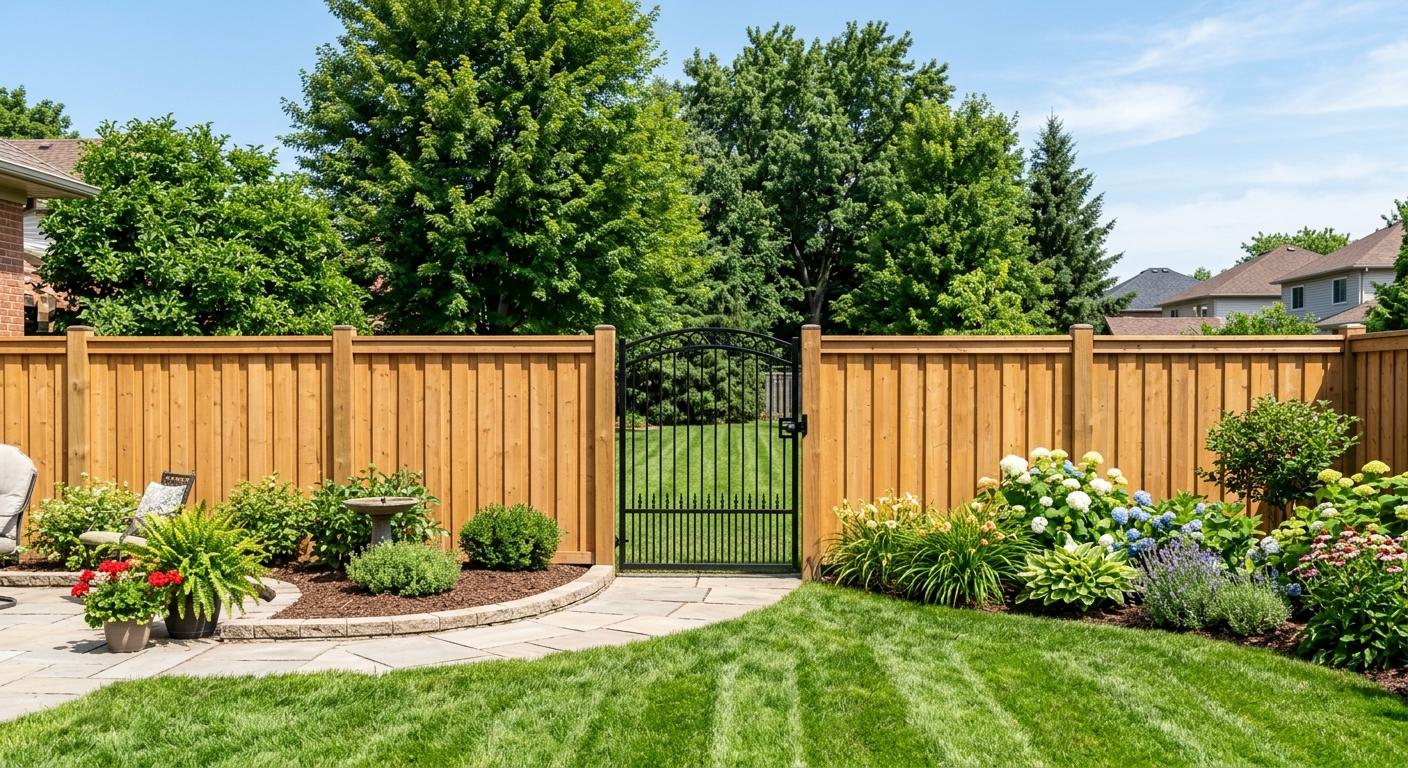
Fencing options and costs in Ladner
Ladner homeowners typically start their fencing search with one goal in mind—privacy, pets, or curb appeal—and then they compare materials and installed costs. With a population of 23,016 (Statistics Canada, 2021 Census), Ladner is busy enough that you’ll usually find multiple contractor crews in the Lower Mainland–Southwest, but pricing still reflects job complexity. The local housing mix (many detached properties are common throughout the area) creates steady demand for backyard and side-yard fencing, particularly around neighbourhoods where lots tend to have longer fenced perimeters.
In the Lower Mainland–Southwest, mild winters don’t eliminate frost and wind. Posts still need to be set below the local frost influence to reduce heaving, and Fraser Valley–type soils can be wet enough that crews plan for deeper holes, concrete setting on key posts, and more labour time than a dry, easy site. Access also matters: narrow lanes, mature landscaping, and vehicle parking restrictions can add install time even when the fence length is modest.
Where fencing is especially in demand, many residents in areas like Tsawwassen and central Ladner rely on boundary fencing for kids, pets, and wind management on open plots. If you’re replacing an older fence or adding a gate, that mix can move the job into the mid-to-upper part of the regional price bands.
Use the table below to compare typical longevity, maintenance, and installed pricing—then we’ll break down what pushes quotes higher or lower for Ladner projects.
| Material |
Lifespan |
Maintenance |
Privacy Rating |
Price per Linear Foot |
| Pressure-treated pine (standard wood) |
10–15 years |
Stain/seal every 2–3 years |
High |
$55 – $95 |
| Cedar (natural rot resistance) |
15–25 years |
Light stain/seal as needed (typically every 3–4 years) |
High |
$75 – $120 |
| Vinyl / PVC (no-maintenance) |
20–30 years |
Rinse as needed; avoid impacts |
High |
$75 – $130 |
| Chain-link (galvanized steel) |
20–35 years |
Minimal; occasional rust checks |
Low–Medium |
$30 – $55 |
| Aluminum ornamental |
25–40 years |
Wash occasionally; inspect fittings |
Medium |
$90 – $170 |
| Composite / recycled material |
20–30 years |
Low; clean debris buildup |
High |
$95 – $160 |
Prices are estimates only and vary by project scope, site access and material selection.
What affects the price of fencing in Ladner
In Ladner and across the Lower Mainland–Southwest, two quotes for the “same” fence can differ by 30–50% because the hidden variables change the labour hours and the materials you actually need. Even when the fence height and style match, post quantities, embedment depth, extra bracing for wind, gate framing, and the time spent on demolition and disposal can all move the total dramatically. This is also why the regional pricing can still sit higher than a simple online calculator: wet soil conditions and access constraints are common along the Lower Mainland.
One of the biggest drivers is frost influence. Coastal BC can be shallower than Ontario or Alberta, but contractors typically set posts deeper than the bare minimum—often roughly 4–6 inches below the design frost influence—so posts resist heaving. In colder inland regions, that can translate to 1.5–2.0 m embedment, requiring longer posts and concrete setting; the same principle applies in Ladner, just usually with shorter depth requirements, deeper holes still being common for wet sites. If your yard is damp and the hole walls don’t hold, crews may switch from gravel packing to full concrete for key posts, which raises cost.
Cost also depends on wind exposure. While the Prairies see more extreme gust loads, Lower Mainland–Southwest homes can still experience strong wind on open lots, so solid wood and vinyl privacy panels often need tighter post spacing and reinforced rails. A third local factor is moisture: the mild but wet conditions here accelerate wood weathering and rot if the wrong treatment or maintenance schedule is chosen.
Concrete examples: (1) if your fence replaces a failing section, removal and disposal can add a day, especially with old concrete footings; (2) if the grade is soft and wet, crews spend more time stabilizing holes and curing concrete before rails go on; (3) if you need corner and gate posts set in concrete for strength, that adds materials and labour even for mid-range projects. As a result, a modest wood installation can land near the $55–$95 band, while privacy-focused vinyl often moves toward the $75–$130 band once gates and reinforced posts are included.
| Price Factor |
Why It Matters |
Cost Impact |
| Fence length in linear feet |
The more runs you have, the more posts, rails, and panels (and labour time) you need. |
Highest impact |
| Post depth required |
Post embedment affects resistance to heaving and ensures stability in damp soils. |
Medium–High |
| Post setting method |
Concrete vs. gravel pack vs. driven posts changes both material and install time. |
Medium–High |
| Material choice |
Vinyl/cedar cost more than chain-link, and metal/aluminum can include fabrication and hardware. |
High (for premium materials) |
| Gate count and type |
Double drive-through gates and self-closing hardware require stronger framing. |
High |
| Grade and terrain |
Sloped yards require stepped or raked panels and extra layout time. |
Medium |
| Old fence removal and disposal |
Hauling, deconstructing, and dealing with old post bases can add a full day. |
Medium |
| Permit fees and survey / property line locate |
Locates prevent encroachment issues; permits can add lead time and administrative costs. |
Low–Medium |
Permits & regulations in British Columbia
In British Columbia, fence rules are driven by local bylaw requirements and—when you go taller—permit thresholds. As a homeowner in Ladner, you’ll want to assume that fences above a height threshold (commonly around 2.0 m, or about 6.5 ft, at the rear and roughly 1.0–1.2 m, or 3–4 ft, at the front or corner) often require a building permit. Even when a fence is below the threshold, it must still respect property lines and municipal setback bylaws.
Before any digging, always arrange utility locates. In BC, homeowners and contractors typically use BC 1 Call to mark buried services so crews can trench and set posts safely. Also consider getting a survey or at least a property line locate from your pins before installing—boundary disputes are expensive, particularly when a new fence is already framed.
Shared fence ownership generally follows provincial line-fences legislation, which matters when your project touches a neighbour’s boundary or requires decisions on repair vs. replacement. Practically, your contractor should coordinate placement and document the layout so you can show how the fence was set relative to the property line.
Licence and compliance checks should be part of your process: ask for their British Columbia licence details, a current certificate of insurance showing liability coverage, and proof of worker coverage (Workers’ compensation clearance/coverage, typically via WCB). You can verify with the contractor’s online listings/registry presence and review the dates and coverage amounts directly on the insurance certificate; insist that the clearance document aligns with the project timeframe.
Choosing the right fence material for Ladner
Choosing a fence material in Ladner is mostly about matching your priorities—privacy, low maintenance, lifespan, and upfront budget—to Lower Mainland–Southwest climate realities. The region’s frost influence is not “zero,” and moisture levels are high enough that wood needs correct treatment and ongoing care. If you want dependable privacy, you’ll usually land on pressure-treated pine, cedar, vinyl/PVC, or composite—while chain-link and aluminum ornamental typically prioritize boundary definition over privacy.
Pressure-treated pine is the budget-friendly route, but it needs staining or sealing every 2–3 years to prevent grey weathering and to slow surface splitting. Cedar looks better longer and has natural rot resistance, but it still benefits from periodic staining/sealing to maintain appearance and reduce moisture uptake. Vinyl/PVC is popular for low maintenance: you typically rinse it, and it won’t rot, but extreme cold impacts can cause cracking if panels are stressed; good post spacing and reinforced corner/gate framing helps. Chain-link has the longest life per dollar, but it offers low privacy unless you add screening. Aluminum ornamental won’t rust, stays attractive, and suits wind-exposed lots, though it provides medium privacy at best.
For post-depth, contractors in the Lower Mainland–Southwest still often set below the frost influence and frequently use concrete setting for privacy corners, fence ends, and gate posts to prevent wobble and gate sag. In wet yards, concrete can also provide stability when soil doesn’t hold cleanly. Wind and snow load aren’t as severe as some Prairie regions, but sagging rails and loose posts are common failure points—especially on long runs—so proper embedment and alignment matter more than many homeowners expect.
Example: if a comparable 6-foot privacy run comes in near $85 per linear foot for pressure-treated wood but vinyl lands closer to the $120 per linear foot range, the price difference can be justified when you want to avoid repeat staining and reduce long-term labour and material costs—particularly if you don’t want to manage upkeep schedules.
| Material |
Cold Tolerance |
Lifespan |
Annual Maintenance |
Best For |
Price Band |
| Pressure-treated pine |
Good with proper treatment and regular sealing |
10–15 years |
Low–Moderate (stain/seal every 2–3 years) |
Budget privacy with a maintenance plan |
$55 – $95 |
| Cedar |
Good; resists rot better than many softwoods |
15–25 years |
Low–Moderate (typically every 3–4 years) |
Attractive privacy in a damp coastal environment |
$75 – $120 |
| Vinyl / PVC |
Good; avoid panel stress and impact damage |
20–30 years |
Very Low (rinse as needed) |
Low maintenance privacy |
$75 – $130 |
| Chain-link |
Very good; galvanized steel holds up to cold |
20–35 years |
Low (inspect tension and coating) |
Security and pet containment without privacy needs |
$30 – $55 |
| Aluminum ornamental |
Excellent; resists rust and corrosion |
25–40 years |
Low (wash and inspect fittings) |
Ornamental curb appeal and wind tolerance |
$90 – $170 |
| Composite / recycled |
Good; performance depends on correct installation |
20–30 years |
Low (clean debris; check fasteners) |
Privacy with reduced upkeep |
$95 – $160 |
How to choose a fencing contractor in Ladner
Choosing the right contractor in Ladner starts with verification, because a fence is only as good as the embedment, spacing, and hardware used on site. First, confirm the contractor has the appropriate British Columbia licence for their work (where applicable to the trade/business structure) and request a current certificate of liability insurance. For worker coverage, ask for their WSIB/WCB coverage clearance document (in BC, this is typically handled through WCB documentation rather than WSIB wording). Don’t just accept “yes”—look at the issue date and coverage amounts on the certificate of insurance, and confirm the clearance is valid for the period the fence will be built.
Next, get 2–3 itemised written quotes. Each quote should separate labour from materials and should list what’s included: fence supply, post depth/embedment method, rail/bracing details, gate fabrication, concrete setting quantities, and disposal of the removed fence. Avoid lump-sum quotes that don’t show assumptions—ask whether the price includes permit pulls (if needed), property line locating/survey support, and utility locate coordination.
Warranty matters too. Require clarity on workmanship warranty length (not just product warranty), whether it covers posts, rails, and gates, and if the manufacturer warranty is transferable if you sell the home. For payment, a safe guideline is never paying more than 10–15% upfront; hold back a meaningful portion until the job is complete and inspected. Finally, request a firm start date and a completion estimate in writing, including weather contingencies common to Lower Mainland–Southwest schedules.
- Ask for BC licence/business information and verify it matches the company name on the quote.
- Review liability insurance: certificate holder, policy dates, and adequate coverage for fencing work.
- Request WCB worker coverage clearance (valid dates) and confirm it covers the crew scheduled.
- Insist on itemised quoting: posts, rails, panels/slats, gates, concrete, and hardware listed separately.
- Confirm embedment method and expected post depth relative to frost influence and your soil conditions.
- Ask who pulls permits (if required) and whether permit fees are included or billed separately.
- Confirm utility locate responsibility and whether they coordinate BC 1 Call markings before digging.
- Verify property line approach: survey/locate assumption and how they mark boundaries on site.
- Check removal/disposal scope: do they haul old fencing and how is concrete/footing handled?
- Ask about gate hardware: self-closing, latch type, hinges, and reinforcement for double gates.
- Get warranty details in writing: workmanship, product warranty, and what voids coverage.
- Set payment terms in writing: keep upfront at 10–15% max and hold a completion holdback.
Red flags to watch for: (1) “We’ll figure out the property line later” without a locate/survey plan; (2) quotes that don’t specify post depth or setting method in wet soil; (3) refusal to provide insurance certificate or WCB clearance; (4) lump-sum pricing with no gate or removal/disposal scope; and (5) starting work without scheduling utility locates, especially in established Ladner neighbourhoods where buried services are common.
Frequently asked questions — fencing in Ladner
What's the best fence for privacy?
For privacy in Ladner, the best balance of appearance and long-term performance is usually a solid privacy design using vinyl/PVC or cedar, or pressure-treated pine if you’re comfortable with regular upkeep. In the Lower Mainland–Southwest, moisture and wind mean that proper post spacing and reinforced corner and gate posts are what prevent the fence from becoming wavy over time. If you want low maintenance, vinyl/PVC privacy fencing commonly fits the $75–$130 installed price band, while cedar privacy is often a step higher depending on board thickness and gate complexity. If you’re on a tighter budget and can commit to staining, pressure-treated pine typically lands closer to the $55–$95 band. Whichever you choose, ask the contractor how they’ll set end posts and gate posts (often concrete for stability) and whether they’ll adjust the layout for your property grade.
How do I compare fencing quotes?
When comparing quotes in British Columbia, don’t just look at the total—compare what’s included. Ask each contractor to provide an itemised breakdown covering labour vs. materials, number of posts, post depth/embedment method, rail/bracing style, and the exact gate hardware. For Ladner’s wet-soil conditions, confirm whether they use gravel packing or concrete setting for corners and gates, and whether they account for deeper holes where soil is soft. Also check disposal: removal and haul-away of your old fence can change the price materially. Finally, clarify permit and locate responsibilities—if your fence is near common height thresholds, you may need a permit, and you’ll need BC 1 Call utility marking before any digging. Good quotes usually align with regional bands like $30–$55 for chain-link, $55–$95 for wood, and $75–$130 for vinyl/PVC.
How long does fence installation take in Ladner?
Most residential fence installs in Ladner take anywhere from 1 to 4 days, depending on length, site access, and whether you’re removing an old fence. A straightforward run with easy access, minimal slope, and no major gate work can be completed quickly, while longer privacy projects with multiple gates often take additional time for layout, setting posts, reinforcement, and final alignment. Weather matters too: the Lower Mainland–Southwest can shift from wet to firm ground within days, and crews may pause to ensure concrete setting is stable before rails go on. If permit approval or property line locating is required, your timeline may also extend due to lead times. A contractor who gives you a start date and a completion estimate in writing is usually better positioned to coordinate these variables.
Can I install a fence on a slope in Ladner?
Yes—fences can absolutely be installed on slopes in Ladner, but how they’re installed affects cost and long-term performance. Contractors typically use either stepped panels (stair-step layout) or raked panels (consistent rail slope) depending on the fence style and how level you want the top. Privacy fences often look best with stepped sections, though it requires careful layout so spacing and pickets/boards remain consistent. Sloped yards also increase measurement and layout time, and you may see higher cost compared with a flat run even if the linear footage is the same. Ask your contractor how they’ll handle grade transitions near gates and corners, because uneven stress can make gates sag or latch poorly over time. A thorough quote should reflect slope work rather than treating it as an identical install to a flat lot.
What is the most weather-resistant fence for Ladner's climate?
For Ladner’s mild but wet coastal climate, weather resistance usually points to materials that don’t rely on wood for structural longevity. Vinyl/PVC and aluminum are strong options because they resist rot and corrosion, and properly installed vinyl can maintain appearance with minimal maintenance. Cedar can also perform very well thanks to rot resistance, but it still benefits from staining/sealing to protect exposed surfaces. Pressure-treated pine can be durable if maintained, but it’s more likely to grey, warp, or split when upkeep is skipped. Chain-link is often the longest-lasting low-maintenance choice, though it won’t provide privacy. In terms of typical costs, vinyl/PVC privacy often falls in the $75–$130 band, while chain-link commonly sits around the $30–$55 band. “Most weather-resistant” ultimately depends on correct post depth and setting method for your soil, not just the material label.
How do I prevent wood fence rot in Ladner?
Preventing wood rot in British Columbia comes down to three things: material quality, installation details, and maintenance timing. First, use properly pressure-treated lumber that’s intended for ground contact where required, and don’t allow untreated wood to contact soil. Second, insist on correct post embedment—contractors usually set posts below the local frost influence and often use concrete for corner and gate posts so the fence remains stable even in wet ground. Stability reduces racking, which creates gaps that trap moisture. Third, keep up with sealing or staining: pressure-treated pine commonly needs attention every 2–3 years, while cedar typically needs lighter maintenance every 3–4 years depending on sun exposure and sprinkler overspray. Finally, check bottom rails and pickets after heavy rain—if you notice standing water, poor drainage, or fastener rust, address it early to stop rot from starting behind boards.