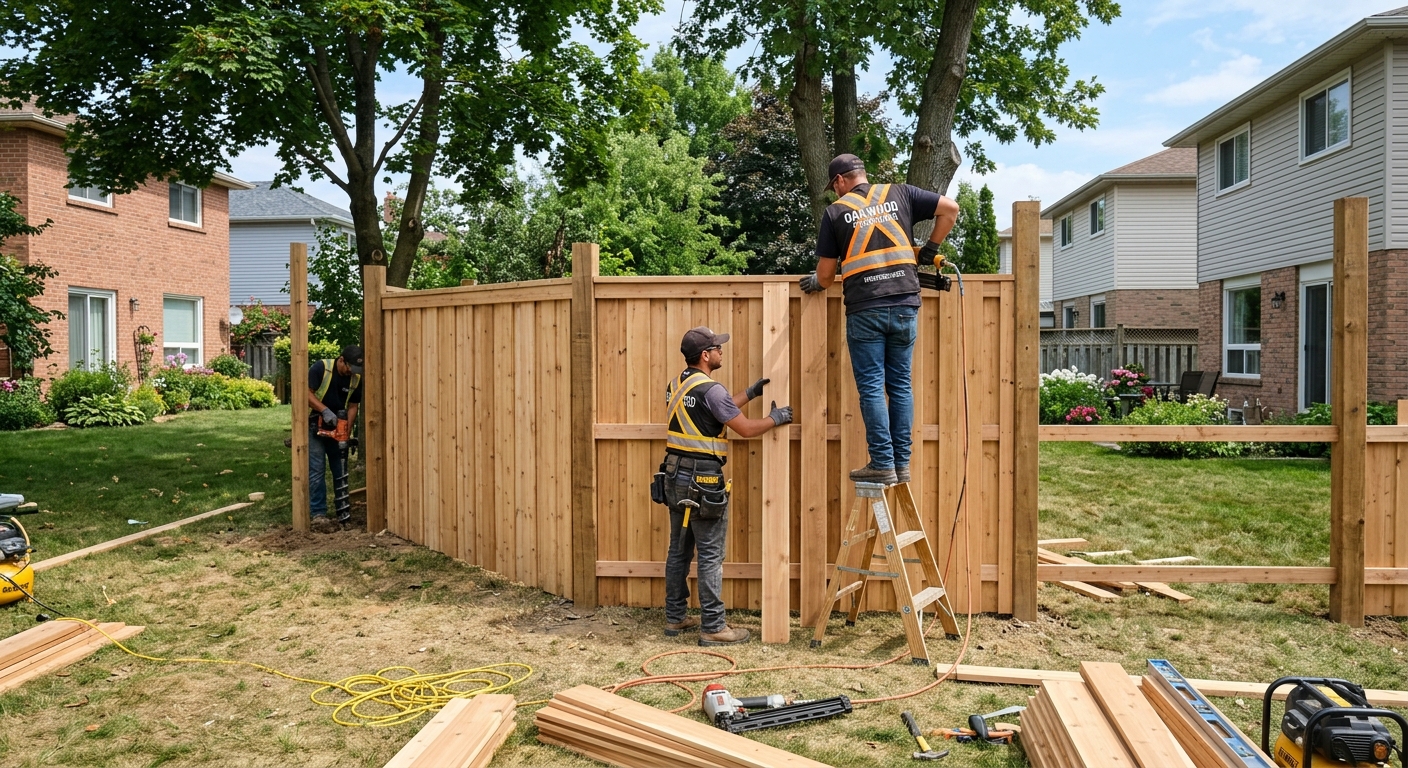
Fencing options and costs in Harewood
In Harewood, fencing is a practical upgrade and a curb-appeal investment, especially for the many homeowners who manage outdoor space season after season. With a 2021 population of 8,769 (Statistics Canada, 2021 Census), demand is steady, and each detached home along key streets becomes a potential project once privacy, pets, or yard separation become priorities. In the Lower Mainland–Southwest, mild winters don’t eliminate frost—wind and wet soils still mean contractors plan for post stability, and deeper holes plus concrete setting are common where ground holds water. That combination usually pushes real-world pricing above the absolute “low end” of the material bands.
Crews in the area are busiest around the neighbourhood of Central Harewood, where lots are commonly bordered by hedges, older tree lines, and established fences that may need replacement or re-alignment. Accessibility also affects cost here: many properties have landscaping, narrow gate paths, or mature roots, so labour hours for careful demolition and hole excavation can add up. If you’re replacing a solid privacy run with a wind-friendly design, expect a different material cost structure and sometimes different post spacing.
Below is a practical comparison of common fence materials and what they typically cost installed in this tier, so you can translate quotes into apples-to-apples decisions before you talk to a contractor.
| Material |
Lifespan |
Maintenance |
Privacy Rating |
Price per Linear Foot |
| Pressure-treated pine (standard wood) |
10–20 years |
Stain/seal every 2–3 years; inspect posts and rails annually |
High (solid boards) |
$55–$95 |
| Cedar (natural rot resistance) |
20–30 years |
Still benefits from staining every 3–4 years; clean debris from bottom rails |
High (solid or close-spaced pickets) |
$70–$115 |
| Vinyl / PVC (no-maintenance) |
20–35 years |
Wash only; check posts and hardware after storms |
High (solid privacy panels) |
$75–$130 |
| Chain-link (galvanized steel) |
25–40 years |
Occasional rinse; tension checks for gates |
Low (open mesh) |
$30–$55 |
| Aluminum ornamental |
25–40 years |
Rinse annually; touch-up if damaged |
Medium (semi-privacy) |
$90–$170 |
| Composite / recycled material |
20–30 years |
Low; periodic washing; check for warping near ground contact |
High (solid boards) |
$85–$140 |
Prices are estimates only and vary by project scope, site access and material selection.
What affects the price of fencing in Harewood
In Harewood and across the Lower Mainland–Southwest, two homeowners can receive bids that differ by 30–50% for the “same” fence length because the quote is really built on site conditions and construction details. That gap is common in British Columbia due to labour availability, the amount of post excavation required in wetter soils, and how contractors handle frost protection, wind loading, and old-fence removal. For example, a straight run with easy access may land near the wood band of $55–$95 per linear foot, while a privacy fence with concrete-set corner/gate posts and careful step grading can push closer to the vinyl band of $75–$130 depending on materials.
Frost line depth is one of the biggest hidden drivers. In cold conditions, posts must be set well below the design frost depth to limit heaving—guidance commonly targets about 4–6 inches below the design frost depth, which often means “bare minimum” isn’t used. While BC’s coastal frost is typically shallower than the Prairies, Lower Mainland–Southwest wet soils often require deeper holes than you’d expect, plus concrete setting for stability in privacy panels and for heavier gate hardware.
Wind exposure also matters: open sites and exposed corners can require stronger posts, tighter spacing, or reinforced panel designs. Coastal BC’s mild but wet climate can accelerate rot for untreated wood, increasing maintenance and affecting whether concrete setting is needed at the bottom of rails.
Concrete examples in Harewood that raise or lower cost: (1) if your yard drains poorly and the soil becomes soft after winter rains, excavations take longer and holes may require more concrete to stabilize posts; (2) if you have mature roots or a narrow side yard, crews may spend extra time hand-digging around obstacles; (3) if you’re swapping an old chain-link run with a solid privacy fence, the change in bracing and gate strength usually adds labour even when the measured length is similar.
| Price Factor |
Why It Matters |
Cost Impact |
| Fence length in linear feet — the primary cost driver |
More panels and posts means more materials and labour hours |
Directly increases the total; often the largest swing |
| Post depth required — frost line determines post length and hole depth |
Deeper holes reduce heaving risk and stabilize posts in wet soils |
Higher labour + longer posts; may require more concrete |
| Post setting method — concrete vs. gravel pack vs. driven posts |
Wet or unstable ground typically needs more rigid setting for gates/privacy |
Concrete setting usually costs more but improves longevity |
| Material choice — vinyl vs. cedar vs. chain-link |
Materials differ in structural requirements and expected service life |
Vinyl and cedar typically cost more than chain-link and standard pine |
| Gate count and type — walk-through vs. drive-through (double) |
Gates require stronger frames, more bracing, and different hardware |
One gate can add noticeable cost; double driveway gates add more |
| Grade and terrain — sloped yards require stepped or raked panels |
Uneven grades add layout time and additional labour for alignment |
Often adds 5–20% depending on slope complexity |
| Old fence removal and disposal |
Demolition, hauling, and dump fees affect total cost |
Can add significant labour and disposal expense |
| Permit fees and survey / property line locate |
Regulatory steps prevent encroachment and ensure compliant placement |
Typically minor to moderate, but crucial for accuracy |
Permits & regulations in British Columbia
In British Columbia, fences above a height threshold—often around 2.0 m (6.5 ft) at the rear and 1.0–1.2 m (3–4 ft) at the front or corner—may require a building permit, depending on your exact location and how the fence is classified by municipal rules. In Harewood, you also need to respect property lines and any municipal setback bylaws that apply to your address. The key practical step: before digging post holes, you must have underground utilities located through the appropriate utility locate service (BC 1 Call). For peace of mind, many homeowners also confirm boundaries by obtaining a survey or having property pins located before installation, especially if you’re replacing an older fence that may have shifted over time.
Shared fence ownership and responsibilities are commonly guided by provincial line-fences legislation, so confirm which side you share with a neighbour and whether your fence is considered a shared boundary. Work that typically does require a permit: installing a taller fence that crosses the height threshold (and in some cases, structural features like privacy walls). Work that typically does not require a permit: like-for-like fence replacements under the applicable height threshold, assuming setbacks and property lines are unchanged.
To verify your contractor in Harewood, ask for proof before work starts: (1) a copy of their BC business licence/registration where applicable and confirm they’re in good standing using the appropriate online business registry; (2) liability insurance certificate showing coverage amounts and your address/job referenced; (3) proof of coverage under workers’ compensation (WSIB/WCB equivalent coverage in BC) by requesting an insurance clearance letter or current proof of coverage. If they can’t provide certificates promptly, treat it as a major red flag.
Choosing the right fence material for Harewood
Choosing the right fence material in Harewood comes down to matching your priorities—privacy, low maintenance, budget, and lifespan—to the realities of the Lower Mainland–Southwest climate: wet soils, freeze-thaw cycles, and coastal winds that can stress posts and rails. Pressure-treated pine is the budget-friendly option, but it typically needs staining every 2–3 years to reduce grey weathering and protect the top surface and rail edges. Cedar offers better natural rot resistance and a warmer look; it still benefits from periodic staining to keep it from drying out and turning patchy. Vinyl/PVC is the low-maintenance choice because it doesn’t need painting or staining; however, in extreme cold snaps it can become more brittle, so proper spacing and hardware installation matter. Chain-link delivers the longest life for the lowest upfront cost, but it’s not a privacy solution on its own unless you add slats, screening, or landscaping. Aluminum ornamental looks sharp, won’t rust, and handles wet air well, but it provides less privacy by design.
For post depth in this region, contractors generally plan around frost protection and wet ground stability rather than assuming “coastal means shallow.” Concrete-set posts are common for corner posts, privacy runs, and especially gate posts because the hardware loads are higher. Wind and snow load effects show up as panel movement risk—so solid privacy panels usually call for stronger bracing and more careful alignment.
A concrete cost example: if you choose chain-link at the $30–$55 per linear foot band for a back boundary, you’ll save heavily upfront, but you may spend later on privacy add-ons. If you upgrade to wood or cedar in the mid-range, the added privacy and reduced need for supplementary screening can justify spending closer to the $55–$95 band—especially for families who use the yard year-round.
| Material |
Cold Tolerance |
Lifespan |
Annual Maintenance |
Best For |
Price Band |
| Pressure-treated pine |
Good when stained and sealed; protect cut ends |
10–20 years |
Light inspection; stain/seal every 2–3 years |
Budget-conscious privacy with planned upkeep |
$55–$95 |
| Cedar |
Good; stable in wet coastal air when kept maintained |
20–30 years |
Inspect; stain/clean every 3–4 years |
Natural look and better rot resistance |
$70–$115 |
| Vinyl / PVC |
Moderate; proper installation prevents brittleness issues |
20–35 years |
Wash/inspect hardware; usually no staining |
Low-maintenance privacy and clean appearance |
$75–$130 |
| Chain-link |
Good; galvanized steel resists corrosion |
25–40 years |
Occasional rinse; check tension and posts |
Security and long service life on a budget |
$30–$55 |
| Aluminum ornamental |
Good; no rust in wet climates |
25–40 years |
Rinse annually; inspect for dents and alignment |
Front yard curb appeal with semi-visibility |
$90–$170 |
| Composite / recycled |
Good; still needs good bottom clearance from soil |
20–30 years |
Low; wash as needed; check for warping near ground |
Solid fencing with less upkeep |
$85–$140 |
How to choose a fencing contractor in Harewood
Choosing the right fencing contractor in Harewood starts with proof they can legally and safely run the job. In British Columbia, confirm they carry liability insurance by requesting a certificate of insurance that lists your property/job and shows coverage limits. For workers’ compensation, ask for proof of current coverage (BC WCB clearance/proof of registration, often provided as a clearance letter or insurance document). Licensing/registration expectations vary by business type, but you can still verify legitimacy by checking the contractor’s business registry information and looking for consistent, professional contact details.
Next, collect 2–3 itemised written quotes, ideally with a labour + materials breakdown rather than a single lump sum. The best quotes list measured linear footage, number of posts, post spacing, gate count, setting method (concrete vs. gravel pack), and the specific fence system (board size, thickness, picket spacing, panel height). Read the exclusions: ask whether permit pulls are included if a permit is needed, whether old fence removal and disposal are included, and whether site restoration (topsoil/seed or sod touch-ups) is part of the scope.
Warranty matters: request the workmanship warranty length (how long they stand behind installation) and the product/manufacturer warranty. Ask if warranties are transferable to a new owner—this can matter if you sell in the next few years. Payment schedule should be conservative: never pay more than 10–15% upfront, and hold back a portion until substantial completion and clean-up are verified. Finally, get the start date and a completion estimate in writing, including weather-based contingencies since wet ground can extend excavation timelines.
- Ask for BC liability insurance certificate and verify the coverage is active.
- Request proof of workers’ compensation coverage (clearance/proof document) before signing.
- Get itemised quotes showing post count, spacing, and setting method.
- Confirm whether concrete is included for corner/gate posts and any required privacy panels.
- Ask how they handle slope: stepped vs. raked sections, and how that affects height.
- Confirm disposal/hauling is included for removed fence materials.
- Verify permit responsibility: who applies and who pays if a permit is required.
- Check for a written timeline including excavation and installation phases.
- Review warranty details: workmanship duration and manufacturer warranty terms.
- Clarify payment milestones and request a holdback amount until completion.
- Ensure they provide a site plan or layout approach referencing property line placement.
- Ask who provides the fencing hardware (hinges, latches) and what warranty it carries.
Red flags I commonly see in Harewood include: (1) contractors who won’t provide itemised labour/materials and only offer a vague lump sum; (2) missing or outdated insurance/coverage documents; (3) promises of “instant” installation with no schedule for excavation curing times for concrete-set posts; (4) refusing to explain how they’ll protect underground utilities with BC 1 Call; and (5) very low bids that omit gate bracing, post-depth standards, or disposal—then increase cost later after holes are already dug.
Frequently asked questions — fencing in Harewood
How do I compare fencing quotes?
To compare fencing quotes in Harewood, don’t start with the total price—start with what’s included. Ask each contractor for an itemised breakdown: measured linear footage, number of posts, panel/board specs, gate count, and the post setting method (concrete-set vs. gravel pack). Make sure they’re quoting the same height and style, and clarify whether disposal of the old fence is included. Also confirm whether a permit is required and who handles it, since taller privacy fences may trigger permit steps in British Columbia. If one quote is in the chain-link band around $30–$55 per linear foot and another is a solid privacy option, you’re not comparing like-for-like—privacy panels and gate bracing change the labour and materials.
How long does fence installation take in Harewood?
Timing varies mainly with access, slope, and ground conditions, which matter a lot in the Lower Mainland–Southwest. A straightforward straight run on level ground can be installed in a few working days, but wet or root-heavy excavations can extend the schedule. If concrete-set posts are part of the design—common for gate and privacy points—crews still typically install on a tight timeline, but curing and hardware alignment steps can stretch the final completion date. For multi-gate yards or stepped sections along a slope, expect extra layout and post alignment time. If you’re replacing an older fence, demolition and haul-away can add a day or two depending on volume and access for trucks.
Can I install a fence on a slope in Harewood?
Yes, you can install a fence on a slope in Harewood, but it needs proper design so the fence stays level-to-grade in the right way. Most contractors use either stepped panels (separate “levels” between posts) or raked sections that follow the slope. Which approach is best depends on the material: solid privacy panels usually look best with stepped configurations, while ornamental aluminum often supports a cleaner raked approach. You should also confirm height measurement rules with your contractor and how they’re keeping the fence within the allowed threshold at each section. Because slopes also affect post hole depth, the embedment and setting plan must be adjusted so posts don’t heave or tilt after wet-season cycles.
What is the most weather-resistant fence for Harewood's climate?
For Harewood’s coastal BC conditions—wet soils, wind exposure, and freeze-thaw cycles—vinyl/PVC and properly installed cedar are often the most consistently weather-resistant choices. Vinyl/PVC won’t rot and typically requires only washing and hardware checks, which is why it’s popular for low-maintenance privacy runs. Cedar naturally resists rot, and when installed with correct post protection and periodic staining, it performs well in British Columbia’s moisture-rich air. Chain-link is also highly weather-resilient due to galvanized steel, but it won’t provide privacy without add-ons. Wood can be weather-resistant too, but pressure-treated pine needs staining/sealing on a schedule to prevent premature surface breakdown and moisture issues.
How do I prevent wood fence rot in Harewood?
Wood rot prevention in Harewood is mostly about keeping wood components dry and stable at the ground line. First, ensure posts are set with frost protection and in the right setting method for wet soil—concrete-set posts for corners and gates are common because they resist movement and hold alignment. Second, minimize direct contact between wood rails/boards and soil or standing water; reputable contractors leave appropriate clearance and manage how rails sit relative to grade. Third, use proper fasteners and seal any cut ends during installation. Finally, plan maintenance: staining/sealing every 2–3 years for pressure-treated pine and periodic maintenance for cedar helps slow grey weathering and reduces moisture penetration. Choosing a contractor who details these steps in the quote makes a big difference.
What is the cost per linear foot for fencing in Harewood?
In Harewood, pricing per linear foot in the Lower Mainland–Southwest usually falls within the installed bands for typical residential projects, depending on material and site conditions. As a starting point, chain-link often lands around $30–$55 per linear foot, while standard wood installations commonly price in the $55–$95 per linear foot range. Vinyl/PVC privacy fencing typically costs more, commonly around $75–$130 per linear foot, largely due to material cost and the structural requirements of privacy panels and gates. Aluminum ornamental is often higher, frequently around $90–$170 per linear foot. Your final number depends on length, number of gates, slope, post depth, and whether old fence removal/disposal and permits are included.