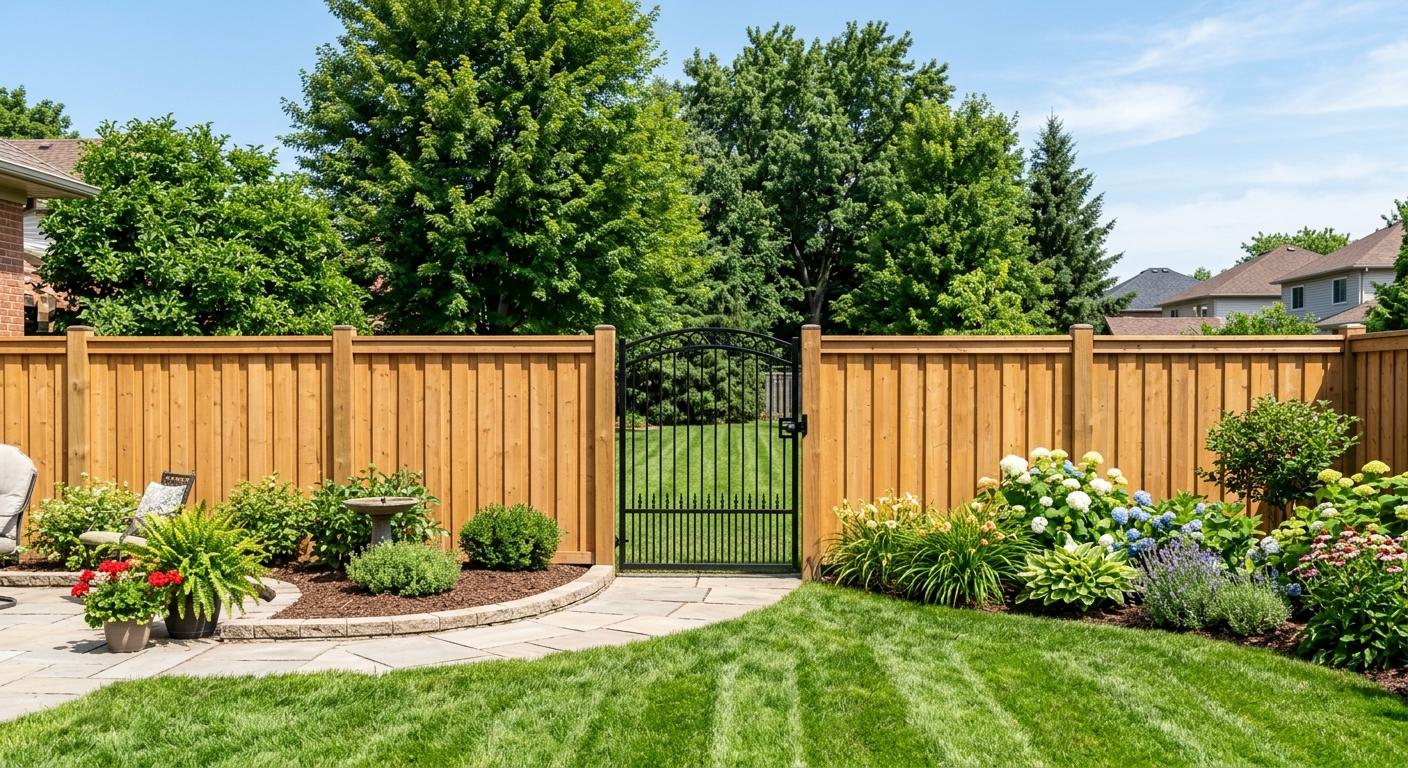
Fencing options and costs in Comox
Comox is a beautiful place to own a home—and that also means lots of homeowners want fences that can handle coastal wind, frequent rain, and the occasional hard freeze. With 65.8% of dwellings in the area being single-detached homes (Statistics Canada, 2021 Census), many properties have yard perimeters that need privacy screening, pet control, or boundary definition. Demand is especially visible around family-focused neighbourhood pockets like Cumberland Road and the older housing streets closer to the shoreline, where lots tend to be more established and fence replacements come up often. (Statistics Canada, 2021 Census also shows 39.6% of homes were built before 1981, which commonly correlates with older perimeter features that are due for an upgrade.)
On Vancouver Island and the Coast, fencing costs are shaped by moderate coastal frost (roughly 45–60 cm), plus persistent wind off the Strait of Georgia and Juan de Fuca Strait. That combination usually increases installation time: posts still need to be buried safely below frost depth (often around 75–90 cm in practice), and builders often use concrete-set posts where soil is wet, clay-rich, or disturbed. Coastal salinity also influences material choice—quality galvanized or powder-coated hardware and properly rated boards matter for long service life. Contractor availability can affect pricing too, because good crews schedule around weather windows and longer set times when concrete footings are required.
Below is a practical snapshot of common fencing materials for Comox, using typical installed ranges you’ll see when comparing quotes in this market. Use it to sanity-check what you’re being asked to pay before you sign a contract.
| Material |
Lifespan |
Maintenance |
Privacy Rating |
Price per Linear Foot |
| Pressure-treated pine (standard wood) |
10–15 years |
Stain/seal every 2–3 years; check for loose boards |
7/10 (solid boards) |
$55 – $85 |
| Cedar (natural rot resistance) |
15–25 years |
Seal/stain every 2–4 years; occasional board replacement |
8/10 (solid boards) |
$70 – $105 |
| Vinyl / PVC (no-maintenance) |
20–30 years |
Rinse as needed; inspect post caps |
8/10 (solid styles) |
$70 – $110 |
| Chain-link (galvanized steel) |
30+ years |
Minimal; rinse salt residue; tighten hardware |
2/10 (open visibility) |
$35 – $60 |
| Aluminum ornamental |
25–40 years |
Minimal; wash and check fasteners |
3/10 (ornamental pickets) |
$80 – $140 |
| Composite / recycled material |
20–30 years |
Low; wash and inspect for warping |
7/10 (solid panels) |
$95 – $130 |
Prices are estimates only and vary by project scope, site access and material selection.
What affects the price of fencing in Comox
In Comox, two contractors can quote the “same” fence and still end up 30–50% apart, largely because the real variables live below the surface: how the posts must be set for coastal frost, how wind loads shape the framing, and how difficult your yard is to access. Your home’s age can matter too. With a sizable share of Comox housing stock built before 1981 (Statistics Canada, 2021 Census), you often see older boundaries, outdated corner posts, and uneven ground that force extra layout time and deeper corrective digging.
On Vancouver Island and the Coast, frost depth is usually shallow compared with Ontario and Alberta, but posts still must be installed below frost to reduce heaving and long-term leaning. In practice, that often means burying posts about 4–6 inches below the effective frost line; many residential installs land around 75–90 cm of embedment. In colder regions farther east or on the Prairies, posts often need to go much deeper (commonly 1.5–2.0 m), which is why you’ll hear larger concrete and longer-post costs there. Here, you’re typically paying for correct footing depth and good drainage, not extreme depth—yet wind exposure still affects design choices. Taller solid privacy fences can catch more wind and may require closer post spacing or heavier rails, while open styles (like chain-link) usually tolerate standard spacing. Also, wet coastal weather can accelerate rot in untreated or marginal wood, increasing repair risk—so treated materials and proper fasteners can change the quote even if the fence looks similar.
Concrete examples from Comox: (1) If your soil is clay-rich or stays saturated, contractors often switch from gravel packs to concrete-set posts, adding labour and disposal time; (2) If there’s slope or rock pockets near the line, installing raked or stepped panels takes additional measuring, cutting, and alignment effort. On budget choices, wood and chain-link can fall near the region’s lower bands, such as chain-link at roughly $35–$60 per linear foot, while privacy-heavy vinyl or cedar commonly run closer to $70–$110 per linear foot depending on style and height.
| Price Factor |
Why It Matters |
Cost Impact |
| Fence length in linear feet |
Materials, rails, posts, and labour scale directly with total run |
Largest driver; small scope changes move the total quickly |
| Post depth required |
Effective frost protection controls embedment and post length |
Can materially increase labour and material waste if longer posts are needed |
| Post setting method |
Concrete set vs gravel pack vs driven posts changes time and crew requirements |
Concrete-set typically adds more cost but reduces heaving risk |
| Material choice |
Vinyl, cedar and chain-link behave differently with salt air and moisture |
Switching materials can shift pricing into different regional bands |
| Gate count and type |
Gates require stronger posts, hardware, and often diagonal bracing |
Extra gates frequently raise totals disproportionately |
| Grade and terrain |
Slope requires racked panels/stepping and careful layout to keep alignment |
More cutting, measuring and rework time |
| Old fence removal and disposal |
Demolition, hauling, and disposal fees add labour |
Can add noticeable cost especially for concrete footings or mixed materials |
| Permit fees and survey / property line locate |
Administrative steps and locating reduce boundary disputes but add upfront cost |
Depends on your municipality and height/location; can be a planned add-on |
Permits & regulations in British Columbia
In British Columbia, permits can apply to fences depending on height and location. As a rule of thumb, fences above about 2.0 m (6.5 ft) along the rear and 1.0–1.2 m (3–4 ft) at the front or corner often trigger permit requirements (final thresholds depend on the specific municipal bylaw for the area you’re in). All fences must also respect property lines and local setback rules, which is why you should avoid guessing with “eyeballed” boundaries—especially on lots with older surveys or landscaped encroachments.
Before digging any post hole, call for utility locates through the appropriate provincial service (BC 1 Call). Even if your fence line is “straightforward,” buried lines and service stubs are common on residential streets.
Shared fence ownership is typically handled under provincial line-fences legislation concepts: neighbours may share maintenance responsibilities depending on whether the fence is treated as a boundary fence, which is why it’s smart to communicate in writing before work starts.
Step-by-step for Comox homeowners: (1) Ask for the contractor’s BC licence details and confirm the business listing online; (2) request a current certificate of insurance showing liability coverage (and the correct named insured); (3) verify coverage for workers by asking whether they carry the applicable workplace coverage (WSIB/WCB) and request a clearance letter or proof; (4) keep copies with your contract so you’re protected if something goes wrong.
Choosing the right fence material for Comox
Choosing the right fence material in Comox comes down to matching your priorities—privacy, low maintenance, budget, and lifespan—to a coastal climate that’s mild but wet, with frequent wind exposure. Pressure-treated pine is usually the most budget-friendly look you can get, but it typically needs staining or sealing every 2–3 years to avoid grey weathering and reduce moisture-driven wear. Cedar costs more upfront, but it naturally resists rot and blends nicely with existing older homes; it still generally needs periodic sealing to keep colour and prevent surface checking. Vinyl/PVC offers true low maintenance and won’t rot, but in extreme cold it can become brittle at thin edges—so you want quality product, proper expansion allowance, and correct post spacing for wind. Chain-link is the longest-life budget option and handles moisture well, but it’s not for privacy unless you add screening (plants or privacy slats). Aluminum ornamental is rust-resistant and mid-range in price, but it provides open visibility rather than solid privacy.
For Vancouver Island and the Coast, don’t skip on post embedment: even with shallow frost lines (around 45–60 cm), correct practice usually means concrete-set posts or properly planned footings in many residential scenarios, especially where soils are disturbed, clay-rich, or saturated. Wind and snow loads are the other piece: taller solid fences take wind pressure, so rail spacing, post spacing, and bracing matter as much as the material. A wood privacy fence can be a strong value, but if your goal is “install and forget,” vinyl often justifies the upgrade—especially when you compare the hassle of regular staining. For example, if a cedar privacy fence comes in near the $70–$105 per linear foot band, and a similar vinyl privacy style lands closer to $70–$110, many homeowners choose vinyl to reduce ongoing maintenance time in a salty coastal environment.
| Material |
Cold Tolerance |
Lifespan |
Annual Maintenance |
Best For |
Price Band |
| Pressure-treated pine |
Good with proper treatment and fasteners |
10–15 years |
Light-to-moderate (plan 2–3 year re-stain) |
Budget privacy where you’re okay with periodic upkeep |
$55 – $85 |
| Cedar |
Good; benefits from regular sealing |
15–25 years |
Moderate (typically 2–4 year sealing) |
Natural look with better rot resistance |
$70 – $105 |
| Vinyl / PVC |
Very good when installed with correct allowances |
20–30 years |
Low (rinse and inspect periodically) |
Low maintenance and consistent appearance |
$70 – $110 |
| Chain-link |
Excellent; unaffected by rot |
30+ years |
Very low (hardware check, rinse if needed) |
Security and pet control where privacy isn’t required |
$35 – $60 |
| Aluminum ornamental |
Excellent with coated metal construction |
25–40 years |
Low (wash and check fasteners) |
Curb appeal with long-term rust resistance |
$80 – $140 |
| Composite / recycled |
Good; depends on product quality and installation |
20–30 years |
Low (wash; inspect for warping) |
Clean modern look with minimal upkeep |
$95 – $130 |
How to choose a fencing contractor in Comox
Picking the right fencing contractor in Comox is mostly about proof and details. First, verify British Columbia licensing: ask for the contractor’s business information and licence number, then check it through the appropriate BC registry or online listing. Next, request a current certificate of liability insurance; confirm the coverage is active and includes fencing-related work. Then check workforce protection: ask for proof of the applicable workplace coverage (WSIB/WCB) and a clearance letter or equivalent documentation so you know workers are covered on your site. If a contractor won’t provide paperwork promptly, that’s a major warning sign.
Get 2–3 itemised written quotes rather than one lump sum. You want a breakdown showing labour, posts and rails, concrete (if used), hardware, gates, and disposal/removal. Carefully read what’s excluded: many “cheap” quotes omit old fence removal, utility locating fees, permit handling, or additional post depth where frost protection is required. Clarify whether material delivery, stump/rock pocket handling, and final alignment adjustments are included. Ask about warranties too: workmanship warranty length (often the more important part), product manufacturer warranty, and whether warranties are transferable if you sell your home.
Payment schedule matters in BC. A safe approach is never paying more than 10–15% upfront, then holding back until the final walkthrough is complete. Finally, get your timeline in writing: proposed start date, weather-dependent scheduling notes, and an estimated completion window.
- Confirm BC licence/business details before work starts.
- Request certificate of liability insurance and verify it matches the legal name on the contract.
- Ask for WSIB/WCB coverage proof (clearance letter or equivalent).
- Get 2–3 itemised quotes (materials + labour) with line-by-line pricing.
- Ask who calls for utility locates and whether it’s included.
- Confirm post depth and footing method in writing (concrete-set vs gravel pack).
- Ensure wind exposure design is addressed (rails, spacing, bracing for solid/privacy styles).
- Clarify whether gates are included, including hardware and any upgrades.
- Confirm disposal and dump fees for old fence removal (and whether hauling distance is included).
- Ask if permits are required for your height/location and whether permit pulling is included.
- Verify warranty terms: workmanship duration, manufacturer coverage, and transferability.
- Set payment milestones with a holdback until the final cleanup and walkthrough.
Concrete red flags we see around Comox: (1) quoting only with a “per foot” number but no detailed embedment plan; (2) refusing to show insurance/coverage documents; (3) lowball pricing that skips old fence disposal or assumes easy access; (4) starting without written scope for gates and footing type; (5) asking for most of the money upfront (well beyond 10–15%) without a signed completion plan.
Frequently asked questions — fencing in Comox
Do I need a permit to build a fence in British Columbia?
In British Columbia, many fences don’t require a permit, but height and location often determine whether you need one. A common rule of thumb used in BC municipalities is that fences above about 2.0 m (6.5 ft) along the rear and 1.0–1.2 m (3–4 ft) at the front or corner may require a permit. For Comox homeowners, the safest approach is to ask your contractor to confirm the relevant local bylaw for your address (height, placement, and any corner visibility rules). Also plan for utility locates before digging post holes. If your fence is boundary-adjacent or close to setbacks, having a survey locate your property pins can prevent boundary disputes later.
How long does a wood fence last in Comox?
A wood fence’s lifespan in Comox usually depends on the species, how it’s treated, and whether posts are set correctly for coastal frost and wet soil. Pressure-treated pine is often around 10–15 years when installed with proper embedment and quality hardware, while cedar commonly reaches 15–25 years with periodic sealing. Coastal moisture and wind matter: solid privacy fences catch more wind load, which can loosen rails and fasteners over time if framing isn’t built strong enough. Also, if posts aren’t buried below effective frost protection (often ~75–90 cm in practice), heaving can cause leaning sooner than expected. If you’re budgeting, wood typically sits near the region’s $55–$85 per linear foot band, but maintenance timing can affect your long-term cost.
Who owns and maintains a shared fence?
Shared fences are handled under provincial line-fences principles, but the practical answer depends on whether the fence is truly a boundary fence and how the neighbours agreed to it. In Comox, you’ll commonly see shared responsibility when the fence sits directly on the property line. If it’s a “shared” boundary arrangement, neighbours may share maintenance and repair costs proportionally or by agreement. Before building, confirm in writing who maintains which sections, and whether replacement is triggered by damage, leaning, or rot. If you’re upgrading an older fence (some Comox homes are older, with many built before 1981 (Statistics Canada, 2021 Census)), it’s especially important to document the condition and scope so you don’t end up disputing responsibility later.
How do I find my property line before fencing?
The best way to find your property line is to locate the original survey pins or commission a survey if yours is unclear. For Comox homeowners, relying on landscaping boundaries or “estimated” measurements can lead to encroachment and neighbour disputes. Start by checking for existing survey documentation from when the property was purchased, then look for property pins/corner markers. If you can’t confirm them, hire a surveyor for a property line locate. It’s also worth doing before you schedule concrete-set posts, because post placement errors are expensive to correct. Your fencing contractor should be able to coordinate layout once your pins are located, and they should incorporate local setbacks into the line.
What's the most low-maintenance fence?
In Comox, the “most low-maintenance” option is typically vinyl/PVC or properly coated metal (like aluminum ornamental), because neither rots and both tolerate coastal moisture well. Vinyl/PVC is popular for privacy styles and can last 20–30 years with minimal upkeep—usually just occasional rinsing and hardware inspection. Composite/recycled products also tend to be low maintenance, though it depends on product quality and installation. If you want maximum longevity with minimal fuss and don’t need privacy, chain-link is very low maintenance too (often 30+ years) but it won’t block views unless you add screening. Price-wise, vinyl/PVC commonly lands in the $70–$110 per linear foot range, which is higher than chain-link (often $35–$60) but can be justified by years of reduced maintenance.
How tall can my fence be in Comox?
Fence height rules in Comox depend on where the fence sits (front/corner versus rear) and the specific municipal bylaw. A common BC planning guideline is around 2.0 m (6.5 ft) for rear fences, with more restrictive limits for front or corner areas (often about 1.0–1.2 m). Because wind exposure and visibility rules can vary, you should confirm your proposed height and location before ordering materials. This is also important for permit planning: higher fences are more likely to trigger a building permit. If you’re installing a solid privacy fence, remember that coastal wind off the Strait of Georgia and Juan de Fuca Strait can increase loads on rails and posts—so height isn’t the only factor; engineering spacing and post settings matter too.