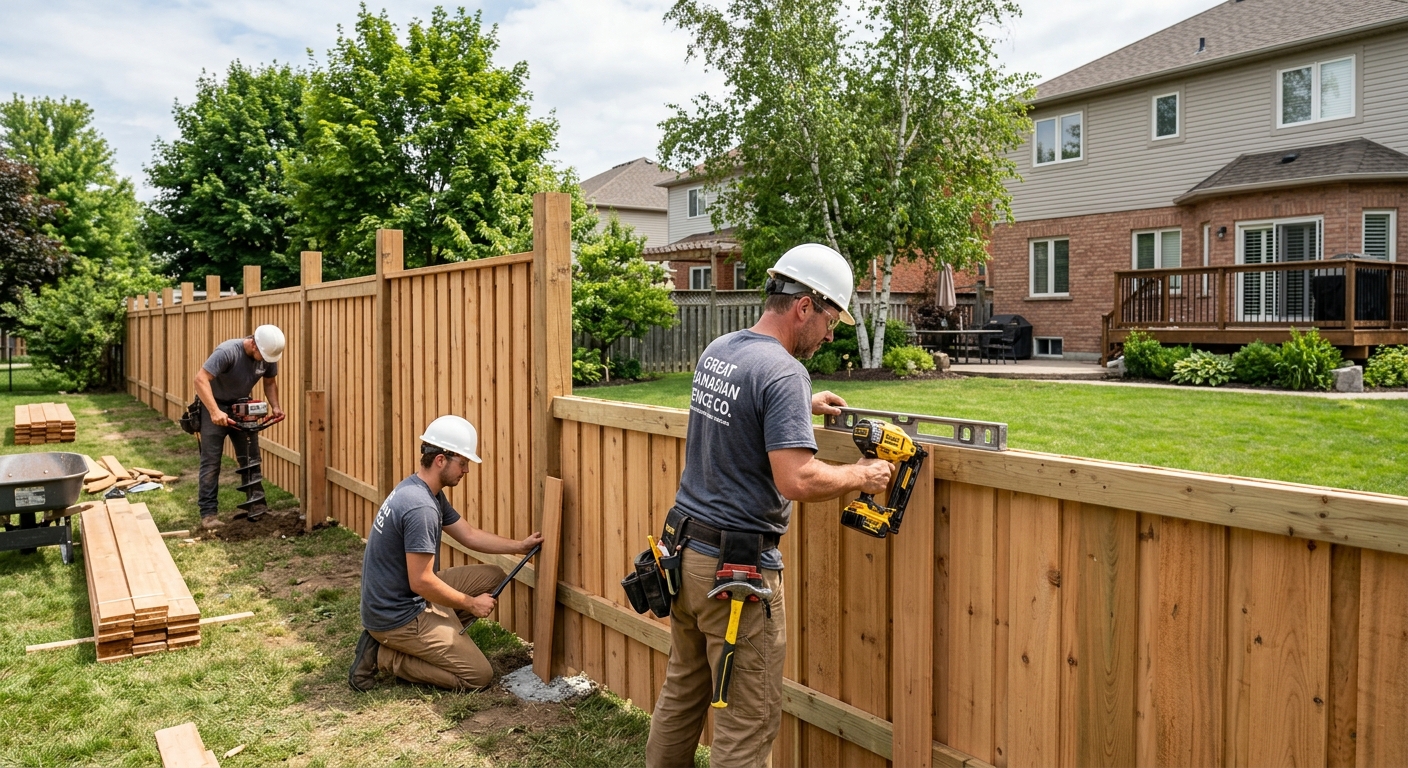
Fencing options and costs in Armstrong
Armstrong is a small community in the North Okanagan where fencing demand stays steady because many homes are detached. In the 2021 Census, Armstrong recorded 5,323 people living across about 1,850 homeowner households (Statistics Canada, 2021 Census). With 69.3% of dwellings being single-detached homes, each detached property is effectively a “front-and-back yard” opportunity—privacy, pets, and boundary definition are common reasons homeowners contact contractors.
In the Thompson–Okanagan, fencing costs are shaped less by the fence style and more by how frost depth and soil interact with post installation. Interior valleys can require deeper, concrete-set posts to avoid freeze–thaw heaving; that adds auger time, concrete, and longer posts compared with milder coastal microclimates. Wind exposure on more open lots (especially toward agricultural benches and less sheltered lanes) can also influence hardware choices and panel design, sometimes pushing prices closer to the upper end of the wood and PVC ranges. That’s also why contractor availability and scheduling can matter—Armstrong projects often align with busy spring/early-summer installs when many homeowners start post-holing at once.
For areas around Armstrong’s downtown edge and the surrounding residential blocks, expect steady demand for repairs and privacy upgrades on older properties. About 42.7% of homes were built before 1981 (Statistics Canada, 2021 Census), so it’s common to see more fence replacements where existing posts have loosened over time.
Use the comparison below to sanity-check quote ranges before you talk to a contractor.
| Material |
Lifespan |
Maintenance |
Privacy Rating |
Price per Linear Foot |
| Pressure-treated pine (standard wood) |
12–20 years |
Stain/seal every 2–3 years |
Good–Very good (solid boards) |
$21 – $33 |
| Cedar (natural rot resistance) |
18–28 years |
Light staining every 2–4 years |
Very good (solid boards) |
$26 – $42 |
| Vinyl / PVC (no-maintenance) |
20–30 years |
Wash only (periodic) |
Good (slatted or solid styles) |
$28 – $48 |
| Chain-link (galvanized steel) |
25–35 years |
Occasional re-tension/coat touch-ups |
Low (mesh), medium with inserts |
$18 – $28 |
| Aluminum ornamental |
25–40 years |
Wash, occasional paint touch-up (rare) |
Low–Medium (open pickets) |
$30 – $55 |
| Composite / recycled material |
20–30 years |
Minimal cleaning; inspect hardware |
Good–Very good (depending on panel) |
$30 – $52 |
Prices are estimates only and vary by project scope, site access and material selection.
What affects the price of fencing in Armstrong
In Armstrong and across the Thompson–Okanagan, two quotes for the “same” fence line can land 30–50% apart because the real drivers aren’t the boards—they’re the ground conditions, install method, and detailing. Contractors priced for interior frost and heavier post anchoring will quote higher than firms assuming shallow, easy augers. In practice, Armstrong sits in a region where colder freeze–thaw cycles often mean post holes must be set below the regional frost line so the posts don’t heave and gradually misalign rails.
A key rule of thumb is setting post depth about 4–6 inches below the design frost depth. In colder parts of interior BC, this often means deeper hole excavation and frequently concrete-set posts. Concrete setting adds materials and labour, so wood projects that might look like the $55–$85 wood installation range can shift toward the upper end when holes are deeper, rebar/anchors are used, or the fence requires more bracing. If you’re choosing vinyl in exposed areas, the same site conditions can move you toward the higher end of typical PVC pricing (often overlapping the $75–$115 install band) once you add heavier hardware and tighter spacing.
Wind exposure is another cost lever: more exposed lots may require closer post spacing, heavier posts, and sometimes semi-open designs to reduce wind load. That’s especially noticeable on open benches where gusts act like a lever against rails.
Three Armstrong examples I see frequently: (1) clayey or poorly drained spots slow excavation and increase concrete/cure time, (2) lawns that are heavily compacted at grade require more prep to achieve consistent post embedment, and (3) older fence lines often come with stubborn remnants—removal and disposal can add hours even when the new fence footprint is unchanged.
| Price Factor |
Why It Matters |
Cost Impact |
| Fence length in linear feet |
Every foot adds posts, rails, and fasteners; labour scales directly |
Highest driver (often 50–70% of the total) |
| Post depth required |
Frost line depth determines post length and hole depth to prevent heaving |
Can add 10–30% depending on ground |
| Post setting method |
Concrete vs. gravel pack vs. driven posts changes materials and time |
Concrete-set posts typically raise costs |
| Material choice |
Wood, vinyl, cedar, chain-link, and aluminum differ in material and install complexity |
Upgrades can move you between common price bands |
| Gate count and type |
Double drive gates and swinging gates need stronger frames and hardware |
Often the second-biggest cost jump |
| Grade and terrain |
Slopes require stepped posts/panels or raked rails for clean alignment |
Can add labour and material waste |
| Old fence removal and disposal |
Hauling and extra labour are needed for existing posts and rails |
Frequently adds several hours and disposal fees |
| Permit fees and survey / property line locate |
Permits and locating pins reduce disputes and rework |
Usually smaller line items, but prevent expensive redesign |
Permits & regulations in British Columbia
In British Columbia, whether you need a permit can depend on the fence height and where it sits relative to your property. A common threshold is that fences above 2.0 m (6.5 ft) at the rear and 1.0–1.2 m (3–4 ft) at the front or corner often require a building permit. Even when a permit isn’t required, your fence still needs to respect property lines and municipal setback bylaws.
Before any digging, you should have utility locates completed. Homeowners and contractors should call the appropriate service for your area (in BC, use BC 1 Call) so you don’t hit power, gas, or telecom lines during post-hole excavation. It’s also smart to obtain a survey or locate your property pins before installing—this avoids encroachment issues, which can delay projects and create neighbour disputes.
Shared fences are handled under provincial line-fences rules, which affect how costs and responsibilities are managed between adjoining owners.
What typically DOES require a permit: taller fences exceeding the height thresholds (especially at the rear/side corners), and projects that trigger municipal review.
What typically does NOT require a permit: many standard-height replacement fences along the same footprint and alignment, provided they meet setback and property-line requirements.
To verify your contractor in Armstrong/BC, ask for (1) proof of licensing/registration where applicable (check the relevant BC trade/contractor registry online), (2) a current certificate of insurance showing general liability and adequate limits, and (3) clearance/coverage documentation for workplace protection (WSIB/WCB coverage, as applicable to the contractor’s operations). Review the paperwork directly and confirm the policy dates before work starts.
Choosing the right fence material for Armstrong
Choosing a fence in Armstrong is really about matching material to your priorities—privacy, low maintenance, budget, and lifespan—while respecting interior BC freeze–thaw conditions. With Armstrong’s older housing stock (42.7% built before 1981) and typical Thompson–Okanagan winters, post performance matters as much as the panel material. If the posts don’t stay stable, rails misalign and even “good” boards fail early.
Pressure-treated pine is the budget-friendly option. It’s usually the fastest way to hit the $55–$85 wood installation band, but it needs staining or sealing every 2–3 years to slow grey weathering and protect fasteners. Cedar generally looks better and resists rot naturally, so it often lasts longer (commonly 18–28 years) with periodic maintenance, typically every 2–4 years. Vinyl/PVC offers no-stain convenience, but in extreme cold it can become brittle if installed with incorrect temperature practices or if hardware isn’t properly rated—so quality brackets and correct expansion considerations matter. Chain-link is the longest-life “value per year” for security, but it won’t give much privacy unless you add privacy slats or an approved screen system. Aluminum ornamental is rust-resistant and mid-range priced, but it’s rarely used when homeowners want full privacy. Composite/recycled panels can give a balanced look and durability, with low maintenance.
On Thompson–Okanagan frost conditions, many fence lines need posts set well below grade—often requiring concrete-set posts in colder pockets—so ask how your contractor will anchor posts for stability. For a practical comparison: if you’re deciding between pressure-treated pine at roughly the low end of the wood band and cedar higher up, the extra cost can be justified when you want longer appearance life and fewer replacement cycles over a decade.
| Material |
Cold Tolerance |
Lifespan |
Annual Maintenance |
Best For |
Price Band |
| Pressure-treated pine |
Good (when stained and fasteners are compatible) |
12–20 years |
Stain/seal every 2–3 years (low annual cost) |
Budget privacy with periodic upkeep |
$55 – $85 |
| Cedar |
Very good |
18–28 years |
Light staining/sealing every 2–4 years |
Premium look and rot resistance |
$70 – $105 |
| Vinyl / PVC |
Good (hardware/installation quality matters) |
20–30 years |
Wash only; inspect posts/hardware |
Low-maintenance fencing |
$75 – $115 |
| Chain-link |
Excellent |
25–35 years |
Occasional re-tension; spot touch-ups |
Security on a budget |
$35 – $60 |
| Aluminum ornamental |
Excellent (rust resistant) |
25–40 years |
Wash; rare touch-ups |
Curbs appeal with low long-term effort |
$90 – $150 |
| Composite / recycled |
Good (depends on panel design and fastening) |
20–30 years |
Minimal cleaning; check hardware |
Durable, low-maintenance privacy |
$85 – $130 |
How to choose a fencing contractor in Armstrong
Start by verifying the contractor can legally and responsibly do fencing work in British Columbia. Ask for their business details and confirm they’re operating legitimately (check the relevant online registry for their trade/business listing and any applicable contractor registration). Next, request a certificate of insurance showing general liability coverage—read the expiry date and ensure the coverage is active for the entire project window. For workplace coverage, ask how they handle workplace protection documentation (WSIB/WCB coverage or applicable clearance documentation) and verify the clearance date matches your start date. A reputable fencing crew will hand this paperwork over without pressure.
Then get 2–3 itemised written quotes. You want labour and materials broken out separately (posts, rails, panels, fasteners, concrete/aggregate, gates, and removal/disposal). Avoid lump sums that hide the real differences. Carefully review what’s excluded: permit pulls (if required), utility locating fees, property-line locate/survey costs, and whether they haul away old fence materials.
Warranty matters too. Ask for a written workmanship warranty (how long the contractor stands behind installation—often for gate alignment, post stability, and hardware fastening) and a product/manufacturer warranty for the fence system. Confirm whether the warranty is transferable if you sell your home.
On payment scheduling, a safe rule is never pay more than 10–15% upfront. Hold back the remainder until the job is fully complete and final cleanup is done. Make sure your quotes include a start date and completion estimate in writing, because Armstrong scheduling can tighten in spring when many projects hit the ground at once.
- Valid insurance certificate (check policy dates) and liability limit appropriate for fencing work
- Proof of workplace coverage/clearance documentation for their crew
- Itemised quote: materials, labour, post setting method, and hardware listed
- Written scope: fence length, post spacing, panel type, and gate sizes
- Clarify whether old fence removal/disposal is included
- Confirm permit responsibility: who pulls it and what’s included
- Utility locate responsibility stated (BC 1 Call confirmation)
- Property-line approach documented (survey/locate or pin verification)
- Workmanship warranty stated in writing
- Product/manufacturer warranty stated with model/style details
- Payment terms: deposit capped at 10–15% and holdback until completion
- Schedule: start date and realistic completion timeline in the contract
Red flags I see in Armstrong include: vague quotes without post depth or setting method, “too-good-to-be-true” pricing that omits concrete setting when frost conditions require it, refusal to provide insurance/coverage documents, and contracts that don’t mention disposal, permit responsibility, or a workmanship warranty.
Frequently asked questions — fencing in Armstrong
How do I compare fencing quotes?
To compare fencing quotes in Armstrong (and across BC), focus on the same items appearing in every estimate. Ask each contractor to list fence length, post spacing, post depth/setting method (gravel pack vs. concrete-set), panel type, and gate hardware. Make sure disposal of the old fence and any racking/stepped adjustments for grade are included, because those differences change labour time fast. Also check material specs: pressure-treated pine vs. cedar grade, vinyl profile thickness, chain-link gauge, and whether corner bracing is included for wind stability. If one quote is in the mid wood band (for example, around $55–$85 for wood installation) but another is much higher, confirm whether deeper frost-suitable post embedment and concrete are included; those are often the real reasons for the gap. (Statistics Canada, 2021 Census) shows most local housing is detached, so homeowners are commonly replacing similar fence footprints—quote line items should therefore match closely.
How long does fence installation take in Armstrong?
Typical installation time in Armstrong depends mainly on fence length, number of gates, and how hard the ground is to auger. On a straightforward backyard run with manageable access, crews often complete a smaller project in about 1–3 days after post holes are ready. Longer runs or jobs requiring deeper concrete-set posts for frost stability can stretch timelines because each post hole must be dug to the correct depth and the concrete must be set properly. Removing an old fence line also adds hours for disassembly and disposal. Weather matters too—spring is busy in the Thompson–Okanagan, and muddy ground can slow equipment. For planning, request a start date and a completion estimate in writing, and confirm if the quote assumes good weather days versus waiting time. If your property is near the downtown edge where access can be tight, expect slightly slower turnaround due to material handling.
Can I install a fence on a slope in Armstrong?
Yes, you can install a fence on a slope in Armstrong, but the approach needs to be chosen correctly so the fence stays straight and level-looking. Contractors usually use either stepped panels (each section aligns to grade with “steps” at post levels) or raked rails (rails follow the slope while posts are set vertically). Stepped is common for privacy board fences; raked can work well when you want a smoother visual line. The frost-depth requirement still applies, so even when the yard slopes, each post hole must be dug to the appropriate depth below the design frost line to prevent heaving. Slopes can raise costs because it increases labour time for measuring, layout, and sometimes material waste. Ask your contractor to describe how they’ll handle grade changes at corners and where the fence meets a gate, and make sure the quote includes racking/stepping details rather than treating it as a flat yard.
What is the most weather-resistant fence for Armstrong's climate?
For Armstrong’s interior BC freeze–thaw cycles, the “most weather-resistant” choice often depends on how you define weather resistance: rot resistance, wind durability, and low maintenance. Cedar is excellent for rot resistance and looks great through interior winters, but it still benefits from periodic staining. Vinyl/PVC performs well for low maintenance and resists rot, though it relies on quality installation and correct hardware. For maximum longevity with minimal fuss, chain-link is very resilient in cold and wet conditions, and it typically lasts longer than privacy fences because it doesn’t rot. However, chain-link won’t provide privacy without inserts. If you want the best overall durability with a balance of maintenance, many homeowners select cedar or a properly installed vinyl system with frost-appropriate concrete-set posts. Whatever you choose, the post depth and setting method are often the real “weather resistance” factor in Armstrong—because heaved posts undermine any material.
How do I prevent wood fence rot in Armstrong?
Preventing wood rot in Armstrong is mostly about keeping water away from the wood and ensuring the post system is stable. First, insist on the correct post setting method for frost conditions—if posts heave or allow gaps, water collects and the bottom rails and fasteners deteriorate faster. For wood privacy fences, pressure-treated pine should be stained/sealed regularly; without maintenance, it can grey and the surface can wear, letting moisture penetrate. Cedar naturally resists rot better than pine, but it still benefits from periodic maintenance. Also make sure wood-to-soil contact is avoided and the bottom rail isn’t sitting in standing water after rain. Hardware matters too: use compatible, exterior-rated fasteners so corrosion doesn’t accelerate board failure. Finally, keep vegetation trimmed back so airflow reaches the fence and damp stays reduced. If your existing fence is over a decade old (common in Armstrong’s older housing stock—Statistics Canada, 2021 Census), replacement is often cheaper than repeated spot repairs.
What is the cost per linear foot for fencing in Armstrong?
Cost per linear foot in Armstrong depends on material and how much groundwork is required (especially post depth and setting). As a homeowner-friendly guide, wood installation typically lands around $55–$85 for installed projects, while vinyl/PVC often runs closer to $75–$115. If you’re comparing material-only pricing, be careful—installed quotes include labour for post holes, rails, gates, and sometimes removal/disposal. For chain-link, the installed cost is usually lower, often reflecting the $35–$60 band. Aluminum ornamental generally costs more, commonly within the $90–$150 range. The best way to confirm your exact per-foot number is to ask for an itemised quote that shows fence length, number of posts, gate quantity, and whether concrete-set posts are required for frost stability. If the contractor lists shallow post depths, you may see a low initial price that increases repair risk in future freeze–thaw cycles.