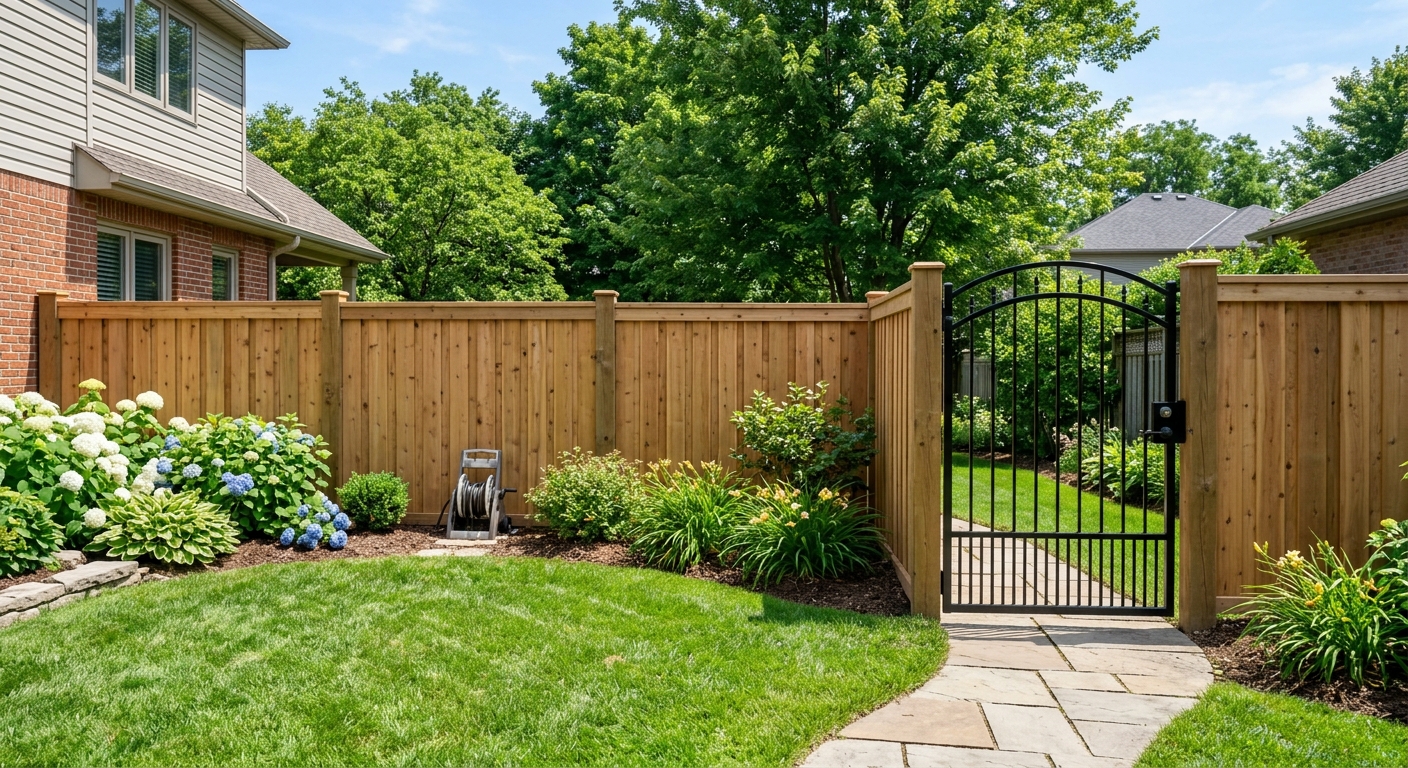
Fencing options and costs in West Kelowna
West Kelowna homeowners typically price fencing around material choice and how the Thompson–Okanagan climate affects post installation. With 68.0% of local dwellings being single-detached homes, there’s steady demand for backyard privacy, dog containment, and boundary upgrades—each detached property is effectively a potential fencing project. That demand is reinforced by an older housing stock: 26.6% of homes were built before 1981, and many of the existing fences were never installed with modern frost-safe post depths.
In this region, costs aren’t just about panels and pickets. Contractors plan around frost depth and freeze–thaw cycles, which means posts often need to be set below grade so they don’t heave. In West Kelowna’s interior valleys, frost depth is commonly deeper than coastal BC—often requiring posts set roughly 75–90 cm (and sometimes deeper depending on soil and exposure) plus concrete-set methods on heavier clay or poorly drained areas. Wind exposure along open benches can also increase labour through tighter post spacing and stronger hardware.
For neighbourhood demand, areas like Lakeview Heights and nearby hillside streets often see upgrades because yards are exposed and homeowners want longer-lasting, straighter fencing that won’t rack in winter winds. With that context, the table below compares typical options and realistic installed ranges so you can benchmark your quotes before you call for a site visit.
| Material |
Lifespan |
Maintenance |
Privacy Rating |
Price per Linear Foot |
| Pressure-treated pine (standard wood) |
10–15 years |
Stain/seal or re-stain every 2–3 years |
8/10 (solid boards/panels) |
$55–$85 |
| Cedar (natural rot resistance) |
15–25 years |
Light staining every 2–3 years |
9/10 (solid boards/panels) |
$70–$105 |
| Vinyl / PVC (no-maintenance) |
20–30 years |
Occasional wash only |
8/10 (solid styles) |
$75–$115 |
| Chain-link (galvanized steel) |
20–35 years |
Occasional hose-down; check tension |
3/10 (privacy not available) |
$35–$60 |
| Aluminum ornamental |
25–40 years |
Occasional wash; no rusting |
4/10 (open pickets) |
$90–$150 |
| Composite / recycled |
20–30 years |
Wash only; minimal repairs |
9/10 (solid styles) |
$95–$145 |
Prices are estimates only and vary by project scope, site access and material selection.
What affects the price of fencing in West Kelowna
In West Kelowna and the broader Thompson–Okanagan region, two “same-size” fence quotes can vary by 30–50% because the job details that control labour are often different. Post installation depth and method is the biggest driver: the frost line depth determines how far down posts must go so they don’t lift during freeze–thaw. Local practice often uses a rule-of-thumb of setting posts about 4–6 inches below the design frost depth to prevent heaving. In colder Ontario and Alberta markets, that can translate into 1.5–2.0 m post depths and concrete-setting costs that raise both labour time and material requirements; while West Kelowna is milder than those regions, interior valley frost still makes proper installation essential.
Wind exposure matters too. On more open benches in the Thompson–Okanagan, wind load can push contractors to use closer post spacing, heavier rails, and sometimes open-style panels to reduce stress on hardware. Chain-link may still be economical, but heavier line posts and gates can change the overall budget. At the same time, coastal BC’s mild but wet conditions tend to accelerate wood rot unless treatment and drainage details are done correctly—so wood projects in the coast can sometimes cost more than expected if failures have to be rebuilt.
Concrete examples in West Kelowna: (1) clay-heavy lots near the lakeshore or low spots may require concrete-set posts for stability, adding auger time and material cost; (2) steep access in hillside streets can add labour for stepped panels, extending install time; (3) replacing an old fence often includes removal and haul-away, which can add several hundred dollars to more than a thousand depending on debris volume. If you’re choosing between wood at roughly $55–$85 per linear foot versus vinyl at $75–$115, the “extra” is often justified when concrete-set posts or stronger bracing are needed and you want fewer maintenance cycles.
| Price Factor |
Why It Matters |
Cost Impact |
| Fence length in linear feet |
Every foot needs posts, rails, and labour |
Major increase; typical 1 ft increase scales linearly |
| Post depth required |
Frost line determines post length and hole depth |
Higher depth can add hours, auger rental time, and more concrete |
| Post setting method |
Concrete vs. gravel pack vs. driven posts affects stability |
Concrete-set often costs more but reduces heaving risk on clay/poor drainage |
| Material choice |
Vinyl/cedar/chain-link differ in hardware and installation time |
Wood can be mid-cost; vinyl usually higher; chain-link lowest but with strong gates |
| Gate count and type |
Gates require heavy framing, hardware, and alignment |
One double drive gate can materially raise the budget versus a simple walk gate |
| Grade and terrain |
Slopes require stepped or raked rails and extra layout time |
Can add labour and material waste |
| Old fence removal and disposal |
Haul-away and demo time add work beyond new builds |
Often a noticeable add-on; varies with volume and access |
| Permit fees and survey / property line locate |
Some fencing heights and situations trigger more paperwork |
Small but real costs; a locate can prevent costly rework |
Permits & regulations in British Columbia
In British Columbia, fences above a height threshold often require a building permit. A common guideline is fences over roughly 2.0 m (6.5 ft) for rear yards, and 1.0–1.2 m (3–4 ft) for front yards or corners—though exact requirements can vary by municipal bylaws and location on the lot. Regardless of height, fences must respect property lines and municipal setback bylaws, and you should confirm any restrictions tied to corner lots, easements, or utility corridors.
Before you dig any post holes, arrange for utility locates so you don’t hit buried services. In B.C., this is typically done through BC 1 Call. Also, get a survey or at least confirm your property pins before installing. In West Kelowna, encroachment disputes are one of the easiest problems to avoid—especially on older lots where original boundary markers may have been disturbed.
Shared fence ownership is commonly handled under line-fences principles in provincial legislation: if it’s a true shared boundary fence, neighbours may share responsibilities, but the exact rules depend on how the fence sits and how the boundary is defined.
To verify a contractor in West Kelowna: check their British Columbia licence status via the relevant online registry they provide; request a certificate of insurance showing liability coverage (and ask who the insured party is); and confirm workers’ coverage for jobsite labour (WSIB/WCB coverage—most trade contractors will have proof you can review). If a contractor can’t provide certificates promptly, treat that as a warning sign and ask before you book a start date.
Choosing the right fence material for West Kelowna
Choosing the right fence material in West Kelowna is about matching what you care about—privacy, low maintenance, budget, and lifespan—to a climate that drives freeze–thaw movement, winter winds, and occasional wet conditions. With interior valley frost, post depth is critical: even the best-looking fence will fail early if posts aren’t set below the regional frost line. That’s why many installs use concrete-set posts on heavier clay, poorly drained areas, or yards with known soil movement. For lighter, better-drained sites, contractors may use alternative setting methods, but the decision should be made after checking soil conditions on-site.
Pressure-treated pine is usually the budget-friendly route, but expect staining or re-staining every 2–3 years to limit grey weathering and keep boards looking uniform. Cedar offers natural rot resistance and a warmer appearance, but it still benefits from periodic maintenance to avoid surface graying and premature wear at fence bottoms. Vinyl/PVC is popular for low maintenance—just wash occasionally—but extreme cold snaps can make installers choose specific hardware and allow for appropriate expansion spacing. Chain-link is the longest-lasting “lowest cost” boundary option, yet it’s not a privacy solution unless you add screening or slats (which changes airflow and wind load). Aluminum ornamental is durable and rust-resistant with a mid-range cost, but it’s typically open for visibility, so privacy is limited.
Where the price gap makes sense: if a basic pressure-treated wood privacy fence lands around $55–$85 per linear foot and cedar comes in near $70–$105, cedar can be justified when you want fewer aesthetic disappointments over time—especially on prominent streetscapes where fence appearance matters year-round. Vinyl can cost more than wood, but for busy households wanting low upkeep, it often pencils out over the longer service life.
| Material |
Cold Tolerance |
Lifespan |
Annual Maintenance |
Best For |
Price Band |
| Pressure-treated pine |
Good when posts are frost-set correctly |
10–15 years |
1–2 touch-ups or plan for staining every 2–3 years |
Budget privacy on stable soils |
$55–$85 |
| Cedar |
Good; performs well with proper end-grain sealing |
15–25 years |
Stain/light upkeep every 2–3 years |
More natural look with strong rot resistance |
$70–$105 |
| Vinyl / PVC |
Very good; requires correct expansion allowance |
20–30 years |
Wash as needed |
Low-maintenance privacy |
$75–$115 |
| Chain-link |
Excellent; strong in wind with proper tensioning |
20–35 years |
Minimal; check tension and hardware |
Security and containment |
$35–$60 |
| Aluminum ornamental |
Excellent; corrosion-resistant |
25–40 years |
Wash and quick inspections |
Front-lot curb appeal with durability |
$90–$150 |
| Composite / recycled |
Good; suited to stable mounting hardware |
20–30 years |
Wash only; inspect fasteners |
Durable, privacy-focused panels |
$95–$145 |
How to choose a fencing contractor in West Kelowna
When you’re hiring in West Kelowna, start by verifying licensing, liability insurance, and workers’ coverage. In B.C., ask the contractor for their proof of registration/licence (they should be able to point you to their listing details), then request a certificate of insurance showing general liability coverage. For jobsite protection, confirm they have workers’ compensation coverage for their crew (WSIB/WCB coverage in the way they’re established federally/provincially—most will provide a clearance letter or proof document). Don’t accept “we’re covered” as a verbal answer; ask for documents you can keep with your contract file.
Next, get 2–3 itemised written quotes. You want a labour-and-materials breakdown that shows post types, setting method (concrete vs. gravel pack), rail style, panel thickness, gate materials, and haul-away. A lump-sum only quote makes it harder to compare apples-to-apples—especially where frost-depth installation details differ between contractors. Also verify what’s excluded: permit pull, utility locate coordination, old fence removal/disposal, and whether the quote includes property line locating if you need a survey.
Warranty should be clear and in writing. Ask for a workmanship warranty length (how long they stand behind the installation) and confirm whether the product/manufacturer warranty applies to materials and whether it’s transferable to a new owner. Payment should be conservative: never pay more than 10–15% upfront; keep a holdback until the fence is complete and inspected. Finally, insist on a written timeline with a start date and estimated completion—weather and post-hole conditions can affect schedules, but you should still get a dated plan.
- Ask for proof of B.C. licence/registration before scheduling.
- Request a current certificate of liability insurance (and confirm limits).
- Confirm workers’ coverage with a clearance letter/proof document.
- Get 2–3 itemised quotes with separate labour and materials lines.
- Ensure post depth and setting method are explicitly stated (frost-safe installation plan).
- Confirm gate hardware brand/type and whether hinges/latches are included.
- Ask who coordinates BC 1 Call utility locates.
- Clarify whether disposal/removal of the old fence is included.
- Verify permit responsibility: who pulls it if required.
- Check warranty: workmanship duration and product warranty terms.
- Use a payment schedule with a holdback until final walk-through.
- Require start date and completion estimate in writing.
Red flags to watch for in West Kelowna: a quote that skips post depth details; “one price” without an itemised scope; refusing to provide insurance/coverage documents; vague timelines with no start/finish target; and pushing for large upfront deposits or cash payments before any contract paperwork is signed.
Frequently asked questions — fencing in West Kelowna
How deep should fence posts be for West Kelowna's frost?
For West Kelowna, you should plan post depth around the regional frost depth and your soil conditions. In the Thompson–Okanagan interior valleys, frost can be deeper than coastal BC, so contractors typically set posts below the design frost line to reduce freeze–thaw heave—often using a rule-of-thumb of going about 4–6 inches below design frost depth. On heavier clay, poorly drained areas, or spots that stay wet longer, concrete-set posts are commonly chosen because they’re more stable as ground conditions change through winter. The safest approach is a contractor who checks site drainage and can explain how they’re building to frost-safe depth rather than giving a single “standard” number for every yard. (Statistics Canada, 2021 Census)
Wood vs vinyl vs aluminum fence — which is best?
“Best” depends on your priority and your maintenance tolerance in West Kelowna. Wood (pressure-treated pine or cedar) can be a good value for privacy, but it usually needs periodic staining—often every 2–3 years—to keep colour and reduce weathering. Vinyl/PVC is typically higher upfront (often aligning with the $75–$115 per linear foot band) but is very low maintenance, making it a strong choice for busy households. Aluminum ornamental usually costs more (often in the $90–$150 range) and provides curb appeal with durability, but it’s generally not a privacy fence because of open pickets. If you want privacy and low maintenance, vinyl or cedar solid styles are usually the best fit; if you want security and a lower spend, chain-link often outperforms on price and longevity.
Do I need a permit to build a fence in British Columbia?
In British Columbia, permits are often triggered by fence height and location. A common guideline is that fences over about 2.0 m (6.5 ft) in rear yards and roughly 1.0–1.2 m (3–4 ft) in front yards or corners may require a building permit. Even when a permit isn’t required, you still must follow municipal setback bylaws and stay within your property lines. In West Kelowna, the practical step is to confirm the fence’s proposed height, exact location, and whether there are easements or corner-lot restrictions before you dig. Also, call for utility locates (BC 1 Call) before post holes. If you’re unsure, ask your contractor to confirm permit responsibility in writing—good fencing quotes clearly state who pulls the permit if required.
How long does a wood fence last in West Kelowna?
In West Kelowna’s Thompson–Okanagan conditions, a wood fence lifespan depends on both material and installation quality. Pressure-treated pine often lands around 10–15 years when posts are installed frost-safe and the fence is maintained (typically staining every 2–3 years). Cedar generally lasts longer—often 15–25 years—because it resists rot better, especially when end-grain and bottom rails are handled correctly. The biggest early failure pattern we see is post heaving or rapid board deterioration where moisture collects—usually tied to improper post depth, poor setting method on clay/low spots, or missing drainage details. If your quotes are close, compare the post depth and setting plan first; that’s more predictive of how many winters your fence will survive than the brand name alone.
Who owns and maintains a shared fence?
Shared fence responsibilities in British Columbia typically depend on where the boundary is and how the fence is classified under provincial line-fences principles. If a fence is truly on the boundary, neighbours may share maintenance obligations; if it’s on one property (even if it functions like a shared fence), the owner of the land generally bears maintenance. For West Kelowna homeowners, the best practical step is to confirm the location of the fence relative to property pins or a survey, since older lots can have boundary-marker issues. Before repairs or replacements, talk with your neighbour and document agreement on scope—especially for materials, height, and whether one party is upgrading privacy. A contractor should also be able to clarify whether your work is entirely within your parcel or overlaps the boundary.
How do I find my property line before fencing?
To find your property line before fencing in West Kelowna, start with your property pins and any existing survey documents. If you don’t have recent survey info, hire a licensed surveyor or ask for a property line locate so you can mark corners and boundary direction accurately. Many problems start when a fence is installed “by eye,” especially on older properties where markers may have shifted or been covered by landscaping. It’s also important to identify easements (for utilities/rights-of-way) before you dig, because fencing may need to respect access. While a contractor can help with layout, you should confirm boundary points using a proper locate or survey. Finally, plan for BC 1 Call utility locates before any post hole digging, so your layout stays accurate and safe.