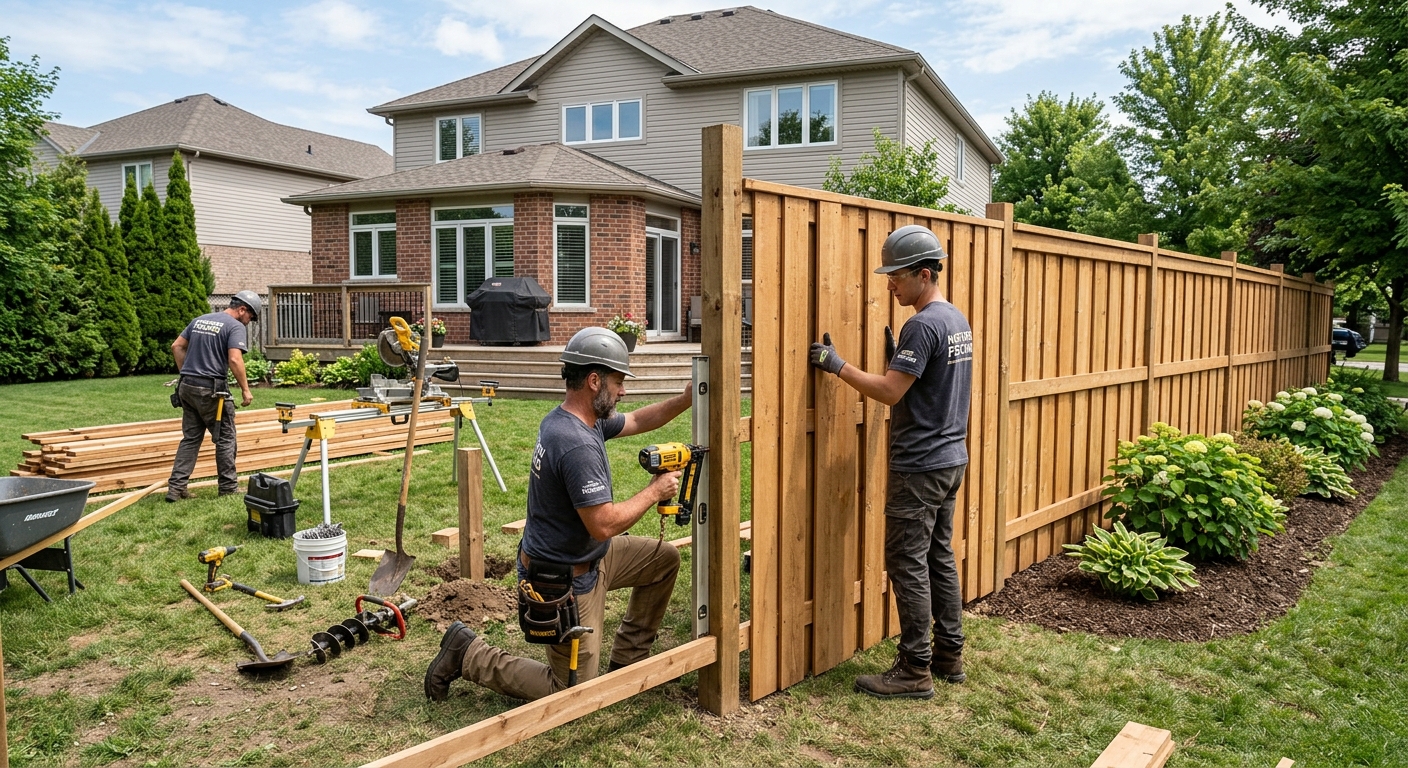
Fencing options and costs in Jackson Heights
In Jackson Heights, Alberta, the right fence usually comes down to balancing privacy, wind stability, and how often you’re willing to maintain wood. With a small local population of 3,911 (Statistics Canada, 2021 Census), demand concentrates where homeowners have the most exterior exposure—each detached home is effectively another potential fencing project, so neighbourhood patterns matter. In the broader Calgary economic region, trades availability is generally strong, but the Prairie weather drives higher labour demands when compared with milder parts of Canada.
Calgary’s Prairie continental climate brings long freeze–thaw cycles, and that’s a major reason fencing quotes aren’t just “material times a rate.” Contractors typically plan frost protection by setting posts about 4 ft (≈120 cm) deep (or roughly 120 cm placement into the ground) to reduce heaving risk. For 6 ft privacy fences and gate posts, that often means more excavation, more concrete, and longer posts—especially in open, wind-exposed areas where racking loads are higher. If you’re near Southport Landing-style open corridors or anywhere your backyard catches prevailing winds, you’ll usually see stronger panel and post requirements, which shifts costs upward.
That’s why Jackson Heights homeowners often compare wood, cedar, vinyl, chain-link, aluminum, and composite side by side before booking measurements—so they can match the fence to how their yard actually behaves. Below is a practical cost-and-performance snapshot to help you transition into estimating your own project.
| Material |
Lifespan |
Maintenance |
Privacy Rating |
Price per Linear Foot |
| Pressure-treated pine (standard wood) |
10–20 years |
Stain/seal every 2–3 years |
High (solid boards) |
$40–$80 |
| Cedar (natural rot resistance) |
15–25 years |
Seal every 2–3 years (recommended) |
High (solid boards) |
$55–$95 |
| Vinyl / PVC (no-maintenance) |
20–30 years |
Minimal (rinse as needed) |
Medium–High (panel dependent) |
$45–$90 |
| Chain-link (galvanized steel) |
25–40 years |
Low (occasional rinse) |
Low (privacy requires slats) |
$25–$55 |
| Aluminum ornamental |
30–50 years |
Low (rinse and occasional touch-ups) |
Low–Medium |
$70–$120 |
| Composite / recycled material |
25–35 years |
Low (wash; no staining) |
High (solid or board-style) |
$75–$120 |
Prices are estimates only and vary by project scope, site access and material selection.
What affects the price of fencing in Jackson Heights
In Jackson Heights, Alberta, you can absolutely see 30–50% differences between quotes for the same fence line because the “hidden” parts of installation vary: post depth strategy, panel strength for wind, excavation conditions, and how contractors price layout and site time. Even within the Calgary area, one crew may be quoting a basic post setting plan while another is including heavier wind bracing and fully concreted footings for privacy panels. That prairie exposure is a real cost driver—materials that look similar on a brochure can perform very differently once the frost line and high gusts are considered.
Frost line depth sets how deep posts must be set to prevent heaving. In colder Alberta regions, it’s common to plan post placement around 4–6 inches below the design frost depth, which often works out to roughly 1.5–2.0 m of ground penetration for many standard installations. That increases concrete volume and excavation time, and it can also require longer posts (more material cost). Wind exposure on the Prairies also drives tighter post spacing and heavier rails for solid wood or vinyl privacy fences, while chain-link stays cheaper partly because it has more airflow.
Local examples: (1) A 6 ft privacy fence on exposed lots typically needs stronger framework and closer spacing, pushing costs toward the mid–upper end of the wood or vinyl ranges. (2) If your yard is hard-packed or has rocky soil, excavation slows down and labour rises, especially when posts are meant to be concrete-set. (3) If you already have an old fence to remove, disposal and hauling can add time and tipping fees.
For budgeting, it helps to anchor expectations: chain-link often lands lower (about $25–$55 per linear foot), while wood and vinyl privacy commonly sit around mid to upper pricing (about $40–$90 per linear foot) when post depth and wind loading are done correctly. Housing-stock age can also matter—older yards sometimes need more grading around fence lines, which can change how posts sit and how much racking correction is needed.
| Price Factor |
Why It Matters |
Cost Impact |
| Fence length in linear feet |
Every additional foot adds posts, rails, and labour |
High (primary driver) |
| Post depth required |
Frost protection determines post length and hole depth |
Medium–High |
| Post setting method |
Concrete vs. gravel pack vs. driven posts changes labour and longevity |
Medium–High |
| Material choice |
Strength and airflow differ (privacy panels resist wind differently) |
Medium |
| Gate count and type |
Drive-through double gates need heavier frames |
High |
| Grade and terrain |
Slope requires stepped or raked panel systems |
Medium |
| Old fence removal and disposal |
Hauling, dump fees, and salvage (or disposal) time |
Medium |
| Permit fees and survey / property line locate |
Paperwork time and locating pins reduce boundary disputes |
Low–Medium |
Permits & regulations in Alberta
In Alberta, fencing is generally simple when you stay within your property line and respect municipal setback bylaws. However, fences above a height threshold—commonly about 2.0 m (6.5 ft) at the rear and about 1.0–1.2 m (3–4 ft) at the front or corner—often trigger a building permit requirement. Before anyone digs, ensure you know whether your fence location and height put you into the permit category, because the permitting process can add scheduling time and inspection requirements.
Every fencing job also needs utilities verification. Before digging post holes, call Alberta One-Call to request utility locates. You should also confirm your boundary using a survey or property line locate before installing posts; a small shift can create encroachment disputes that cost far more to correct later than it does to locate pins upfront.
Shared fence ownership along boundary lines is typically handled under Alberta’s line-fences rules, so it’s smart to confirm who is responsible for what—especially if your neighbour may also benefit from the fence.
How to verify your contractor in Jackson Heights, Alberta: (1) confirm their Alberta licence status through the relevant public registry or business listing, (2) ask for a current certificate of liability insurance and check that it matches your job address, and (3) request WSIB/WCB coverage evidence (or the applicable clearance documentation). If they can’t provide documents right away, that’s a red flag—quality fencing relies on proper coverage as much as it does on material.
Choosing the right fence material for Jackson Heights
Choosing a fence in Jackson Heights is really about matching material performance to Calgary-area freeze–thaw cycles, wind, and how much time you want to spend maintaining it. Pressure-treated pine is usually the budget pick, but it typically needs staining or sealing every 2–3 years to prevent grey weathering and to keep moisture from accelerating wear at joints. Cedar often looks better longer and naturally resists rot, yet it still benefits from periodic sealing in this climate. Vinyl/PVC is popular for low maintenance, but in extreme cold it can become more brittle if not installed with correct expansion considerations. Chain-link is the longest-life “low fuss” option and handles weather well, but it doesn’t deliver true privacy unless you add slats or move to a privacy top/mesh system.
Post-depth requirements matter regardless of material. With Prairie frost cycles, plan for posts set deeply (often around 4 ft ≈ 120 cm into the ground as a frost-protection approach). For solid 6 ft privacy fences and gate posts, concrete-set footings are commonly used to prevent heaving and racking. That’s one reason privacy fences generally cost more than chain-link: you’re paying for deeper excavation and sturdier framing to handle wind and snow load impacts on solid panels.
Where the dollar difference makes sense: if you compare a mid-range wood privacy fence (often around $40–$80 per linear foot) to vinyl (often $45–$90), vinyl can be justified when you want fewer maintenance seasons and longer service intervals. But if your yard is highly exposed and your priority is maximum strength, the extra investment in better posts and rails will usually outperform any minor material savings.
| Material |
Cold Tolerance |
Lifespan |
Annual Maintenance |
Best For |
Price Band |
| Pressure-treated pine |
Good with proper sealing |
10–20 years |
2–3 year stain cycle (seasonal prep) |
Budget privacy with periodic upkeep |
$40–$80 |
| Cedar |
Very good |
15–25 years |
2–3 year seal cycle (recommended) |
Premium look and strong rot resistance |
$55–$95 |
| Vinyl / PVC |
Good (install correctly for cold) |
20–30 years |
Little to none (rinse) |
Low-maintenance privacy |
$45–$90 |
| Chain-link |
Excellent |
25–40 years |
Low (occasional rinse) |
Security, airflow, value |
$25–$55 |
| Aluminum ornamental |
Excellent |
30–50 years |
Low (rinse) |
Decorative fencing with no rust |
$70–$120 |
| Composite / recycled |
Very good |
25–35 years |
Low (wash) |
Solid privacy with minimal upkeep |
$75–$120 |
How to choose a fencing contractor in Jackson Heights
When you’re hiring a fence contractor in Jackson Heights, Alberta, start by verifying the core proof items: Alberta licensing (where applicable to their trade/business), liability insurance, and WSIB/WCB coverage. Ask for documents before you sign anything. To check liability, request a certificate of insurance and confirm it lists your jobsite (or at least your project location) and that coverage limits are reasonable. For coverage, ask for proof of WSIB/WCB enrollment or a clearance letter showing you’re protected if an on-site injury occurs.
Next, get 2–3 itemised written quotes—not just one number. A good quote separates labour (excavation, setting, framing, install), materials (posts, rails, panels, fasteners, gates), and logistics (site protection, disposal, any concrete). Read exclusions carefully: is permit pulling included, or is it your responsibility? Is old fence removal and dump disposal included, or billed separately per truckload? Also check if they include property line locate/survey costs or if they assume pins are already known.
Warranty matters. Ask about workmanship warranty length and whether it covers post setting, sagging, and wind-related racking at typical loads. Confirm product/manufacturer warranty terms and whether it’s transferable to future owners—some brands are strict about this.
Payment schedule should be conservative: never pay more than 10–15% upfront. Hold back a portion until the fence is complete, straight, properly tensioned (where applicable), and cleaned up. Finally, require a start date and a realistic completion estimate in writing, including weather contingency days for Calgary-area freeze–thaw conditions.
- Request proof of current liability insurance (certificate provided before work starts)
- Request WSIB/WCB clearance or documentation
- Verify the contractor’s Alberta business/registration information publicly
- Ask whether concrete is included where required for privacy and gate posts
- Confirm post depth approach for frost protection (and whether it’s included in the scope)
- Get quotes measured and itemised by linear foot and by fence section (not lump sum)
- Ask for a gate framing spec (hinges, latch type, reinforcement) included in the price
- Confirm how they handle slopes (stepped vs raked) and who sets the line level
- Confirm disposal and hauling are included or quoted separately with rates
- Ask if permit pulling and inspections are included when required by height/location
- Confirm warranty terms: workmanship duration + product warranty transferability
- Use a payment schedule with no more than 10–15% upfront and a completion holdback
In Jackson Heights, specific red flags include: (1) a quote that refuses to confirm frost-depth and post-setting method, (2) no written scope for gate reinforcement, (3) “lump sum only” pricing with no disposal/permit clarity, (4) inability to provide insurance and WCB/WSIB proof, and (5) asking for large upfront payments (well beyond 10–15%).
Frequently asked questions — fencing in Jackson Heights
What's the best fence for privacy?
For privacy in Jackson Heights, Alberta, the best results usually come from solid board-style wood, vinyl/PVC privacy panels, or composite privacy systems. In Calgary’s freeze–thaw environment, the privacy rating isn’t just about “solid vs not”—it’s also about structure. A solid fence sees more wind load, so contractors typically set posts deeper (often around 4 ft ≈ 120 cm for frost protection) and use concrete-set footings for 6 ft panels and gate posts. If you’re comparing costs, privacy wood often falls around $40–$80 per linear foot, while vinyl privacy commonly runs $45–$90. If you choose chain-link, expect poor privacy unless you add slats or a privacy screen system.
How do I compare fencing quotes?
When comparing fencing quotes in Jackson Heights, start by making sure each proposal includes the same scope: post depth plan, concrete vs gravel pack, panel type, gate hardware, and disposal. Quotes can vary by 30–50% when one includes frost-depth excavation and the other assumes shallower holes. Ask for an itemised breakdown—labour, materials, and extras like permit pulls (if required), utility locate coordination, and old fence removal. Also compare warranty terms: workmanship and product coverage. Finally, check pricing against the local bands—chain-link often sits around $25–$55 per linear foot, while aluminum/metal is typically higher at $70–$120. A “cheap” quote can cost more later if it omits concrete setting or uses fewer posts.
How long does fence installation take in Jackson Heights?
Timing in Jackson Heights depends on fence length, access, and how many posts are being concreted. After layout and utility locates, most crews can complete installation faster on straight runs, but longer projects take extra time for excavation at frost-depth and for gate framing. Weather also matters: during freeze–thaw periods in the Calgary region, concrete setting and digging schedules can shift. As a practical expectation, a typical mid-size residential fence might take a few days of active work, with excavation and concrete cure affecting the exact sequence. If your project includes permit processing (often for taller fences), that can also add scheduling time before installation starts.
Can I install a fence on a slope in Jackson Heights?
Yes, you can install a fence on a slope in Jackson Heights, Alberta. The key is how it’s graded: most contractors use stepped panels or a raked system so the fence line stays level-to-the-yard without creating gaps that make privacy weaker and can increase racking in wind. Because Calgary-area freeze–thaw can move soils, a careful post-by-post approach matters more than trying to “average” the slope. When you request your quote, ask how they will handle your grade and whether the price includes labour for stepped/raked layout adjustments. A well-done sloped installation may cost slightly more due to layout time and material cutting, but it prevents long-term misalignment and uneven panel performance.
What is the most weather-resistant fence for Jackson Heights's climate?
For Jackson Heights’ Prairie continental climate, the most weather-resistant options are typically chain-link (galvanized steel) and well-installed aluminum ornamental—both handle cold and wet cycles well. Chain-link is also less affected by wind pressure because it allows airflow through the mesh, which reduces strain on posts. If you need privacy rather than just durability, a properly concreted wood, cedar, vinyl, or composite privacy fence can also perform extremely well, as long as frost protection and wind loading are addressed. In most Calgary-area jobs, post depth and correct setting method are as important as material. If you’re comparing budgets, chain-link commonly lands in the $25–$55 per linear foot range, while aluminum/metal often sits higher at $70–$120.
How do I prevent wood fence rot in Jackson Heights?
Preventing rot for wood fences in Jackson Heights starts with how the posts and boards are treated and installed. Choose pressure-treated pine or cedar and make sure fasteners and contact points reduce moisture retention. The big win is proper post setting: posts should be set with frost protection in mind (often requiring deep holes and frequently concrete footings on privacy fences) so water doesn’t pool at ground contact. Also keep wood off soil where possible and seal/stain on a regular cycle—pressure-treated pine usually needs attention every 2–3 years, and cedar benefits from sealing as well. Finally, confirm your contractor includes correct rail spacing and doesn’t trap water in panel seams. In Alberta winters, ignoring these details can shorten lifespan significantly, especially during repeated freeze–thaw.