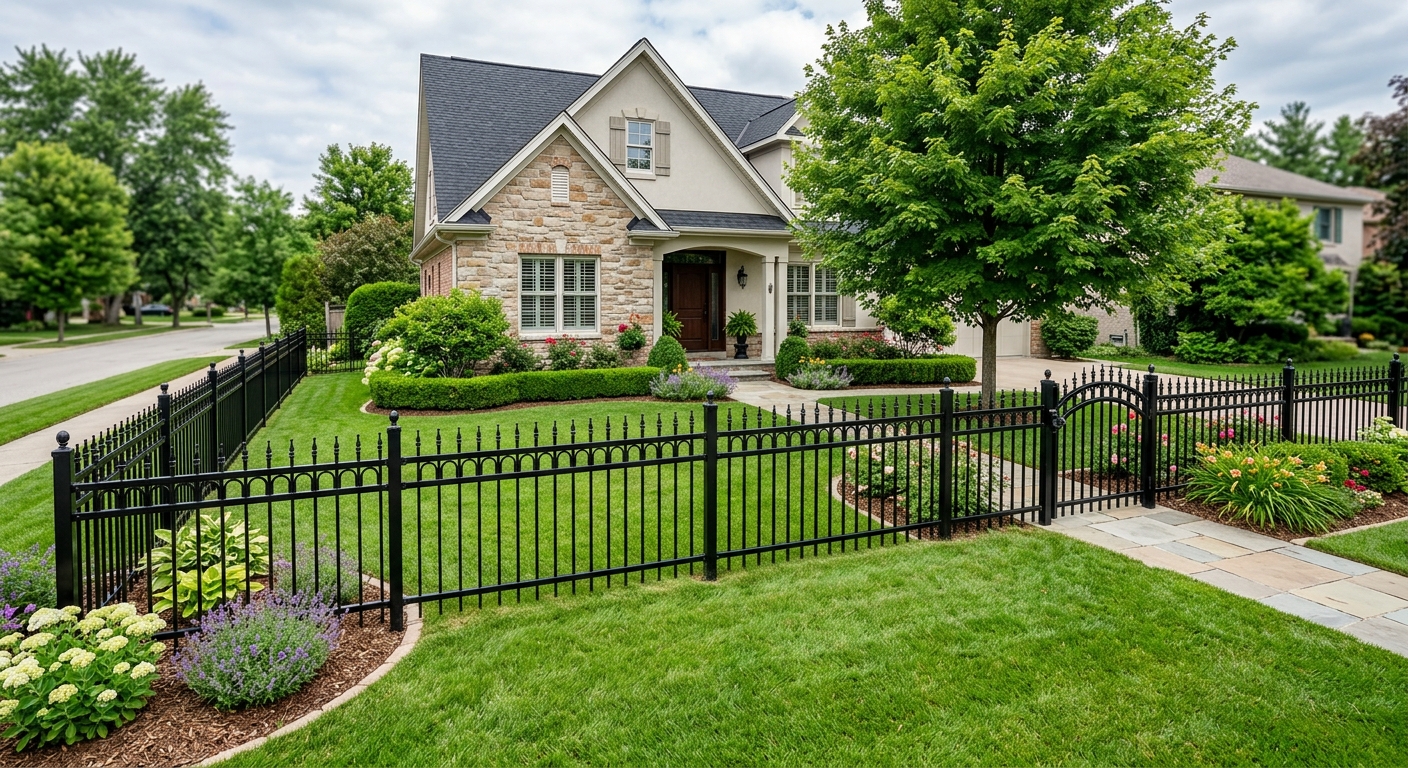
Fencing options and costs in Trail
In Trail, British Columbia, homeowners typically fence for privacy, property definition, and animal control—especially because most local housing stock is older. With about 70.4% of dwellings being single-detached homes (Statistics Canada, 2021 Census), there’s a steady, predictable demand for backyard upgrades, dog runs, and boundary replacements. Ownership is also relatively high, with 68.9% of households owning homes, which tends to translate into more long-term exterior projects rather than short-term rentals.
Cost in the Kootenays is shaped less by “panel price” alone and more by the ground they set into. The freeze–thaw cycle and frost depth drive deeper augering, more concrete per post, and additional labour for corners and gate posts. In valley areas around Trail, colder winter lows tend to keep frost active longer, so many installs use concrete footings set close to (or below) local frost depth rather than the lighter tamped-backfill approach used in milder regions. That’s why two fences that look similar on paper can land far apart in price.
Trade demand is especially strong in established neighbourhoods like downtown Trail and the West Trail area, where older lots often need board/rail replacements, privacy upgrades, and rail-to-gate retrofits. Contractors also see heavier work when yards are sloped or when there’s an existing fence that must be removed before new posts can be set correctly.
Below is a practical comparison of common fencing materials you’ll hear about from Trail contractors, including typical lifespan, maintenance expectations, and price ranges that reflect the region’s deeper post requirements.
| Material |
Lifespan |
Maintenance |
Privacy Rating |
Price per Linear Foot |
Price Range |
| Pressure-treated pine (standard wood) |
8–15 years |
Stain/seal every 2–3 years to slow grey weathering and splitting |
High (solid boards) |
Approx. $45–$75/LF |
$45 – $75 |
| Cedar (natural rot resistance) |
15–25 years |
Seasonal inspection; re-stain as needed (often every 3–5 years) |
High (solid boards) |
Approx. $60–$95/LF |
$60 – $95 |
| Vinyl / PVC (no-maintenance) |
20–30 years |
Rinse as needed; check alignment after extreme cold snaps |
High (solid panels) |
Approx. $70–$110/LF |
$70 – $110 |
| Chain-link (galvanized steel) |
20–35 years |
Minimal; occasional tension/repair at corners |
Low–Medium (privacy slats optional) |
Approx. $30–$55/LF |
$30 – $55 |
| Aluminum ornamental |
25–40 years |
Wash/rinse; inspect gate hardware |
Low–Medium (open pickets) |
Approx. $80–$140/LF |
$80 – $140 |
| Composite / recycled material |
20–30 years |
Low; follow manufacturer cleaning instructions |
High (solid styles) |
Approx. $85–$130/LF |
$85 – $130 |
Prices are estimates only and vary by project scope, site access and material selection.
What affects the price of fencing in Trail
In Trail and across the Kootenays, quotes for what looks like the same fencing job can differ by 30–50%. The biggest driver is how your contractor has to design and build for local ground and wind—not just which boards or panels you pick. Labour availability can also tighten seasonally, and once a crew has to mobilize equipment for deeper augering and concrete setting, the cost per post climbs quickly.
The frost line is the core reason. In Kootenay conditions, posts are typically set about 4–6 inches below the design frost depth to reduce heaving. In colder regions closer to southern interior winters, posts often need roughly 1.5–2.0 m into the ground, which increases labour time, requires longer posts, and adds more concrete per footing—especially for structural corners and drive-through gate posts. That’s why wood installs can land near the top end of the $45–$75 wood band and why vinyl or aluminum projects frequently track toward the upper portion of their ranges.
Trail’s microclimates matter too. Valley-bottom yards can see persistent freeze longer than milder spots, so a “quick set” method isn’t always realistic. For concrete cost examples: (1) a 70 ft privacy fence with 9–10 concrete-set posts can require noticeably more concrete than the same length on a flatter, easier yard; (2) adding a double driveway gate often means heavier hinges and at least two reinforced posts with deeper footing, which can shift the overall project closer to the $70–$110 vinyl band or the $80–$140 aluminum band even if the run length stays similar; (3) removing an old fence layer by layer (rails, posts, and buried anchors) adds labour that doesn’t show in material-only comparisons.
Also, many Trail homes were built before 1981 (87.4% of dwellings, Statistics Canada, 2021 Census), meaning more frequent boundary renovations and older underground utilities to work around—another reason site assessment affects the final quote.
| Price Factor |
Why It Matters |
Cost Impact |
| Fence length in linear feet |
Most costs scale directly with total run length (posts, panels, labour travel time) |
High (often the largest portion of the quote) |
| Post depth required |
Frost line determines how deep holes must be for heave resistance |
Medium–High (adds excavation time and concrete) |
| Post setting method |
Concrete-set posts resist lateral and uplift forces better in freeze–thaw soils than gravel packs alone |
Medium (concrete + labour vs. lighter backfill) |
| Material choice |
Vinyl/PVC and aluminum have higher material costs; cedar and wood involve finish and longevity trade-offs; chain-link is cheapest but offers less privacy |
High (selects the base price band) |
| Gate count and type |
Drive-through double gates require heavier posts, bracing, and hinge hardware |
High for drive-through; Medium for walk-through |
| Grade and terrain |
Slope requires stepped panels or racked rails, and longer post lines or more labour fitting |
Medium (labour and material trimming) |
| Old fence removal and disposal |
Unearthing old posts, hauling scrap, and site cleanup add time and dump fees |
Medium (can add 10–25% depending on conditions) |
| Permit fees and survey / property line locate |
Admin costs and locating boundary pins reduce dispute risk and prevent rework |
Low–Medium (often small, but crucial when needed) |
Permits & regulations in British Columbia
In British Columbia, fences above certain height thresholds often trigger a building permit—commonly around 2.0 m (6.5 ft) for rear yards and roughly 1.0–1.2 m (3–4 ft) for front or corner areas, depending on the application and local rules. Regardless of height, you still need to respect property lines and any municipal setback requirements that apply in your area of Trail.
Before digging any post holes, it’s essential to arrange utility locates (BC 1 Call is the usual channel in the province). Digging without locates is a major risk even for straightforward fencing because service lines can run close to foundations and boundary edges.
Step-by-step, homeowners in Trail can reduce headaches: (1) confirm your boundary by getting a survey or at least locating your property pins; (2) ask your contractor to confirm the line-fence approach and ensure construction stays on your side unless you’re using a shared fence arrangement; and (3) if your planned fence height crosses the typical thresholds, request permit guidance and determine whether a permit is required before work starts.
As a practical rule of thumb: privacy fences and tall ornamental fences are the projects most likely to need permits. Lower-than-threshold repair-in-kind replacements usually don’t require new permits, but verification is still worth it.
For the contractor check: verify the fence builder’s BC licence/registration where applicable for their trade, review their certificate of insurance (liability) for the correct policy dates and coverage limits, and confirm their clearance letter for worker coverage (WSIB/WCB equivalent coverage in your jurisdiction). Ask to see proof before signing.
Choosing the right fence material for Trail
Choosing a fence in Trail is really about matching material to how it will behave through freeze–thaw, snow loading, and strong winter winds. Pressure-treated pine is the budget-friendly option, but it needs proactive finishing—usually staining or sealing about every 2–3 years—to prevent grey weathering and early splitting. Cedar looks better for many homeowners and naturally resists rot, which can be a real advantage in wetter stretches, but it still benefits from regular inspection and periodic staining.
Vinyl/PVC offers the lowest day-to-day maintenance (wash and occasional checks), yet in extreme cold it can contract; proper post spacing and panel mounting details matter, especially when the yard is exposed. Chain-link is the lowest upfront material cost and usually lasts a long time, but privacy is limited unless you add privacy slats or a lattice/trellis solution. Aluminum ornamental fencing won’t rust and performs well through interior winters, but it’s typically open-picket—so it’s better for visibility and curb appeal than full privacy. Composite/recycled panels can deliver a solid privacy look with low maintenance, but the best results still depend on correct footing depth and straight post lines.
For Trail’s Kootenay frost environment, concrete-set posts are commonly the safer choice when you want long-term stability. Even when material changes, the ground work is often similar: deeper post holes and properly set footings to reduce heaving. Heavier snow drifts and wind can rack lighter frames, so tighter post spacing and reinforced framing are important for tall privacy fences.
Dollar example: if you’re comparing a wood privacy run that lands around the $45–$75 band versus vinyl closer to the $70–$110 band, the extra vinyl cost can be justified when you want fewer maintenance cycles in an area where older homes (87.4% built before 1981) are often busy with other exterior tasks.
| Material |
Cold Tolerance |
Lifespan |
Annual Maintenance |
Best For |
Price Band |
| Pressure-treated pine |
Good (with proper seal and post depth) |
8–15 years |
Inspect yearly; stain/seal every 2–3 years |
Lower upfront cost and classic look |
Wood installation: $45–$75 |
| Cedar |
Good (natural durability helps through wet/dry swings) |
15–25 years |
Inspect yearly; re-stain as needed (often 3–5 years) |
Appearance and rot resistance |
Wood installation: $60–$95 |
| Vinyl / PVC |
Very good (proper spacing prevents contraction issues) |
20–30 years |
Minimal (wash; check hardware after extreme cold) |
Low maintenance and clean lines |
Vinyl / PVC: $70–$110 |
| Chain-link |
Excellent (metal survives freeze–thaw well) |
20–35 years |
Low (check tension and corner posts) |
Security and budget control |
Chain-link: $30–$55 |
| Aluminum ornamental |
Excellent (powder-coated; cold doesn’t corrode like wood rot) |
25–40 years |
Minimal (rinse and hardware checks) |
Decorative appearance with durability |
Aluminum / metal: $80–$140 |
| Composite / recycled |
Good (avoid poor installation practices) |
20–30 years |
Low (follow manufacturer cleaning) |
Privacy with less upkeep than wood |
Composite: $85–$130 |
How to choose a fencing contractor in Trail
Picking a contractor in Trail is mostly about verifying they’re set up to do the “hard parts” correctly: deep post installation for frost, clean linework, and proper safety/coverage. Start by confirming British Columbia licensing/registration where applicable for fencing work. Next, ask for proof of liability insurance—you want a current certificate with adequate coverage limits—and confirm they have the correct worker coverage clearance letter for their crews (WSIB/WCB coverage requirements in the province/jurisdiction they operate under).
Then get 2–3 itemised written quotes. A strong quote breaks down labour and materials separately (posts, rails, panels/boards, hardware, concrete, gates, and any fence removal). Avoid lump sums that don’t explain what’s included, especially because in the Kootenays the concrete and excavation scope can swing your final total.
Read exclusions carefully: is permit pulling included (if required), is disposal included for old fencing, and is the quote for surface grading/backfill or for proper stepped/raked installation on sloped yards? Ask about warranty details: you want a clear workmanship warranty length, the manufacturer warranty on materials, and whether warranties are transferable if you sell your home.
For payment terms, never pay more than 10–15% upfront. Hold back remaining payments until the job is complete, posts are set and cured as required, and all gates are functional. Request a start date and completion estimate in writing, with a weather contingency statement that reflects freeze–thaw schedules typical for Trail.
- Confirm proof of liability insurance with policy dates and coverage amount
- Ask for the worker coverage clearance letter before work begins
- Verify any required BC registration/licence for the specific work being quoted
- Require an itemised quote: labour, materials, concrete/footings, hardware, gates
- Ensure post depth/frost design method is stated (not “standard depth”)
- Confirm whether old fence removal and disposal are included
- Check if utility locates are included or your responsibility
- Ask who handles permits if your fence exceeds the typical BC height thresholds
- Verify warranty terms: workmanship duration and manufacturer warranty coverage
- Clarify payment schedule and holdback amount
- Request a written timeline with start and completion dates
- Confirm gate hardware spec (hinge type, latch type, reinforcement posts)
Concrete red flags we see in Trail include: (1) quoting “shallow tamped posts” without discussing frost depth; (2) refusing to provide insurance paperwork or clearance letter; (3) offering a price with no concrete/excavation line items; (4) not addressing slope/grade (racking vs. stepped panels) when your yard isn’t level; and (5) asking for most payment up front (beyond 10–15%) or pushing you to sign before reviewing scope and warranty.
Frequently asked questions — fencing in Trail
How do I handle a fence dispute with a neighbour in British Columbia?
In Trail and across British Columbia, the best first step is to confirm where the boundary actually is. Get a survey or locate your property pins and compare that to where the fence line was built. If the dispute is about a shared fence, British Columbia line-fence rules typically guide cost-sharing and responsibilities, but the starting point remains the legal boundary. Then document everything: photos of the fence condition, measurements, and any written communications. If you can’t resolve it directly, consult a professional (often a surveyor) to clarify the boundary and consider mediation options before escalating. If you’re planning changes, avoid removing or rebuilding in a way that could be seen as encroachment while the boundary is unclear.
What fence style offers the best wind resistance in Trail?
For wind resistance in Trail, the goal is to reduce “sail” while keeping the frame rigid under lateral loads. Solid privacy fences can perform well when they’re built with proper reinforcement—strong line posts, correctly spaced vertical posts, and reinforced corner/gate supports with concrete-set footings designed for frost. Semi-privacy (lattice with spacing) and properly tensioned chain-link also hold up, but chain-link is less private. On exposed stretches—common on ridgeline or open yard fronts—installers may tighten post spacing and add diagonal bracing to prevent racking. If you’re budgeting, remember wind-prone sites often cost closer to the top of the material band once labour and reinforced framing are added.
How much does a fence cost in Trail?
Fence costs in Trail depend heavily on length, gate count, and how deep the posts must be set for frost. As a baseline, wood fencing typically comes in around $45–$75 per linear foot, while vinyl/PVC commonly runs about $70–$110 per linear foot. Chain-link is usually the lowest cost at about $30–$55 per linear foot, and aluminum ornamental often lands around $80–$140 per linear foot. If your yard is sloped or you need fence removal, expect the project to move toward the higher end because excavation, concrete volume, and labour increase. Most of the variation between quotes in the Kootenays comes from footing scope and access, not just the material you choose.
How deep should fence posts be for Trail's frost?
For Trail’s freeze–thaw conditions, post depth must be planned around the design frost depth rather than using “2 ft” rules from milder regions. In practice, many contractors set posts about 4–6 inches below the design frost depth to help prevent frost heave. That usually means deeper holes and longer posts—often in the range of roughly 1.5–2.0 m depending on local frost conditions and your soil. For corner posts and gate posts, concrete-set footings are commonly used to resist uplift and lateral pressure. The exact depth should be confirmed in writing in your quote, because soil type, drainage, and slope can change the needed design.
Wood vs vinyl vs aluminum fence — which is best?
“Best” depends on your priorities. Wood (pressure-treated or cedar) gives a classic look and usually costs within the wood band (often similar to $45–$75 per linear foot for standard pressure-treated builds, with cedar often trending higher). However, wood requires ongoing maintenance: expect staining/sealing every couple of years for pressure-treated pine. Vinyl/PVC is the lowest-maintenance option but typically costs more—often around $70–$110 per linear foot—and installation details matter in extreme cold. Aluminum is highly durable and resists rust, often priced around $80–$140 per linear foot, but it’s commonly more ornamental with less privacy unless you choose a solid/privacy style. In Trail’s climate, correct post depth is critical for all three.
Do I need a permit to build a fence in British Columbia?
In British Columbia, permits are commonly required for fences above typical height thresholds—often around 2.0 m (6.5 ft) at the rear and roughly 1.0–1.2 m (3–4 ft) at the front or corner—though local application details can change outcomes. Even when permits aren’t required, fences must follow property line rules and municipal setback bylaws in the Trail area. Before work starts, you should also plan for utility locates by calling the BC 1 Call process before any post-hole digging. To verify a contractor’s process, ask whether they include permit pulling (if required) and confirm in writing how they handle setbacks and property line locating to avoid encroachment disputes.