Fencing options and costs in West Vancouver
In West Vancouver, the right fence choice usually comes down to privacy needs, maintenance tolerance, and how much coastal wind you expect from your yard’s orientation. With a population of 44,122 and 12,535 homeowner households (Statistics Canada, 2021 Census), most streets here have someone updating an existing boundary fence—especially around older single-detached neighbourhood pockets where replacements are common. In fact, 55.6% of dwellings are single-detached homes (Statistics Canada, 2021 Census), so fencing work is steady for perimeter replacements, front-yard upgrades, and side-yard privacy barriers. The housing-stock mix matters too: 53.8% of homes were built before 1981, and those properties often have aging posts, leaning panels, or gaps that fail over successive wet winters.
Lower Mainland–Southwest pricing is shaped by “mild but not trivial” frost and wind. Even in coastal BC, contractors typically set posts below the local frost influence to reduce heaving, and wetter soils around the region often mean deeper holes, more concrete at key posts (corners and gates), and extra labour time. If you’re in wind-exposed areas near the North Shore ridgeline corridors (for example, parts of Canyon Heights or Sentinel Hill), crews often recommend tighter framing and stronger post spacing, which can push you into the higher end of the material ranges. Once you know whether you want wood, vinyl, chain-link, or ornamental metal, it’s easier to compare realistic installed budgets—so here are common cost bands and what they tend to look like in West Vancouver.
| Material |
Lifespan |
Maintenance |
Privacy Rating |
Price per Linear Foot |
| Pressure-treated pine (standard wood) |
10–15 years |
Stain/seal every 2–3 years |
8/10 (solid boards) |
$55 – $95 |
| Cedar (natural rot resistance) |
15–25 years |
Light staining yearly; periodic reseal |
9/10 (solid boards) |
$65 – $110 |
| Vinyl / PVC (no-maintenance) |
20–30 years |
Rinse as needed; no staining |
8.5/10 (privacy styles) |
$75 – $130 |
| Chain-link (galvanized steel) |
25–40 years |
Occasional rinse; keep tensioned |
2–3/10 (security only) |
$30 – $55 |
| Aluminum ornamental |
30–40 years |
Wash; minor touch-ups if needed |
3–4/10 (semi-privacy with infill) |
$90 – $170 |
| Composite / recycled material |
20–30 years |
Minimal cleaning; rare repairs |
8/10 (solid or semi-solid) |
$80 – $150 |
Prices are estimates only and vary by project scope, site access and material selection.
What affects the price of fencing in West Vancouver
In the Lower Mainland–Southwest, it’s common to see the “same” fence quote swing by 30–50% across different contractors and neighbourhoods. A big reason is that West Vancouver jobs often combine tight access (driveway gates, landscaping, steep driveway edges) with wetter soils and frequent wind load. Labour availability also influences timing and rates; crews may charge more when they’re booking multiple replacement projects during peak season. Meanwhile, material pricing can differ by brand and profile (privacy slats, post caps, reinforced corners), and those structural details are what make a fence last through BC’s wet seasons.
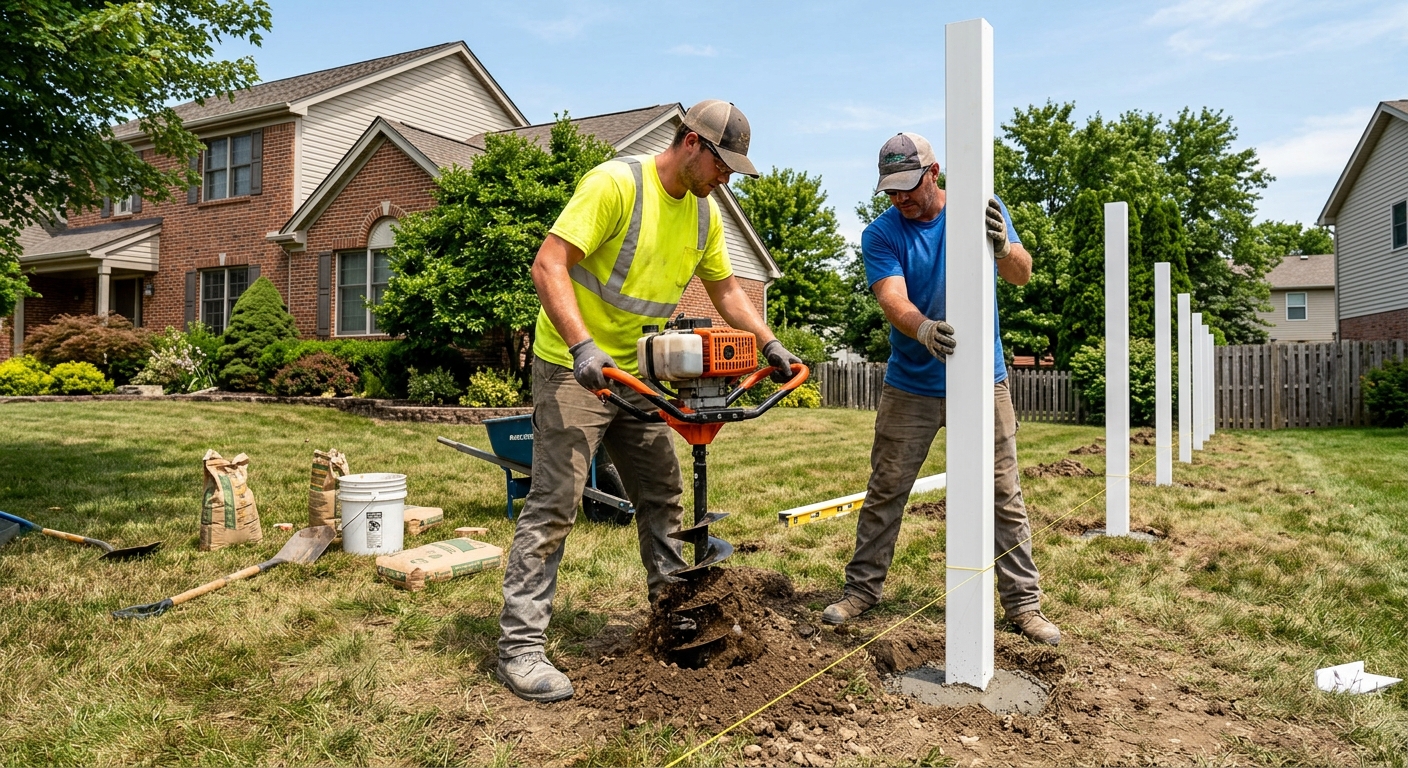
Post depth is another cost lever. Frost line guidance in Canada is typically about setting posts roughly 4–6 inches below the design frost influence, and while BC coastal conditions are shallower than Ontario or Alberta, contractors still commonly go deeper than “bare minimum.” The cost impact is real: deeper holes mean longer posts, more excavation time, and more concrete for corner posts, gate posts, and privacy runs. In colder Ontario and Alberta regions, posts often need to go about 1.5–2.0 m into the ground, which raises material and labour cost; in West Vancouver you may not match that depth, but wind-exposed yards often still end up using concrete-set posts for stability.
Two local examples that commonly raise costs: (1) granite-like or wet clay soils around excavations can slow auger work and increase disposal; and (2) sloped properties in the hills often require stepped panels or raked framing, which adds labour and trim. By contrast, a flat backyard with easy truck access can keep you nearer the lower bands—e.g., chain-link around $30 – $55 per linear foot—while solid privacy wood or vinyl can move toward $75 – $130 per linear foot once you add stronger posts, more bracing, and reinforced gate hardware.
| Price Factor |
Why It Matters |
Cost Impact |
| Fence length in linear feet |
Most fencing is priced by perimeter; every extra foot adds labour, rails, and materials |
Major driver (often determines the final total) |
| Post depth required |
Frost and soil conditions affect how deep holes must be; deeper holes mean longer posts |
Moderate to major (more excavation, more concrete) |
| Post setting method |
Concrete vs gravel pack vs driven posts affects stability and water movement |
Moderate (concrete increases material and install time) |
| Material choice |
Vinyl and composite are structural systems; cedar needs specific detailing |
Moderate to major (moves you across $ bands) |
| Gate count and type |
Double gates, sloped tracks, and custom latches demand more framing and hardware |
Moderate (gates can add significant cost per opening) |
| Grade and terrain |
Sloped yards require stepping or raking; steep sites increase labour and layout time |
Moderate (often adds trim, labour hours, and wastage) |
| Old fence removal and disposal |
Hauling, deconstruction, and disposal vary by material and access |
Low to moderate (can become moderate on tight sites) |
| Permit fees and survey / property line locate |
Some projects need permits and accurate pin locations to avoid encroachment |
Low to moderate (timing and paperwork add overhead) |
Permits & regulations in British Columbia
In British Columbia, fence rules are typically tied to height, location, and setbacks, and some fences do need a building permit. As a practical guideline, fences above the common threshold of about 2.0 m (6.5 ft) at the rear and about 1.0–1.2 m (3–4 ft) at the front or corner often trigger a permit requirement (depending on local bylaws and the fence’s exact position). Regardless of permit needs, your fence must respect property lines and any municipal setback bylaws.
Before you dig any post holes, you should call for utility locates. In BC this is done through BC 1 Call (or the equivalent utility-locating service for your area). Even if your yard looks clear, a single buried service line can turn a routine post-hole into an expensive delay or safety issue. Next, verify your property pins or obtain a survey/locate so you can confirm where the fence should sit—especially in West Vancouver where older boundary lines and prior survey methods can differ from what owners remember.
For shared fences and boundary disputes, line-fences legislation in BC governs shared responsibility and cost-sharing where applicable. For homeowner verification, ask your contractor for: (1) their licence/registration details (as required for the work type), (2) proof of liability insurance, and (3) coverage for worker-related claims as applicable. You can also request a current certificate of insurance and any contractor clearance documentation provided by their insurer, then confirm dates and scope match your project before work starts.
Choosing the right fence material for West Vancouver
Choosing a fence in West Vancouver is mostly about matching material performance to coastal weather and your day-to-day preferences: privacy, low maintenance, and how often you’re willing to refinish. Pressure-treated pine is the budget-friendly route, but it typically needs staining/sealing every 2–3 years to prevent grey weathering and premature surface breakdown. Cedar looks great and naturally resists rot better, which matters in our wet winters, but it still requires periodic staining to keep its colour and to protect the surface. Vinyl/PVC offers genuinely low maintenance—no staining, easy rinsing—but it can become brittle if exposed to frequent extreme cold snaps; West Vancouver is usually mild, yet coastal temperature swings still make installation quality and correct panel restraint important.
Chain-link is the most economical and long-lasting option, but it won’t give you privacy unless you add slats or planters. Aluminum ornamental fencing resists rust and looks clean for decades, though it’s not designed for full privacy. In windy or exposed yards, wind load affects panel stiffness; solid wood and vinyl privacy styles usually need stronger posts and bracing rather than wider spacing. On post installation, even with Lower Mainland–Southwest’s relatively shallow coastal frost influence, contractors typically still set posts below frost influence and often use concrete for corner posts, gate posts, and privacy runs—because soil moisture and wind both work against fence alignment.
As a quick money reality check: if chain-link at roughly $30 – $55 per linear foot meets your security goal but not your privacy goal, upgrading to vinyl privacy around $75 – $130 per linear foot can be justified when you’ll actually use your yard—especially if you’re adding a gate and wind-resistant framing. The higher upfront cost buys you calmer daily outdoor space rather than just “a boundary.”
| Material |
Cold Tolerance |
Lifespan |
Annual Maintenance |
Best For |
Price Band |
| Pressure-treated pine |
Good (stain protects surface) |
10–15 years |
Seasonal check; stain/seal every 2–3 years |
Budget privacy with planned upkeep |
$55 – $95 |
| Cedar |
Good (seasonal shrinkage normal) |
15–25 years |
Light stain yearly or as needed |
Natural look + better rot resistance |
$65 – $110 |
| Vinyl / PVC |
Very good (quality installation matters) |
20–30 years |
Rinse or wash as needed |
Low maintenance privacy and clean lines |
$75 – $130 |
| Chain-link |
Excellent (metal resists weathering) |
25–40 years |
Minimal; tension checks and wash |
Security, long service life, lower cost |
$30 – $55 |
| Aluminum ornamental |
Excellent (no rust) |
30–40 years |
Wash; inspect hardware |
Front curb appeal with security |
$90 – $170 |
| Composite / recycled |
Good (varies by brand/profile) |
20–30 years |
Minimal cleaning; rare repairs |
Maintenance-free look with solid panels |
$80 – $150 |
How to choose a fencing contractor in West Vancouver
When you hire a fencing contractor in British Columbia, don’t rely on word-of-mouth alone—verify core protections up front. Ask for proof of liability insurance (and confirm it covers fencing work, jobsite activities, and property damage), and request their worker-coverage documentation as applicable. If they subcontract, ask who will actually be on your site and whether their coverage extends to your project. For licensing, check the contractor’s relevant registry/online listing that matches the type of work they’re doing, and confirm the clearance is current. For your peace of mind, keep copies of their certificate of insurance and any clearance letter on file before the first post hole is dug.
Next, get 2–3 itemised written quotes—not lump sums—so you can compare like-for-like. A good quote breaks out labour hours, excavation and post setting method, material grades, rail spacing, gate hardware, and whether removal/disposal is included. Read the exclusions: are permits included or an add-on? Is old fence removal included? Is site restoration (topsoil, landscaping patching, and cleanup) part of the scope? Warranty matters too: ask for the workmanship warranty length and whether the product/manufacturer warranty is included in a way that stays valid if you sell your home (transferability is a common question).
Finally, manage payment. Don’t pay more than about 10–15% upfront; hold back the remainder until the job is complete, posts are set correctly, gates align, and final cleanup is done. Ask for a written timeline: planned start date, estimated duration, and what happens if weather delays installation.
- Request their proof of liability insurance before signing anything.
- Confirm worker coverage documentation is current and matches your project dates.
- Verify the contractor’s registration/licence status using the appropriate BC online registry.
- Ask for itemised quotes: labour, materials, concrete/post setting, gates, and disposal.
- Confirm whether permit pulling is included or billed separately.
- Check whether utility locates are arranged prior to digging.
- Ask who does layout and property line verification (survey vs locate pins).
- Clarify old fence removal: take-away, hauling, and disposal fees.
- Get written details for post depth, spacing, and which posts are concrete-set.
- Confirm gate hardware: latch type, hinges, and whether reinforcement is included.
- Review workmanship warranty duration and what it covers (settling, misalignment, fasteners).
- Don’t pay more than 10–15% upfront; hold back until final inspection and cleanup.
In West Vancouver, red flags include: quotes that don’t specify post depth and setting method, “unlimited” work using vague scopes (no gate hardware or disposal details), refusal to provide an insurance certificate, asking for large upfront payments, and a missing written start/completion timeline—especially if they can’t explain how they’ll handle wet soil, slope, and wind exposure.
Frequently asked questions — fencing in West Vancouver
What fence style offers the best wind resistance in West Vancouver?
For West Vancouver’s coastal wind exposure, the best wind resistance usually comes from solid privacy panels with reinforced framing and properly anchored corner and gate posts. In practice, that means tighter rail spacing, strong posts, and consistent bracing rather than “lightweight” construction. Vinyl privacy fences can perform well in wind when they’re installed with correct post anchoring and bracing; however, poorly spaced posts can cause wobble over time. Cedar also handles wind well because it’s rigid when assembled properly, but it needs quality joinery and good post setting in wet soil. If you’re mainly protecting pets or security and want the most airflow, chain-link is inherently wind-permeable and often resists wind load better—but it won’t provide privacy. In most cases, we recommend discussing your yard’s wind direction and whether you’re on an exposed slope so the contractor can size posts and framing appropriately.
How much does a fence cost in West Vancouver?
Installed fence pricing in West Vancouver typically follows the regional material bands set for the Lower Mainland–Southwest. Chain-link often lands around $30 – $55 per linear foot, making it the lowest-cost option when you mainly need boundary security. Wood and cedar privacy fences usually sit in the mid-range, with wood commonly described around $55 – $95 per linear foot depending on design, board spacing, and whether you’re doing solid privacy. Vinyl/PVC privacy frequently costs more upfront, often around $75 – $130 per linear foot, largely due to materials and the structural requirements for privacy panels. Final totals depend heavily on length, gate count, and your soil and slope—wet sites may require deeper holes and more concrete. If your current fence is failing, removal and disposal can also affect the estimate.
How deep should fence posts be for West Vancouver's frost?
Even though coastal BC has a milder frost influence than many inland regions, fence posts still need to be set below the frost influence to reduce heaving. A common contractor approach in Canada is to set posts roughly 4–6 inches below the design frost depth, and in practice many crews in the Lower Mainland set a bit deeper than the bare minimum—especially in wetter soils—so the fence stays aligned. For your West Vancouver yard, the real determinant is soil conditions (wet clay versus drier fill) and how exposed the fence is to wind. Corner posts and gate posts are often concrete-set because they carry higher loads and help prevent movement at the most stressed points. The best way to confirm is to have the contractor specify their planned post depth in writing and describe the setting method. If your contractor won’t commit to a depth and anchoring plan, that’s a major quality gap.
Wood vs vinyl vs aluminum fence — which is best?
“Best” depends on your priority. If you want privacy with a natural look and are comfortable with periodic upkeep, cedar is often a top choice in West Vancouver; if you want a lower upfront cost and planned maintenance, pressure-treated pine is a common budget route. If you want minimal maintenance and a clean, modern look, vinyl/PVC is usually the easiest to live with—its cost is higher, but many homeowners appreciate not having to stain. Aluminum ornamental fencing is typically the best fit for curb appeal and security with long service life, but it doesn’t deliver full privacy unless you add specific infill elements. In a coastal and wet climate, all materials can perform well when installed correctly—especially post anchoring and proper bracing for wind. If your goal is privacy, vinyl privacy or cedar/wood solid panels usually beat ornamental styles. If your budget is tight and security is the main goal, chain-link tends to be the most economical alternative to any of these.
Do I need a permit to build a fence in British Columbia?
In British Columbia, some fences do require a permit based on height and location. A common threshold used in practice is around 2.0 m (6.5 ft) for rear fences, and about 1.0–1.2 m (3–4 ft) for front or corner areas, though exact requirements depend on where the fence sits relative to property boundaries and any applicable municipal rules. Even when a permit isn’t required, your fence still must respect property lines and any municipal setback bylaws. Before digging post holes, you should also arrange utility locates through BC 1 Call and confirm your property pins (survey/locate) so you don’t build into a neighbour’s space. For shared boundary situations, line-fences legislation can affect how costs and responsibilities are handled. The safest approach is to ask your contractor whether a permit is required for your specific height and placement and to have that in writing before work starts.
How long does a wood fence last in West Vancouver?
A wood fence in West Vancouver commonly lasts about 10–15 years for pressure-treated pine when it’s installed with good detailing and maintained with staining/sealing every 2–3 years. Cedar often performs better in our wet coastal environment, with typical lifespans around 15–25 years because of its natural rot resistance—again assuming the fence was built with correct post anchoring and proper drainage. The biggest factors affecting longevity aren’t just the wood type: it’s the post setting method, how water is managed at the base, and whether the fence can resist wind without repeated movement. Wet soils can accelerate surface wear if boards trap moisture near the ground. If you’re considering an upgrade because your current fence is leaning or showing soft posts, that’s a sign that post setting and embedment depth may have been inadequate. A well-built fence with the right finish plan usually outlasts one that’s “good enough” but underbuilt at the corners and gates.