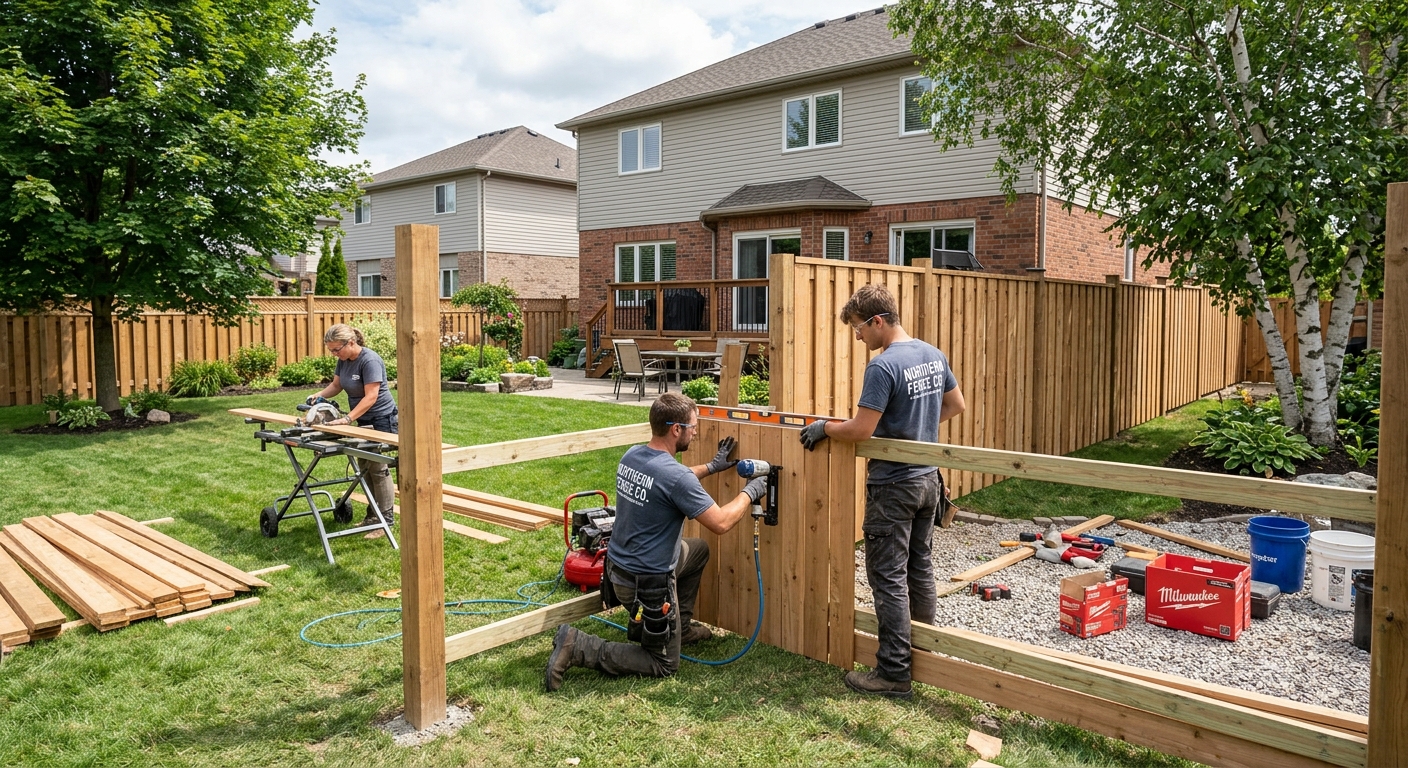
Fencing options and costs in Murrayville
Murrayville homeowners often start with a simple question: which fence will still look good after a few winters? With a population of 11,420 (Statistics Canada, 2021 Census), and steady demand tied to everyday residential living, fences are a common upgrade for both privacy and property definition. The Lower Mainland–Southwest’s housing mix means lots of yard boundaries—especially around family homes in the Murrayville area near 216 Street and the core commercial strip—where homeowners add panels, gates, or full perimeter runs as properties are maintained and updated.
In this part of British Columbia, pricing is shaped by mild but persistent frost and wind, plus wetter Fraser Valley soils. Even when temperatures don’t “freeze hard” like inland provinces, posts still need deeper embedment to limit heaving. That typically means more excavation, more concrete setting on key posts (corners, gates, privacy runs), and longer materials—so bids can move quickly if a site is sloped or access is tight. Contractor availability can also affect lead times during busy spring and early summer, which is when many installs line up around landscaping schedules.
Because each project has different fence height, finish grade, and how many existing sections are removed, comparisons are best made by material and per-foot budget. Use the table below as a realistic planning range for Murrayville, then fine-tune your quote after a site walk.
| Material |
Lifespan |
Maintenance |
Privacy Rating |
Price per Linear Foot |
| Pressure-treated pine (standard wood) |
10–20 years |
Stain/seal every 2–3 years |
High (solid panels) |
$55 – $95 |
| Cedar (natural rot resistance) |
15–25 years |
Light staining every 2–4 years |
High (solid boards) |
$70 – $110 |
| Vinyl / PVC (no-maintenance) |
20–30 years |
Wash only; inspect fasteners |
High (privacy styles) |
$75 – $130 |
| Chain-link (galvanized steel) |
25–40 years |
Occasional coating touch-ups |
Low (needs slats/planting for privacy) |
$30 – $55 |
| Aluminum ornamental |
25–40 years |
Occasional cleaning |
Medium (open pickets) |
$90 – $170 |
| Composite / recycled material |
20–30 years |
Wash; avoid harsh solvents |
High (if solid/composite boards) |
$85 – $145 |
Prices are estimates only and vary by project scope, site access and material selection.
What affects the price of fencing in Murrayville
In Murrayville and the wider Lower Mainland–Southwest, two quotes for the same “typical” backyard fence can still swing by 30–50%. The biggest reason is that installers price for real conditions: soil moisture, frost heave risk, how much concrete is needed, and how many hours it takes to excavate and set posts safely. Material differences matter too—vinyl/PVC often lands higher because of its structural requirements—while wood and chain-link tend to track closer to their listed regional budget bands.
Frost line depth drives embedment. Local guidance across Canada often targets post embedment around 3 feet minimum, but in practice crews usually go deeper than the bare minimum to account for mild but persistent freeze events. In the Lower Mainland–Southwest, that commonly translates into deeper holes and more labour than a dry-site install would need elsewhere. Posts also need to be set below the design frost zone to reduce heaving—meaning extra excavation time, longer posts, and more concrete, especially for corner posts and gate posts.
Wind exposure and panel design are another cost lever. While wind loads in the Prairies push toward tighter spacing and heavier framing, coastal BC’s combination of breezes and wet cycles affects wood longevity; without correct treatment and drainage, wood rot accelerates. That can lead to higher “total cost” when homeowners choose pressure-treated pine but later spend more on maintenance.
Concrete examples: (1) A straight 6 ft run on flat, well-drained soil may price closer to $55–$95 for wood, but (2) the same length on a wetter slope where deeper holes and raked/stepped panels are required can climb toward the upper end. (3) Adding two heavy gates can push you further into the vinyl/PVC band ($75–$130) because of hinges, reinforcement, and stronger posts.
| Price Factor |
Why It Matters |
Cost Impact |
| Fence length in linear feet |
Every added foot increases materials, labour, and equipment time |
Highest; can dominate the entire budget |
| Post depth required |
Frost conditions determine hole depth and post length |
Moderate to high; deeper holes mean more labour and concrete |
| Post setting method |
Concrete vs gravel pack changes material cost and installation time |
Moderate; concrete setting typically costs more |
| Material choice |
Vinyl/PVC and metal require more structural hardware and specific framing |
Low to high; vinyl often prices above wood; chain-link is usually lowest |
| Gate count and type |
Gates need stronger frames, hinges, and sometimes double-gate reinforcement |
High; each gate can materially add to labour/materials |
| Grade and terrain |
Slope requires stepped construction, raked tops, and extra layout time |
Moderate; increases time and waste |
| Old fence removal and disposal |
Demolition, hauling, and sometimes separating materials increases hours |
Moderate; can add noticeably to project cost |
| Permit fees and survey / property line locate |
Some heights and locations require additional documentation |
Low to moderate; varies by scope and complexity |
Permits & regulations in British Columbia
In British Columbia, fence rules are often tied to height and location. As a homeowner in Murrayville, you should assume that fences above the typical thresholds—commonly around 2.0 m (6.5 ft) at the rear and about 1.0–1.2 m (3–4 ft) at the front or corners—may require a building permit, depending on where the fence sits and how your municipality has adopted local requirements. Even when a permit is not needed, all fence work must respect property lines and municipal setback bylaws.
Before you dig any post holes, call for utility locates. Use the appropriate service in your province (BC 1 Call in British Columbia). Next, confirm property boundaries: getting a survey or at least a locate of property pins helps prevent encroachment disputes that can become expensive to unwind.
Shared fence ownership and responsibilities are handled under provincial line-fences legislation, so if you’re replacing or building near a shared boundary, it’s wise to document agreements and keep communication clear with your neighbour.
Licence, insurance, and coverage checks: Ask for (1) the contractor’s British Columbia licence number (or business registration details where applicable), (2) a current certificate of liability insurance, and (3) confirmation of coverage for workers (WCB coverage where required). Where to look: request the insurance certificate from the contractor directly, and use online registries for licence/business verification. Also ask for a clearance letter where your contractor’s coverage framework supports it—if they can’t provide documentation, that’s a warning sign.
Choosing the right fence material for Murrayville
Choosing the right material in Murrayville comes down to matching your priorities—privacy, low maintenance, and lifespan—to a climate that cycles through wet conditions and occasional frost. Pressure-treated pine is usually the budget-friendly option, but to avoid grey weathering and early wear, it needs staining or sealing roughly every 2–3 years. Cedar offers better natural rot resistance and a nicer look, yet it still benefits from regular maintenance to keep it looking uniform and to slow surface checking.
Vinyl/PVC is popular with homeowners who want minimal upkeep. It doesn’t need staining, but extremely cold snaps can make some rigid components more brittle; reputable installers also frame it correctly and use appropriate fasteners and spacing so it stays straight in wind. Chain-link is typically the longest-lasting, lowest-cost fence system in this region, but it won’t provide privacy unless you add slats, lattice, or plant screening. Aluminum ornamental fencing offers clean appearance and won’t rust, making it a good choice if you want visibility and a tidy front-yard boundary; it’s usually priced above basic wood and chain-link due to material and fabrication.
For Lower Mainland–Southwest installs, post depth and setting matter more than the label on the material. Even with milder BC winters, crews commonly set posts deeper to reduce heaving risk, and many privacy fences use concrete-set corner/gate posts for stability. If you’re planning a solid privacy run in wind-prone stretches, a stronger post-and-panel system is worth the spend. For example, upgrading from chain-link (~$30–$55 per linear foot) to vinyl/PVC (often ~$75–$130) can be justified when privacy is the goal and you want fewer ongoing maintenance visits—especially if you expect to keep the fence for decades.
| Material |
Cold Tolerance |
Lifespan |
Annual Maintenance |
Best For |
Price Band |
| Pressure-treated pine |
Good (with proper treatment and drainage) |
10–20 years |
Check for loose boards; light seal/stain as needed |
Budget privacy with a maintenance plan |
$55 – $95 |
| Cedar |
Good (naturally rot resistant) |
15–25 years |
Inspect and stain lightly every few years |
Appearance + natural rot resistance |
$70 – $110 |
| Vinyl / PVC |
Moderate to good (install quality matters) |
20–30 years |
Rinse/clean; inspect hardware |
Low maintenance privacy |
$75 – $130 |
| Chain-link |
Very good (galvanized steel) |
25–40 years |
Minimal; check for tension and coating |
Security boundary on a tighter budget |
$30 – $55 |
| Aluminum ornamental |
Very good (powder-coated) |
25–40 years |
Clean as needed |
Front-yard curb appeal |
$90 – $170 |
| Composite / recycled material |
Good (designed for exterior exposure) |
20–30 years |
Wash; inspect fasteners |
Solid privacy with long-term low upkeep |
$85 – $145 |
How to choose a fencing contractor in Murrayville
Start by verifying the basics that protect you as a Murrayville homeowner. In British Columbia, ask for proof of the contractor’s licence/business registration (as applicable), a current certificate of liability insurance, and worker coverage (WCB) for their crew. How to check: request documents before work begins, confirm the details on the insurance certificate match the company name, and use online registries to verify licence/business information. If the contractor can’t provide documentation quickly, it’s safer to keep shopping.
Next, get 2–3 itemised written quotes. You want a breakdown that separates labour, materials, post setting, gate hardware, and any disposal or hauling. Avoid “lump sum” quotes that don’t explain what happens if you hit wetter soil, old concrete, or rocky ground. Read the scope for exclusions: is permit pulling included (where required), are utility locates and property line verification part of the plan, and is old fence removal and disposal included?
Warranty clarity matters. Ask how long they warranty workmanship, whether manufacturer warranties apply to the specific product installed, and whether warranties transfer if you sell the home. Also confirm a payment schedule: never pay more than about 10–15% upfront; hold back a portion until the fence is complete and inspected. Finally, insist on a written start date and a completion estimate—seasonal scheduling can be tight in spring and early summer due to the typical wave of yard projects.
- Ask for licence/business verification details and confirm them before signing.
- Request a certificate of liability insurance showing current coverage limits.
- Confirm WCB/worker coverage for their crew (and ask for proof).
- Get 2–3 itemised quotes with labour and materials listed separately.
- Ensure post-depth and setting method (concrete vs gravel pack) is stated.
- Confirm gate type and hardware (hinge type, latches, reinforcement).
- Ask who handles disposal of removed fencing and packaging.
- Check whether utility locates and property-pin verification are included.
- Verify warranty terms: workmanship duration, manufacturer coverage, transferability.
- Agree on payment milestones; keep a holdback until final walk-through.
- Get the layout method: measurements, string lines, and how they handle slopes.
- Confirm cleanup and post-install grading—no buried debris or undermined base.
In Murrayville, red flags often include: vague scope language (“materials as required” without specifics), refusal to provide insurance/licence proof, quotes that don’t explain how posts will be set in wetter soil, missing gate reinforcement details, and asking for a large upfront payment before any layout or permits are confirmed.
Frequently asked questions — fencing in Murrayville
What is the most weather-resistant fence for Murrayville's climate?
For Murrayville and the Lower Mainland–Southwest, the most weather-resistant options are typically cedar with proper maintenance, vinyl/PVC installed with correct framing, or galvanized chain-link for longevity. Cedar’s natural rot resistance helps in BC’s wetter conditions, but it still needs periodic staining to keep the surface protected. Vinyl/PVC performs well in moisture and doesn’t rot, but the install quality matters—post embedment and reinforcement at corners and gates are what prevent wobble and stress in damp, windy weather. Chain-link is extremely durable against rain exposure, but it won’t deliver privacy unless you add slats or a secondary screening layer. If you want a practical “best balance,” many homeowners choosing privacy end up around the vinyl band (often $75–$130 per linear foot) because it reduces ongoing upkeep in our freeze–thaw cycles.
How do I prevent wood fence rot in Murrayville?
Wood rot prevention in Murrayville is mainly about stopping moisture at the posts and bottom edges. Make sure the contractor sets posts properly below frost-affected movement zones and uses concrete setting for critical points like corner posts and gates. A concrete-set post reduces rot risk compared with a purely gravel or surface-buried approach in wetter Fraser Valley soils. Next, choose pressure-treated pine with a quality grade and ensure proper board spacing and drainage—solid boards trapped against grade can stay wet longer. Ask about staining/sealing schedules; pressure-treated pine commonly needs attention every 2–3 years to slow grey weathering and surface checking. Finally, keep mulch and soil back from the fence base so it doesn’t hold moisture against the wood, especially after heavy rain and snow melt.
What is the cost per linear foot for fencing in Murrayville?
In Murrayville, pricing usually lands within regional British Columbia bands depending on material, height, and site conditions. As a planning benchmark, chain-link often comes in around $30–$55 per linear foot, while wood fences are commonly budgeted at about $55–$95 per linear foot installed. Vinyl/PVC typically costs more—often $75–$130 per linear foot—because the material and structural hardware requirements are higher. Aluminum ornamental can be the highest, often $90–$170 per linear foot. Your final number can move based on slope, gate count, how many posts must be set deeper with concrete in wetter soil, and whether old fence removal/disposal is included. The best quotes break these items out rather than giving one flat figure.
Should I repair or replace my old fence in Murrayville?
Repair is often worth it when the fence posts are still solid, boards are only partially damaged, and the framing hasn’t shifted. If posts are leaning, rotten below the soil line, or gate hardware is failing due to movement, replacement usually saves money long term—especially in wet BC conditions where hidden rot spreads. A good estimator will inspect post integrity, check how the fence sits relative to grade, and note whether concrete footings have cracked or settled. In practice, if you’re seeing multiple soft boards, recurring fastener failure, or the fence has become uneven due to heaving or soil saturation, replacing the affected run (or the whole section) is usually the cleaner fix. If your quote is close—say a small repair vs. moving to the low-to-mid wood band of $55–$95 per linear foot—ask for a line-by-line comparison so you know exactly what you’re buying.
How do I handle a fence dispute with a neighbour in British Columbia?
In British Columbia, fence disputes are common when boundaries, shared sections, or maintenance responsibilities aren’t clear. Start with documentation: identify the property line properly by locating survey pins or obtaining a survey, and take photos showing the current fence location and condition. If the fence is on or near a shared boundary, review the situation under provincial line-fences principles (shared ownership and responsibilities can apply depending on circumstances). Communicate in writing, propose a practical solution (for example, repairing a specific section rather than replacing everything), and keep records of contractor quotes. If the dispute involves encroachment, don’t “adjust” the fence on your own—wrong placement can create bigger costs. Consider using a surveyor before any major changes, and ask your contractor to work from confirmed marks rather than estimates.
What fence style offers the best wind resistance in Murrayville?
Wind resistance in Murrayville is best achieved with stronger framing, correct post embedment, and panel design that reduces “sail” effect. Solid privacy styles—properly built with solid boards and well-braced rails—can perform very well when the contractor uses the right spacing, reinforces corners, and sets posts deeper to account for ground movement. Vinyl and wood privacy fences both handle wind well when they use sturdy posts and reinforced gate framing; poorly built fences will rack quickly, especially after wet, heavy rain followed by breezy weather. Chain-link can be very wind-permeable (less “catching”), which can reduce load, but it won’t provide privacy by itself. If your yard is in a more exposed area, ask for a design that balances airflow with stability: strong posts, tightened rail spacing, and reinforced corner/gate posts. A good installer will also plan for the slope so panels don’t create wind-catching gaps.