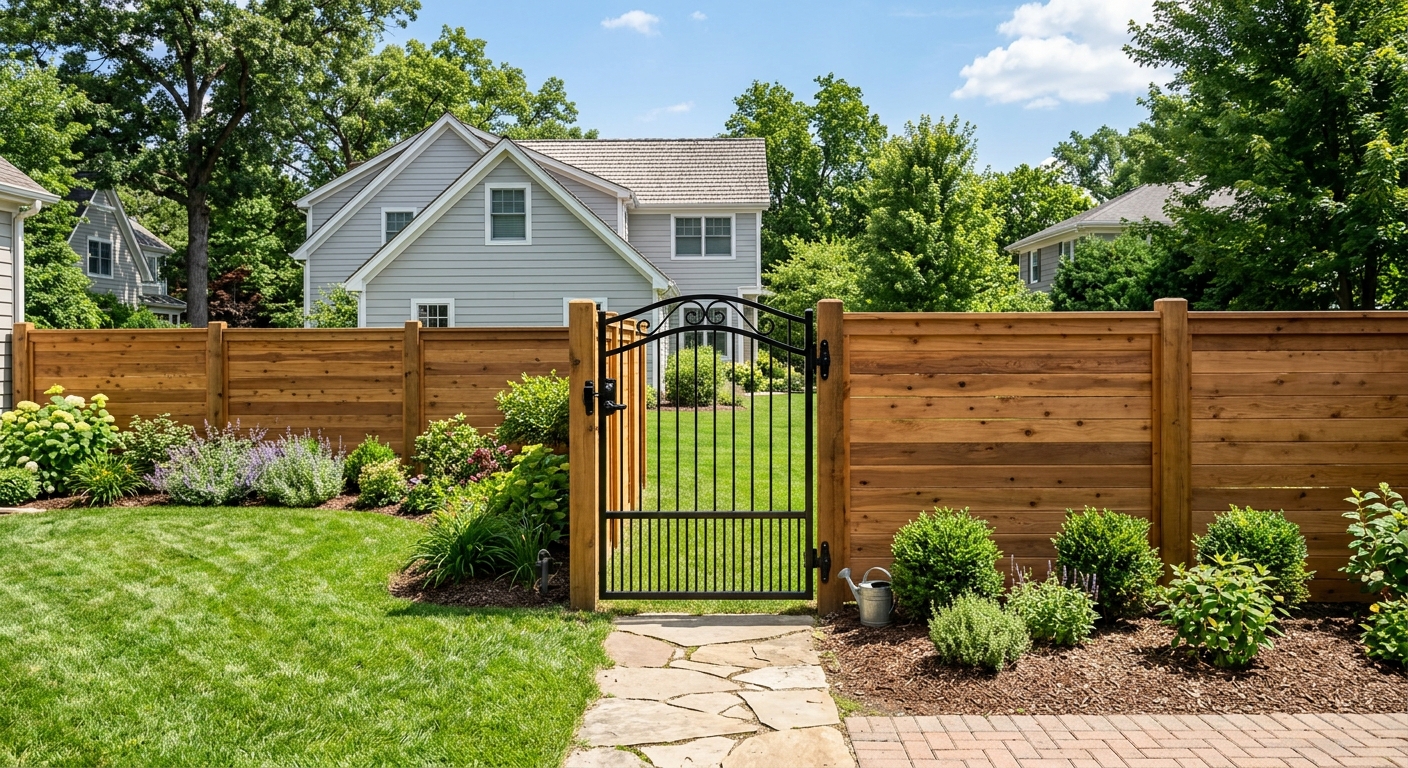
Fencing options and costs in Deer Run
Deer Run, Alberta is a community where fences are more than curb appeal—they’re built to handle Prairie winter extremes and steady wind. With a population of 4,910 (Statistics Canada, 2021 Census), there’s a steady base of homeowners and a lot of detached properties that upgrade boundaries as their homes and landscaping mature. That detached housing pattern is important because each fenced yard represents repeat demand for replacement panels, new gates, and post repairs after freeze–thaw seasons.
In Calgary’s economic region, costs are strongly shaped by climate: long freeze–thaw cycles mean fence posts must be protected against heaving. In practice, that usually means setting posts about 4 ft (≈120 cm) deep, often with concrete footings for 6 ft privacy fences and for gate posts where loads are highest. Solid panel fencing also sees meaningful wind racking on the open Prairies, so we usually tighten post spacing and use sturdier hardware than you’d see with more air-through systems.
Contractor availability can also affect price in Deer Run. During the spring installation rush—when soil is workable and before summer scheduling fills—crews may prioritize full-day site access and straightforward runs, which can change labour quotes even for the same materials. We also see high demand around established residential pockets like the east and south sides where yards are more exposed to wind and where homeowners frequently add privacy along back lanes and side boundaries.
Below is a comparison of typical options you’ll see in Deer Run. Use it to sanity-check bids before you sign.
| Material |
Lifespan |
Maintenance |
Privacy Rating |
Price per Linear Foot |
Price Range |
| Pressure-treated pine (standard wood) |
10–20 years |
Stain/seal every 2–3 years; inspect rails and fasteners |
Medium to high (solid pickets) |
$40–$80 |
$40 – $80 |
| Cedar (natural rot resistance) |
15–25 years |
Light stain yearly or as needed; still benefits from sealing |
High (solid or close-spacing) |
$55–$95 |
$55 – $95 |
| Vinyl / PVC (no-maintenance) |
20–30 years |
Rinse only; check for contraction gaps and impact damage |
High (solid panels/boards) |
$45–$90 |
$45 – $90 |
| Chain-link (galvanized steel) |
25–40 years |
Occasional wash; replace ties/wire where needed |
Low to medium (air-through) |
$25–$55 |
$25 – $55 |
| Aluminum ornamental |
25–50 years |
Wash annually; inspect for loose fittings |
Low (decorative pickets) |
$70–$120 |
$70 – $120 |
| Composite / recycled material |
20–35 years |
Rinse/clean; check for warping at fastener points |
High (solid boards) |
$70–$115 |
$70 – $115 |
Prices are estimates only and vary by project scope, site access and material selection.
What affects the price of fencing in Deer Run
In Deer Run (Calgary economic region), two quotes for what looks like the “same fence” can still land 30–50% apart. The difference is usually in what’s not obvious on a site walkthrough: how deep posts must go for frost protection, how much wind-stiffening the design needs, whether gates are included as swing/drive-through units, and how steep or obstructed the run is. Labour availability also shifts pricing because Calgary crews balance multiple installs across the region—when soil conditions and access line up, the job moves faster, and that can reduce total labour hours.
Frost depth is a major driver. While many homeowners think “one set depth fits all,” the Prairie freeze–thaw cycle means we typically set fence posts about 4 ft deep, using concrete footings especially for 6 ft privacy fences and gate posts. Practically, we aim for roughly 4–6 inches below the design frost depth to reduce the risk of heaving. That depth means larger auger holes, more concrete and longer posts—so your material cost and labour both increase compared with milder regions. On the Prairies, open exposure also increases wind loading, so privacy systems often require closer post spacing and heavier rails; lighter chain-link usually stays cheaper because it lets wind pass through.
Two examples from real Deer Run-style yards: (1) a 40 ft privacy run with two gates often costs noticeably more than the same length without gates because gate posts need heavier bracing and longer setting. (2) a long run on a sloped back edge may add steps/racking, increasing layout time and labour hours—so even if you select a budget option, installation labour rises.
If you’re comparing options, a wood or vinyl privacy fence often tracks mid-to-upper pricing (commonly within $40–$80 or $45–$90 per linear foot, depending on height and post spacing). By contrast, a chain-link boundary may come in lower—often within $25–$55 per linear foot—because it’s lighter to frame and usually easier to set on uneven ground.
| Price Factor |
Why It Matters |
Cost Impact |
| Fence length in linear feet |
Most costs scale directly with run length (posts, rails, labour) |
Largest single driver; affects nearly every line item |
| Post depth required |
Frost protection governs hole depth and post length |
Deeper/frost-safe installs increase excavation and materials |
| Post setting method |
Concrete-set posts provide stability in freeze–thaw conditions |
Concrete generally adds cost vs gravel pack or lighter methods |
| Material choice |
Vinyl/cedar/wood and chain-link behave differently under wind load |
Wood and vinyl typically mid-range; chain-link lower; metal top end |
| Gate count and type |
Drive-through/double gates require heavier framing and hardware |
Often adds significant labour and steel components |
| Grade and terrain |
Slopes require stepped panels or raked rails for clean alignment |
Layout time and material waste increase |
| Old fence removal and disposal |
Demo isn’t free—hauling and disposal add time |
Can raise the project cost even if the new fence is budget-friendly |
| Permit fees and survey / property line locate |
Setbacks and property lines must be accurate before digging |
Sometimes moderate adders; avoids costly rework |
Permits & regulations in Alberta
In Alberta, fences above a height threshold often require a building permit, particularly when they are tall enough to affect sightlines, safety, or adjacent properties. A common practical guideline is that rear fences around 2.0 m (6.5 ft) and front or corner fences around 1.0–1.2 m (3–4 ft) may trigger permit requirements—so you should confirm your exact height and location before scheduling excavation.
All fences must respect property lines and municipal setback bylaws. Before digging any post hole in Deer Run, you also need to complete utility locates through Alberta One-Call so you don’t hit buried services. If there’s any uncertainty about the boundary—common in older neighbourhoods or where markers have shifted—getting a survey or at least a property pin locate before installing is one of the best ways to avoid disputes.
Shared fence ownership rules are handled under Alberta’s line-fences framework, so you’ll want to clarify whether any portion is shared and who is responsible for costs, especially where disputes sometimes arise after new builds or landscaping changes.
What typically requires a permit: taller fences near the height thresholds, and projects that involve any variance or special conditions. What typically does not: replacement of an existing fence in the same location and with the same height (still confirm locally, and verify you’re not changing it).
Before you hire, verify your contractor’s documentation: check an online licence registry (where available), request a current certificate of liability insurance naming you as applicable, and confirm WSIB/WCB coverage status through their clearance letter or proof. If they can’t provide those documents promptly, treat it as a red flag and request another contractor.
Choosing the right fence material for Deer Run
Choosing the right fence material in Deer Run is mostly about matching your priorities—privacy, low maintenance, budget, and lifespan—to Alberta’s freeze–thaw reality. In the Calgary Prairie climate, the fence isn’t just exposed to cold; it also faces repeated expansion and contraction and significant wind loading. That means your post depth and rigidity matter as much as your picket material, especially for 6 ft privacy fences and gate posts.
Pressure-treated pine is usually the lowest upfront option, but it typically needs staining or sealing every 2–3 years to reduce grey weathering and keep fasteners performing well. Cedar looks great and has better natural rot resistance, but it still benefits from regular maintenance for consistent appearance. Vinyl/PVC is popular for homeowners who want low upkeep—most owners rinse it and move on—but extreme cold can make panels contract and can lead to cracking if the system wasn’t designed with proper movement and solid post alignment.
Chain-link is the best match when your priority is durability per dollar: it’s long-lived, generally easiest to maintain, and it survives wind because air moves through it. However, it won’t give you privacy without adding screening or slats. Aluminum ornamental is rust-resistant and mid-to-upper priced, but it’s typically decorative rather than fully private.
On post setting: in the Calgary region we often set posts about 4 ft deep with concrete for privacy and gate stability. That’s less about “whether concrete is fashionable” and more about preventing heaving during freeze–thaw cycles. If you skip that, you’ll often pay later in repairs.
Dollar-wise, the justification depends on what you’re buying. For example, if a cedar privacy fence comes in around the $55–$95 per linear foot range while wood is closer to $40–$80, the extra cost can be worth it if you plan to keep the fence for 15–25 years and want better long-term appearance with rot-resistant boards. If you’re on a tighter budget and want privacy now, pressure-treated wood can make sense—but plan for maintenance.
| Material |
Cold Tolerance |
Lifespan |
Annual Maintenance |
Best For |
Price Band |
| Pressure-treated pine |
Good (with proper post setting and hardware) |
10–20 years |
Check fasteners; plan staining every 2–3 years |
Budget-friendly privacy with DIY-friendly upkeep |
$40–$80 |
| Cedar |
Good (better rot resistance through weather cycles) |
15–25 years |
Sealing/stain as needed; inspect yearly |
Natural look with strong longevity |
$55–$95 |
| Vinyl / PVC |
Good (designed for expansion/contraction) |
20–30 years |
Rinse/washer; spot-check for cracks at impact points |
Low maintenance and consistent appearance |
$45–$90 |
| Chain-link |
Excellent (air-through reduces wind stress) |
25–40 years |
Wash/inspect ties and tension seasonally |
Security, pet containment, and durability |
$25–$55 |
| Aluminum ornamental |
Excellent (no rust) |
25–50 years |
Annual wash; tighten fittings if needed |
Decorative boundaries and long-term value |
$70–$120 |
| Composite / recycled |
Good (install with proper post movement tolerance) |
20–35 years |
Rinse/clean; check fastener points |
Privacy panels without typical wood maintenance |
$70–$115 |
How to choose a fencing contractor in Deer Run
Choosing the right fence contractor in Deer Run starts with proof, not promises. In Alberta, you should verify three things: (1) licensing/competence, (2) liability insurance, and (3) workers’ compensation coverage (WSIB/WCB coverage, depending on the framework that applies to the business). How to check: ask for their licence number and confirm it through the appropriate online registry (and that it’s active), request a certificate of liability insurance and confirm it’s current, and obtain a clearance letter or equivalent proof showing coverage is in place. If they won’t provide these documents before the quote is finalized, you don’t want them digging on your property.
Next, get 2–3 itemised written quotes, not lump sums. A good quote breaks down labour and materials separately (posts, rails, panels, gates, hardware, concrete volume, removal/disposal). Read the scope line-by-line: is permit pulling included (if required), will they locate the property pins or rely on your survey, and is old fence disposal included or extra? For Deer Run, where frost depth drives post depth and concrete setting, ensure the quote specifies post depth and post setting method—otherwise “6 ft fence” can hide a big construction difference.
Warranty matters: confirm workmanship warranty length, the product/manufacturer warranty for material components, and whether warranties are transferable if you sell the home. Payment schedule should be conservative—never more than 10–15% upfront. Hold back the remainder until the fence is complete, cleaned up, and aligned.
Finally, ask for a realistic timeline: the start date, completion target, and what happens if weather delays excavation or curing. Prairie conditions can shift quickly, so insist on it in writing.
- Request licence number and confirm it’s active through the online registry.
- Ask for a current certificate of liability insurance (and verify dates).
- Provide proof/clearance for WSIB/WCB coverage and keep it with the contract.
- Get 2–3 itemised quotes separating labour and materials.
- Confirm post depth and hole size assumptions for frost protection.
- Ensure concrete volume and post setting method are specified.
- Verify gate type (walk-through vs double/drive-through) and hardware grade.
- Check who is responsible for utility locates and property line locate/survey.
- Confirm permit pulling is included where required (don’t assume).
- Ask whether old fence removal and disposal is included.
- Review warranty terms for workmanship and products; ask if transferable.
- Agree on payment schedule: max 10–15% upfront and a final holdback until completion.
Red flags to watch for in Deer Run: (1) no written scope for post depth or concrete setting, (2) vague quotes that don’t break down labour/materials, (3) reluctance to provide insurance/WSIB/WCB proof, (4) pushing large upfront payments, and (5) promises of “same-day” installs that ignore frost-protection drilling needs and curing time.
Frequently asked questions — fencing in Deer Run
What's the most low-maintenance fence?
For most Deer Run homeowners, vinyl/PVC is the lowest-maintenance “set it and mostly forget it” option. In our Calgary region context, it’s typically priced mid-range—often within about $45–$90 per linear foot depending on height, post spacing and whether it’s a solid privacy design. Cedar and pressure-treated wood can last well, but they usually require periodic staining/sealing (commonly every 2–3 years) to keep the finish looking even and to protect boards through freeze–thaw seasons. Chain-link is low effort too, but it won’t provide privacy unless you add slats/screening, which then becomes maintenance. Whatever you choose, the biggest low-maintenance difference comes from doing the fundamentals correctly: proper post depth, secure hardware and a straight layout that won’t rack under Prairie wind loads.
How tall can my fence be in Deer Run?
In Alberta, fence height limits depend on where the fence sits (front, corner, rear) and how tall it is relative to commonly used thresholds that may require a permit. A practical guideline used in the field is that rear fences around 2.0 m (6.5 ft) and front or corner fences around 1.0–1.2 m (3–4 ft) may trigger permit requirements. Even when a fence is allowed, you must still follow property line setbacks and local municipal bylaws. Because rules can be situation-specific (especially at corners or near driveways), the safest step is to measure the exact location, confirm your proposed height in writing with your contractor, and clarify whether a permit is needed before posts are set. This avoids the most common costly mistake: rebuilding after a setback/height correction.
Should fence posts be set in concrete here?
In Deer Run and the broader Calgary region, concrete setting is commonly recommended for stability because the Prairie climate brings long freeze–thaw cycles and heaving risk. Local guidance typically expects posts to be set about 4 ft (≈120 cm) deep—often with concrete footings—especially for 6 ft privacy fences and for gate posts where loads are highest. Concrete isn’t always required for every low-risk scenario, but it’s the standard approach when wind racking and frost protection matter. If a contractor suggests shallow holes or gravel-only for a privacy system in an exposed yard, that’s a risk to discuss before you sign. Your quote should specifically state post depth and method; if it doesn’t, ask. The cost difference can be noticeable, but it’s usually far less than the cost of replacing a fence line after seasonal movement.
What's the best fence for privacy?
For privacy in Deer Run, solid-panel materials like vinyl/PVC, cedar, pressure-treated wood (with close spacing), or composite boards typically perform best. Your final “privacy rating” depends on whether the design is truly solid and how much space is left at the bottom and along posts. In the Calgary market, installed pricing for privacy-focused systems is often mid-to-upper range—frequently in the $40–$80 per linear foot band for wood and $45–$90 per linear foot for vinyl/PVC, depending on height and post construction. The key climate factor is wind: solid fences catch more wind, so they need sturdy bracing, tighter post spacing and usually concrete-set posts for 6 ft systems. If you choose a cheaper material like chain-link, privacy usually requires add-ons (slats/screening), and those can reduce airflow and add their own maintenance.
How do I compare fencing quotes?
To compare quotes in Deer Run fairly, make sure you’re comparing the same build. Ask for itemised line items: post depth, post setting method (concrete vs gravel pack), concrete quantity, rail style, panel spacing, gate type, and whether removal/disposal is included. Look for clarity on layout—especially on sloped yards where stepped or raked panels can change labour time. Confirm whether permits are included if your fence is near thresholds (like 2.0 m rear or 1.0–1.2 m front/corner). Compare pricing per linear foot, but only after confirming height, materials and construction specs. If one quote is, say, at the low end of chain-link ($25–$55) while another is for privacy wood or vinyl ($40–$80 or $45–$90), you’re not comparing apples to apples. The most useful comparison is: are the post depth and gate hardware identical?
How long does fence installation take in Deer Run?
Most fence projects in Deer Run take about 1–3 days for installation once materials are on site, but that depends heavily on run length, gate complexity, and terrain. In Calgary-area conditions, post setting depth and accurate alignment are the work that takes time—especially when crews are augering to frost-safe depths and setting posts straight on uneven ground. A straightforward 40–60 ft run with no gates and minimal grading may complete quickly, while longer privacy lines with multiple gates and fence removal can stretch the schedule. Weather can also affect progress; crews may pause for freezing conditions or when ground is too wet to auger cleanly. A reputable contractor will provide a start date and completion estimate in writing, with a note about potential weather impacts and when any cement-based settings will be ready for final hardware.