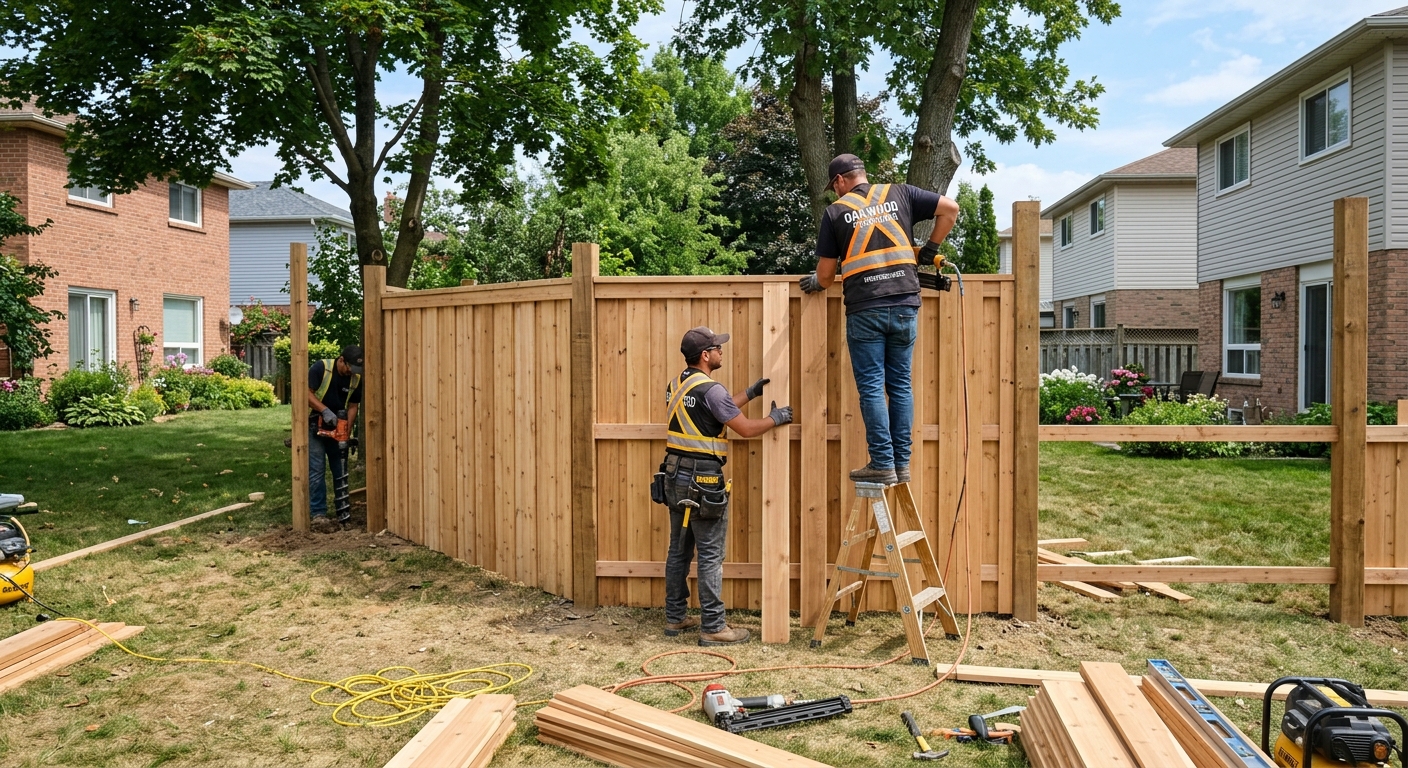
Fencing options and costs in Eau Claire
Eau Claire, Alberta is a small community with a tight housing base: in the 2021 Census, the population was 1,875 (Statistics Canada, 2021 Census). That matters for fencing because the strongest predictor of local demand is the number of detached homes—every backyard boundary is an opportunity for a privacy upgrade, a safer pet enclosure, or a wind-sturdy replacement. With Calgary’s broader housing market spilling into the area, contractors also see steady call volume for perimeter work, especially where yards are exposed and gates get used daily.
Pricing in Eau Claire generally follows the Calgary economic region’s Prairie continental climate: long freeze–thaw cycles and open wind exposure mean frost protection and racking resistance drive cost. In practice, post holes often need to be dug to roughly 4 ft (about 120 cm) deep (or set below the frost line using local guidance) for 6 ft privacy fences and gate posts. That increases excavation time, concrete volume, and labour. It’s also why wood and vinyl privacy panels usually land in the mid–upper part of typical Alberta ranges, while chain-link stays in the lower–mid range because airflow reduces wind pressure on the line.
In Eau Claire, fence demand is often highest around residential pockets near community amenities where backyards tend to be open to prevailing winds, and where homeowners prioritize privacy for gatherings. If you’re comparing options, the table below summarizes typical lifespans, upkeep, privacy performance, and the installed price range per linear foot for this area—then we’ll break down what moves your quote up or down.
| Material |
Lifespan |
Maintenance |
Privacy Rating |
Price per Linear Foot |
| Pressure-treated pine (standard wood) |
10–20 years |
Stain/seal every 2–3 years to limit greying and splitting |
High (solid panels) |
$40–$80 |
| Cedar (natural rot resistance) |
15–25 years |
Light stain or oil as needed (typically every 2–4 years) |
High (solid panels) |
$50–$95 |
| Vinyl / PVC (no-maintenance) |
20–30 years |
Rinse as needed; avoid impact damage and check for extreme-cold cracking |
High (privacy styles) |
$45–$90 |
| Chain-link (galvanized steel) |
20–40 years |
Occasional wash; straighten posts after impacts |
Low to Medium (visibility depends on slats) |
$25–$55 |
| Aluminum ornamental |
30–50 years |
Minimal; occasional cleaning |
Low to Medium (open design) |
$70–$120 |
| Composite / recycled material |
20–30 years |
Rinse and inspect; follow manufacturer cleaning |
Medium to High (solid styles) |
$60–$110 |
Prices are estimates only and vary by project scope, site access and material selection.
What affects the price of fencing in Eau Claire
Even for the “same” fence height, quotes for fencing in the Calgary region (and into Eau Claire) can vary by about 30–50%. The biggest reason is that site conditions don’t price evenly: excavation difficulty, post-setting depth, wind-loading requirements, and how contractors treat gates and corners can shift total installed cost significantly. Labour availability also matters—when multiple crews are booked for concurrent perimeter jobs, scheduling changes can affect your overall quote and protection measures for existing landscaping.
In Eau Claire, the Prairie frost cycle is a primary driver. Contractors generally set posts about 4–6 inches below the design frost depth guidance (often translating to roughly 1.5–2.0 m total post embedment depending on local conditions), so fence lines resist heaving in spring thaw. Deeper holes mean more digging time, additional concrete where required, and sometimes longer posts—so the materials and labour increase together. Wind exposure on the Prairies also pushes design: solid wood or vinyl privacy panels typically need closer post spacing and fully concreted footings to prevent racking, while chain-link can stay more economical because it lets airflow through. In colder regions compared with milder climates, wood and vinyl installers also plan for stronger bracing and better alignment so panels don’t distort after freeze–thaw cycles.
Two practical examples show how local conditions change cost in Eau Claire. First, a 40 ft straight run on level ground may price in the wood range (about $40–$80 per linear foot), but adding 2–3 gate positions can move the same project toward the upper end because gate frames require extra steel and heavier post embeds. Second, a sloped backyard that needs stepped panels can add labour for layout and cutting, which can push a chain-link job that might otherwise sit near $25–$55 per linear foot higher once the install becomes more layout-heavy. Housing age in the area also matters—older properties often have buried fence remnants or less accessible planting beds, and removing obstructions can add hundreds to the job.
| Price Factor |
Why It Matters |
Cost Impact |
| Fence length in linear feet |
Every additional foot adds posts, rails, brackets, and finish labour |
Largest driver; scales the total directly |
| Post depth required |
Frost line determines embedment; deeper embedment increases hole size and post length |
Can add material + labour; major uplift in cold months |
| Post setting method |
Concrete vs. gravel pack vs. driven posts changes excavation and stabilization time |
Concrete-set typically costs more but reduces long-term movement |
| Material choice |
Vinyl/cedar/wood and privacy panels handle wind differently than open chain-link |
Shifts you across the $25–$120 per linear foot range |
| Gate count and type |
Gates require stronger framing, hinges, latches, and often heavier posts |
Often adds a noticeable premium per gate |
| Grade and terrain |
Slope requires stepped or raked panels; layout becomes more complex |
More labour and more cuts/hardware |
| Old fence removal and disposal |
Demolition adds time; hauling and disposal aren’t always straightforward |
Can add hours and disposal fees |
| Permit fees and survey / property line locate |
Verification work reduces disputes and helps avoid rework |
Often moderate but can be significant on complex boundaries |
Permits & regulations in Alberta
In Alberta, fence permitting commonly applies when you’re building above certain height thresholds—often around 2.0 m (about 6.5 ft) at the rear and roughly 1.0–1.2 m (3–4 ft) at the front or corner, depending on local bylaw rules. Regardless of height, all fences must respect your property line and any municipal setback requirements. Before digging post holes, homeowners should arrange utility locates through Alberta One-Call to confirm where buried services run. Even if you’re “pretty sure” the line is clear, one unexpected cable or line can end a job fast—and create repair costs you didn’t budget.
Step-by-step, here’s how a homeowner in Eau Claire should verify a contractor and protect themselves. (1) Ask for their Alberta business licence information and proof they’re operating lawfully, then confirm their standing using the appropriate online business registry resources. (2) Request certificate of liability insurance showing adequate coverage; review dates and ensure the certificate lists your contractor as the insured party. (3) Verify workers’ compensation (WSIB/WCB) coverage for the crew—ask for a clearance letter or confirmation document from the contractor’s insurer/coverage provider.
For safety: work that usually does not require a building permit is minor like-for-like panel swaps, routine repairs, or replacing a section to match the existing height and style within the same footprint (but your local bylaw still governs property line setbacks). Work that does require a permit is typically building a new fence (or substantially increasing height) that crosses the local threshold—especially when it’s in the front/corner zone or exceeds 2.0 m rear height.
Also keep in mind shared fence ownership rules are governed by provincial line-fences legislation—so if the fence is a boundary fence, confirm roles and responsibilities before installation.
Choosing the right fence material for Eau Claire
Choosing a fence material in Eau Claire is mostly about matching what you want—privacy, low maintenance, budget, and lifespan—to what the Calgary Prairie climate demands: deep frost embedment, strong wind resistance, and alignment stability through freeze–thaw. Pressure-treated pine is typically the budget starting point, but it needs staining or sealing every 2–3 years to prevent grey weathering and to keep boards from splitting. Cedar offers a naturally rot-resistant look with better longevity for many homeowners, though it still benefits from periodic maintenance to preserve appearance and reduce surface checking.
Vinyl/PVC is popular because it’s low maintenance: you can generally rinse it and move on. The trade-off is upfront cost and the need for proper installation—long straight runs still require robust posts and bracing so panels don’t flex in wind. In extreme cold, poorly installed vinyl can become brittle or crack if it isn’t supported correctly, which is why solid privacy styles often require the same deeper post setting and sturdier framing as wood. Chain-link is the lowest-cost, long-life option and performs well in wind because it allows airflow; however, it doesn’t deliver much privacy unless you add slats or privacy screening. Aluminum ornamental gives curb appeal and won’t rust, but it’s not a privacy solution without inserts.
For Prairie exposure, concrete-set posts are commonly used where privacy panels face wind—especially for corners, line bracing points, and gates. With the frost cycle, post depth is not where you “save”: setting too shallow can lead to movement that costs more later. If you’re deciding between wood and vinyl, it’s common to see wood privacy around $40–$80 per linear foot and vinyl/ PVC around $45–$90—spending the extra $5–$20 per foot can be justified if you want fewer maintenance weekends for 15–25 years. A 60 ft run could be roughly $300–$1,200 more to go vinyl, depending on access and gate count, but you’re paying for a different ownership experience.
| Material |
Cold Tolerance |
Lifespan |
Annual Maintenance |
Best For |
Price Band |
| Pressure-treated pine |
Good when properly treated and installed with adequate embedment |
10–20 years |
Inspect; plan stain/seal every 2–3 years |
Budget-friendly privacy with willing maintenance |
$40–$80 |
| Cedar |
Good; handles moisture better than many standard softwoods |
15–25 years |
Inspect; light staining/oiling typically every 2–4 years |
Natural look, rot resistance, premium feel |
$50–$95 |
| Vinyl / PVC |
Good if supported correctly through deep posts and bracing |
20–30 years |
Minimal (rinse and check for impact cracks) |
Low maintenance privacy for windy backyards |
$45–$90 |
| Chain-link |
Excellent; flexible system suits freeze–thaw movement |
20–40 years |
Occasional rinse; tighten where needed |
Security and pets with minimal airflow resistance |
$25–$55 |
| Aluminum ornamental |
Very good in cold; won’t rust with proper coating |
30–50 years |
Minimal cleaning |
Appearance and boundary definition (not full privacy) |
$70–$120 |
| Composite / recycled |
Good; best when installed per manufacturer specs |
20–30 years |
Minimal; follow cleaning instructions |
Moderate privacy with lower upkeep |
$60–$110 |
How to choose a fencing contractor in Eau Claire
Choosing the right fencing contractor in Eau Claire is mostly about proof and clarity. First, verify Alberta coverage and ability to work. Ask for their Alberta business licence details, then confirm liability insurance by requesting a certificate that clearly lists the contractor as the insured party and shows valid dates. For workers’ compensation, ask for WSIB/WCB clearance documentation (or equivalent proof of coverage). Don’t accept verbal “we’re covered” answers—request the document before work starts, and make sure it matches the company name on the quote.
Next, get 2–3 written, itemised quotes. You should see labour and materials broken out: line fencing components (posts/rails/bracing), gate frames, concrete quantity allowances (if used), and any hauling or disposal. A lump-sum-only quote often hides the real drivers—like whether post holes are concreted or simply backfilled, or whether removal/disposal is included. Read exclusions carefully: ask if the permit pull (when required), utility locate scheduling (typically homeowner-initiated or coordinated), and final cleanup are included.
Warranty matters. Confirm workmanship coverage length (often a set number of years for alignment/post stability) and whether the product/manufacturer warranty is included with your purchase. Also ask if warranties transfer if you sell your home.
For payment, never pay more than 10–15% upfront. Use a holdback until substantial completion and gate operation checks are done. Finally, request your start date and completion estimate in writing so scheduling delays don’t become disputes.
- Confirm the contract uses your exact measurements and shows linear footage of each run.
- Ask whether corner posts and gate posts are concrete-set and to what embedment depth.
- Ensure quotes specify material grade (e.g., pressure-treated board type, cedar thickness, vinyl fence system).
- Verify they include bracing details for Prairie wind exposure (especially for privacy fences).
- Check if rail spacing is listed (missing specs often leads to weaker installs).
- Confirm gate hardware (hinges, latch, self-closing/stop features) is itemised.
- Ask whether they do a site walk for obstructions and confirm utility-locate responsibility.
- Make sure they state disposal and debris cleanup in writing (old fence removal is often extra).
- Look for a written timeline and weather fallback plan for winter work in Alberta.
- Request proof of liability insurance and workers’ compensation clearance before signing.
- Confirm change-order process: what triggers extra costs and how they’ll document it.
- Ask for warranty terms in plain language, including who covers what if panels move.
Concrete red flags in Eau Claire: (1) quotes that omit post depth and concrete assumptions, (2) no itemised gate pricing despite a double gate, (3) promises of “no permits needed” without checking local height/placement thresholds, (4) refusing to provide insurance/coverage documents, and (5) pushing for large upfront payments beyond 10–15%.
Frequently asked questions — fencing in Eau Claire
Should I repair or replace my old fence in Eau Claire?
In Eau Claire, the decision usually comes down to how far the fence has moved from frost and wind racking. If posts are still solid (no meaningful leaning, no gaps at the bottom after thaw), a repair—replacing broken rails, tightening hardware, or swapping a few boards—can be the smartest move. However, if you’re seeing multiple posts lifting or leaning, that’s a sign the original embedment wasn’t adequate for Alberta freeze–thaw. Repairing a failing foundation often becomes “patch-and-pray.” Also consider the cost difference: new privacy wood installations often fall within about $40–$80 per linear foot, while chain-link can be about $25–$55 per linear foot, so replacing may still be competitive when labour on multiple repairs adds up. A quick assessment of post stability and spacing will tell you whether repair is likely to last through the next spring thaw.
How do I handle a fence dispute with a neighbour in Alberta?
Fence disputes in Alberta are usually best handled by starting with facts: confirm the property line with a survey or locate your property pins, then document what exists and who built what (photos and measurements help). In Alberta, shared fence ownership and responsibilities are governed by provincial line-fences legislation, so you’ll want to follow the process for notice and contributions rather than arguing informally. Practical next steps: (1) write down the issue clearly (height, location, safety, drainage impact), (2) request a joint site walk to compare boundaries, and (3) if needed, obtain a professional survey locate so both parties can rely on the same reference points. If the dispute is about a required permit due to height/placement, don’t assume—verify the applicable threshold before building. Keep communication respectful and in writing; it protects both neighbours and prevents costly rework.
What fence style offers the best wind resistance in Eau Claire?
For Eau Claire’s Prairie wind exposure, the “best” style depends on whether you need privacy. Solid wood or vinyl privacy fences can resist wind well when they’re engineered for it—meaning correct post embedment depth for frost protection, strong bracing, and fully set gate and corner posts (often with concrete footings). Without those, solid panels catch wind and can rack. If you want maximum wind resilience with less structural demand, chain-link is often the most forgiving option because airflow reduces pressure on the line; it typically costs about $25–$55 per linear foot and can last a long time through Alberta freeze–thaw cycles. Aluminum ornamental also handles wind well structurally (open design), but it’s not privacy. For most windy backyards where privacy matters, a solid privacy style with the right post system usually performs best over time—even if it’s mid–upper cost compared with chain-link.
How much does a fence cost in Eau Claire?
In Eau Claire, your installed fencing price generally tracks the Calgary economic region ranges driven by frost-depth post setting and wind loads. For a typical project, wood installs commonly land around $40–$80 per linear foot, vinyl/PVC around $45–$90 per linear foot, and chain-link around $25–$55 per linear foot; aluminum ornamental often sits higher at about $70–$120 per linear foot. Your final number can swing based on length, gate count (gates cost more than straight runs), terrain (slopes require stepped or raked sections), and whether the contractor uses concrete-set posts for privacy and gates. Older yards can also cost more if disposal or removal of the old fence is needed. If you’d like a tighter estimate, the best approach is 2–3 itemised quotes that specify post embedment method, gate hardware, and disposal so you’re comparing like-for-like.
How deep should fence posts be for Eau Claire's frost?
In Alberta, the key is setting posts below the local frost effects so the line doesn’t heave in spring thaw. For the Calgary region’s long freeze–thaw cycles, a common practical target is setting posts about 4–6 inches below the design frost depth guidance—often translating to roughly 1.5–2.0 m total embedment depending on conditions and the fence type. In many Calgary-region builds, that can look like about 4 ft (approximately 120 cm) deep embedment for privacy fences and gate posts, particularly where wind load is high and movement would be noticeable. Solid wood and vinyl privacy fences usually require more robust embedment and often concrete-setting at line posts, corners, and gates. Chain-link can sometimes tolerate less aggressive embedment, but it still should be frost-protected. Your contractor should state post depth and setting method clearly in the quote before digging.
Wood vs vinyl vs aluminum fence — which is best?
“Best” depends on your priority. Wood privacy is often the right balance for budget and traditional look; pressure-treated pine is commonly in the $40–$80 per linear foot range and cedar can be higher, but wood requires maintenance (stain/seal every couple of years) to limit weathering. Vinyl/PVC is popular in Alberta for low maintenance; it often sits around $45–$90 per linear foot, and it can last 20+ years when properly supported through deep post embedment for frost and solid bracing for Prairie winds. Aluminum ornamental costs more—often $70–$120 per linear foot—but it’s durable and won’t rust, making it a great option when you don’t need privacy (or you’re okay with an open design). In Eau Claire, where wind and thaw cycles are real cost drivers, the “best” material is the one installed with the correct post system for frost and the right spacing/bracing for the wind load you’ll face.