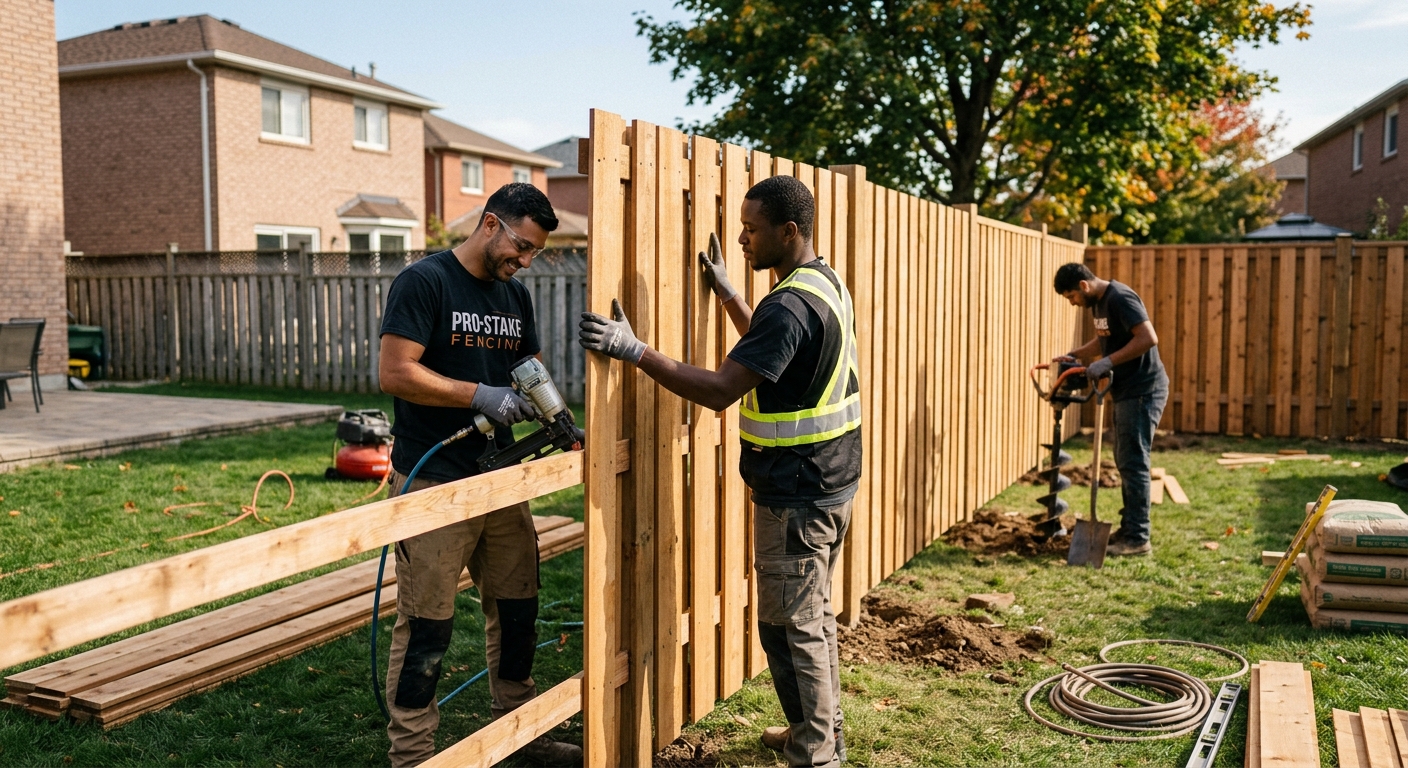
Fencing options and costs in Duncan
Duncan, British Columbia has a mix of older homes and a steady number of homeowner households, which is why fencing projects show up year-round. In the 2021 Census profile, 1,415 households in Duncan are owner-occupied (57.6% of households own), and 41.8% of local dwellings are single-detached houses—each detached property is a potential fencing customer for privacy, pet containment, and yard definition. The area also has a large share of housing stock built before 1981 (61.3% of dwellings), meaning many fences are due for upgrades from weathered boards, loose rails, or corrosion at fasteners.
On Vancouver Island and the Coast, pricing reflects moderate coastal frost and frequent wind exposure. Although the frost line is relatively shallow (often about 45–60 cm), contractors still set posts below frost to reduce heaving and long-term leaning—commonly burying posts around 75–90 cm, and using concrete where soils are wet, clay-rich, or disturbed. Coastal wind off the Strait of Georgia and Juan de Fuca Strait also affects the build: solid privacy fences need tighter post spacing or more robust posts compared with open styles like chain-link or aluminum.
In Duncan, trades are especially busy around the downtown and residential corridors near the Cowichan River and the East Duncan neighbourhood area, where lots often have mature landscaping, narrower access, and clear sightlines that push homeowners to higher-quality, wind-ready installations. Below is a practical cost comparison to help you align material choice with your budget before you request a detailed quote.
| Material |
Lifespan |
Maintenance |
Privacy Rating |
Price per Linear Foot |
| Pressure-treated pine (standard wood) |
10–15 years |
Stain or seal every 2–3 years; tighten hardware as needed |
Medium–High (solid boards) |
$55–$85 |
| Cedar (natural rot resistance) |
15–25 years |
Light re-staining every 2–4 years; check for warped boards |
High (solid or semi-solid) |
$70–$105 |
| Vinyl / PVC (no-maintenance) |
20–30 years |
Occasional wash; inspect for rare impact damage |
High (solid privacy designs) |
$70–$110 |
| Chain-link (galvanized steel) |
20–35 years |
Minimal; rinse salt air if near coastal exposure |
Low–Medium (see-through) |
$35–$60 |
| Aluminum ornamental |
25–40 years |
Occasional cleaning; check hinges on gates |
Low–Medium (ornamental) |
$80–$140 |
| Composite / recycled material |
25–35 years |
Low; periodic cleaning; inspect for local impact |
Medium–High (board-style systems) |
$90–$130 |
Prices are estimates only and vary by project scope, site access and material selection.
What affects the price of fencing in Duncan
In Duncan and across Vancouver Island and the Coast, two quotes for what looks like the same fence can differ by 30–50% once you price the real-world factors: access, footing conditions, gate complexity, wind design, and how far a contractor has to travel for crews and disposal. Even within the same city, a backyard with easy truck access and clean soil can be straightforward, while a fence line with rock pockets, slope, wet clay, or limited staging adds time for digging, setting, and alignment.
Frost depth is a major driver. On Ontario and Alberta jobs you may see posts go roughly 1.5–2.0 m into the ground, but on coastal BC the frost line is shallower. Still, contractors typically set around 75–90 cm so posts sit below frost depth and resist seasonal heaving. That depth affects post length, hole excavation, and how much concrete (if used) is required, which is why a “simple” yard fence can jump noticeably when concrete-set footings become necessary.
Wind exposure also plays a cost role. Prairies wind often leads to tighter post spacing and heavier panels; in Duncan, winds can be frequent and coastal, so solid privacy fences usually need more robust build choices than open styles. Finally, coastal moisture accelerates wood rot if treatment and hardware quality are off—so treated lumber isn’t always a cheaper outcome once you factor in maintenance intervals. For example, opting for pressure-treated pine at the $55–$85 band can be a good budget move, but frequent board replacements from poor post setting can erase that savings compared with cedar or vinyl systems in the $70–$110 range.
Local examples: (1) If your Duncan fence line has saturated winter soil, concrete footings and careful backfill can add labour and disposal time; (2) if you’re adding a double drive-through gate near a driveway, the stronger framing often costs more than you expect; (3) if you have an uneven grade, stepped panels mean extra layout time and material. With Duncan’s older housing stock (61.3% built before 1981), it’s also common to remove older posts that are partially buried or set in inconsistent materials—this affects replacement costs and cleanup.
| Price Factor |
Why It Matters |
Cost Impact |
| Fence length in linear feet |
The longer the run, the more posts, rails, fasteners, and labour hours |
Typically the biggest single driver; scales directly with linear footage |
| Post depth required |
Frost protection reduces heaving; deeper holes need more excavation and longer posts |
Can add meaningful cost when moving from “standard set” to below-frost concrete footings |
| Post setting method |
Concrete-set posts perform better in wet or clay soils; gravel pack can be less costly but less forgiving |
Concrete generally increases labour and material/disposal costs |
| Material choice |
Vinyl, cedar, and aluminum behave differently in salt air and wind; hardware quality matters |
Material premiums can swing the project into different price bands (wood vs. vinyl vs. metal) |
| Gate count and type |
Gates require heavier frames, hinges, latches, and precise alignment |
One double drive-through gate can add substantial cost versus a simple walk gate |
| Grade and terrain |
Slopes require stepped or raked panel design to keep a clean top line |
Extra layout time and waste can increase unit costs |
| Old fence removal and disposal |
Hauling, dismantling, and dealing with embedded posts add labour |
Removal can add a noticeable line-item cost, especially with concrete bases |
| Permit fees and survey / property line locate |
Locates reduce encroachment risk; some height/locations trigger permitting |
May add a modest fixed cost, but prevents expensive disputes and rework |
Permits & regulations in British Columbia
In British Columbia, fences may require a building permit once you go above local height thresholds (often around 2.0 m for portions at the rear and roughly 1.0–1.2 m near the front or corner, depending on how the fencing is classified by the municipality). Regardless of permit status, your fence must respect property lines and follow municipal setback bylaws. A fence dispute almost always becomes more expensive when posts are set without confirming line location—so in Duncan, verify before digging.
Before any post hole is dug, call for utility locates. In BC this is typically handled through BC 1 Call. If you’re unsure where services run (especially along older residential streets), don’t guess—utilities marks can save you from dangerous strikes and expensive repairs.
Step-by-step, to verify you’re working with a legitimate contractor in Duncan: (1) Ask for proof of liability insurance (and confirm the certificate of insurance is current and includes the worksite/contractor as named). (2) Check for the contractor’s licence information through the appropriate BC registry so you know they’re authorized for the scope they’re quoting. (3) Confirm they carry workers’ compensation coverage (WSBC) for their employees—this is especially important when crews are cutting, digging, and hauling materials. (4) Request a clear written scope and confirmation of permit responsibility (if any), so you can see who is pulling what approvals.
Shared fence ownership and line-fence expectations are governed by provincial line-fences legislation, so if your fence sits on or near a boundary, clarify shared costs in writing before the first delivery arrives.
Choosing the right fence material for Duncan
The right fence material in Duncan should match your priorities—privacy, low maintenance, budget, and lifespan—while respecting local coastal conditions: frequent wind, wet weather, and moderate frost. On Vancouver Island and the Coast, frost can be shallow, but posts still must be set below frost depth (commonly burying around 75–90 cm) to prevent heaving and gradual leaning. That means the “best material” is the one that performs when installed correctly, with the right post setting and corrosion-resistant hardware.
Pressure-treated pine is usually the lowest upfront option. However, in BC’s wet, windy climate, untreated-looking grey weathering and surface cracking can appear sooner if you don’t stain. Plan on staining or sealing about every 2–3 years. Cedar looks better naturally and resists rot longer; it still benefits from periodic maintenance, especially on fence tops and near ground contact.
Vinyl/PVC offers no-paint convenience, but extreme cold snaps can make some cheaper vinyl more brittle—choosing a quality product and correct installation helps. Chain-link is the longest-life budget fence, but it doesn’t provide privacy unless you add slats/planting. Aluminum is corrosion-resistant and attractive with minimal maintenance, though it won’t block as much wind or view compared with solid wood or vinyl. Composite/recycled boards can be a strong middle ground for longevity with low upkeep, but they cost more up front.
Where the price difference is justified: if privacy and wind stability matter, a cedar or vinyl privacy fence often costs more than chain-link, but it can save money over time by reducing board replacement and hardware failures. For example, a wood fence in the $55–$85 band may work if you’re comfortable with regular upkeep; if you want to minimize maintenance, vinyl systems in the $70–$110 band can be worth the premium, especially on boundary lines that face wind off the water.
| Material |
Cold Tolerance |
Lifespan |
Annual Maintenance |
Best For |
Price Band |
| Pressure-treated pine |
Good (with correct post depth and hardware) |
10–15 years |
Inspect yearly; stain/seal every 2–3 years |
Budget privacy with active homeowner maintenance |
$55–$85 |
| Cedar |
Good (rot resistance improves performance in wet BC) |
15–25 years |
Inspect yearly; light stain as needed every 2–4 years |
Natural look and longer service life |
$70–$105 |
| Vinyl / PVC |
Good (quality products handle temperature swings better) |
20–30 years |
Minimal (wash and check for impact damage) |
Low maintenance privacy in coastal weather |
$70–$110 |
| Chain-link |
Very good (metal with corrosion-resistant coating) |
20–35 years |
Minimal (rinse salt spray if exposed) |
Security with lowest upfront cost |
$35–$60 |
| Aluminum ornamental |
Very good (powder-coated or anodized systems) |
25–40 years |
Minimal (occasional cleaning) |
Attractive, rust-resistant boundary fencing |
$80–$140 |
| Composite / recycled |
Good (depends on product spec and installation) |
25–35 years |
Low (cleaning; inspect for local impacts) |
Long-life boards with minimal upkeep |
$90–$130 |
How to choose a fencing contractor in Duncan
Choosing the right fencing contractor in Duncan is mainly about verifying coverage and getting clear documentation. Start with British Columbia licensing and insurance. Ask for their licence details and confirm they have current liability insurance—look for the certificate showing the insurer, policy number, effective dates, and that coverage is active for the work. Next, verify workers’ compensation coverage through WSBC (WCB): you want to see that the contractor’s employees are covered so you’re not exposed if someone is injured while digging post holes or moving materials. Don’t accept “we’re fine” answers—ask for proof.
Then request 2–3 itemised written quotes. You want a breakdown of labour hours (installs, removals, gate framing), materials (posts, rails, boards/mesh, fasteners), and concrete/disposal line-items. Avoid a single lump-sum number unless the scope is extremely specific. Read exclusions carefully: is old fence removal included? Are permits and property line locate included or billed separately? Is disposal/hauling included, especially if concrete footings are present?
Warranty matters. Ask for two parts: (1) workmanship warranty (how long the company stands behind alignment, post setting, and panel sag), and (2) manufacturer product warranty (hinges, slats, board material defects). Confirm whether warranties are transferable to future owners.
For payment schedule, never pay more than 10–15% upfront. Hold back a portion until the job is complete and measured for line and height. Get a start date and completion estimate in writing so delays tied to weather, deliveries, or pickup/disposal don’t become a free-floating timeline.
- Confirm BC licence details match the fencing scope being quoted.
- Request a current certificate of liability insurance (effective dates visible).
- Verify WSBC clearance/coverage for the contractor’s workers (not just subcontractors).
- Insist on a written, itemised estimate (labour, materials, concrete, disposal, gates).
- Ask who is pulling permits and if permit fees are included or extra.
- Confirm whether the quote includes utility locates responsibility.
- Check whether post depth and concrete-set requirements are described clearly.
- Ensure gate hardware is listed (hinge type, latch, finish) and whether gates are reinforced.
- Request details on how they handle sloped yards (stepped vs. raked panels).
- Ask for disposal inclusion for old boards and embedded posts.
- Get warranty terms in writing, including workmanship duration.
- Set a payment schedule with a holdback until completion and final measurement.
Concrete red flags I often see in Duncan: vague scopes with no line-item material list; no proof of WSBC/insurance; quotes that ignore post-depth and frost-set requirements; “we’ll decide later” gate hardware or footing methods; and insisting on large upfront payments without a signed schedule and warranty terms.
Frequently asked questions — fencing in Duncan
What is the cost per linear foot for fencing in Duncan?
In Duncan, fencing cost per linear foot generally lands in the same tiers used across Vancouver Island and the Coast, depending on materials and build details. As a quick guide, chain-link often falls around $35–$60 per linear foot, while pressure-treated wood commonly trends toward $55–$85. Vinyl/PVC is typically higher, often around $70–$110, and aluminum ornamental can run $80–$140 where decorative framing and gate hardware are involved. Final pricing shifts with post depth and setting method (especially in wet or clay-rich pockets), how many gates you need, and whether old fence removal and concrete footings are part of the work.
Should I repair or replace my old fence in Duncan?
Most older fences in Duncan can be repaired, but replacement is usually the smarter move when the posts are shifting, panels are racking in wind, or the fence line is leaning due to inadequate post setting. Coastal BC’s frequent moisture and wind mean boards can rot from the ground up, while hardware corrosion and post movement often signal deeper installation issues rather than surface problems. A repair may work if you’re only swapping a few damaged boards/rails and the posts are solid. Replace more than 30–40% of sections when you’re repeatedly tightening, patching, and re-aligning. If your existing fence was built decades ago (common with Duncan’s older housing stock), upgrading the post setting—often to below-frost depth using proper concrete where needed—can prevent the “new fence, same problem” cycle.
How do I handle a fence dispute with neighbour in British Columbia?
Fence disputes in British Columbia are usually easier when you handle them calmly and document everything. First, confirm the location of the boundary: if you’re unsure, use a survey or property line locate instead of relying on old marks. Next, review shared fence expectations under provincial line-fences legislation—many disputes come down to who pays for what, especially if one side wants a higher privacy fence. Collect photos showing damage and wind movement points, then propose a practical solution (repair vs. replacement) with a written contractor estimate. If neighbours disagree on costs or placement, you may need mediation or formal steps. In the meantime, avoid digging near boundary lines until you’ve done proper utility locates and confirmed the line location—BC homeowners can face real costs when posts are set in the wrong place.
What fence style offers the best wind resistance in Duncan?
For wind resistance in Duncan, solid privacy fences can perform well, but they must be engineered for wind loads: heavier posts, correct post depth, solid bracing at the right intervals, and—often—slightly tighter spacing than you’d use in a sheltered yard. Open styles like chain-link and ornamental aluminum generally catch less wind force and can tolerate higher exposure with standard spacing, which is why they often last better on very windy lines. That said, if your goal is privacy from neighbours while still managing wind, consider a well-built board fence with vented panel options or a quality vinyl system designed for gusty coastal conditions. The key is not just the material, but the foundation and reinforcement. On Vancouver Island, we set posts below frost depth (commonly around 75–90 cm) to reduce movement during freeze-thaw cycles.
How much does a fence cost in Duncan?
Total fence cost in Duncan depends mostly on linear footage, number of gates, fence type, and how much site prep is required (soil conditions, slope, and old fence removal). If you want a quick reality check: a simple run with chain-link may start in the ballpark of $35–$60 per linear foot, while a wood privacy fence often trends around $55–$85. Vinyl/PVC privacy typically runs $70–$110, and aluminum ornamental is commonly $80–$140 depending on height and gate complexity. Concrete-set posts can raise the unit price, but they often prevent future leaning and board failure where soils are wet or clay-rich. If you share your approximate fence length and gate count, a contractor can translate the bands into a credible total.
How deep should fence posts be for Duncan's frost?
On Vancouver Island and the Coast, coastal frost is relatively shallow, but posts still need to be set below frost depth to prevent heaving and long-term leaning. In practice for Duncan residential fences, posts are often buried around 75–90 cm (about 30–36 inches), and the exact depth depends on local soil and the specific frost protection approach used by the installer. If soil is saturated, disturbed, or clay-rich, you’ll commonly see concrete footings used to stabilize the base. Avoid “just surface set” methods—coastal freeze-thaw and wet winters can move posts even where the frost line isn’t as deep as in Alberta or Ontario. A good quote should state post depth and footing method (concrete vs gravel pack) and explain why it fits your yard conditions.